Igor had a way of making a request sound reasonable. Elena learned that early in their marriage. Her husband never said, “Give me money.” Instead, he said things like, “You know they’re going through a hard time,” or “They’re my parents, Lena, not strangers,” or “Just this once. I promise it’s the last time.”
Over six years, there had been more “last times” than Elena could count.
Elena was a senior contracts manager at a logistics company. Her salary was good and steady. Igor worked as an engineer at a factory. He earned less, but he made a decent living. Together, they should have been comfortable. They would have been, if so much of their money hadn’t regularly gone to Igor’s parents, Gennady and Oksana.
It started small. Igor’s father had taken out a car loan and miscalculated his payments. He asked to borrow thirty thousand rubles until his next pension payment. Elena gave it to him. Three months later, Oksana called: their refrigerator had broken, and they urgently needed a new one. Igor asked Elena to help, so she paid for it. Then came a television, a bathroom renovation that had “run over budget,” and a seaside holiday because, as Igor put it, “Lena, they’ve worked all their lives. They deserve a break.”
The money disappeared quietly, as though it were soaking into sand.
No one in Igor’s family made a habit of repaying debts. They never openly refused; they simply never brought the subject up. Igor didn’t remind them. When they met, Gennady would clap his son on the shoulder and say, “Our provider is doing well.” Oksana called Elena her “golden daughter-in-law.” Both seemed to believe those compliments settled the account.
At first, Elena waited. Surely they would remember on their own. Surely they would feel awkward about it. Then she began dropping careful hints. Igor listened, nodded, and said, “Yes, of course. I’ll talk to them.” He never did.
Eventually, Elena understood how the arrangement worked. No one expected to repay anything. Some people earned the money, and others spent it.
“You think about it too much,” Igor told her one day when she tried to calculate how much they had given his parents that year.
“Igor, it’s nearly two hundred thousand rubles.”
“They’re my parents. They’re not strangers.”
“Two hundred thousand,” Elena repeated. “That’s our holiday. It’s the kitchen renovation we’ve put off for two years.”
He was quiet for a moment.
“They’re having a hard time.”
“They’ve been having a hard time for six years.”
Igor went out onto the balcony. The conversation ended there.
They started talking about Oksana’s birthday in February. She was turning sixty-five, and Gennady wanted a restaurant, live music, and a good menu. Igor came home with an itemized list.
“The restaurant is eighty-five thousand. The host is twenty-five. Balloons and flowers are fifteen. A custom cake is eight.”
Elena looked at the sheet of paper.
“One hundred and thirty-three thousand rubles.”
“More or less,” Igor said.
“And who’s paying for it?”
He hesitated.
“Lena, you understand. Dad has his pension, and Mom has hers. They can’t afford a party like this.”
“Can we?”
“Well, we have the money.” Igor sat beside her and placed his hand over hers. “It’s for Mom. She only turns sixty-five once.”
Elena looked out the window. Fine, gray February snow was falling.
She could have said no. She knew she should have. But Igor was looking at her with such open, almost childlike hope that the word stuck in her throat.
“All right,” she said. “I’ll take care of it.”
And she did. Igor accompanied her to view the restaurant, approved the room, and stepped aside again. Elena negotiated with the host, ordered the cake, and explained Oksana’s wishes to the florist. Her mother-in-law wanted plenty of peonies and insisted on pink tablecloths.
The final bill came to one hundred and forty-one thousand rubles, a little over budget.
Elena transferred the money, saved the receipts, and put them in a folder. Just in case.
The day of the celebration was unusually warm for April. The sun was out, a light breeze was blowing, and the temperature was almost fifteen degrees Celsius. The restaurant was small but well regarded, right in the city center. The room looked exactly as Oksana had wanted: peonies on every table, tablecloths in just the right shade of pink, and gentle live music from one corner.
There were around forty guests: relatives, neighbors, and old friends of Gennady’s from the factory. Oksana moved from table to table, accepting congratulations and laughing. She looked truly happy.
Elena sat beside Igor, smiled when she was supposed to, drank water, and barely touched her food. She listened to the toasts.
“To people who know how to host!” said one of Gennady’s former colleagues, raising his glass.
“To a generous family!” added a neighbor.
“Gennady, what a wonderful party you’ve put together!” exclaimed a woman in a blue dress.
Gennady accepted the praise graciously. He thanked people, nodded, and smiled broadly, like a man pleased that everyone had noticed his hard work.
Igor said nothing. He didn’t interrupt or explain that Elena had paid for and organized the entire event. He just sat there with a faint smile.
Elena watched him. Something shifted inside her, slowly, like ice moving beneath water. It wasn’t quite anger. It was the exhaustion that comes when you realize you have no reason to keep enduring something.
She only turns sixty-five once. It’s for the sake of the family. How many times had she told herself some version of that?
The host announced another toast. Guests reached for their glasses. At that moment, Elena stood up. She moved calmly, like someone who had already made her decision.
“May I?” she asked. Her voice was soft, but it carried through a pause in the music and conversation.
The host gestured for her to speak. Several guests turned toward her.
“I’d like to say a few words.” Elena raised her glass. “Oksana, happy birthday. You deserve a celebration.”
Her mother-in-law nodded and smiled, visibly touched.
“And I’m glad it turned out so beautifully. The restaurant, the flowers, the host, the cake—it’s exactly what you wanted.”
Guests nodded in agreement. The mood was warm and friendly.
“I want you all to know,” Elena continued, “that I paid for it.”
The silence lasted only about three seconds, but everyone felt it.
“One hundred and forty-one thousand rubles. The restaurant, the host, the decorations, and the cake. I have the receipts.” Her voice remained steady. “And this isn’t the first time I’ve paid for something this family needed. I’ve done it many times over the past six years. I thought I was helping. But today, when I heard everyone thanking Gennady for this beautiful party, I realized it was time to say something. This is the last financial help you’ll receive from me. From now on, you’ll have to manage on your own.”
The room went quiet. Even the musicians stopped playing.
The guests looked at Gennady. He sat holding his glass, his broad smile frozen on his face.
Igor stared at the tablecloth.
Oksana slowly lowered her glass. After several seconds, she stood so abruptly that her chair scraped across the floor.
“How dare you?” she said, almost in a whisper. “At my birthday party. In front of my guests.”
“I’m telling the truth,” Elena replied evenly. “In front of the guests, yes. They thanked you in front of everyone, too.”
“You had the nerve to—”
“Oksana…”
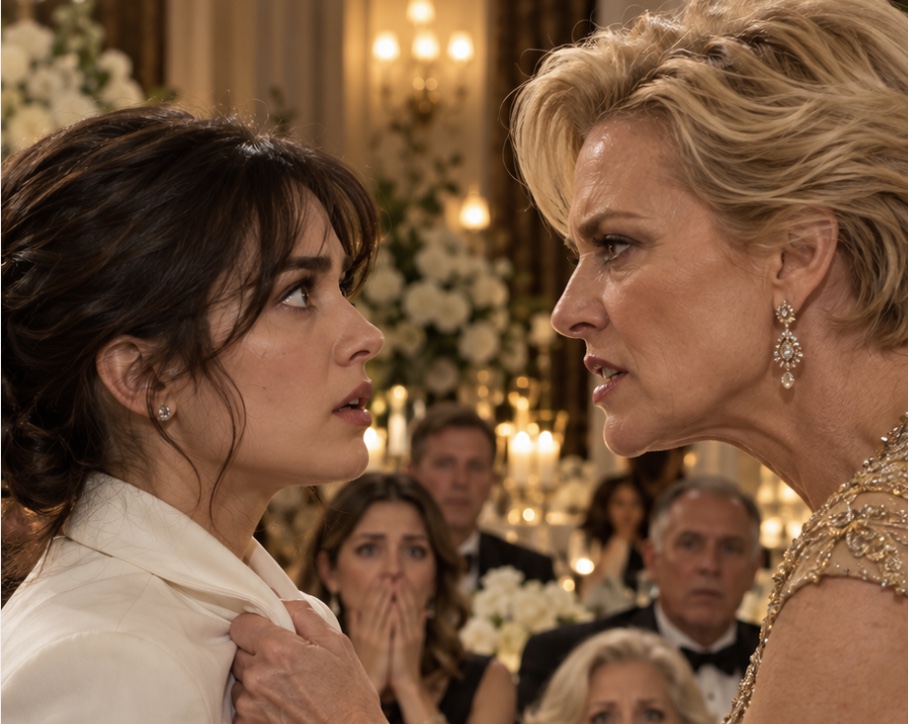
Her mother-in-law came quickly around the table and grabbed Elena by the collar of her jacket. Her fingers tightened around the fabric.
“Say one more word and you’ll regret it,” Oksana said through clenched teeth.
Guests rose from their seats. Someone cried out. The woman in the blue dress knocked over her glass. The host took a confused step forward, unsure what to do.
Elena didn’t flinch or shout. She took Oksana’s wrist, gently but firmly, and removed her hand from the jacket.
“Don’t do that,” Elena said. “There’s no need.”
Oksana stepped back, red patches spreading across her face.
Whispers filled the room. Gennady remained seated, holding his glass in both hands as though he were afraid he might drop it.
Elena looked around. Forty people were watching her—some confused, some curious, and some plainly sympathetic.
“All I wanted to say,” she continued, “was that this was a beautiful party. I’m glad Oksana got to spend her birthday somewhere lovely. Now you know who paid for it. That’s all.”
She picked up her handbag, put her phone inside, nodded to the host, and walked out.
The corridor was quiet and cool. It smelled of fresh flowers from a large floor vase Elena had chosen herself the week before.
She reached the exit and pushed open the glass door.
The April evening smelled of wet asphalt after rain. Elena stopped on the steps and took a deep breath. Something in her chest slowly loosened, as though she had kept her fist clenched for six years and had finally opened it.
The door closed behind her.
“Lena!” Igor caught up with her on the steps. “Lena, wait.”
She kept walking toward the parking lot.
“Please, stop.” He moved in front of her.
She stopped.
He stood there in the navy jacket she had ironed that morning. He looked bewildered. Not guilty—just caught off guard, like a man who hadn’t yet decided what to do.
“Why did you do that?” he asked.
“Do you really not understand?”
“There were guests there. My parents. Mom is upset.”
“Your mother grabbed me by the collar, Igor. In front of forty people.”
He grimaced.
“She lost her temper. You provoked her.”
Elena studied her husband for a long moment. Then she nodded slowly. At last, she understood.
“You’re telling me this is my fault.”
“I’m not saying that. I’m saying you could have handled it differently.”
“How? By staying quiet for another six years?”
“Lena, they’re family.”
“Igor, I’ve given your family more than half a million rubles over those six years. Your parents haven’t returned a single kopeck. You’ve never asked them to. And you’ve never once thanked me yourself, just because you meant it.”
He said nothing.
“I paid one hundred and forty-one thousand rubles for today. Your father accepted everyone’s congratulations as if he’d arranged the whole thing. You sat there and said nothing.” Elena took out her car keys. “That tells me everything I need to know.”
“Where are you going?”
“Home.”
“Wait. Let’s talk properly.”
“We just did.” Elena opened the car door. “Go back to your parents, Igor. They probably need your support.”
She got in and closed the door.
The next morning began quietly. Igor had returned late at night. Elena had heard him moving around the kitchen and sitting in the living room for a long time. At breakfast, neither of them spoke.
After work, Elena opened her banking app and canceled the additional card she had arranged for Igor several years earlier. She made no announcement. A few taps, and it was done.
Igor noticed that evening.
“Lena, my card isn’t working.”
“I canceled it.”
“Why?”
“Because your mother grabbed me by the collar,” Elena said, and left the room.
The following week, Oksana called. Elena saw her name on the screen and let the phone ring. Gennady called too. She didn’t answer.
Then Igor called from another room.
“Mom says they need help paying for the venue. Apparently there’s still an outstanding balance.”
“No,” Elena said immediately.
Igor came into the hallway.
“Lena, they owe money. They can’t just—”
“They can,” Elena said. “They’ll have to learn how.”
“But the people at the restaurant are waiting to be paid.”
“Igor.” Elena turned to face him. “Listen to yourself. You’re asking me for money for the family whose member grabbed my clothes in front of all those guests.”
He fell silent.
“Handle it yourself. Work it out, make calls, arrange payments. Leave me out of it.”
Igor paid the remaining balance from his own salary. Elena knew because she overheard him calling the bank about a small loan: thirty thousand rubles. Before, she would simply have transferred that amount without a word.
Two weeks later, Elena packed some of her belongings and moved into a small apartment she had inherited from her aunt. It was in another part of the city and had been rented out for years, but the tenants had recently left.
She took a suitcase from the wardrobe and filled it with the things that mattered. Igor stood in the bedroom doorway.
“You’re leaving.”
“Yes.”
“Because of the birthday party?”
Elena placed her folder of documents into the suitcase. It held the receipts for the one hundred and forty-one thousand rubles.
“Because of the six years before it.”
“Lena, we can fix this. I’ll talk to my parents.”
“You said that every time,” she replied. “Every time you promised to talk to them, and every time nothing changed. They liked things the way they were.” She closed the suitcase. “And so did you.”
Igor had no answer.
Elena picked up her suitcase and handbag.
“I’ll file the paperwork at the end of the month,” she said at the door. “There isn’t much to divide. We can have a lawyer look it over and settle things quickly.”
The divorce went through without a fight: court, documents, signatures. Igor didn’t contest anything. Perhaps he hoped until the last moment that Elena would change her mind. She didn’t.
Oksana never called Elena after hearing about the divorce. Gennady once messaged Igor to say that “Lena had gone too far.” Elena learned about it by chance and felt little about it.
Now they had to handle their own bills, small debts, and everyday expenses. Igor sometimes complained to mutual friends that it was hard. They sympathized. No one asked whether it had been hard for Elena to carry his family’s expenses for six years.
Her one-bedroom apartment turned out to be nicer than she remembered. She painted the walls white and bought new curtains without asking for anyone’s opinion.
On her first Saturday there, she sat at the table with a cup of coffee and looked out the window. No one called to ask for help. No messages arrived about urgent expenses. Her phone lay facedown, silent.
Elena never threw away the receipts. She put them in a desk drawer—not as a reminder of what she had lost, but as proof that she knew how to count. Once she had added it all up, the answer had been clear.
She never paid for anyone else’s parties again.