Pavel proposed in March, and Valeria said yes—not because everything was perfect, but because she felt at ease with him. Comfortable in a simple, human way. He never pressured her or rushed her, and they could sit together in silence without it feeling awkward. That seemed important.
Before the wedding, Valeria knew little about his parents. They had worked at a factory, were now retired, and lived in their own apartment twenty minutes away. Pavel spoke of them evenly, without much warmth but without complaint—the way people talk about relatives they are used to, even if they have never quite understood them.
She met them for the first time a month before the wedding, over lunch at their apartment. Valeria brought a cake, smiled, and answered their questions. Viktor Anatolyevich sat at the head of the table looking as though he had been pulled away from something important. He asked where she worked. When she answered, he nodded without interest.
“A middle manager,” Viktor Anatolyevich repeated, as if entering it into a record. “I see.”
Tamara Lvovna gave a sideways smile and passed the salad.
At the time, Valeria told herself it was only a first meeting. Some people took longer to warm up. She would give them time.
She did. It made no difference.
After the wedding, they saw Pavel’s parents about four times a month, either at his parents’ place or at their own. At every visit, Viktor Anatolyevich found a way to suggest that his daughter-in-law was not quite what he had expected. He was never openly rude. He simply dropped remarks into the conversation.
“Pasha has always liked home cooking,” he said when Valeria heated up store-bought cutlets.
 
“We don’t waste money in this family,” he said when someone mentioned her new jacket.
“Young people are different these days,” he would say, with a look that made it clear he considered different a bad thing.
Tamara Lvovna stayed quiet or nodded when her husband was present. Alone with Valeria, she sounded friendlier, almost affectionate, but her questions went places she had no business going. How much did Valeria earn? Did she get bonuses? Did Pasha spend a lot of money on her?
Pavel saw all of it. One day, Valeria said to him plainly:
“Your father acts as though he needs to remind me every time that I’m not good enough.”
“He’s like that with everyone,” Pavel replied. “Don’t take it personally.”
“With everyone, or just with me?”
Her husband was silent for a moment. Then he said his father was simply old-fashioned. Everything was fine, really. Valeria did not bring it up again. She understood that this conversation would lead nowhere.
Eventually, she found a way to manage. She kept her distance, gave them as little to argue with as possible, arrived at holiday gatherings with a neutral expression, and left as soon as she reasonably could. Home was her own space, and it was quiet. Nobody made cutting remarks over dinner there.
Valeria worked for a distribution company. She handled purchasing and suppliers and built spreadsheets that nobody else could make sense of on the first try. She had spent three years in one position, then another year and a half. During that time, the company’s processes changed, new suppliers came in, and business grew. Valeria was always the person who knew what needed doing—not because she was lucky, but because she understood the work better than anyone else.
When the director called her in and offered her the position of department head, she was not surprised. Still, she had to steady her breathing a little as she walked back to her office. Her salary would nearly double. That was a substantial change.
She told Pavel that evening. He was sincerely happy for her. He hugged her, said she had earned it, and suggested they go to a restaurant. They went, and had a lovely evening.
“Will you tell your parents?” Valeria asked over dessert.
“Of course. They’ll be pleased.”
Valeria did not ask who, exactly, would be pleased, or why. She just nodded.
Pavel told them the following week. Valeria was not there, so she did not know how the conversation went. She soon found out what it had led to.
Tamara Lvovna called on Wednesday afternoon while Valeria was in a meeting. Then she left a voice message: “Lera, congratulations, of course. We ought to get together and talk.”
“Your mother called,” Valeria told Pavel that evening.
 
“So? She congratulated you.”
“She said we need to talk.”
“About what?”
“I don’t know. But I heard her tone.”
Pavel looked at his wife and shrugged.
“Call her and find out.”
Valeria did not call. Instead, on Friday, she invited his parents over for Sunday lunch. Better to meet at home, she thought, where she could get up and go to the kitchen whenever she needed to.
On Sunday morning, she made roast meat, chopped vegetables, and prepared a fruit drink. Pavel helped set the table. His parents arrived at exactly one o’clock.
Viktor Anatolyevich looked around the entryway as he took off his coat.
“This place is all right. Clean.”
By his standards, it was a compliment.
They sat down. For the first twenty minutes, they talked about the weather, their health, and the lift that had finally been repaired in his parents’ building. Valeria listened, served the roast, and made sure everyone had something to drink.
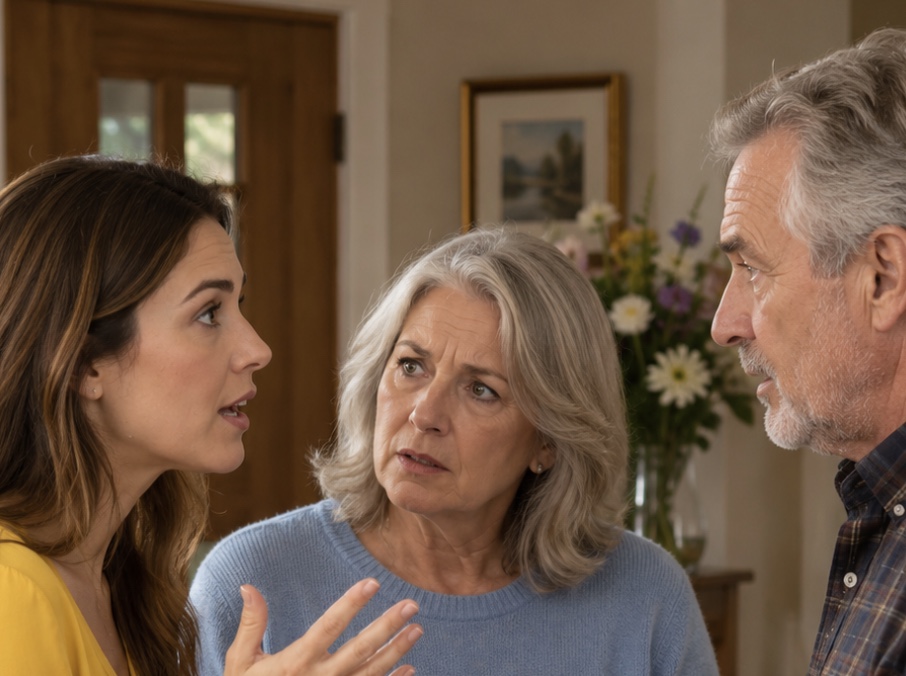
Then Tamara Lvovna set down her fork and looked at her daughter-in-law.
“Valeria, there’s something we wanted to say. Pasha told us about your promotion. We’re very pleased. Well done.”
“Thank you.” Valeria looked up.
“Your salary must be quite decent now.” Tamara Lvovna folded her hands at the edge of the table. “Viktor and I have been working out our expenses. They’ve gone up lately. Medicine is expensive, Vitya’s sister is going into hospital, and our niece Olesya has to switch to paid tuition. Everything has happened at once.”
“I’m sorry to hear that,” Valeria said evenly.
“Good,” Viktor Anatolyevich put in. “Sympathy is fine, of course. But you need to do something, too.”
Valeria looked at her father-in-law.
“What do you mean?”
 
“Help your relatives,” Viktor Anatolyevich said, as if the answer were obvious. “You’re earning good money now. Family shares what it has. How much can you set aside each month?”
The room seemed to fall quiet. Pavel sat across from Valeria, looking down at his plate.
She slowly put down her spoon.
“Wait. You want me to send money to your relatives every month?”
“Not relatives,” Tamara Lvovna corrected her gently. “Family. There’s a difference. Olesya needs help with her studies, and Vitya’s sister needs treatment. These aren’t strangers.”
“They are to me,” Valeria said. “I’ve never spent any time with either of them.”
“How can you call them strangers?” Tamara Lvovna raised her eyebrows. “You married into this family. Pasha has known his cousin since she was little.”
“Pasha has. I haven’t.” Valeria turned to her husband. “Pash?”
Pavel looked up. He hesitated.
“They are family,” he said quietly.
Something tightened in Valeria’s chest.
“Do you agree with them?” she asked him directly.
“Well, they’ve explained what’s going on…”
“I’m asking whether you think I should give money every month to people I barely know.”
Pavel looked back down at his plate.
Viktor Anatolyevich cleared his throat.
“Come on, what kind of discussion is this? Decent people help one another. You couldn’t afford to before; we understand that. Now you can. That’s why we’re bringing it up.”
“So when I earned less, I wasn’t expected to help,” Valeria said slowly. “Now I am.”
“Not expected,” Tamara Lvovna interjected. “It would simply be the kind thing to do. The family thing.”
“The family thing,” Valeria repeated. “Tell me, Tamara Lvovna: in four years of marriage, how many times have you and Viktor Anatolyevich helped Pavel and me? I don’t mean with advice. I mean with money or practical help.”
Her mother-in-law narrowed her eyes slightly.
 
“That’s different.”
“Why?”
Viktor Anatolyevich set his glass down harder than necessary.
“We didn’t come here to have our behavior examined.”
“Then why did you come?” Valeria asked calmly. “To tell me how much I’m supposed to transfer every month?”
“We came for a family lunch,” Tamara Lvovna said firmly. “We’ve simply raised an important matter.”
“Important to whom?”
Tamara Lvovna straightened in her chair.
“To the family. We’ve discussed it, and you’ll help the relatives each month. We can settle on an amount, but the main point is clear.”
Valeria looked at her mother-in-law. Then at Viktor Anatolyevich. Then back at her husband.
Pavel continued eating without raising his eyes.
Valeria stood up from the table. She did not do it abruptly. She simply picked up her plate and walked to the kitchen. She put it in the sink, turned on the tap for a second, then turned it off. For a while, she stood at the window looking toward the neighboring building.
Someone was hanging laundry on a balcony. The wind caught a bedsheet.
Valeria returned to the dining room. Her in-laws were watching her. At last, Pavel was too.
“I’ll be direct,” she said, standing beside the table. “There will be no monthly payments. Not to Olesya, not to Viktor Anatolyevich’s sister, and not to anyone else. I earn my salary, and I decide what to do with it.”
“Valeria—” Pavel began.
“Wait,” his wife said. “I haven’t finished.”
She looked from one parent to the other. Viktor Anatolyevich wore the expression of a man who had just been deeply insulted. Tamara Lvovna pressed her lips together.
“For four years, I kept quiet when Viktor Anatolyevich made it clear I wasn’t good enough for this family. I kept quiet when Tamara Lvovna asked about our spending as if it were her business. I thought it was easier than arguing over every remark. But now you’re telling me to give part of my salary to people I barely know, and presenting it as though it’s only natural. That isn’t how a family treats someone.”
 
“You talk as though we’re trying to rob you,” Viktor Anatolyevich said through his teeth.
“I’m talking this way because I didn’t ask either of you how to spend my money. And I don’t intend to.”
Tamara Lvovna turned to her son.
“Pasha, say something to her.”
Pavel rubbed his temple. He looked at Valeria with an expression she had learned to recognize: he wanted this to be over. He wanted peace at the table again, regardless of how it was achieved.
“Valeria, they aren’t asking for your whole salary. Just a little help for the family. Is that so difficult?”
“You’ve taken their side,” Valeria said quietly. “You didn’t ask me what I thought. You didn’t tell your parents we’d discuss it first. You just asked me to give in.”
“There aren’t sides. We’re a family.”
“Whose family, Pasha?” Valeria held his gaze. “Yours. Not mine. I have no relationship with Olesya or your father’s sister. Demanding money from me for their expenses doesn’t make us closer.”
Viktor Anatolyevich pushed his plate away.
“So now you call greed a principle?”
“Viktor Anatolyevich,” Valeria said calmly, “in four years, you haven’t said one kind thing to me. You’ve never asked how I was doing because you genuinely wanted to know. But the moment Pavel told you I’d been promoted, you remembered Olesya and the hospital bills. That tells me why you’re here.”
Her father-in-law stared at her with open irritation. Tamara Lvovna folded her arms.
“We’ve made our decision,” her mother-in-law said, slowly and distinctly. “You’ll help the relatives every month. We can discuss a reasonable amount without all this arguing. It’s simply helping the family.”
Something settled inside Valeria. It was not anger so much as clarity. She could no longer pretend there had been any misunderstanding.
“No,” she said. “I won’t.”
“Pasha!” Tamara Lvovna turned to her son again.
 
“Mum, let me handle this.” Pavel got up and walked over to his wife. “Valeria, let’s step out and talk privately.”
“There’s nothing to discuss privately,” she replied. “I’ve said what I needed to say.”
“You don’t understand how this looks,” he said, lowering his voice, though his parents could still hear him. “They don’t mean any harm. The relatives are having a hard time.”
“I understand exactly what I’ve seen,” Valeria said. “Your parents came into our home and announced that I’d be sending money every month. They didn’t ask. They didn’t suggest we talk it over. They announced it. And you’re standing beside me, asking me not to make things worse.”
Viktor Anatolyevich rose from the table. He was taller than Pavel, a detail that, for some reason, stood out to Valeria just then.
“Listen, daughter-in-law,” he said deliberately. “That’s not how we do things in this family. Money is shared. You help today; someone helps you tomorrow. It’s that simple.”
“When have you helped us?” Valeria asked. “Tell me specifically.”
Viktor Anatolyevich narrowed his eyes.
“We raised Pasha…”
“And?” Valeria said. “That doesn’t count as help to the two of us. You raised your own son.”
Tamara Lvovna stood up too.
“You’re being rude,” she said.
“I’m speaking plainly. Those aren’t the same thing.”
“Pasha,” Tamara Lvovna said, staring at her son, “does she listen to you at all?”
There was something about the question that left Valeria speechless for a moment. Then she found her answer.
“I’m not a dog, Tamara Lvovna,” she said evenly. “I’m asking you to leave our home.”
The silence lasted perhaps three seconds.
“What?” Viktor Anatolyevich stared at her as though she had spoken in a language he did not understand.
“I’m asking you to leave. Right now.”
“Valeria.” Pavel stepped toward his wife. “They’re my parents.”
“I know,” she said. “And you can leave with them if you think they’re right.”
He looked at her, then at his mother, then back at Valeria.
 
“Are you serious?”
“Completely.”
Pavel said nothing for about ten seconds.
“Fine,” he said, and went to the entryway to get his jacket.
Valeria stood beside the table and watched Tamara Lvovna button her coat. Viktor Anatolyevich put on his shoes without a word. Pavel helped his mother with a fastening. All three left. The door did not slam; it simply closed.
Valeria returned to the kitchen. The roast was still warm on the stove. She washed the plates and wiped the table, working steadily, without hurrying.
Then she poured herself a glass of water and sat by the window.
Pavel came home late that evening. He went into the living room and sat on the sofa. Valeria was there, reading.
“You shouldn’t have treated them like that,” he said without preamble.
“Who, exactly?” Valeria asked, keeping her book open.
“Mum and Dad. They’re not your enemies.”
“I know. They just think they have the right to decide what happens to my salary. That’s bad enough.”
“They’re getting older. They’re worried about their relatives. Can’t you understand that?”
“I do.” Valeria closed her book. “And you understand that I said no. But instead of standing beside me, you asked me to give in. Then you left with them.”
“You told me to go.”
“Because you’d already made your choice. I only said it out loud.”
Pavel rubbed his face.
“Valeria, let’s not make this into some huge drama.”
“It answered a question I’ve been asking myself for a long time. Now I know.”
“What question?”
“Whose feelings matter more to you.”
Pavel fell silent.
Over the following days, he kept trying to talk to her. Sometimes he was calm; sometimes he was irritated. He explained that his parents had not meant any harm, that she needed to be more flexible, that families sometimes handled things this way. Valeria listened and answered briefly. She waited for him to say something new.
 
He never did.
On the fifth day, Pavel brought up the money again. Perhaps, he suggested, she could help Olesya just once. No monthly arrangement—only enough to settle the matter.
Valeria got up, poured herself a coffee, and said:
“I’m filing for divorce.”
Pavel stared at her.
“Over money?”
“Over the fact that you haven’t apologized for a single thing in five days. You still think I should have given in. You think your parents were right, and that I was wrong to ask them to leave.” Valeria took a sip of coffee. “I don’t want to live with someone who sees it that way.”
She filed the paperwork two weeks later. At first, Pavel tried to delay things. He asked her to think again and said they could work it out. Valeria had thought about it. She had been thinking long before he walked out with his parents. She had been thinking through all those years of keeping quiet at family dinners.
The divorce was finalized by spring.
There was little to divide. They had lived in a rented apartment; the only things they owned together were some furniture and a small balance in a joint account. They settled everything without going to court.
Tamara Lvovna sent Valeria a long message after the divorce, accusing her of destroying the family out of greed and pride. Valeria read half of it, then closed it.
Olesya eventually switched to evening classes and found a job. Viktor Anatolyevich’s sister left the hospital. Everyone’s life went on, as lives usually do, without Valeria’s money.
Valeria rented a small apartment closer to work. It felt like her own—not because she owned it, but because nobody came over on a Sunday carrying a jar of jam and a list of somebody else’s expenses.
 
Things were going well in her new position. Her colleagues did not know about the divorce; Valeria had not told them. She simply worked. She opened a savings account and began putting money aside. She never once regretted refusing to give it to Olesya.
One evening, a friend called to ask how she was doing and whether she regretted her decision.
“No,” Valeria answered without hesitation.
“Not at all?”
“Not at all. Do you know what’s strange? I feel calmer now than I ever did during my marriage. And I thought I’d simply grown used to being married.”
“You’d grown used to the tension?”
“I’d grown used to thinking it was normal.”
She ended the call. Outside, it was a quiet April evening. The first interest payment from her savings account had arrived—a small amount, but hers. Hers alone, with no negotiations, no family discussions, and no one else’s list of expenses.
Valeria made herself a cup of tea and opened her laptop. She had a work file to finish by morning.
There was work waiting for her. And she was glad of it.