Ksenia inherited the dacha from her grandmother—a small plot of land with an old cottage, a sagging veranda, and a neglected garden. Her grandmother had died three years earlier, leaving the property to Ksenia in her will. All that time, the place had existed somewhere at the back of Ksenia’s mind: it was there, and that was that. She had been too busy to give it much thought.
Then something shifted inside her that spring. In April, Ksenia drove out there simply to see how the property had survived the winter. She got out of the car, walked around the plot, and ran her fingers through the soil. It was good earth—dense, dark, and well rested. The beds were overgrown, but the bones of the garden were still intact. The blackcurrant bushes were alive, the apple trees were standing, and the raspberries had spread so wildly that it was already difficult to reach them.
Ksenia stood there for a minute, surveyed the entire place, and thought, I need to put this back in order.
She worked as a designer at an advertising agency, spending five days a week and eight hours a day at a computer, surrounded by deadlines and endless revisions. The dacha became a kind of counterweight to that life—work she could do with her hands, in the soil, without a screen. Ksenia had not expected to become so absorbed in it so quickly.
 
Pyotr supported the idea. At least, he did in words.
“Wonderful. Let’s work on it,” he said. “I’ll help on weekends.”
“Really?”
“Of course. Homegrown potatoes and cucumbers are always good. I like that sort of thing.”
Ksenia bought seedlings, seeds, and several bags of fertilizer. She drew up a plan for the beds. On the first weekend in May, she went alone—Pyotr said he was tired after the working week and needed to rest. Ksenia nodded and drove there without him.
The following weekend, Pyotr did not go either. A friend suddenly needed his help with something urgent. Then the weather was bad. Then the dirt road was difficult after the rain. Then it was simply, “I’ll come next time, all right?”
That next time never came.
Ksenia kept going by herself. Every weekend—always on Saturday, and sometimes on Sunday as well. She got up at seven in the morning, filled a thermos with coffee, got into the car, and drove forty minutes along the highway, followed by another ten minutes on a dirt road. She worked until lunchtime, often longer. She weeded, watered, tied up the plants, and sprayed them. She brought home the first herbs, then radishes, then cucumbers. Pyotr greeted her, looked approvingly at what she had brought, and said, “Oh, great. Let’s put it on the table.”
He ate it. He praised it. He never mentioned the dacha again.
 
Svetlana Viktorovna—Pyotr’s sixty-two-year-old mother, an energetic woman with an opinion on everything—knew about the property. Ksenia had mentioned several times in casual conversation that she had begun working on the plot. Svetlana Viktorovna would nod and say, “Well done. The land rewards those who care for it,” and then let the subject drop. She never came to the dacha. Not once. Nor did she offer to help.
The summer was hot and the harvest abundant. The earth returned everything Ksenia had invested in it through her labor. The cucumbers grew firm and crisp. The tomatoes ripened in three waves. The potatoes were excellent—Ksenia dug up twelve sacks. There were so many blackcurrants that her hands cramped from picking them. Raspberries, zucchini, pattypan squash, herbs—there was plenty of everything, far more than she had expected.
In August, she began preserving the harvest: jam, pickled cucumbers, tomatoes, lecho, and adjika. She worked in the evenings and on the weekends when she no longer needed to travel to the dacha. The jars formed neat rows on the pantry shelves, and Ksenia looked at them with the special satisfaction that comes when the result of your labor is something you can see and touch.
Pyotr would walk into the pantry, survey the shelves, and say, “Not bad. You know, this should last us all winter.”
“That’s the plan,” Ksenia replied.
“Wonderful. It’ll be delicious.”
Not once during the entire summer did Pyotr ask whether Ksenia was tired. He never offered to go to the dacha with her, even if only to keep her company. He never asked whether she needed help with the preserving. He accepted everything as a given, the way people accept the weather or a train schedule. It was there, and that suited him.
 
Ksenia said nothing. It was not because she feared an argument. She simply did not yet know how to put into words what was bothering her. She could feel that something was wrong, but the wrongness had been spread evenly across the whole summer. There had been no single moment she could point to.
That moment came in September.
On Saturday morning, Pyotr’s mother called. Ksenia was in the kitchen, making compote from the remaining apples. Pyotr said Svetlana Viktorovna wanted to stop by. Ksenia replied that it was fine and she was welcome to come.
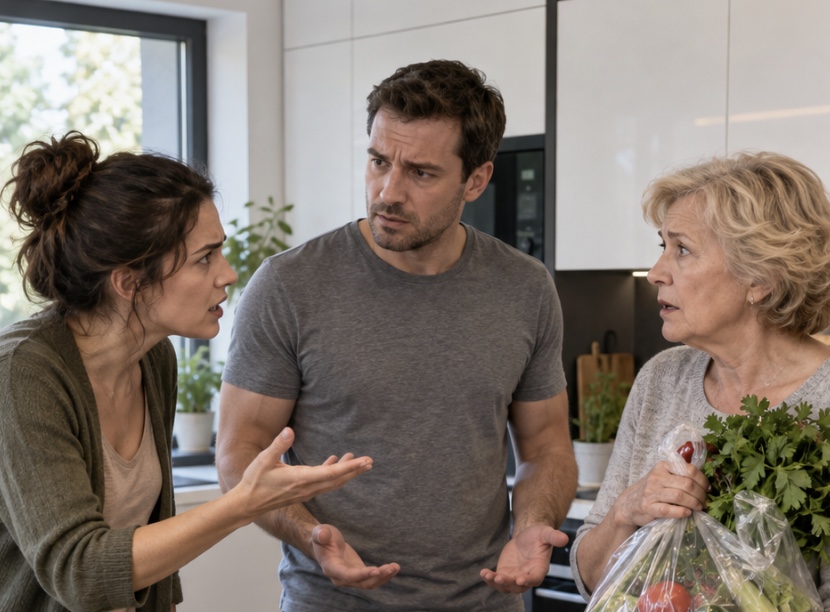
Svetlana Viktorovna arrived at two in the afternoon—not alone, but accompanied by two large plaid shopping bags, the kind people took to the market for bulk purchases. Ksenia saw them in the entryway and froze for a second.
“Hello, Ksyusha,” Svetlana Viktorovna said, walking into the kitchen and looking around like someone who knew exactly why she had come. “It smells lovely in here. Are you cooking something?”
“Compote.”
“Apple? Very nice.” Svetlana Viktorovna set the bags against the wall and sat down. “Ksyusha, I actually came because I wanted to ask you about something. You said the harvest was good this year. I thought I’d take a little home. And Irina needs some too. She has children, and you know they need their vitamins.”
Irina was Pyotr’s thirty-four-year-old sister. She was married, had two children aged seven and four, and lived in another part of the city. She had not visited the dacha once all summer.
“How much do you mean by ‘a little’?” Ksenia asked.
 
“Well, I was thinking one or two sacks of potatoes. Cucumbers and tomatoes—however many you have. And perhaps ten jars of jam, plus some pickles.” Svetlana Viktorovna spoke calmly, as though everything had already been settled. “Irina needs potatoes too. She asked for some. And probably the same number of jars for her.”
Ksenia placed her spoon on its saucer.
“Svetlana Viktorovna, that is most of what we have.”
“So what? You grew enough to last through the winter. You and Petya will have plenty left for the two of you.”
Pyotr was standing beside the refrigerator, looking at his phone. Ksenia turned to him.
“Pyotr.”
“What?”
“Are you listening to this conversation?”
“Yes, I hear you. Mom says we ought to share. That’s normal, Ksyusha. They’re family, after all.”
“Family who never came to help,” Ksenia said evenly.
“Ksyusha, we didn’t know exactly when you needed help,” Svetlana Viktorovna said in a conciliatory tone.
“All summer. Every weekend. I went there alone.”
“Everyone has things of their own to do.”
“I had things to do too. I work five days a week. Every Saturday, I got up at seven and drove to the dacha.”
“Ksyusha, why start keeping score now?” Pyotr finally looked up from his phone. “Mom came over and wants to take a little. It’s hardly a disaster.”
“A little? Two sacks of potatoes, twenty jars of preserves, and however many cucumbers happen to be left?”
“However many there are,” Svetlana Viktorovna said.
 
Ksenia sat down opposite her mother-in-law.
“Svetlana Viktorovna, tell me honestly: do you understand that I did all of this by myself? That Pyotr did not go to the dacha even once? That you never came either? And neither did Irina?”
“Ksyusha, there’s no need to use that tone.”
“I’m not using a tone. I simply want to know whether you understand where all of this came from.”
“Well, you worked on it, and well done. That’s why we’re suggesting that you share it with the family.”
“You’re suggesting that I share,” Ksenia repeated. “You are suggesting what I should do with something I made.”
“Ksenia,” Pyotr said, approaching the table, “that’s enough. Give Mom what she asked for. It won’t leave you destitute.”
“I’ll give her a small portion,” Ksenia replied. “Five jars and one sack of potatoes. That is enough.”
Svetlana Viktorovna shook her head.
“Ksyusha, what good are five jars? I said ten for me and ten for Irina. That would be fair.”
“Fair would mean taking part in the work.”
“Ksenia!” Pyotr raised his voice. “Stop making a scandal over a few jars!”
“Pyotr, this isn’t about jars. It’s about six months of my labor.”
“They’re vegetables. The earth grew them, and you picked them. Don’t turn it into some heroic achievement.”
Ksenia looked at her husband for a long moment. Then she turned toward Svetlana Viktorovna, who sat with her hands folded in her lap, wearing an expression of wounded dignity.
“I didn’t work myself to the bone all summer,” Ksenia said, “just so your mother could haul the harvest away by the sackful.”
Her words came out cold. Not angry—cold, the way words sound when someone finally says what she has held inside for too long and no longer wastes energy wrapping it nicely.
Svetlana Viktorovna straightened.
“I see. So now we’re supposedly hauling everything away by the sackful.”
“You arrived with two large bags and asked for quantities that add up to more than half of everything we have.”
“Ksenia, this is greed,” Svetlana Viktorovna said, the hardness she usually concealed beneath her gentle intonation now entering her voice. “It is wrong to begrudge your family.”
 
“Svetlana Viktorovna, I don’t begrudge my family anything. I simply won’t surrender the result of my work to people who treat it as though they are entitled to it.”
“People?” Svetlana Viktorovna sprang to her feet. “Am I just some outsider to you?”
Ksenia turned back to her husband.
“Pyotr, tell me one thing. Did you ask even once this summer how I was managing out there alone? Did you offer even once to come with me?”
“You never asked me to.”
“I shouldn’t have had to ask. It was supposed to be your dacha too. We are married.”
“Ksenia, you are blowing this out of proportion.”
“You did not come once. Not for a single weekend. I got up at six in the morning forty times over the summer—alone. I weeded alone. Watered alone. Harvested alone. Preserved everything alone. And that means nothing?”
“I had reasons.”
“Every weekend?”
“Ksenia,” Svetlana Viktorovna interrupted, “Petya gets tired. His work is demanding. You only do that advertising work of yours. It isn’t the same.”
“I have a full-time job, five days a week. It is every bit as much a job.”
“Well, it’s different for men.”
 
“Different how?”
“Ksenia,” Pyotr raised his voice again, “enough! Mom came here with good intentions, and you’ve turned this into an interrogation. Apologize to her.”
“For what?”
“For being rude.”
“Pyotr, I told the truth. That isn’t rudeness.”
“You called her a stranger!”
“I said I would not hand the results of my labor to people who did not contribute to it. That applies to everyone—to Svetlana Viktorovna, to Irina, and yes, Pyotr, to you as well.”
Pyotr stared at her. His surprise was obvious. He opened his mouth, closed it again, and took a step back, as though her words carried physical weight.
“To me?”
“You didn’t contribute either. Not once. So you have no right to decide how much I must give away or to whom.”
“I’m your husband.”
“That isn’t an argument in this situation.”
Svetlana Viktorovna picked up one of the bags.
“Come on, Petya. I can see that we aren’t welcome here. Let’s go.”
“Mom, wait.”
“No, Petya. Let her sit here alone with her precious harvest. I don’t beg where people don’t want to give.”
Her voice trembled, not from tears, but from indignation already becoming theatrical. Ksenia watched her without trying to stop her.
“Svetlana Viktorovna,” she said calmly, “I will give you one sack of potatoes and five jars. That is an honest offer.”
“Five jars!” Svetlana Viktorovna threw up her hands. “Do you hear that, Petya? Five jars!”
“Mom, I’ll handle this.” Pyotr looked at Ksenia again with the expression people use when they want someone to understand that she has behaved badly and will soon regret it. “Ksenia, you are behaving terribly.”
“You already said that.”
 
“Mom is hurt.”
“I can see that.”
“Are you going to apologize?”
“No.”
Pyotr picked up his jacket.
“I’ll walk Mom out. I need time to cool down.”
“All right.”
Svetlana Viktorovna went into the entryway and picked up the empty bags she had brought. She put on her coat without looking at Ksenia. Pyotr got dressed behind her.
At the door, Svetlana Viktorovna finally turned around.
“Ksenia, you’re still young. You don’t understand that family is the most important thing.”
“I do understand, Svetlana Viktorovna,” Ksenia replied. “That is precisely why I believe family relationships should be honest.”
The door closed.
Ksenia stood in the entryway for a moment, then returned to the kitchen. The compote was still bubbling gently on the stove. She lowered the heat, stirred it, and tasted it. It was good—apple with cinnamon, just as her grandmother had liked it.
Pyotr returned two hours later. He entered, removed his shoes without speaking, and went into the living room. Ksenia was sitting with a book. She was not really reading it, merely holding it in her hands.
“Mom is very upset,” he said.
 
“I understand.”
“You could have handled it differently.”
“How?”
“You could have given her what she asked for. It wouldn’t have been the end of the world.”
Ksenia closed her book.
“Pyotr, do you understand what happened? Not just today—throughout the entire summer?”
“Ksenia, don’t start talking about the summer again.”
“I have to, because today was the consequence of it. I went to the dacha alone all summer. You never came once. Neither did your mother. Neither did Irina. Then, in September, your mother appeared with two huge bags and announced that I needed to give away more than half of everything. You stood beside her and demanded that I apologize. What exactly am I supposed to apologize for, Pyotr?”
“For calling her an outsider.”
“I never said that. I said I would not give my work to people who had no part in it.”
“That’s the same thing.”
“No. It is fundamentally different.”
Pyotr sat in the chair opposite her.
“Ksenia, you’ve turned a pile of vegetables into a matter of principle.”
“Respect, Pyotr. I have made respect—or the lack of it—a matter of principle.”
“I respect you.”
“You did not ask once how I was coping out there. Not once all summer.”
“You never complained.”
“I should not have to complain. I should simply be able to live beside a husband who notices what is happening without waiting for me to complain.”
Pyotr was silent. Ksenia watched him trying to find an argument—something that would steer the conversation elsewhere, release him from responsibility, and restore the familiar order of things. Usually it worked. Ksenia would yield, the conversation would fade away, and life would continue.
It did not work now.
“Ksenia,” Pyotr finally said, “do you want me to apologize?”
“I want you to understand.”
 
“Understand what exactly?”
“That I am under no obligation to work for your entire family. That when I make something, it belongs to me, and I decide what happens to it. That your mother cannot arrive with bags and announce how much she needs as though I were a warehouse.”
“She didn’t mean any harm.”
“Pyotr, she came with bags. It wasn’t a social visit.”
Her husband fell silent for a long time. Darkness gathered outside the window. Somewhere below, a car door slammed.
“I’ll call Mom,” Pyotr finally said. “I’ll tell her we all got carried away.”
“Pyotr, she didn’t get carried away. She came for something specific and didn’t get it. This isn’t a quarrel. It is simply the outcome.”
“Do you want to fall out with my mother?”
“I’m not fighting with her. I am only stating the facts.”
Pyotr stood up.
“Ksenia, she expects you to call and make peace.”
“I’m not calling her.”
“Why not?”
“Because I haven’t done anything wrong. I have nothing to make amends for.”
Pyotr looked at his wife with an expression Ksenia had never seen before. He was not angry or offended. He was bewildered, as though the rules by which he had lived in this marriage had suddenly changed.
“Ksenia, you sound like a stranger.”
“No. I sound like someone who is tired of being invisible.”
“What is that supposed to mean?”
“It means that I worked all summer and no one saw me. There was a harvest. There were jars. There was a dacha. But I wasn’t there. You came home, ate the cucumbers, praised them, and asked how much I had gathered. You never asked how I was.”
Pyotr opened his mouth.
“Ksenia, I…”
 
“Not now. Just think about it.”
Ksenia stood, took her book, and went into the bedroom. She lay down and opened it to the same page. She still could not read.
Pyotr came in an hour later and sat on the edge of the bed.
“I called Mom.”
“And?”
“She says she’s hurt.”
“I understood that when she left.”
“Ksenia, could you at least send her a message? Just say you didn’t mean to hurt her.”
“I didn’t mean to hurt her, Pyotr. But I’m not going to pretend she was right simply because that would be more convenient for her.”
“So your answer is no.”
“My answer is no.”
Pyotr lay down beside her. He remained silent for a long time, then spoke while staring at the ceiling.
“Ksenia, you can’t behave this way.”
“What way?”
“Like this. Saying everything directly, with no compromise. It destroys relationships.”
“No, Pyotr. Relationships are destroyed when one person keeps enduring things and the other fails to notice. I endured it for six months. Today I stopped.”
The following days were both quiet and tense. Pyotr moved carefully around the apartment, trying not to touch any sensitive subjects. Ksenia went about her life. She worked, finally finished the book she had been putting off since August, and reorganized the pantry. Svetlana Viktorovna did not call. Neither did Irina.
On the third day, Pyotr raised the subject again.
“Ksenia, Mom wants to come over and talk properly.”
“About what?”
“To explain that she didn’t mean anything bad. You understand—she wasn’t acting out of malice.”
“She can come, Pyotr. But I won’t give her anything beyond what I already offered. That will not change.”
“Ksenia…”
“And she should come without bags.”
Pyotr stared at her. Ksenia held his gaze. Then he sighed, picked up his phone, and stepped onto the balcony. He spoke for about fifteen minutes. Ksenia could hear his tone through the glass, but not his words.
 
When he returned, he sat down on the sofa.
“Mom isn’t coming. She says that if this is how things are, then she isn’t welcome here.”
“All right,” Ksenia said.
“It isn’t all right, Ksenia. You’ve turned me against my own mother.”
“No. You put yourself between us when you began telling me how to dispose of the fruits of my labor.”
“I wanted peace in the family.”
“Peace in the family cannot come at my expense, Pyotr. That isn’t peace. It is simply convenient for you.”
Pyotr stood up.
“You need to go to Mom’s house and make peace with her,” he said. “It’s important for us.”
“Pyotr, I’m not going.”
“Ksenia, this is a demand.”
Ksenia looked at her husband. A demand. The word sounded strange, as though it belonged to another conversation in another time.
“Fine,” she said. “Then go yourself. You can take your things with you.”
“What?”
“If you believe I must go and apologize to your mother because I refused to hand over the results of my work, then we have nothing left to discuss. Go to her. You can pack your things today.”
Pyotr stared at her for ten seconds.
“Are you serious?”
“Completely.”
“You’re throwing me out over a few jars of cucumbers?”
“I’m giving you a choice. You made a demand, and I gave you my answer.”
Pyotr did not leave that evening. But something broke between them—not loudly or with a crash, but quietly, the way something breaks when it has been held together by nothing more than a promise for far too long.
 
Their conversations became shorter. Ksenia stopped waiting for her husband to understand things on his own. Now she spoke plainly, without hoping he would work it out for himself. Pyotr returned to the subject of his mother several times, sometimes gently and sometimes with irritation. Ksenia always gave him the same answer: she had already stated her position.
In October, Ksenia filed for divorce. It was not an impulsive decision. She did it calmly and with a clear head. She called a lawyer recommended by friends and arranged a consultation. She clarified the situation regarding the dacha: because she had inherited the property, it was hers alone and would not be divided in the divorce. That mattered. The dacha would remain hers.
When Pyotr learned about the paperwork, he initially refused to believe it.
“Are you serious about this?”
“Yes.”
“Because of the harvest?”
“Because of everything that conversation revealed.”
“Ksenia, this is ridiculous.”
“Perhaps.”
“Let’s talk properly. I’m ready now.”
“Pyotr, we did talk. Several times. I saw that you heard the words, but not their meaning. It isn’t your fault. We are simply built differently.”
“You aren’t giving me a chance.”
“I gave you the whole summer,” Ksenia said simply. “Forty weekends when you could have come with me. That was your chance. You didn’t take it.”
Pyotr moved in with his mother in November, taking his belongings with him for good. Ksenia helped him pack, called a taxi, and closed the door behind him.
Winter began quietly.
In the mornings, Ksenia would go into the pantry, choose a jar, and look at the label she had written herself in August: cucumbers, tomatoes, adjika, blackcurrant jam. She would carry it into the kitchen, cook, and eat. It felt good—not merely because the food tasted good, though it did. It felt right. Her hands, her soil, her winter.
One day, the neighbor across the landing asked what smelled so delicious in Ksenia’s apartment. Ksenia brought her a jar of adjika for no special reason. The neighbor accepted it, thanked her, and asked for the recipe. Ksenia wrote it down on a piece of paper.
That was generosity—the kind you choose to offer, not the kind someone takes from you without asking. The difference was enormous.
 
In February, Ksenia began planning the next growing season. She bought new seeds and ordered fertilizer. She thought about expanding the tomato beds; the previous summer had shown her that there was not enough room. She wrote a list of jobs for April in her notebook.
Snow lay outside the window. The dacha stood empty, waiting for spring. Ksenia looked at her list and thought that this time she would go even earlier—at the end of March, as soon as the snow melted. She would see how the raspberries had survived the winter. Perhaps she would plant more blackcurrant bushes.
No one would wait for the results. No one would arrive carrying empty bags. It would be her land and her summer alone.
Ksenia closed the notebook and went to put the kettle on.