Anastasia bought her apartment when she was twenty-eight. It had three bedrooms, was located in a newly built complex on the outskirts of the city, and stood in a good neighborhood. Her parents helped with the down payment, but she paid off the rest herself, without anyone else’s assistance. Once the renovations were complete and every piece of furniture stood exactly where she wanted it, she remained in the middle of the living room for a long time, thinking, This is mine now.
She met Anton a year after moving in. She liked him almost immediately. He was calm and dependable, and he knew how to talk without making everything feel rushed or complicated. By their third date, she realized the relationship was serious. By the sixth, she knew she wanted him to stay.
After their wedding, Anton moved into her apartment. He did not own a place of his own and had previously been renting. Anastasia had no objection. The apartment was spacious, and there was plenty of room for both of them. The third bedroom remained almost empty. It held several boxes they had never unpacked, and they vaguely talked about turning it into either a study or a guest room.
“Later,” they both kept saying.
 
But later never seemed to come.
Anastasia’s opinion of her mother-in-law, Inna Petrovna, was neutral. The older woman called on Sundays, visited about once a month, remained polite, and did not interfere in their lives. Sometimes she arrived with a pie, stayed for a little while to chat about nothing in particular, and then went home.
She and Anton were close. He had grown up without a father, and Inna Petrovna had raised him alone. Their bond was evident in the way they spoke to each other. Anastasia was not troubled by it. A mother’s attachment to her son seemed perfectly natural.
Anton’s sister, Elizaveta, lived her own life. She and her husband, Igor, rented an apartment, and the families rarely saw one another except on holidays. Anastasia had no strong feelings about Liza. She was harmless enough, simply a little distant.
For three years, that was how their life continued—quietly and normally.
Then everything began to change.
Inna Petrovna called one Wednesday evening. Anastasia heard only fragments of the conversation while she cooked. The television was playing in the background, and Anton spoke softly. When the call ended, he came into the kitchen and sat at the table.
“Mom was talking about Liza,” he said.
“What happened?”
“Nothing happened. Their rent is just very expensive, and Mom is worried about them.”
“What does that have to do with us?”
Anton shrugged, poured himself a glass of water, and remained silent for a moment.
“Nothing yet. She was just talking about it.”
 
Anastasia let the matter go. Other people’s rent was not her problem, and she did not give the conversation another thought.
A few days later, Inna Petrovna called again. This time, she called Anastasia directly.
“Nastenka, you understand how difficult things are for young couples. Liza and Igor pay fifty thousand rubles a month in rent. That is an enormous amount of money, while you have a room sitting empty.”
Anastasia paused.
“Inna Petrovna, the room is not empty. We store things there, and we plan to turn it into a study.”
“But who knows when you’ll actually do that? In the meantime—”
“We’ll do it soon,” Anastasia said firmly, leaving no room for further discussion.
Her mother-in-law changed the subject. Anastasia, however, remembered the exchange and understood exactly where it was leading.
A week later, Inna Petrovna came to the apartment in person.
She arrived on Saturday afternoon. Anton greeted her in the hall, and the two of them spoke quietly before moving into the living room. Anastasia came out of the kitchen, said hello, and put the kettle on.
“Nastya, I want to have a serious conversation,” Inna Petrovna said. “It’s about Liza.”
“I’m listening.”
“They’re having a very hard time. Fifty thousand a month is more than a third of Igor’s salary. They cannot save any money or make any progress. You have a large apartment and a spare room. If they could stay here for a few months—”
“No,” Anastasia said.
 
Inna Petrovna pretended not to have heard her.
“I understand it might be a little inconvenient, but Liza is tidy, and so is Igor. They wouldn’t bother you.”
“Inna Petrovna, I heard you, and my answer is no. I do not want to share my apartment with people who are practically strangers to me.”
“Strangers? They’re family!”
“They’re your family. My family is Anton and me.”
Her mother-in-law turned to her son. Anton stared down into his cup.
“Anton, talk to your wife.”
“Mom, Nastya said no,” he replied.
“But surely you understand—”
“Mom. She said no.”
Inna Petrovna left about an hour later. Anastasia believed that was the end of it. Her husband had supported her, and the subject was closed.
She was wrong.
Every few days, Inna Petrovna brought it up again. Sometimes she called Anton; sometimes she contacted Anastasia herself. Each time, she presented the same request in a slightly different way.
“Nastya, you understand it would only be temporary. Just a few months while they save for a place of their own.”
“Nastenka, I’m not asking you to give them the apartment. It’s only one room.”
“Liza is planning to have a baby. She needs stability right now.”
“Think about how this looks. Your room is unused while your relatives spend fifty thousand every month on rent.”
Anastasia always gave the same answer.
No.
She did not shout or speak rudely. She was simply firm.
 
No. I have already answered. I am not going to change my mind.
At first, Anton remained silent during these conversations. Then he cautiously began raising the subject himself.
“Mom says Liza really is in a difficult situation.”
“Maybe she is. That doesn’t mean my apartment is the solution.”
“Nastya, it isn’t your apartment. It’s ours.”
Anastasia was quiet for a moment.
“Anton, it is my apartment. I bought it before we were married. You know that.”
He fell silent and never used that argument again. Instead, he tried another approach.
“She’s my sister. I can’t simply stand by and watch her struggle.”
“Then help her financially. Pay part of her rent if you want to. She is your sister, so those choices are yours to make. But moving people into my home is not a decision you can make alone.”
“You’re being too harsh.”
“I’m being honest about what I want.”
One Sunday, Inna Petrovna arrived with Liza, without any warning.
Liza was pleasant. She smiled, said very little, and did not openly ask for anything. Yet the visit had clearly been staged. They sat in the kitchen while Inna Petrovna talked about the hardships facing a young married couple. Liza occasionally nodded, and the purpose of the performance was unmistakable: look at the person you are refusing to help. Get to know her better, and perhaps saying no will become more difficult.
Anastasia remained polite and composed throughout the visit. After they left, she spoke to Anton.
“Please don’t bring Liza here without warning again.”
“That was Mom’s idea.”
“Anton, I’m asking you. Don’t let it happen again.”
He shrugged. Anastasia could not tell whether that meant agreement or refusal.
One evening, she finally asked him outright.
“Do you want them to move in?”
He hesitated.
“I want to help my sister.”
“That isn’t an answer. Do you want them living here with us?”
 
“Temporarily.”
“For how long?”
“Until they find a place of their own.”
“Is that an actual deadline?”
He paused again.
“They won’t stay forever.”
Anastasia nodded and did not pursue the conversation. She had received her answer. There was no deadline. No one had even considered one. They were thinking only about getting her to agree.
The conversations continued, and the pressure did not ease. Anastasia held her ground, but she was growing tired—not so much of the situation itself as of having to repeat the same answer while everyone acted as though she had said nothing at all.
“Temporarily” was not a period of time. It was an expectation—the expectation that she would eventually become accustomed to the idea and stop resisting.
About a month passed after the subject was first raised.
On Thursday evening, Anton called to say he would be late. Anastasia ate dinner alone, watched television for a while, and went to bed early because she was exhausted after work.
 
At half past nine, she heard the front door open. Then she heard another voice—a woman’s voice.
She walked into the hall.
Inna Petrovna was taking off her coat. Anton stood beside her.
“Good evening,” Anastasia said. “Did something happen?”
“Nothing happened,” her mother-in-law replied. “I wanted to talk.”
“At ten o’clock at night? You knew we weren’t expecting visitors.”
“I’m not a visitor. I’m his mother.” Inna Petrovna walked past her into the living room. “Anton, put the kettle on.”
Anastasia looked at her husband. He avoided her eyes.
They sat around the kitchen table. Inna Petrovna waited until Anton had poured the tea, then folded her hands in front of her.
“Nastya, I have some news for you. Liza and Igor are moving tomorrow.”
“Where?” Anastasia asked.
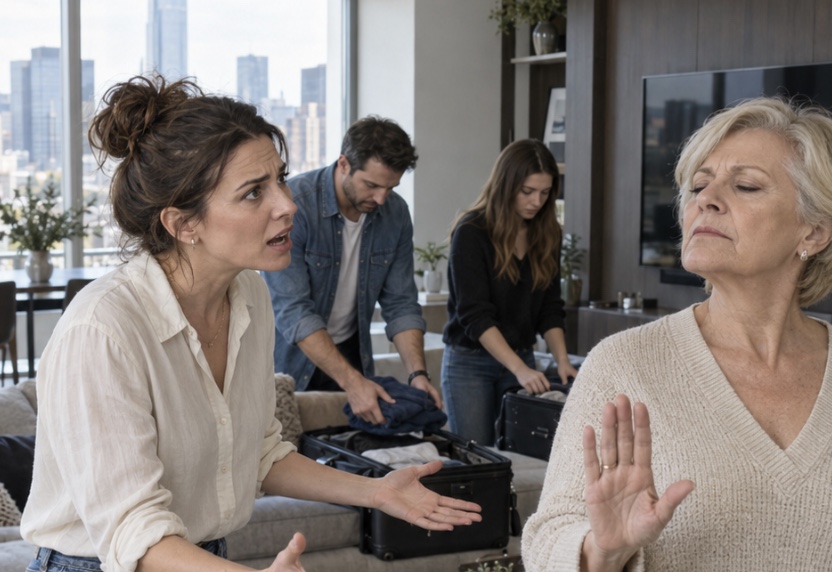
“Here,” her mother-in-law answered calmly. “Into the spare room. Anton and I have already settled everything. They’re packing their belongings now.”
Anastasia looked at her, then at Anton, and back at Inna Petrovna. She wanted to be certain she had heard correctly. The older woman met her gaze evenly, like someone announcing a final decision that was no longer open to discussion.
 
“Wait,” Anastasia said. “Tell me who made this decision.”
“Anton and I discussed everything. The room is available, they have nowhere else to go, and it won’t be for long.”
“I never agreed to this. I told you no several times. Did none of that matter?”
“Nastya, they are already packing.” Inna Petrovna frowned slightly. “The suitcases are being filled as we speak, so don’t start making a scene.”
Anastasia fell silent.
She studied her mother-in-law’s composed face and the casual way she held her cup, as though the matter had been resolved and all that remained was to wait for the daughter-in-law to surrender.
At that moment, everything became perfectly clear.
There had never been a real discussion. No one had been trying to reach an agreement with her. For weeks, they had listened to her without hearing her. Not one of them had treated her refusal as an actual answer. They had simply given her time to get used to a decision they had already made.
Anastasia stood, went into the bedroom, and opened the top of the wardrobe. She took down the travel bag she normally used for business trips, returned to the kitchen, and placed it in front of Anton.
“Anton,” she said, “pack your things.”
He stared at the bag.
“Nastya…”
“You made a decision about my apartment without me. That means you can spend tonight at your mother’s house. Liza and Igor can go there as well.”
“Are you serious?” He looked bewildered, like a man who had been certain everything would happen quietly.
 
“Completely.”
“You’re doing this over one room?” Inna Petrovna’s voice rose. “You’re destroying your family because of a single room?”
“I am not destroying this family. I am asking you to leave my apartment.”
“This is Anton’s home too!”
“Anton lives here with my permission, just as you are here now with my permission. I can withdraw that permission.”
“You can’t speak to us like that!”
“Inna Petrovna,” Anastasia replied, “that is exactly how I am speaking. This apartment belongs to me. I bought it before the marriage. I repeatedly refused to let your relatives move in. You and Anton made the decision behind my back because you expected me to accept it. I will not.”
Inna Petrovna turned sharply toward her son.
“Anton! Say something to her!”
Anton sat like a man hit by a wave he had failed to anticipate. He had clearly expected his wife to complain and then give in. He must have assumed everything would eventually sort itself out, just as it often did, without a serious confrontation.
“Nastya,” he finally said, “let’s not do this now. Mom will leave, and then we can talk properly.”
“We have been talking for weeks. I kept saying no. You went ahead and decided for me. This is no longer about having a calm conversation. It’s something else entirely.”
“You’re not really going to throw me out of my own home.”
“I am asking you to leave tonight. I’m not throwing you into the street. I’m telling you to go and think about what you did—in the same place where you made decisions about my property.”
“Anton, she has completely lost her mind!” Inna Petrovna cried. “All this over one room! She’s throwing her husband out over a room!”
“Inna Petrovna,” Anastasia said evenly, “I am asking you to leave as well. You arrived late at night without warning to inform me that people I never invited would be moving into my apartment tomorrow. I will not continue this discussion.”
“Don’t you understand that we’re family? Family!”
 
“I understand. You are Anton’s family. But this apartment is mine, and I decide who lives here.”
Inna Petrovna rose and began talking about selfishness, about how no decent wife treated her husband this way, and about a daughter-in-law who had no idea what a real family meant. Anastasia did not interrupt. She simply stood and waited.
Eventually, Anton got up and packed a bag—not the one Anastasia had brought him, but one of his own. He said nothing. He still wore the expression of a man who could not understand how events had taken such an unexpected turn.
They left at half past ten.
Anastasia locked the door behind them and stood in the hall for a while. Then she returned to the kitchen, washed the cups, and wiped down the table.
Liza and Igor did not arrive the following day.
For the first several days, the phone rang constantly. Inna Petrovna called to accuse her. Anton alternated between sounding wounded, conciliatory, and wounded all over again. Liza sent a single cold message:
Do you realize what an awkward position you’ve put us in?
Anastasia replied:
I didn’t put you in any position. You planned to move into my apartment without my consent.
Liza never wrote again.
Anastasia remained alone in the apartment. During the first few days, it felt unfamiliar—quiet, empty, strange. Then it began to feel different. When she returned from work, no one was waiting with complaints or another discussion about Liza. She made tea, opened a book, and went to bed whenever she pleased.
It was a little lonely.
But it was peaceful.
Three weeks later, Anton asked to meet. Anastasia agreed. She was not certain what she wanted to say, only that they needed to talk. It would be better to do so calmly and in a neutral place.
They met at a café near the apartment. Anton looked unsettled, like someone who had expected the problem to disappear with time, only to discover that it had not.
“Nastya, I understand that I was wrong,” he said. “I should have spoken to you first.”
“Yes, you should have.”
“Mom put me under a lot of pressure. I didn’t have the strength to resist her.”
“Anton, I understand that your mother pressured you. But you still made the decision. You agreed with her. You kept it from me. You counted on me giving in. That was not merely pressure. It was your choice.”
“I’m ready to compromise.”
“What compromise?”
 
“Well… Liza won’t move in. We can simply go back to the way things were.”
Anastasia looked at him and thought about those weeks—the endless conversations, the way she had repeatedly said no and been ignored, the way Anton had remained silent while she fended off his mother’s pressure, and the moment he had finally chosen the other side. She remembered him standing with his bag, looking at her in astonishment, as if asking, Are you really serious?
“Anton, I have spent the last three weeks thinking about that. I don’t want to go back to the way things were. Because the way things were meant that my words carried no weight in our marriage. It meant you believed that if you applied enough pressure, I would eventually surrender. I don’t want a marriage built that way.”
He remained silent for a long time.
Then he asked, “Do you want a divorce?”
“Yes.”
He nodded. He did not try to persuade her to change her mind. Perhaps he understood that the conversation was over. Or perhaps he was simply tired.
The divorce proceeded without any major conflict. The apartment legally belonged to Anastasia because she had bought it before the marriage, and Anton did not attempt to claim any part of it. He collected the belongings he had left behind and returned for several boxes. They spoke politely at the door. There were no accusations and no tears.
Inna Petrovna never called again. Neither did Liza.
Anastasia rearranged the furniture in the third bedroom and finally unpacked the boxes that had been sitting there since she moved in. She threw some things away and placed the rest in storage. She positioned a desk by the window, bought a good lamp, and added the bookshelf she had wanted for years but had kept postponing.
At last, she turned the room into what she had always intended it to be: a quiet place for reading and working.
It took one Sunday, and the result was beautiful.
 
Sometimes she thought about those difficult weeks—about how many times she had said no without being heard. She remembered Inna Petrovna saying, “They’re already packing,” as though Anastasia’s refusal were nothing more than a temporary obstacle that could be ignored until it disappeared. She remembered how Anton had assumed she would eventually submit, retreat to another room while his relatives filled her kitchen with noise, and gradually become used to their presence.
She had not submitted.
Occasionally, she wondered what would have happened if she had agreed. Perhaps Liza and Igor really would have stayed only a few months. Anton would have been pleased, his mother would have stopped pressuring them, and there would have been no confrontation. Maybe everything would have worked out.
But Anastasia understood how arrangements like that usually unfolded. “A few months” without a firm date was not a deadline. And if they could disregard her wishes once, they could do it again. That would have become the pattern of their marriage.
The apartment was quiet now. In the mornings, she drank coffee in the living room. She worked in her new study and heard only the sound of her own footsteps.
Sometimes the silence felt too deep.
At other times, it felt exactly right.
She was getting used to it.