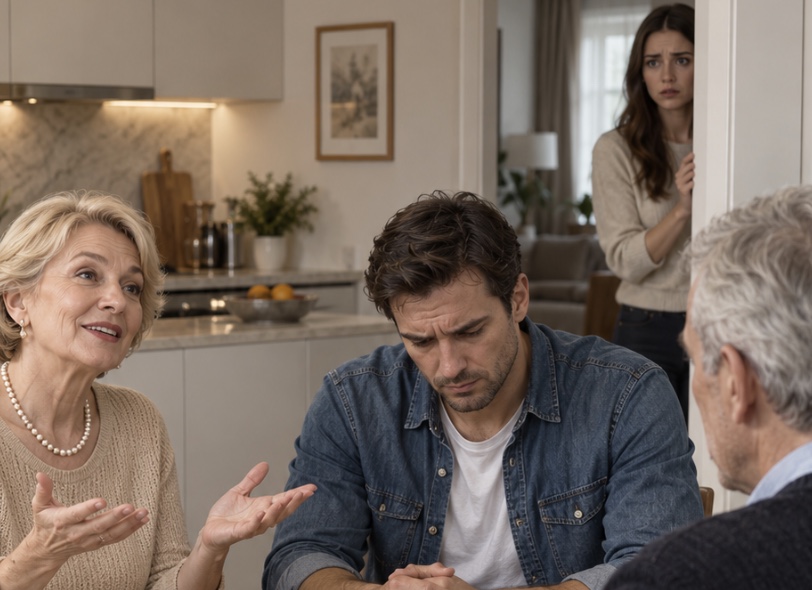
“I’ve already told my friends the apartment is practically ours!” my mother-in-law boasted while I stood outside the kitchen door
Nadezhda had inherited the apartment. Her grandmother passed away in February, when Nadezhda was thirty-six, leaving her a one-bedroom flat in a five-story building on a quiet street lined with linden trees. It wasn’t in a new development and it certainly didn’t have an expensive renovation—just an ordinary apartment with wooden window frames and creaking parquet floors. Nadezhda paid for a modest renovation herself: she repainted the walls, replaced the plumbing, and bought a decent sofa. The apartment became truly hers—not merely on paper, but in every sense of the word.
Igor came into her life a year later. They met through mutual friends, began dating, and married a year and a half after that.
Nadezhda worked as an accountant for a construction company and earned a steady fifty-eight thousand rubles a month. Igor was a sales manager at a wholesale company, and his income varied—sometimes sixty thousand, sometimes forty-five, depending on the season.
They lived in the apartment that had once belonged to Nadezhda’s grandmother. It was now legally Nadezhda’s, having been registered in her name before the marriage, so it had never become marital property. They had discussed this before the wedding, and Igor had accepted it without objection. At least, that was how it had seemed at the time.
 
Igor’s parents, Vera Borisovna and Boris Petrovich, lived outside the city. Their house was about a forty-minute drive away—far enough to make daily visits unlikely, yet close enough for them to appear without warning.
Boris Petrovich had retired five years earlier, while Vera Borisovna still worked as a sales clerk in a small hardware store. Their house was old and wooden, with a modest plot of land. It was tolerable in summer, but in winter the cold drifted through every room, the radiators worked only intermittently, and every year Vera Borisovna complained that she could no longer tell whether she was inside the house or standing outdoors.
At first, Nadezhda’s mother-in-law treated her neutrally. She was neither warm nor openly cold—simply polite. She and Boris Petrovich visited about three times a month and occasionally stayed for lunch. Vera Borisovna might remark that the soup could have been richer, while Boris Petrovich usually said nothing, drank his tea, and watched television. Nadezhda never argued or tried to force a closer relationship. She simply remained courteous and kept a comfortable distance.
The first serious conversation took place in October, two years after the wedding. Nadezhda and Igor were sitting in the kitchen on a Sunday evening. Igor was drinking coffee while Nadezhda read something on her phone. The conversation began as casually as any other.
“Listen, I’ve been thinking about something,” Igor said. “I want to talk it over with you.”
 
“I’m listening.”
“My parents can’t manage that house anymore. It’s freezing in winter, the roof leaks in summer, and it needs major repairs. They have some savings—Dad has been putting money aside. It isn’t much, but it’s something. So I thought maybe we could combine everything.”
Nadezhda looked up from her phone.
“Combine what, exactly?”
“The money. Their savings and ours. Then we could sell the apartment.”
“My apartment.”
“Well, we both live here, so it’s ours.”
“It belongs to me,” Nadezhda replied calmly. “It’s registered in my name. We’ve already discussed this.”
“I remember. Just hear me out. If we combine their savings with the money from selling your apartment, we could buy a proper house—something large and modern. My parents could have one or two rooms, and we’d have an entire floor to ourselves. It would be convenient for everyone.”
Nadezhda locked her phone and placed it on the table.
“Igor, you just suggested that I sell the apartment my grandmother left me so that we can move in with your parents. Do you hear yourself?”
“We wouldn’t be living with them. It would be a large house, and we’d have a separate floor. That’s different.”
“No, it isn’t. It would still be one house, on one property, with Vera Borisovna in the rooms downstairs.”
 
“She’s a perfectly normal woman.”
“I didn’t say she wasn’t.” Nadezhda spoke evenly, without irritation, like someone who wanted to be heard and had no desire to start an argument. “I’m saying that this apartment is the only property I own. I’m not selling it.”
Igor fell silent. He took a sip of coffee and then said:
“Just think about it. Don’t reject the idea immediately.”
“I’ve already given you my answer.”
“Fine,” her husband said as he stood. “Fine.”
Nadezhda picked up her phone again. The conversation was over, but an unpleasant aftertaste remained—faint yet lingering, like the damp smell that hangs in a closed room after rain.
Over the next several weeks, Igor returned to the subject repeatedly. He didn’t start arguments; he approached it methodically. One day, he told her that Boris Petrovich had spent the money he had saved for dental treatment on a new boiler. Another day, he showed her photographs of houses with large gardens, beautiful porches, and spacious living rooms. Sometimes he tried a different approach and talked about children.
They weren’t planning to have any yet, but Igor kept pointing out how wonderful it would be for their future children to have their grandparents nearby. They would have help and support, he said. Nadezhda listened and nodded. She neither agreed nor gave a final refusal. She simply left the matter suspended.
Something about his persistence troubled her. It wasn’t the idea of buying a house; she understood that his parents were genuinely struggling. What worried her was the proposed arrangement: sell her apartment, pool the money, and buy something jointly. She kept turning the same questions over in her mind. Who would legally own the new house? In whose name would it be registered? If all four of them became owners, what share would belong to her? And if everything went wrong, would she be left with anything at all?
 
She kept those questions to herself.
Then Vera Borisovna changed.
The difference was unmistakable, like the shift in the air just before a thaw. Her mother-in-law began calling more often and speaking more warmly. One day, she arrived without warning carrying homemade pastries. Nadezhda hadn’t even known that Vera Borisovna could bake.
Over tea, she asked about Nadezhda’s job and about her friend Lena, whom Nadezhda had mentioned a few times. She listened attentively, nodded, and laughed in all the right places.
Then came the property listings.
“Nadyusha, I’ve been looking at a few houses,” Vera Borisovna said one day, pulling out her phone. “Here, take a look. This one is in Sosnovka—two hundred square meters, a twelve-sotka plot, two bathrooms, and an excellent layout.”
Nadezhda studied the photographs. The house was beautiful—bright and airy, with large windows and a spacious veranda.
“See? The entire second floor is separate,” Vera Borisovna continued. “This room could be your bedroom, and here’s the living room. The kitchen is open-plan. Borya and I would stay downstairs in our own part of the house. We’d hardly ever cross paths.”
“Hardly ever,” Nadezhda repeated.
“Well, perhaps we’d see each other at breakfast,” her mother-in-law said with a smile. “But we’re family. That’s a good thing.”
Nadezhda continued scrolling through the photographs. The kitchen really was spacious. In her current apartment, there was barely enough room for a table for two.
 
“It’s beautiful,” she said cautiously.
“Isn’t it?” Vera Borisovna’s delight seemed genuine. “I knew you’d like it. Here, look at this one too. It’s closer to the city, although it’s a little smaller.”
They sat together for almost an hour, Nadezhda browsing the photographs while Vera Borisovna commented on each house. When Igor came home, the conversation included him as well. He sat beside them, showed his wife several listings of his own, and watched her with cautious hope.
Nadezhda drank her tea and thought that the house really was lovely. She was also tired of two people squeezing into a one-bedroom apartment with such a tiny kitchen. Yet she couldn’t tell whether Vera Borisovna had truly changed or was merely being pleasant because she desperately wanted a particular answer.
The thought came and went. Nadezhda didn’t push it away, but she didn’t allow it to grow either. She simply kept it somewhere inside her—quietly, like an object she didn’t need at the moment but didn’t want to lose sight of.
A week later, Igor said he had found a real estate agent.
“It’s too early to involve an agent,” Nadezhda replied.
“We’d just meet him. Ask about the market, find out how much your apartment could sell for, and see what houses cost in those areas.”
 
“I never said I was selling the apartment.”
“Nadya, let’s at least get the numbers. It doesn’t commit us to anything.”
Nadezhda considered it. Numbers were only information. They weren’t a decision.
“All right,” she said. “But listen to me—no pressure. I’ll hear him out, think it over, and give you my opinion.”
“Of course.” Igor nodded quickly. Too quickly, Nadezhda thought, though she chose not to dwell on it.
The real estate agent’s name was Anton. He was about thirty-five, businesslike, and confident, with a tablet in his hand and plenty to say. He came over on Saturday afternoon, inspected the apartment, and asked several questions. Then he sat at the kitchen table and explained that the flat was in good condition, the market was active, and a realistic asking price would be around 3.2 million rubles—perhaps a little more if they negotiated well.
Anton then showed them several houses in the suburbs. They were all different: one was too far away, another needed extensive repairs, and the third was the very house Nadezhda and Vera Borisovna had already looked at. It was in Sosnovka, measured two hundred square meters, and had a separate second floor.
“This one is listed at 6.8 million,” Anton said. “If you have 3.2 million from the apartment plus the family’s savings, you’re roughly there. You might need a small loan, but it really would be a very modest one.”
Nadezhda entered the figures into her phone. Then she asked how ownership would be arranged.
 
“However you agree,” Anton replied. “You can register it in shared ownership, or you can put it in one person’s name.”
“And if it’s shared, how exactly would the shares be divided?”
“That depends on how much each party contributes. If you put in 3.2 million and they contribute 3.6 million, each side would own roughly half. But that needs to be written into the contract in advance.”
“I see,” Nadezhda said.
After Anton left, Igor was full of energy. He paced around the apartment talking about the house, the garden, and how pleasant summers there would be. Nadezhda listened while thinking about the ownership shares. If her apartment was worth 3.2 million and the house cost 6.8 million, while his parents contributed 3.6 million, her share would be less than half. And if they needed a loan, who would take it out? In whose name would it be?
She asked none of those questions aloud. She simply kept thinking.
The days passed. The conversations continued—gentle, persuasive, and enveloping. Vera Borisovna now messaged her almost every day, forwarding listings and sharing photographs of interiors. Once, she even sent a link to curtains for the room they had discussed as Nadezhda and Igor’s future bedroom. Nadezhda stared at the curtains and thought that something was happening—something for which she had not yet found the right name.
 
Around the beginning of November, Igor said that the real estate agent wanted them to start preparing the documents needed to list the apartment for sale. Nadezhda answered vaguely. Sometimes she said she needed more time to think. Other times, she simply changed the subject.
Then it happened.
One Saturday, she came home with groceries earlier than planned. Igor was there, speaking on the phone in the kitchen. Nadezhda took off her shoes in the entryway and froze because her husband’s voice had a particular quality—the way people speak when they believe no one else can hear them.
“She’s almost agreed, Mom,” Igor was saying. “The agent is already asking for the documents. I think we’ll sign in about two weeks.”
There was a pause.
“Yes, I understand. But the main thing is to pay the deposit quickly, before she changes her mind. After that, everything will be easier.”
Another pause.
“The registration? We’ll discuss that later. The important thing is to sell the apartment first.”
 
Nadezhda stood in the entryway with the shopping bags in her hands. Igor continued speaking behind the kitchen door, but more quietly now, and she could no longer make out the words. Then she heard laughter—light and satisfied. Vera Borisovna replied, but Nadezhda caught only fragments.
She placed the bags on the floor without making a sound.
She stood there for a moment. Then she picked them up again and walked into the kitchen.
Igor was standing by the window with his smartphone, his back to the door. When he heard her footsteps, he turned, and something flickered across his face before he could hide it. It wasn’t guilt. It was more like the mild confusion of someone caught at an inconvenient moment.
“You’re back already?” Igor asked.
“As you can see,” Nadezhda replied, beginning to unpack the groceries onto the table.
She asked nothing else. She put everything away and filled the kettle. Igor said something about the evening—apparently suggesting that they visit his parents and look again at the house they had been discussing. Nadezhda nodded while thinking about what she had overheard.
The main thing is to pay the deposit quickly, before she changes her mind.
 
We’ll discuss the registration later.
They drove out that evening. The journey took forty minutes. Igor drove and chatted about unimportant things while Nadezhda looked out the window and answered briefly. The sky was gray, and dusk was already falling. Beyond the city, bare trees lined the road, lending the landscape a bleak, melancholy air.
Vera Borisovna greeted them at the door, animated and cheerful, with tea already waiting on the table. Boris Petrovich was sitting in the living room. He stood to greet them and made some remark about the weather. The conversation began peacefully. They looked again at photographs of the house in Sosnovka. Vera Borisovna showed them something on her phone, Igor nodded, and Boris Petrovich asked about the size of the plot.
Then Nadezhda’s phone rang. It was her friend Lena. Nadezhda stepped into the hallway so she wouldn’t disturb the conversation.
The call was brief—no more than five minutes. Nadezhda arranged to speak with Lena again the following week, ended the call, and was already reaching for the kitchen door when she heard her mother-in-law’s voice.
Nadezhda stopped.
“I’ve already told the girls that the apartment is practically ours,” Vera Borisovna was saying, sounding pleased, almost joyful, the way people speak about something they consider nearly settled. “Can you imagine how perfectly it has all worked out? The house is good, and the money adds up.”
“Keep your voice down,” Boris Petrovich said quietly.
 
“Oh, don’t be ridiculous. She’s talking to her friend.”
Nadezhda did not move.
“The important thing is that, as soon as they sell the apartment, the money must come straight to us while it’s still warm, so to speak,” Vera Borisovna continued. “And I think the house should be registered in my name. That way there won’t be any claims later. Our money, our house.”
“But she’s contributing too,” Boris Petrovich said.
“Exactly—she’s contributing. And that’s a good thing. But if we register the house in her name, then it will begin: my share, my rights. If it’s in my name, it will all belong to the family, and there will be no arguments.”
“Does Igor know?”
“Igor agrees. We discussed everything last week. He understands that his parents need to protect themselves.”
Nadezhda stood silently in the hallway. A spoon clinked against a cup behind the door. Boris Petrovich said something too quietly for her to hear. Then Vera Borisovna spoke again.
“The girls asked when we’ll be moving. I told them we should have everything settled by spring.”
Nadezhda placed her hand on the door handle and walked in.
Vera Borisovna fell silent in the middle of her sentence. Boris Petrovich looked up. A peculiar silence settled over the room—the kind that comes when everyone knows someone has overheard them, but no one knows exactly how much.
“Nadyusha, are you back already?” Vera Borisovna asked with a smile that hadn’t had time to look natural.
“Yes,” Nadezhda said as she approached the table. “There’s one thing I want to understand. You’re already telling your friends that the apartment is yours. You intend to register the house in your name. And all of this was discussed with Igor without me.”
Vera Borisovna gave a slight shrug.
“Nadyusha, you misunderstood. It was only a conversation.”
“I understood perfectly,” Nadezhda replied. “You said you wanted the house registered in your name so that I wouldn’t be able to make any claims. You also said Igor agreed. That wasn’t just a conversation.”
 
“Now listen,” Vera Borisovna said, changing her tone. Her voice became softer and more patient, almost instructive. “We are investing the money we spent our whole lives saving. We need to know that it is protected. It’s perfectly normal to safeguard ourselves. You’re an adult; you should understand that.”
“I do understand,” Nadezhda said. “You want to take the money from the sale of my apartment and register the house in your name. That isn’t protecting yourselves. It means I surrender my only home and end up with nothing.”
“You would have a house,” Vera Borisovna objected, her tone sharpening. “A large, beautiful house. Why should it matter whose name is on the documents if you live there?”
“It matters to me.”
At that moment, Igor entered the kitchen. Perhaps he had heard the raised voices, or perhaps he had simply sensed the sudden pause. He looked at his wife, then at his mother and father.
“What happened?” he asked.
“I overheard the conversation,” Nadezhda said. “Did you know they intended to register the house in Vera Borisovna’s name?”
Igor did not answer immediately. His silence was clearer than any words could have been.
“Nadya, don’t make a scene,” her husband finally said. “We’re only trying to find a solution that works for everyone.”
“You knew,” Nadezhda repeated. It wasn’t a question but a statement.
 
“I knew my parents wanted it registered in their name. Yes. They’re contributing money, and it’s important for them to protect themselves. That’s reasonable.”
“When did you discuss this with them?”
“Last week.”
“But you didn’t discuss it with me.”
“I thought those were details. I assumed we would eventually reach an understanding.”
Nadezhda looked at her husband. So that was how it was. For weeks, they had talked about a joint purchase, a separate floor, convenience, and mutual benefit. Yet throughout that time, he had been having another conversation with his parents—one in which her apartment became cash and that cash became someone else’s property. She was apparently expected to sign the papers without asking unnecessary questions.
“Those aren’t details, Igor,” Nadezhda said quietly. “They are the entire point of this arrangement.”
“You’re exaggerating,” Igor said in a conciliatory tone, though irritation crept into his voice. “No one was trying to deceive you. My parents simply have their own concerns. We needed to find a compromise.”
“A compromise is something people reach together. It isn’t one person deciding everything for another and then asking her to sign.”
 
Vera Borisovna could no longer contain herself.
“Nadya, that’s enough. We were trying to do what was best for the entire family, and you’re turning it into a scandal. Forgive me, but this is pure greed.”
“Vera Borisovna,” Nadezhda said, “this isn’t greed. It is my apartment—the one my grandmother left me. I am not selling it.”
“There you go again,” her mother-in-law sighed.
Boris Petrovich had remained silent throughout the exchange. Now he lowered his eyes to the table and slowly stirred his cold tea—a man who disagreed with what was happening but had no intention of saying so aloud.
Igor turned to his wife.
“Nadya, just think about it. We’ve already made arrangements with the real estate agent, and we’ve practically chosen the house. Everything is falling apart because of your stubbornness.”
“Not because of my stubbornness,” Nadezhda replied. “It is falling apart because you planned a deal involving my apartment behind my back.”
“This is our family!” Igor raised his voice. “You aren’t alone, do you understand? There’s me, and there are my parents. You can’t always think only about yourself.”
“You just made it perfectly clear that, in your family, my apartment is nothing more than a resource—something you can use as long as it suits you.”
There was nothing more to say. Nadezhda took her jacket from the back of the chair.
 
“I’m going home,” she said.
“Nadya.” Igor stepped toward her.
“I’m going home,” she repeated from the entryway. “You can come later. We need to talk.”
She took the car because the keys were with her. Igor remained at his parents’ house.
The drive back to the city seemed shorter than the journey there. Nadezhda did not think about divorce, money, or what would happen the following day. She thought about the way Vera Borisovna had talked about curtains for their future bedroom. How she had sent photographs of interiors. How she had started calling more often and asking about Lena, a person she had never shown any interest in before. How Igor had approached the subject from a different angle each time—children, space, convenience.
A month of careful, patient work. And throughout it all, in a parallel conversation Nadezhda knew nothing about, they had already decided that the house would not belong to her.
She parked outside the building, went upstairs, and unlocked the door. She walked into the kitchen and put the kettle on. Then she took out a mug she had bought by the sea several years earlier. It was blue, with a chipped anchor painted on one side. Her grandmother had disliked mugs like that, calling them frivolous. Nadezhda had loved them since childhood.
She sat with the mug and waited.
Igor arrived at about eleven. He walked into the living room and sat on the sofa. He remained silent for a minute before speaking.
“You were unfair to Mom.”
Nadezhda placed her mug on the table.
 
“Igor, I want you to pack your things.”
“What?”
“I’m asking you to pack your things. Please.”
Igor stared at her as people do when they have not yet decided whether something is serious.
“Nadya, are you really doing this because of one conversation?”
“Not because of the conversation,” she interrupted. “Because you spent several weeks persuading me to sell the apartment while knowing the house would be registered in your mother’s name. You knew and said nothing. That wasn’t a misunderstanding. It was a choice.”
“I thought we would get there gradually. I thought you would understand on your own.”
“Understand what? That I should give up the only home I own and live in someone else’s house under someone else’s rules?”
“It wouldn’t be someone else’s house. It would belong to the family.”
“Igor,” Nadezhda said evenly, without tears or shouting, “the crib I slept in as a child once stood in this apartment. My grandmother left it to me for a reason. It isn’t an asset to be invested. It is mine. And you knew that from the beginning.”
Igor said nothing.
“Pack your things,” Nadezhda repeated. “Not tonight, if you don’t want to. But within the next few days.”
He did not argue that night. He went into the bedroom, and Nadezhda remained in the kitchen.
The next morning, Igor left for work without eating breakfast. He returned that evening subdued and made no attempt to continue the conversation. Three days passed that way. On the fourth, he packed a bag.
“I’ll stay with my parents for now,” he said in the entryway.
“All right,” Nadezhda replied.
“Are you filing for divorce?”
“Yes.”
 
Igor stood there for a moment. He seemed about to add something, but instead he put on his jacket and walked out.
Nadezhda closed the door. She went into the kitchen and opened the window.
From a desk drawer, she took out her grandmother’s old notebook—not to read it, but simply to hold it. Its dark green cover was worn slightly around the edges. Nadezhda placed it on the table and poured herself a glass of water.
The apartment was entirely hers. Just as it had always been.
The divorce was finalized without much difficulty. There was nothing to divide: the apartment was premarital property, and they had accumulated almost nothing together. Igor did not contest the divorce and signed everything after two court hearings. Through mutual acquaintances, Nadezhda heard that Vera Borisovna spent a long time explaining to her friends why the house purchase had fallen through. She said her daughter-in-law had turned out to be greedy and had ruined the entire deal. Nadezhda thought about it without anger. She simply registered it as a fact.
The two-hundred-square-meter house in Sosnovka, with its separate second floor and twelve-sotka plot, remained listed on the real estate agent’s website.
Meanwhile, peace returned to the apartment on the quiet street lined with linden trees. Nadezhda moved the armchair. Igor had always kept it facing the television, but she preferred it by the window. She bought a new mat for the entryway. Then she called Lena, and the two of them finally met at a café and talked for three hours.
One day in February, Nadezhda found her grandmother’s recipe for pastries in a drawer. It was handwritten, with little notes in the margins. She attached the sheet to the refrigerator with a magnet and planned to make them that weekend.
That was her decision to make.
Hers alone.