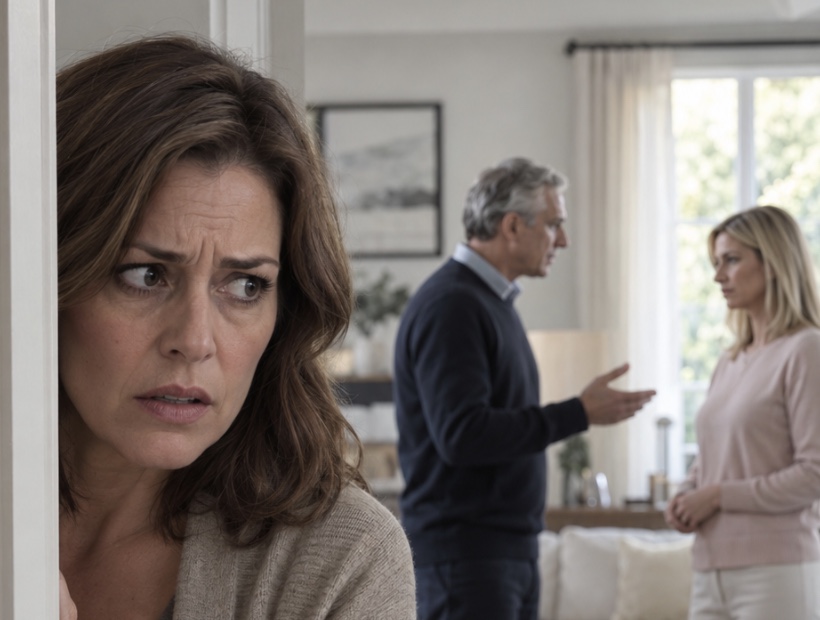
She Hadn’t Even Finalized the Inheritance When She Overheard Who Her Husband Had Already Promised Her Apartment To
“So, in two weeks, the apartment will officially be yours?” Vitaly asked far too quickly, reaching for the envelope on the table.
Nadezhda covered it with her hand.
“I’ll read it myself.”
“I only noticed the name of the notary’s office. What happened?”
She pulled out the notice and read it again, although she already knew every line. The six-month waiting period following the death of her cousin Valentina had ended. The estate had been reviewed, and in two weeks Nadezhda would be able to collect the inheritance certificate and register the apartment in her own name.
It was a two-bedroom apartment in an old brick building near the city center. The building was several decades old but solid, with thick walls, spacious rooms, a wide hallway, and tall windows. Aunt Valentina had lived there alone and kept the place in good condition until the final months of her life.
Nadezhda had rarely discussed the inheritance with her husband. She was not trying to hide anything; she simply disliked making plans before the paperwork was complete. During the previous six months, the notary had verified family ties, searched for other heirs, checked for any will naming someone else, and requested several official records. Nadezhda had gathered certificates, made two trips to the archives, and refused to count on anything until the process was over.
“Aunt Valentina died,” she said. “She left the apartment to me.”
 
Vitaly straightened.
“The apartment we visited a few years ago?”
“Yes.”
“The two-bedroom place?”
“That’s the one.”
He glanced at the envelope again, suddenly animated.
“That’s incredible. Why didn’t you tell me?”
“Because nothing has been finalized yet.”
“But the notary says it’s practically done.”
“Practically isn’t the same as legally.”
Vitaly crossed the kitchen, opened the window, and looked down into the courtyard. Minutes earlier, he had planned to spend the evening watching sports. Now he had forgotten both the television and dinner.
“Does the place need renovating?”
“Only cosmetic work. Aunt Valentina looked after it.”
“What do you think it’s worth?”
Nadezhda shrugged. “I haven’t checked.”
“We should look at listings. It’s a good neighborhood. We could sell it, add some money, and buy something newer.”
“I’m not planning to sell it.”
“Then we could rent it out.”
 
“I haven’t decided what I want to do.”
Vitaly nodded as if he accepted that answer, but within a minute he was asking about the size of the rooms, the bathroom, and whether there was a balcony. He did not ask a single question about Valentina or how Nadezhda felt entering the apartment after her death.
Valentina had never been merely a distant relative. When Nadezhda’s parents worked late, she picked the girl up from school, helped with homework, took her to the cinema, and always spoke to her as though her thoughts mattered. Years later, Nadezhda visited regularly, brought groceries, accompanied her to medical appointments, and helped her manage utility bills.
Valentina had been seriously ill during her final months. Nadezhda said goodbye to her in the hospital and later arranged the funeral with the help of two elderly neighbors. Vitaly had appeared only for the memorial service, claiming he was too busy to do more.
Now he was studying the apartment with the intensity of someone who had cared for it for years.
Nadezhda had met Vitaly eight years earlier at a mutual friend’s birthday party. He worked as a technician at an electronics repair shop, spoke easily, and seemed refreshingly straightforward. With him, she had believed she would never need to guess what another person was thinking.
They moved in together several months later, renting a small one-bedroom apartment. About a year after that, they married. They had no children. Both agreed that they should settle their housing situation before starting a family.
For all eight years, they remained tenants.
During the first two years, they moved three times. One landlord decided to sell. Another apartment had dangerous wiring. The third was too far from Nadezhda’s workplace. Eventually they found a decent place and stayed.
Nadezhda worked as an administrator at a private clinic, while Vitaly continued repairing electronics. They did not compare every detail of their salaries, but they had agreed to save each month for a mortgage deposit.
 
In practice, most of those savings came from Nadezhda.
Vitaly always seemed to have an urgent expense. First, he replaced a perfectly functional car. Then he bought an expensive multimedia system. A few months later, he needed a new phone because the old one supposedly no longer held its charge.
After that, his mother asked for help buying an appliance. Then his sister Larisa needed money for her son’s trip. Each time, Vitaly promised that the following month would be different.
Nadezhda never objected to helping family. She only reminded him that a down payment would not materialize on its own.
“I know,” he always said. “It’s just bad timing.”
The circumstances changed. The result never did. Nadezhda saved faithfully; Vitaly contributed occasionally, then found something more important to do with his share.
The notary’s letter transformed his attitude toward housing overnight.
He opened several property websites, compared prices in Valentina’s district, researched renovation costs, and wrote down the numbers of two contractors.
“You’re not going to let the place deteriorate, are you?” he asked.
“No.”
“The pipes need checking. So does the wiring. Old buildings can hide all kinds of trouble.”
“I’ll have them inspected.”
 
“I can go by myself.”
“I have the keys.”
He smiled. “Exactly. Give them to me, and I’ll look around.”
“We’ll go together after the registration is complete.”
The smile vanished immediately.
Over the next several days, Vitaly repeatedly returned to the subject of official residence registration. Could another person be registered immediately? What documents would be required? How difficult would it be to remove someone from the registry later?
At first, Nadezhda answered briefly. Finally, she asked him directly.
“Who are you planning to register there?”
“No one. I’m only curious.”
“You’ve never been curious about these things before.”
“We’ve never had an apartment before.”
“I don’t have the ownership certificate yet.”
“But you will.”
He said it with the confidence of a man who had already completed a plan and was merely waiting for the calendar to catch up.
What disturbed Nadezhda was not his interest in legal details. It was his complete indifference to her feelings. He discussed walls, prices, keys, registrations, and possible occupants, yet never once asked whether she was ready to go through her late aunt’s belongings.
 
Two weeks remained before the paperwork would be complete.
One August evening, Nadezhda left work early after the clinic’s final appointments were canceled. She bought vegetables on the way home, expecting to prepare dinner before Vitaly returned.
The upper lock on their rented apartment had not been secured. From the kitchen, she heard her husband’s voice.
He was already home.
She was about to call out when she heard Larisa’s name and stopped in the hallway.
“I’m telling you, it’s practically settled,” Vitaly said confidently. “The documents will be ready in two weeks.”
Nadezhda quietly placed the grocery bag on the entryway cabinet.
“It’s a perfectly good apartment,” he continued. “I sent you the photos. The building is old, but it’s sturdy, and the institute is easy to reach from there.”
He paused to listen.
“Larisa, don’t start. Of course Sasha can move in. He’s twenty-two, not fifteen. It’s time he lived independently.”
Nadezhda removed her shoes slowly, careful not to bump the wardrobe door.
Larisa’s son Alexander studied part-time, drifted from one temporary job to another, and still lived with his mother. Nadezhda had nothing against him, but they were not close.
“Nadya will agree,” Vitaly went on. “And if she hesitates, I’ll talk sense into her. The apartment becomes family property anyway.”
He listened again and laughed.
 
“We don’t need to ask her about every little thing. Your son needs a home more than she needs two empty rooms. We’re staying here for now, so why leave the place locked up?”
Nadezhda gripped the strap of her handbag. Heat rushed into her face, but her thoughts became remarkably clear.
Vitaly was not merely suggesting that they help a relative. He had already promised away an apartment that did not belong to him.
“I’ll hand over the keys as soon as we get the documents,” he said. “Sasha can start moving his things. We’ll tell Nadya it’s only for a few months. She’ll get used to it.”
Nadezhda did not enter the kitchen.
She picked up the groceries, quietly opened the front door, and stepped back onto the landing. The lift was on another floor, so she walked down. Outside, the August evening was still bright, and children were playing in the courtyard.
She sat on a bench near the neighboring entrance and stared at her phone for several minutes.
Then she opened the messenger account linked to Vitaly’s tablet. Several days earlier, he had asked her to find a workshop address in one of his conversations, and the account had remained signed in through her browser. He had never imagined that he had anything to hide.
The conversation with Larisa was longer than Nadezhda expected.
Vitaly had sent his sister the photographs Nadezhda had taken for the notary: every room, the kitchen, the hall, and the balcony. He had copied them from their shared cloud folder without asking her.
Larisa was already deciding which furniture to throw away and which pieces to keep.
“The large room will be Sasha’s bedroom,” she had written, followed by a link to a sofa.
Alexander had sent pictures of a computer desk and asked whether Valentina’s bookcase could be removed. Elsewhere, Larisa discussed clearing the old dishes from the kitchen. Vitaly assured her that Nadezhda would not mind because she was not using the apartment anyway.
There was even a voice message from Alexander describing the friends he would invite to his housewarming party and asking whether they could occasionally stay overnight in the second room.
 
Vitaly had replied, “Just don’t make too much noise. Most of the neighbors are elderly.”
He was already setting rules for life in someone else’s home.
Nadezhda took screenshots, emailed them to herself, and saved the entire conversation in a separate folder. Only then did she return home.
Vitaly was sitting in front of the television, perfectly relaxed.
“You’re late,” he said.
“I stopped at the store.”
“Where are the groceries?”
Nadezhda looked at him. “I left the bag in a friend’s car. I’ll collect it tomorrow.”
She did not mention his call with Larisa. He did not tell her about it either.
The next morning, Nadezhda called the notary and requested an appointment.
He saw her that afternoon. She explained everything plainly, neither exaggerating nor portraying Vitaly as more threatening than he was.
“The certificate will be issued when the remaining checks are complete,” the notary reminded her. “An apartment received through inheritance is your separate property. Your husband does not become a co-owner and cannot make decisions about it without your consent.”
“Even though I’m inheriting it while married?”
 
“Even then. Inherited property is not jointly acquired marital property.”
“Can he register someone there without me?”
“No. Only the owner can authorize that.”
Nadezhda asked about registering the title, obtaining the official extract, and protecting the apartment from an unauthorized occupant.
The notary advised her not to hand over original documents, sign any powers of attorney, or surrender control of the keys.
“Once the property is registered, replace the lock cylinder if you believe anyone could have copied the old key.”
The apartment key was in Nadezhda’s possession, but Vitaly had borrowed her key ring several times while they sorted through Valentina’s belongings. She could not know whether he had made a duplicate.
Two weeks later, Nadezhda received the inheritance certificate. The six-month period had expired, no other heirs had appeared, and every inquiry had been resolved. She then filed the documents for state registration.
As soon as the ownership record appeared in the registry, she drove to the apartment with a new lock cylinder and a set of tools.
The rooms smelled of closed windows and old wood. A photograph of Valentina still stood in a plain frame on the hallway cabinet. Nadezhda ran a finger along the edge of the glass, then placed the picture safely inside a drawer.
After that, she changed the lock.
She removed the fixing screw, pulled out the old cylinder, installed the new one, and turned the key several times. The mechanism moved smoothly.
She kept one key and sealed the spare set in a thick envelope, which she arranged to store temporarily in the notary office’s safe until all final documents and extracts had been issued. The notary had no authority over the keys and no access to the apartment; the sealed envelope could be returned only to Nadezhda.
For the time being, she would keep no key to the inherited apartment at home.
She told Vitaly only that the registration was complete.
“Excellent,” he said. “When are we going to see it?”
“I’ve already been there.”
“Without me?”
“I had to collect documents.”
“Where are the keys?”
 
“With me.”
Vitaly held out his hand. “Give me a set. Just in case.”
“In case of what?”
“I’m your husband.”
“That isn’t an explanation.”
He lowered his hand and pretended not to be offended.
“Fine. Later.”
The following day, Vitaly announced that he would be home late. Nadezhda did not ask why.
At about seven that evening, Alexander called her.
“Nadezhda, where are you?”
“At home.”
“We’re outside Aunt Valentina’s apartment.”
She rose from her chair.
“Who is ‘we’?”
“My mother, Uncle Vitaly, and me. He wanted to show us the rooms, but for some reason his key doesn’t work.”
Nadezhda closed her eyes for a moment. So a copy had existed after all.
“The old key no longer works because I changed the lock.”
Silence followed.
“Does Uncle Vitaly have a new key?” Alexander finally asked.
“No.”
“But he said the apartment was ready.”
“Alexander, I never invited anyone there, and I have not given you permission to live in my apartment.”
Larisa took the phone from her son.
“Nadezhda, what is this performance? We didn’t arrive in the middle of the night, and we’re not strangers. We only wanted to look around.”
“You will not inspect my apartment when I’m not there.”
“Vitaly said Sasha could live here.”
 
“Vitaly is not the owner.”
“You could have warned us.”
“You should have spoken to me before making plans for someone else’s property.”
Vitaly’s irritated voice sounded in the background.
“Give me the phone.”
Larisa handed it over.
“Nadya, open the door. We’re already here.”
“I’m not there.”
“Then bring the key.”
“No.”
“Stop being ridiculous. Everyone has wasted time coming here.”
“You brought them without asking me. You can explain the situation yourself.”
She ended the call.
Vitaly rang four more times. She did not answer.
He returned late and flung open the door to their rented apartment so hard that the handle struck the wall.
“You changed the lock on purpose?”
“Yes.”
“Just to make me look like a fool in front of my sister?”
Nadezhda sat at the kitchen table with a closed folder in front of her.
“You managed that without my help.”
“Larisa crossed the entire city! Sasha cleared his evening!”
“Neither of them was invited.”
“I wanted to show them the apartment.”
“Whose apartment?”
Vitaly stopped.
“Don’t twist my words.”
“Whose apartment were you going to show them?”
“Yours. But we’re married.”
 
“And what exactly does that entitle you to do?”
“Normal people help their relatives.”
“With things they own.”
“Those two rooms will sit empty while Sasha has nowhere of his own.”
Nadezhda opened the folder and laid several printed pages before him. The first showed the apartment photographs he had forwarded. The second contained the discussion about throwing out furniture. The third showed his promise to hand over the keys immediately after registration.
Vitaly scanned the first page.
“You read my private messages?”
“I found messages in which you were giving away my property.”
“That was a private conversation with my sister.”
“And my apartment isn’t private?”
He tossed the papers onto the table.
“I didn’t sell anything.”
“You promised Alexander a place to live.”
“Temporarily.”
“Your sister was choosing furniture, and her son was assigning rooms and planning a housewarming party.”
“They were only considering possibilities.”
“You wrote that you didn’t need to ask me.”
Vitaly turned toward the window. After several seconds, he spoke more quietly.
“I knew you would make everything difficult.”
“So you decided to deceive me?”
“I wanted to help my nephew.”
“In eight years, you never once offered your car to a relative for several months.”
He spun around. “What does my car have to do with this?”
“It belongs to you. You could give Larisa the keys and announce that Alexander would be using it.”
“That’s different.”
“Of course it is. You use the car. I was the one expected to surrender the apartment.”
 
“You got it for free.”
Nadezhda rose slowly, her face draining of color as her fingers tightened around the folder.
“For free?”
Vitaly knew instantly that he had gone too far, but pride kept him from retreating.
“I mean you didn’t buy it.”
“I lost someone who had loved me since childhood. I spent half a year gathering records, visiting archives, and handling the estate. To you, all of that became nothing more than spare rooms for your nephew.”
“Don’t be dramatic.”
“You never even asked how I felt when I walked into that apartment.”
“Because this is about common sense, not feelings.”
Nadezhda gave a brief laugh without humor.
“Your version of common sense is remarkably consistent. My income must go into savings, while yours can be spent. My apartment must solve your sister’s problem, while your car remains yours alone. My consent is optional, but your comfort is beyond discussion.”
“I contributed to our life.”
“Whenever it suited you.”
“You keep score of everything.”
“Because if I don’t, other people start doing the counting for me.”
Vitaly clenched his jaw.
“So family means nothing to you?”
“Your family planned to move into my apartment before I even received the final extract. Apparently, I mean even less to them.”
“Larisa did nothing wrong.”
“She asked whether I would agree, which means she knew there was no decision. Then she kept choosing furniture anyway.”
Vitaly walked to the door and back again.
“What happens now? Will you leave the apartment empty just to spite everyone?”
“I will decide what happens to it.”
“You’re not going to consult me?”
“Advice comes from someone who respects the owner’s rights. You had already made the decision for me.”
They slept in separate rooms that night.
 
Vitaly left the next morning without saying goodbye. Nadezhda gathered her documents, checked the ownership extract again, and arranged a consultation with a lawyer.
She did not want to make a decision about her marriage while angry. She needed to understand what would happen to their savings, rental agreement, and shared obligations.
They owned no real estate together and had no children. Vitaly had bought his car during the marriage, although he handled most of its payments and paperwork himself. The money intended for a mortgage deposit was held in an account in Nadezhda’s name, and she could document the deposits.
The lawyer explained which records she should preserve and advised her to stop paying any of Vitaly’s personal expenses that were unrelated to their shared obligations.
A few days later, Nadezhda began moving her belongings into the inherited apartment.
She did not sneak away. That morning, she placed boxes in the hallway, booked a vehicle, and told Vitaly calmly, “I’m moving today.”
He emerged from the bedroom and stared at the packed things.
“For how long?”
“Permanently.”
“Because of one argument?”
“Because I spent eight years being expected to understand every excuse you made. And because you believed you could give away my apartment without speaking to me.”
“We could have reached an agreement.”
“You already had an agreement—with Larisa.”
Vitaly sat on the edge of a chair.
“Do you want a divorce?”
“Yes.”
“You won’t even think about it?”
“I’ve thought about it since the evening I overheard your phone call.”
He looked at the boxes as though he had not believed she would truly leave until that moment.
“What about this apartment?” he asked, referring to the rental.
“The lease is in both our names. I’ve notified the landlord that I’m moving out. My portion is paid through the end of the current rental period.”
Nadezhda placed a folder on the entryway cabinet.
“These are copies of the recent payment receipts, the landlord’s details, and the meter readings. From now on, you’ll handle it.”
Vitaly flipped through the papers.
Nadezhda had always managed the lease. She contacted the owner, reported the readings, tracked payment dates, and called repair workers when something broke. Vitaly had accepted this as part of domestic life and rarely asked for details.
“You could at least help me find another place,” he said.
“I could. I won’t.”
“You’re leaving me alone with the rent.”
“I’m leaving you with your share of adult life.”
“How convenient.”
“It wasn’t convenient for me to save almost alone for years while you found one urgent purchase after another.”
He threw the folder back onto the cabinet.
“Money again.”
“Yes, Vitaly. Money, housing, and documents matter—especially when one person believes he can control what belongs to someone else.”
Nadezhda collected her final bags and checked the rooms. She kept the key to the rental because she remained on the lease until the paid period ended. There was no fight over possessions. She took only her documents, personal belongings, and the items she had bought for herself.
The inherited apartment felt strangely quiet.
Nadezhda opened the windows, washed the floors, cleared one bedroom, and emptied a wardrobe. She did not rush to discard Valentina’s belongings. She placed the photographs in a box, left the books on their shelves, and sorted through the dishes little by little.
Every object reminded her of Valentina, but the memories were not oppressive. Here, there were no secret promises, hidden arrangements, or debates over who deserved her property more.
Larisa called once.
“Did you really refuse to let Sasha live there?”
“I never promised him anything.”
“But Vitaly said—”
“Then speak to Vitaly.”
“You have an empty room.”
“An empty room does not become someone else’s property because they noticed it.”
“Sasha was counting on it.”
“He counted on the word of a man who had no right to give it.”
 
Larisa began explaining that her son had already told his friends he was moving, but Nadezhda stopped her.
“Tell him the truth. The apartment is mine, and I decide who lives there. This conversation is over.”
Larisa did not call again.
Vitaly made several attempts to bring Nadezhda back. First, he insisted the entire situation had been a misunderstanding. Then he suggested that Alexander could pay the utilities. Finally, he proposed forgetting the conflict and renovating the apartment together.
Nadezhda always gave the same answer.
“This was never about renovation.”
When Vitaly realized she would not change her mind, he agreed to the divorce. With no children and no possible claim to the inherited apartment, they settled the remaining property matters separately and went together to submit their application at the registry office.
Vitaly barely spoke on the way.
Outside the building, he stopped.
“Do you honestly believe an apartment was worth ending our marriage?”
Nadezhda looked at him without anger.
“The apartment didn’t end our marriage. It ended when you decided that my consent could be replaced by a promise you made to your sister.”
“I was trying to help.”
“You were trying to look generous at my expense.”
He had no answer.
By early autumn, Nadezhda had settled into the apartment. She turned one room into a bedroom and used the second as a workspace and storage area. She sold nothing and made no rushed changes.
She had the pipes checked, hired an electrician to inspect the wiring, and cleaned up the balcony. Every decision was hers, free from plans that other people had made for her.
Vitaly stayed in the rented apartment for another month, then moved somewhere smaller. He refused to sell his car, even though he now had to cover the rent alone.
One day, he sent Nadezhda a message.
“Sasha is still living with Larisa.”
She read it and did not reply.
Alexander’s housing problem had never been her responsibility. He could work more, rent a room, negotiate with his mother, or look for student accommodation. But it had been easier for Vitaly to select someone else’s apartment and present that decision as an act of kindness.
He understood too late that photographs, plans, and promises do not create ownership.
 
Nadezhda finalized the inheritance, changed the lock, and prevented an uninvited person from taking over her home. It was not luck that protected her. It was attentiveness: she overheard her husband before he could hand over the keys and confront her with a finished arrangement.
The apartment remained with its lawful owner.
And Vitaly finally faced the simplest consequence of his actions: you cannot give away something that was never yours.