Saturday at the country house began for Olga with the familiar clatter of dishes in the cramped kitchen rather than a chance to relax. She moved a heavy pot of hot pickling brine onto another burner and wiped her sweaty forehead with the back of her hand.
Outside, autumn rain pattered against the window. The air was damp and chilly, but the kitchen was so hot and stuffy that breathing felt difficult.
Pavel sat at the table, looking rumpled and irritable after waking up. He wore a stretched-out sweatshirt and was picking halfheartedly at a plate of fried eggs.
“Olga, could you keep it down?” he grumbled, pushing his plate away. “It’s the weekend. A person should be allowed to sleep in peace.”
Olga tightened the lid on another three-liter jar and placed it beside the others.
“Of course. Provided that person has actually done something to get tired,” she replied dryly without turning around. “You arrived yesterday, ate dinner, and went straight to the couch. You could at least have brought the empty jars in from the shed.”
 
“I was exhausted after my shift!” Pavel protested. “I do have a job, you know. Besides, those are your tomatoes. You planted them, so you can deal with preserving them.”
Olga gave a bitter little smile. She had been hearing the same argument since spring.
Several months earlier, she had come across an advertisement for an overgrown plot of land with a small but sturdy brick house. The previous owner needed to move quickly and had offered it at a very reasonable price. Olga withdrew the money she had saved before getting married and registered the property in her own name.
Pavel’s only response had been to circle a finger beside his temple, suggesting she had lost her mind. He made it clear from the beginning that he had no intention of breaking his back in a vegetable garden after finishing his regular job.
His mother, Tatyana Ivanovna, had also enjoyed mocking her daughter-in-law. She called Olga “the ditch digger” and confidently predicted that by midsummer she would abandon the place and run home so fast she would leave her shoes behind.
But Olga kept working all summer.
She carried heavy galvanized buckets of water by herself, weeded until her lower back ached, picked pests off the potato plants, and dug out old stumps.
Pavel visited only on weekends—and even then, only when his friends had not invited him away on an outing.
 
When he did come, he usually grilled some meat for himself, ate a substantial dinner, and went to bed.
Now large, evenly shaped potatoes were drying on the veranda, while the cellar shelves were lined with jars of pickles, vegetable salads, and peppers in tomato sauce.
Suddenly, the family’s attitude toward Olga’s hobby had changed.
“By the way,” Pavel said, looking toward the window, “Mom called yesterday.”
Olga paused with an oven mitt in her hand.
“What did Tatyana Ivanovna want this time? Was she checking whether my back had finally given out after the harvest?”
“There you go again.” Pavel waved away her remark. “You’re always so sarcastic. She just asked how we were doing. And whether we’d harvested much.”
“We?” Olga raised an eyebrow. “Are you referring to yourself in the plural now?”
“I happen to be your husband. That means we share everything, including the harvest. Anyway, Mom asked for a few vegetables. I told her we had plenty. Would it really hurt you to share?”
Olga slowly set the oven mitt on the table.
“Pavel, do you hear yourself? I’ve spent four months working myself to exhaustion here. Your mother didn’t come once all summer, even to check whether I’d collapsed somewhere under a bush. But now she wants vegetables?”
“She’s an older woman!” Pavel raised his voice. “Do you expect her to drag heavy shopping bags around the market?”
“Let Anton do it,” Olga answered immediately. “He’s a healthy thirty-eight-year-old man. He doesn’t have a steady job, but he always finds time to live off his mother. He can pick up a bag and buy some potatoes.”
Before Pavel could respond, a deafening car horn sounded just beyond the fence.
Olga walked to the window and looked outside. A familiar truck—the one Anton occasionally used for delivery work—had pulled up beside the gate, its tires splashing through the autumn mud.
“So that’s what this conversation was really about.” She turned sharply toward her husband. “Did you invite them here?”
“I only told them we’d be at the country house today!” Pavel hurried to his feet. “Olga, don’t make a scene. Bring them a couple of buckets of vegetables, and they’ll leave.”
“Oh, I’ll certainly be bringing something out,” she said through clenched teeth, heading for the door.
 
The rain had almost stopped. Only a fine, cold drizzle lingered in the air.
Olga descended the porch steps and walked toward the fence.
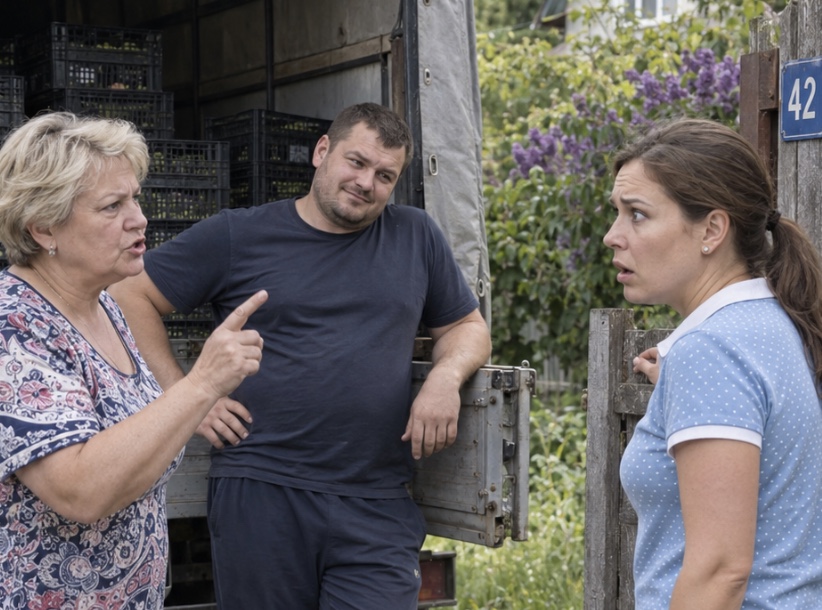
Tatyana Ivanovna climbed awkwardly out of the truck’s cab. She adjusted the silk scarf around her neck, tugged her jacket into place, and marched confidently toward the gate.
Anton jumped out behind her, slamming the door.
“What are you standing there for?” her mother-in-law demanded as she approached. “Move the dog. We’re bringing the truck into the yard.”
Olga stood on the inside of the gate and rested her hands on its wet metal bars.
“The dog is tied up, Tatyana Ivanovna. Why do you need to drive into the yard?”
“Where else would we go?” Anton snapped.
He walked to the back of the truck and lowered the tailgate with a metallic crash.
About ten empty plastic crates stood in the cargo bed.
“We’ve come for potatoes,” Tatyana Ivanovna announced in a tone that allowed no discussion. “Pavel said your shed was so full you could barely walk through it. Pack up some tomatoes, too. Anton brought crates especially for them. You don’t expect me to carry everything in my hands, do you?”
Olga studied the two visitors.
Her mother-in-law had put on lipstick for the occasion and looked as though she had arrived to collect something already promised to her, rather than ask for a favor.
Anton shifted impatiently in his muddy boots, glancing toward the shed.
 
“What tomatoes would those be?” Olga asked with a trace of mockery.
“Ordinary tomatoes!” Tatyana Ivanovna planted her hands on her hips. “Are we family or strangers? Family members should share. Anton needs food for the winter. He has children, child support, expenses. Pavel said you picked three buckets just yesterday.”
“Funny how we didn’t seem to be family while I was doing all the work here this summer,” Olga observed calmly. “You called me a ditch digger. Have you forgotten?”
“There she goes, dragging up the past!” Anton spat into the mud. “Stop wasting our time. We used plenty of fuel getting here on that wreck of a road. Open the gates.”
“You spent money on fuel?” Olga narrowed her eyes. “What a shame. You could have used it to buy vegetables and saved yourselves the trip.”
“Have you completely lost your mind?” Tatyana Ivanovna’s eyes widened. “You’re trying to charge your own family? How dare you!”
“You’re not family to me, Tatyana Ivanovna. Family are the people who helped water the seedlings, weeded the beds in the scorching heat, carried water, and brought in the harvest. You’ve simply turned up for free supplies.”
At that moment, Pavel appeared on the porch.
He had thrown a jacket over his sweatshirt and looked thoroughly displeased, as though Olga were creating needless trouble for him.
“Pavel!” his mother shouted as soon as she saw him. “Say something to your wife! She’s making a complete spectacle of herself! She won’t even let your own mother onto the property. Your brother wasted his time and paid for fuel!”
 
Pavel shifted heavily from one foot to the other, then walked over to stand beside Olga.
“Why are you being so stubborn?” He made a limp gesture toward the truck. “Give them a few vegetables. Is that really too much to ask? We have plenty. Half of it will spoil anyway.”
Olga turned slowly toward him.
“So you don’t mind giving it away?” she asked, carefully enunciating every word. “Did you earth up those potatoes even once? Or perhaps Anton helped unload the fertilizer in spring?”
“I have a job!” her brother-in-law cut in. “I don’t have time to dig around in the dirt. I’ve got deliveries and things of my own to do!”
“Exactly!” Tatyana Ivanovna agreed. “The men work and support their families. You were just enjoying yourself. Gardening is your hobby. You chose to plant all this. Nobody forced you!”
“I planted it for myself,” Olga agreed. “That’s precisely what I’ve been trying to explain.”
“Well, we don’t need very much,” Tatyana Ivanovna said, her voice suddenly softening.
She had decided that Olga was finally giving in.
“We’ll load five sacks of potatoes and take twenty jars of preserves. And pack plenty of carrots for Anton. He likes his vitamins.”
Olga almost burst out laughing.
Five sacks of potatoes. Twenty jars of preserves. And they expected to take everything for free, as though the harvest had simply materialized on its own.
“Then listen carefully.” Olga straightened her shoulders. “Anton, if you want carrots, there’s a market nearby. And if you need pickles, Tatyana Ivanovna, I suggest visiting a shop. They often have good discounts.”
 
“Pavel!” his mother shrieked again. “Do you hear how she’s speaking to me? Are you the head of this family, or do you count for nothing?”
Pavel flushed. The situation was clearly slipping beyond his control.
More than anything, he wanted to return to the warm kitchen, finish his eggs, and stop standing in the cold drizzle between his furious mother and his stubborn wife.
“Don’t make me look like a fool in front of my family,” he muttered, leaning toward Olga. “Let them take it. I’m your husband. We’re one family, so half the harvest belongs to me. I’m giving them my share. Open the gates.”
For a few seconds, the yard fell silent.
Olga slowly turned her head and looked at Pavel for a long moment. Her face remained calm, revealing nothing of her thoughts.
In that instant, she saw the man she had lived with for eight years with unusual clarity.
He had not contributed a single coin toward buying the property. All summer, he had come there to relax, slept until noon, and watched his wife wear herself out in the garden.
Now he was ready to generously distribute the results of her hard work just to make his mother stop shouting and leave him alone.
Olga stepped back from the gate.
 
“Your half, Pavel?” she asked with a sly smile. “So you’ve decided to give your relatives your own share?”
“Yes, I have!” he replied defiantly, clearly pleased with the argument he had found. “Mom, drive in. We’ll load everything now. I’m giving you my half.”
“Wonderful.”
Olga raised a hand and pointed toward the far end of the property, where weeds grew thickly behind an old, leaning bathhouse.
“There’s your share, Pavel. Go ahead and distribute it. Cut Anton a truckload of nettles, goosefoot, and burdock. But nobody is going near my cellar.”
Pavel stared at her in bewilderment.
“Do you even understand what you’re saying?”
“Perfectly.” Olga’s smile disappeared. “I bought this property with my personal savings. I dug the soil. I grew the seedlings. I paid for the seeds, fertilizer, and tools out of my salary. You’ve contributed about as much work here as Anton has contributed to a ballet performance.”
“You conniving little witch!” Tatyana Ivanovna exploded on the other side of the fence.
Dark red blotches spread across her face.
“I hope you end up sitting here all alone with your precious potatoes! Choke on your jars and your vegetables!”
“I’ll be sure to keep your wishes in mind, Tatyana Ivanovna,” Olga answered with exaggerated politeness. “Now turn the truck around. You’re blocking the road. The neighbors will be coming through on their tractor soon.”
 
Anton swore and angrily kicked one of the truck’s tires, hard enough to make the cargo bed shudder.
Then he grabbed the empty crates he had already placed on the ground and hurled them back into the truck with a series of crashes.
Tatyana Ivanovna said nothing more. With her lips pressed into a thin line, she climbed into the cab and slammed the door so forcefully that the mirror shook.
The engine roared. The truck turned around, churning the wet grass and mud beside the fence, then lumbered along the rutted road and disappeared around the bend.
Pavel remained beside the gate for a while.
First he watched the departing truck. Then he turned and gave his wife a dark look.
“What was the point of all that?” he muttered. “You humiliated me in front of my family.”
“On the contrary. I saved you the trouble of loading nettles,” Olga replied with a calm shrug. “Go back inside. Your eggs will be completely cold soon.”
She started toward the porch, then stopped and added:
 
“After breakfast, bring the empty jars in from the shed. It’s your turn to help today.”
Pavel clenched his jaw but did not argue. One look at his wife’s face told him that silence was his best option.
He turned abruptly and trudged back to the house.
About two weeks passed.
Tatyana Ivanovna never called. She made a point of remaining offended and was probably waiting for Olga to apologize first.
Anton did not return either, nor did he mention free vegetables again.
Pavel cautiously raised the subject of making peace several times. He suggested taking his mother a small bag of potatoes and carrots, along with a couple of jars of pickles.
Each time, one long look from Olga was enough to make him quickly change the subject.
 
Olga herself felt wonderful.
Neat rows of homemade preserves lined the cellar shelves. Large, carefully selected potatoes filled the storeroom. The carrots, beets, and onions had all been sorted and prepared for winter.
The most unexpected change, however, was in Pavel.
Once he realized that the harvest would no longer be treated as a free resource for the entire family, he volunteered the following weekend to dig over the garden before winter.
Apparently, the prospect of receiving nothing but nettles and weeds as his future share held very little appeal.