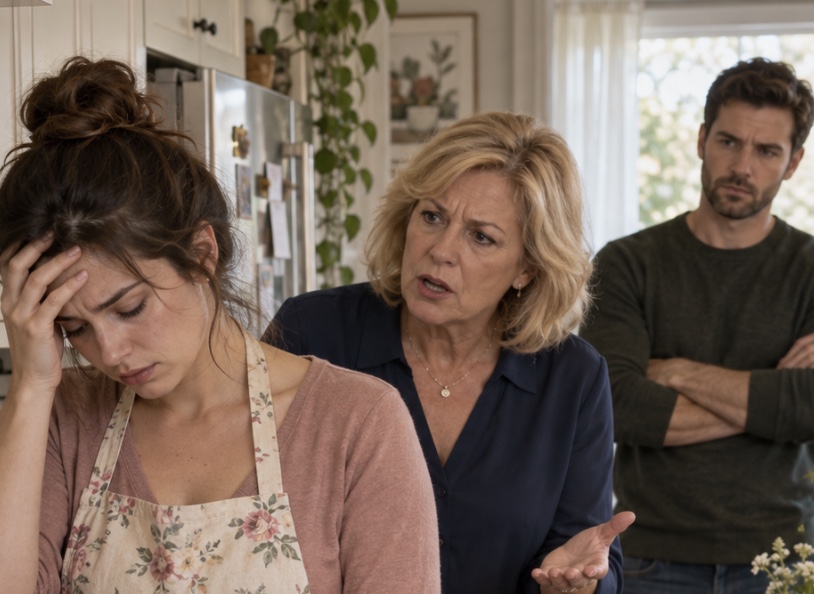
“Roast pork with cheese again?” Zinaida Petrovna’s voice cut through the steam in the kitchen. “Marina, I thought we’d agreed on a special menu for weekends. Pasha has been promising me your famous French-style julienne in little baking dishes all week.”
Marina wiped her damp forehead with the back of her hand, careful not to smear flour across her face, and gave her mother-in-law a tired look. Zinaida Petrovna stood in the kitchen doorway in an elegant burgundy dress, her hair perfectly styled, her lips pursed in disapproval.
Image
“I didn’t have enough cream for the julienne, Zinaida Petrovna,” Marina replied evenly, though the strain showed in her voice. She pulled a heavy tray from the hot oven. “And I didn’t have the energy to go back to the store.”
Pavel appeared in the doorway, drawn by the smell of meat and his mother’s unhappy tone.
 
“Marina, Mom does have a point. Weekends are a chance to do something nice for each other,” he said, sounding conciliatory but faintly reproachful. He leaned against the doorframe. “You’re our cooking fairy. It wouldn’t be hard for you. Mom was looking forward to it. We’re family; we should keep our traditions going.”
Marina said nothing. She transferred the sizzling, delicious-smelling pork to a large serving platter. Months of resentment tightened inside her, but, as usual, she swallowed it to keep the peace.
She was thirty-eight. For the past five years, she had managed a large pharmacy in a residential district. Her job involved far more than working behind the counter. She handled deliveries, argued with unreliable suppliers, checked expiration dates, and calmed angry customers who seemed convinced that their heart tablets didn’t taste minty enough that day. She spent twelve hours at a time on her feet.
When her shift ended on Friday evening, she left the pharmacy smelling of antiseptic, essential oils, and cardboard boxes. Her calves throbbed, and her back wanted nothing more than a bed.
Instead, she went to the supermarket.
The big family meals had begun six months earlier. Zinaida Petrovna had come over for pies one day and, touched by the visit, announced that young people were losing touch with older generations. She suggested getting together every weekend. Pavel embraced the idea at once, declaring that Marina’s cooking was better than anything a restaurant could serve.
At first, Sunday lunch was just for the three of them. Then Zinaida Petrovna began bringing her daughter Oksana, Pavel’s sister. Soon Oksana arrived with her husband, Igor, and their two school-age sons, Denis and Artyom. Without anyone quite acknowledging the change, Sunday lunches turned into gatherings that began on Saturday afternoon and lasted until Sunday evening.
Igor settled on the living-room sofa, turned on the sports channel, and loudly demanded a cold beer. The boys raced through the apartment, scattered cookie crumbs across the pale laminate floor, spilled cherry juice on the chairs, and broke things. Meanwhile, Oksana and Zinaida Petrovna sat at the table, drank tea from the good cups, discussed their acquaintances, and offered Marina household advice.
Marina bore all the expense and did all the work. She and Pavel kept separate budgets while sharing certain financial responsibilities. He paid the mortgage on their two-bedroom apartment; Marina covered utilities, household supplies, and groceries. Since they ate modestly during the week, the arrangement had once seemed fair. Weekly feasts for seven people sent her grocery bills soaring.
 
She thought of the previous evening. At the supermarket, her arms had ached under the weight of her basket. She bought three kilograms of good pork because Igor said chicken never filled him up. She picked up expensive salmon because Zinaida Petrovna liked it on sandwiches. She found cherry tomatoes, avocados, Parmesan, farm butter, smoked sausage, juice for the children, and fruit. At the checkout, the bill came to six and a half thousand rubles. It was much the same every Friday.
Afterward, she dragged the bags to a taxi and carried them up to the third floor because the lift was broken again. Then she stayed up until midnight peeling vegetables, marinating meat, and making fruit drinks. On Saturday morning, she got up early and returned to the stove.
“Marina, bring it in! Igor’s so hungry he’s tapping his fork on the table!” Oksana shouted from the living room over the television.
Marina picked up the heavy platter and carried it in. The relatives were seated around the large extendable table. Igor was pouring drinks. The boys were fighting over the last slice of cured sausage. Zinaida Petrovna was inspecting the table setting with a critical eye.
“Next time you should make a seafood salad,” her mother-in-law said thoughtfully as she helped herself to a generous portion of pork. “The meals are getting a little repetitive. Remember Gosha in Moscow Does Not Believe in Tears? He puts together a wonderful outdoor picnic in half an hour. You have an oven and a food processor, yet we waited a whole hour for the main course.”
A hot lump rose in Marina’s throat, but she stayed quiet. Pavel sat beside her, enjoying his pork, without noticing how exhausted his wife looked. To him, everything seemed fine. The home was full, his relatives were fed, and his wife was busy looking after everyone: the perfect picture of a happy marriage.
He worked in logistics and was tired at the end of each week. He sincerely believed these gatherings helped everyone unwind. It never occurred to him that they were a second, unpaid, exhausting shift for Marina.
Lunch seemed to go on forever. Igor told rambling stories about work. Oksana complained about the price of children’s clothes. The boys loudly demanded dessert. Marina moved between the kitchen and living room, clearing plates, bringing more food, and picking up dirty napkins. Her legs, already worn out by long pharmacy shifts, ached with every step.
The guests finally left that evening. Pavel thanked Marina for the delicious meal, went to the bedroom to watch a film, and promptly fell asleep. Marina was left with a mountain of dishes, greasy pans, a splattered stove, and an empty refrigerator. As she mechanically scrubbed a plate at the sink, she wondered when her life had become an endless effort to meet everyone else’s needs.
Sunday morning began with a phone call. Zinaida Petrovna cheerfully told Pavel that she, Oksana, and the children would stop by for pancakes before going to the shopping centre.
“You’re at home anyway, and it’ll only take Marina twenty minutes to make them,” she chirped into the phone.
Pavel yawned and turned to his wife.
“Mom and Oksana are coming over. Could you quickly mix up some batter?”
Without a word, Marina went to the kitchen. She took out the flour, eggs, and milk. Her movements were automatic, stripped of any pleasure. She mixed the batter, heated the pans, and started cooking. By the time the guests arrived, the apartment smelled of pancakes. The children ran off to play on Pavel’s game console while Oksana and Zinaida Petrovna sat at the kitchen table, waiting to be served.
 
Marina brought them the first stack of hot pancakes, along with sour cream, jam, and what was left of yesterday’s salmon.
“Oh, I nearly forgot!” her mother-in-law exclaimed. “Marina, fetch the jar of my strawberry preserve from the balcony. I brought it over last week.”
Marina nodded and left the kitchen. The enclosed balcony was connected to the living room, and the window between them stood partly open to let in fresh air. It was cool on the balcony. She went to the shelves and began looking for the jar. Then she heard voices coming from the living room. Oksana and Zinaida Petrovna had moved there while she was away.
She could make out every word.
“Mom, this is brilliant,” Oksana said, sounding delighted. “I haven’t spent a penny on groceries this month. Igor’s salary went toward his car loan, and we put all of mine into our holiday fund.”
“What did I tell you?” Zinaida Petrovna replied smugly. “I’m leaving my pension untouched too. I’m saving for a stay at a health resort. Why should we spend money when Pavel’s wife earns a good salary? People who work in pharmacies always have money. Let her feed us. It’s her duty.”
“I know.” Oksana gave a little laugh. “She was annoyed about the julienne yesterday, but she made so much pork that I filled containers with half the tray while she was washing dishes. Igor and I have enough for dinner through Wednesday. We’re saving a fortune. We just need to praise her cooking now and then. Pavel believes we come over because we value family time.”
“And he should,” Zinaida Petrovna said sharply. “She lives in my son’s apartment. They haven’t got children yet, so she has energy to spare. She can earn her place there. She can pull faces all she likes; she’ll put up with it. We only need to keep this going until summer, and then you can fly to Turkey and stay in that nice hotel you wanted.”
The balcony suddenly felt suffocating. Marina stood motionless with the glass jar in her hands. It was as though something stretched tightly inside her had snapped. Each remark landed on her tired shoulders, yet instead of crushing her, their words brought a fierce, unmistakable clarity.
She saw the situation for what it was. They didn’t consider her family. They didn’t respect her work. They didn’t even care about her. To them, she was a convenient, free resource: a restaurant that also supplied groceries to take home. They expected her to fund their holidays with money she had earned through long shifts at the pharmacy, while giving up every weekend at the stove.
Marina slowly returned the jar to the shelf. She took a deep breath, straightened her shoulders, and stepped off the balcony.
She didn’t go straight to the living room. First, she went to the hall and took her thick wallet from her handbag. She kept several months’ worth of receipts in it to track her spending. Then she returned to the others.
Oksana and Zinaida Petrovna were sitting on the sofa. When her mother-in-law saw her without the preserve, she frowned.
“Where are the strawberries, Marina? We’re waiting.”
 
Pavel came in from the bathroom, rubbing his hair with a towel.
“Yes, bring it in before the pancakes get cold,” he said with a smile.
Marina walked to the small coffee table, moved aside some old magazines, and laid down a stack of long white supermarket receipts.
“There won’t be any more pancakes,” she said. Her voice was unusually steady and firm.
“What do you mean?” Oksana blinked beneath her eyelash extensions. “Did you run out of batter? Make some more.”
“I mean the free cafeteria is closed.” Marina looked her sister-in-law in the eye. “I was on the balcony. The window was open, and I heard everything.”
Red blotches spread across Oksana’s face. Zinaida Petrovna leaned back slightly, then quickly recovered.
“How dare you?” she demanded, raising her voice. “Listening to a private conversation? You should be ashamed! Pasha, look at your wife. She’s throwing us out!”
Pavel frowned, glancing between his mother and Marina.
“What’s going on? Have you had an argument?”
Marina lifted the top receipt.
“Pasha, look at this. Yesterday’s groceries cost six and a half thousand rubles. Last Friday’s cost eight thousand. And these are the receipts from the previous month: thirty-four thousand rubles altogether. That’s only the food for the weekend gatherings.”
“So?” Pavel asked, genuinely puzzled. “We have guests. That’s normal.”
“It’s normal for guests to come over once a month and bring a cake,” Marina replied, keeping her eyes on him. “It isn’t normal for your sister and her husband to save on food so they can go to Turkey, or for your mother to save her pension while eating at my expense. I’m paying for their plans with my wages, my health, and my weekends. Behind my back, they talk about how lucky they are, then pack up my food to take home for the week.”
Pavel went still. The towel sank slowly in his hands. He turned to his sister.
“Oksana, is that true? You aren’t buying food for home?”
Oksana shifted on the sofa and looked away.
“Well… Igor has a big car loan. Things are hard for us. We’re family, Pasha. Would you really begrudge your own sister a bowl of soup? You two earn good money.”
“A bowl of soup?” Marina’s voice tightened. “You eat three kilograms of pork in one evening, drink litres of juice, and finish expensive fish and cheese. In six months, you haven’t brought so much as a loaf of bread into this house.”
Zinaida Petrovna sprang to her feet, her face twisted with anger.
“How can you count the food other people put in their mouths? Petty, grasping woman! Pasha, who have you brought into your home? She counts every last kopek! We came with the best intentions—to bring this family closer together!”
 
“Mom, wait,” Pavel interrupted sharply.
For the first time in a long while, he looked at the situation as an adult rather than accepting his mother’s version of it. He remembered how often Marina’s legs hurt on Sundays. He remembered the enormous shopping bags she carried alone. He remembered Oksana boasting recently about the expensive new winter tyres she’d bought for Igor’s car. The pieces came together, and the truth made him feel sick.
The woman he loved had been carrying the burden of relatives who took advantage of her. He had encouraged it because he believed their talk about family traditions.
“Pasha, tell her!” Oksana shrieked. “She lives in your apartment. The least she can do is show some respect to your family!”
Pavel stepped forward, placing himself between Oksana and Marina. His face was pale with anger.
“It’s our apartment, Oksana. We pay the mortgage with our household income; it just happens to be in my name. Marina’s salary paid for everything else while you ate here at her expense.”
“Son!” Zinaida Petrovna gasped, clutching her chest. “How can you speak to your mother like that? That snake has turned you against us!”
“Enough!” Pavel’s shout was so loud that even the children went quiet in the kitchen. “Marina’s right. You’ve had it easy here. Gather your things and leave.”
“You’re throwing your mother out over a piece of meat?” Zinaida Petrovna began to sob theatrically, though her eyes were dry.
 
“I’m asking you to leave because you used my wife,” Pavel said, carefully pronouncing each word. “Oksana, call the boys, get dressed, and go. And put those containers of food from the fridge on the table. Saving up for Turkey at Marina’s expense… I can’t believe your nerve.”
Realising that her usual tactics weren’t working, Oksana snatched up her handbag.
“I’ll never set foot in this house again! You’re greedy, jealous people!” she hissed as she headed to the hall to collect the children.
Zinaida Petrovna lifted her chin, adjusted her hair, and gave Marina a look full of hatred.
“You’ll regret this. You’ve destroyed the family.”
The front door slammed behind them. The apartment felt strangely empty and peaceful. Pavel sank heavily onto the sofa, covered his face with his hands, and let out a long breath. Marina stood in the middle of the room as months of tension began to drain away. Her hands trembled a little, but she felt remarkably light.
Pavel raised his head and looked at her with guilt in his eyes.
“Marina… I’m sorry. I was an idiot. I didn’t see how much money we were spending or understand how tired you were. I thought they were just family meals. I’m sorry I made you put up with all of it.”
Marina sat beside him and gently took his hand.
 
“What matters is that you understand now.”
Two months passed, and life in the apartment changed completely. Weekends began with sleeping late, the smell of freshly brewed coffee, and unhurried walks through the park instead of clattering pans and grocery lists.
Marina looked healthier. The dark circles under her eyes faded, her lower back stopped aching, and she bought herself a beautiful new coat. The money that had once gone toward feeding Pavel’s relatives stayed with them. She and Pavel began saving for a holiday of their own and often had dinner at a small Italian restaurant nearby.
At first, Zinaida Petrovna tried to make Pavel feel guilty. She called to complain about her health, hinting that she was lonely and had no one to cook her a hot meal. Pavel remained gentle but firm. He suggested that Oksana, with all the time and money she’d saved, could bring her groceries or arrange for someone to help her.
 
Oksana sent Marina a couple of accusatory messages. Marina replied with a scan of the receipt from her last big shopping trip and a note: “Your bill for the meals. You know my card details.” Oksana fell silent and blocked her.
One Saturday, Marina sat on the sofa with a book and a cup of mint tea. She listened to the apartment around her. The refrigerator hummed. The wall clock ticked steadily. From the bedroom came the muffled sound of Pavel talking to someone about work. Nobody was shouting. Nothing was being broken. Nobody was demanding another serving of meat.
She took a sip of tea and smiled. Sometimes, to find happiness at home, you have to stop letting in people who arrive with empty plates and pockets ready to be filled. Peace was worth standing up for. At last, her weekends belonged to her.