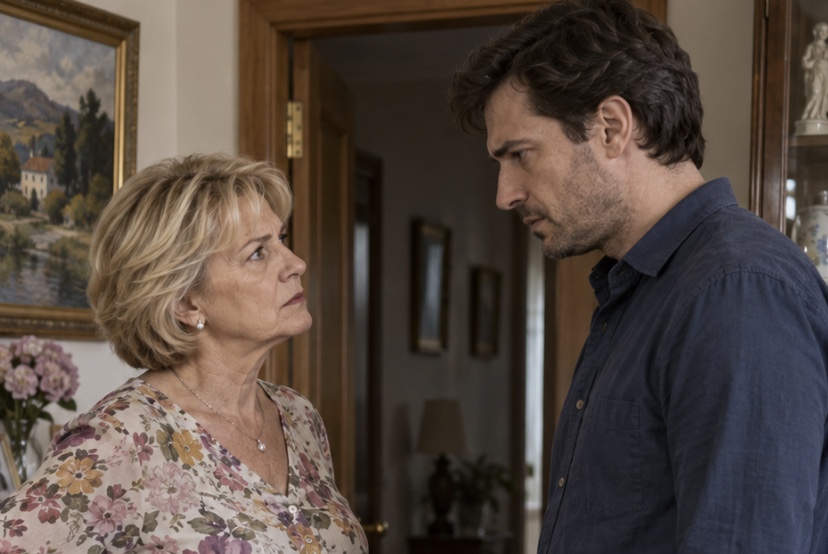
The kitchen smelled of vanilla. Nina Sergeyevna was baking an apple cake while arranging documents on the windowsill.
Her passport. The certificate confirming her inheritance rights. An application for permanent residence registration, which she had downloaded and printed the day before. Tomorrow morning, she and Arkady would go to the public services center. Their appointment was at 9:40.
Arkady had been speaking to his daughter in the other room. Then Nina heard him say, “Hold on, Snezhka. I’m just going over to the neighbor’s for a minute.”
He placed his phone face down on the kitchen table and stepped into the hallway.
But he forgot to end the call.
Nina did not realize it immediately. She removed the baking dish filled with apples from the oven and turned around. In the silence of the kitchen, a cheerful female voice suddenly came clearly through the phone’s speaker.
 
“Dad, don’t drag your feet. Get married and have her register you at the apartment right away, while she’s still completely taken with you. Once you sell her two-bedroom place, put the house in Tutayev in my name, just as we agreed. Oh, and don’t tell her too much about Kostroma, all right?”
Nina stood frozen, holding the hot baking dish with oven mitts, staring at the phone lying face down on her table among her documents.
“Dad? Dad, can you hear me?”
Using two fingers, Nina quietly pushed the phone toward the edge of the table. She placed the apple cake on the counter to cool, then washed her hands.
By the time Arkady returned, she was pouring tea.
“Arkasha, we have a problem,” Nina said as she slid the jar of preserves toward him. “Tomorrow’s appointments at the public services center have been canceled because of some technical issue. They rescheduled us for Tuesday.”
“Tuesday is fine,” he replied good-naturedly, reaching for a slice of cake. “Oh, Ninotchka, your apple cake tastes just like the one my late mother used to make.”
Nina Sergeyevna was fifty-nine years old.
She had spent thirty years sitting behind a service window at the passport office in the municipal housing department on Svoboda Street in Yaroslavl. She began as a passport clerk, later became a senior inspector, and spent her final years in the residence registration department.
For three decades, she had dealt with stamps in strangers’ passports, household registers, family composition certificates, divorces, scandals, and tears shed in front of her window.
Her husband, Valery, had died six years earlier. He suffered a heart attack in the garage. Their daughter, Olga, lived in Cherepovets with her husband and their eight-year-old son, Misha. She called Nina every other day and repeatedly invited her mother to move closer, but Nina always refused.
The two-bedroom apartment on Saltykov-Shchedrin Street had belonged to Nina’s parents and passed to her through inheritance. It was entirely hers—solid, comfortable, and in a good central neighborhood, with windows overlooking a courtyard filled with linden trees. It was not a palace, but local realtors valued apartments like hers at around five and a half million rubles.
Her life was orderly, clean, and extremely quiet.
 
Arkady appeared in February at a social evening for people over fifty, held at the local cultural center. Nina’s friend Lyusya practically dragged her there.
He was tall and gray-haired, dressed in a fine sweater, with an impressively straight posture. He invited Nina to dance a waltz, then asked her for another dance. He introduced himself as Arkady Lvovich, sixty-two years old, a widower and retired shipbuilding engineer from Rybinsk.
“I left the apartment to my former wife,” he told Nina that very first evening, saying it with effortless nobility. “I’m not a greedy man, Ninotchka. I don’t need much.”
He courted her in a way no man had, even when she was twenty.
For International Women’s Day, he gave her lilies of the valley—not ordinary mimosa, but real lilies of the valley. He took her to Tutayev for the weekend and on a boat trip along the Volga to the Tolga Monastery. He repaired the kitchen faucet that had been leaking for two years, put up a shelf, and fixed the electrical outlets.
After three months, he began talking about marriage.
“We’ve both spent enough time sitting alone in our separate corners, Nin. Let’s get married and start living properly, like normal people.”
After six years of living in silence, Nina finally began to thaw.
Only Lyusya remained suspicious.
“Nin, how does a sixty-two-year-old man end up without a place of his own? He says he was an engineer and worked in shipbuilding—but where does his pension go? You should take a closer look at him.”
“You’re just jealous,” Nina would reply dismissively.
 
Then little inconsistencies began to appear—details she deliberately tried not to notice.
He never once invited her to visit him in Rybinsk. Sometimes he claimed his sister was renovating the apartment. Other times he said the place was falling apart and he was embarrassed to take Nina there.
Nina always paid for everything. Arkady’s bank card was constantly “blocked by the bank,” his pension had supposedly been delayed again, or he had simply forgotten his cash at home.
There were also phone calls after which his expression darkened. He would go into the bathroom, turn on the water, and speak through clenched teeth in short, angry sentences.
His daughter Snezhana visited once. She was thirty-six, broad-shouldered, energetic, and loud. She inspected Nina’s apartment with the eye of a professional appraiser, touched the radiator,
The kitchen smelled of vanilla. Nina Sergeyevna was baking an apple cake while arranging documents on the windowsill.
Her passport. Her inheritance certificate. An application for permanent residence registration, downloaded and printed the day before. Tomorrow morning, she would go to the public services center. Her appointment was at 9:40.
Arkady had been speaking to his daughter in the other room. Then he said, “Hold on, Snezhka, I’m just going over to the neighbor’s for a minute,” placed his phone face down on the kitchen table, and stepped into the hallway.
He forgot to end the call.
Nina didn’t realize it immediately. She took the baking dish filled with apples, turned around, and heard a cheerful female voice coming clearly from the phone in the quiet kitchen.
“Dad, don’t drag it out. Get married and register at her address straight away, while she’s still wrapped around your finger. Once you sell her two-bedroom apartment, put the house in Tutayev in my name immediately, just as we agreed. And one more thing—don’t tell her too much about Kostroma, all right?”
Nina stood motionless, holding the hot baking dish with oven mitts and staring at the phone lying face down on her table among her documents.
“Dad? Dad, can you hear me?”
Using two fingers, Nina quietly pushed the phone toward the edge of the table. She set the apple cake aside to cool and washed her hands.
By the time Arkady returned, she was pouring tea.
“Arkasha, there’s a problem,” Nina said, sliding the jar of jam toward him. “Tomorrow’s appointments at the public services center have been canceled because of a technical issue. They could only reschedule us for Tuesday.”
 
“Tuesday is fine,” he replied good-naturedly, reaching for a slice of cake. “Oh, Nina, your apple cake tastes exactly like the one my late mother used to make.”
Nina Sergeyevna was fifty-nine years old.
She had spent thirty years behind the service window of the passport office at the housing authority on Svoboda Street in Yaroslavl. She had started as a passport clerk, then become a senior inspector, and spent her final years working in the registration department. For three decades, she had dealt with other people’s stamps, residential records, household certificates, divorces, arguments, and tears pouring through the little window in front of her.
Her husband, Valery, had died six years earlier after suffering a heart attack in his garage. Their daughter, Olya, lived in Cherepovets with her husband and their eight-year-old son, Misha. She called every other day and kept asking Nina to move in with them, but Nina always refused.
The two-bedroom apartment on Saltykov-Shchedrin Street had belonged to Nina’s parents and came to her as an inheritance. It was solid, comfortable, and entirely hers. It wasn’t luxurious, but it stood in the city center, with windows overlooking a courtyard filled with linden trees. Real estate agents valued apartments like hers at around five and a half million rubles.
Her life was orderly, clean, and very quiet.
 
Arkady had appeared in February at an evening social for people over fifty, held at the local cultural center. Nina’s friend Lyusya had practically dragged her there.
He was tall and gray-haired, dressed in a good-quality sweater, with a straight, dignified posture. He invited Nina to dance a waltz, and then asked her for a second dance. He introduced himself as Arkady Lvovich, sixty-two years old, a widower and retired shipbuilding engineer from Rybinsk.
“I left the apartment to my ex-wife,” he told her on their very first evening together, making the admission sound effortless and almost noble. “I’m not a greedy man, Ninochka. I don’t need much.”
He courted her in a way no one had, not even when she was twenty. On March 8, he brought her lilies of the valley—not the usual mimosa, but real lilies of the valley. They spent a weekend in Tutayev and took a boat trip along the Volga to the Tolga Monastery. He repaired a faucet that had been leaking for two years, installed a shelf, and fixed the electrical outlets.
Three months later, he began talking about marriage.
“We’ve both spent enough time sitting alone in our little corners, Nina. Let’s get married and live like a proper couple.”
After six years of silence and loneliness, Nina’s heart finally began to thaw.
Only Lyusya remained suspicious.
“Nina, why does a sixty-two-year-old man have nowhere of his own to live? He says he’s an engineer and a shipbuilder, but where does his pension go? Take a closer look at him.”
 
“You’re just jealous,” Nina replied dismissively.
Then small warning signs began to appear—things she tried very hard not to notice.
He never once invited her to Rybinsk. Sometimes he claimed his sister was renovating the apartment; other times he said the place was falling apart and that it would be embarrassing to take her there.
Nina always paid for everything. His bank card was either “blocked by the bank,” his pension had been “delayed,” or he had “forgotten his cash at home.”
He occasionally received phone calls that made his face darken. He would go into the bathroom, turn on the water, and hiss short, angry phrases into the phone.
His daughter, Snezhana, visited once. She was thirty-six, broad-shouldered, loud, and self-assured. She inspected the apartment with the practiced gaze of an appraiser, touched the radiator, peered onto the balcony, and then asked as casually as she could:
“Nina Sergeyevna, do you own the entire apartment? Or are there other registered owners?”
Most importantly, Arkady kept pushing Nina to register him at her address.
Not to get married—to register him.
“Nina, I’m practically homeless. I can’t sign up with a doctor or transfer my pension. I’m only asking you to give me an official address. I’m not asking for ownership. Is one little stamp really such a big deal?”
 
“Of course it isn’t,” Nina would answer.
And she printed the application.
Then Snezhana forgot to end the call.
Kostroma.
Arkady had mentioned Kostroma once before, but immediately stopped, as though he had stumbled over the word, and quickly changed the subject to river cruises. Nina hadn’t attached any importance to it at the time.
Now she did.
She didn’t smash dishes or demand an explanation. Thirty years behind the passport office window had taught her one essential truth: a person was not what they claimed to be. A person was what the official records said about them.
So Nina began searching.
First, she checked the online database of enforcement proceedings maintained by the court bailiffs. She entered his full name and year of birth.
The results appeared within seconds.
Arkady Lvovich Streltsov, born in 1964. Seven enforcement cases. Total debt: 1.3 million rubles. Bank loans, payday loans, and unpaid child support.
Next, Nina opened the website of a district court in Kostroma and searched the case records for his surname. Thirty years of working with official documents had taught her exactly where to look.
She found the case.
It was a civil claim seeking recognition that Arkady had lost the right to occupy a residential property and requesting his removal from its official registration.
 
The plaintiff was Valentina Ivanovna Tikhomirova.
The defendant was Arkady Lvovich Streltsov.
The claim had been granted. The proceedings had lasted one year and seven months.
So a woman in Kostroma had registered him in her home. Then she had spent almost two years trying to get him removed through the courts.
Nina called Lyusya. They had spent thirty years working at neighboring service windows, and Lyusya now worked for a property management company.
“Lyusya, is Tanya still working at the passport office in Rybinsk?”
Tanya called back an hour later.
“Nina, where on earth did you find this man? Streltsov was registered in two different apartments here. He was removed from both by court order. And he was never a shipbuilder. He worked rotating shifts as a security guard at a storage facility. His daughter is quite a piece of work, too. Even the people at the municipal offices know about her.”
Nina ended the call and sat in her kitchen for a long time, looking at the linden trees in the courtyard.
Then she called her daughter in Cherepovets.
“Olya,” she said calmly, “come here on Tuesday. And ask Kostya if he knows a lawyer who could spare an hour. I won’t need more than that.”
Until Tuesday, Nina was especially affectionate.
She baked cabbage pies, ironed Arkady’s shirt, and reminded him to bring his original passport and departure certificate.
“You’re wonderful,” Arkady said, kissing her hand. “We’re going to have such a good life together, Nina.”
On Tuesday, he appeared in the hallway dressed for the occasion: a new shirt, freshly polished shoes, and a folder of documents tucked under his arm. Snezhana arrived at nine “to support them in case there was a long line.”
“Nina Sergeyevna, you haven’t forgotten your passport, have you?” she called brightly from the hallway.
 
“I haven’t forgotten,” Nina answered from the kitchen. “Come in here, both of you. We need to have a five-minute conversation.”
They entered and stopped in the doorway.
Three people were sitting at the kitchen table: Lyusya, Nina’s daughter Olya, and an unfamiliar woman of about forty wearing a formal jacket. A stack of printed documents lay before them.
There were no pies on the table.
“Sit down, Arkady Lvovich,” Nina said.
She placed the first sheet in front of him.
“Seven enforcement proceedings. Debts totaling 1.3 million rubles, including unpaid child support.”
Then she placed down a second document.
“A court decision from Kostroma. Valentina Ivanovna Tikhomirova registered you in her apartment and then had to spend a year and seven months removing you through the courts.”
She produced the third page.
“And this is from Rybinsk. Two apartments, and you were removed from both by court order. You were never involved in shipbuilding either, Arkady Lvovich. You worked rotating shifts as a security guard.”
Arkady’s face turned crimson.
 
“What is this amateur investigation supposed to mean?” he demanded. “Those women lied! They slandered me! My exes wanted revenge—they ruined my life!”
“Mr. Streltsov,” the woman in the formal jacket said calmly as she opened her folder, “I’m a lawyer. Let me clarify the situation for everyone present. Permanent residence registration would not give you any ownership rights whatsoever. Nina Sergeyevna inherited this apartment before marriage, so it would not become marital property under any circumstances. However, once registered here, you could only be removed without your consent through legal proceedings. Judging by the Kostroma case, that process might take approximately eighteen months. I assume that was precisely what you were counting on.”
Snezhana stepped forward. Her expression changed completely; her face became red and twisted with rage.
“Who do you think needs you, you old goat?” she shouted. “You’re almost sixty! He only bothered with you because he felt sorry for you, and this is how you repay him—digging through his past!”
Nina looked at her without fear and without tears. There was only quiet disbelief in her eyes as she wondered how she had ever allowed these people into her home.
“Perhaps nobody needs me,” she said evenly. “But for thirty years, Arkady Lvovich, I registered people in apartments and removed them from those registrations. I have encountered more men like you than you could ever imagine. You calculated everything correctly. You simply forgot to check what I had been doing for those thirty years.”
She nodded toward the hallway.
“Your bag is packed. It’s waiting by the door.”
Arkady did not leave quietly. Standing on the landing, he turned around and muttered something about how Nina would “rot alone in her miserable little apartment.”
Snezhana slammed the door so hard that Nina’s mother’s crystal glasses rattled inside the cabinet.
Nina turned the key, returned to the kitchen, and opened the window wide.
For the first time in six months, the apartment felt light and peaceful.
Nina decided not to file a police report. The lawyer honestly explained that no crime had actually been committed: nobody had signed anything, no money or property had been taken, and intentions alone could not be prosecuted.
 
So Nina simply closed that door and never opened it to them again.
Arkady continued calling for another three weeks.
“Ninochka, let me explain everything.”
“Nina, I can’t live without you.”
Then the messages changed.
“You’ll regret this.”
 
She ignored every call and eventually blocked his number, just as she had once added especially troublesome visitors to the passport office’s internal blacklist.
In the autumn, Lyusya mentioned that she had seen him in Tutayev, walking arm in arm with a woman in a burgundy coat.
Nina lay awake for a long time that night.
Eventually, she returned to her orderly, quiet life—but it no longer seemed empty.
She joined the veterans’ choir at the same cultural center Lyusya had once dragged her to and discovered, to her surprise, that she had a good ear for music. She invited Misha to spend the entire summer with her. Together, they fed ducks by the Volga, took a riverboat to Myshkin, and toasted bread with cheese on the balcony, despite every building regulation forbidding it.
And Nina began giving the same warning to every woman in her apartment building.
“Girls, remember this. Registering someone in your apartment takes twenty minutes and a single application. Removing them against their will requires a court order, and it can take years. Before you allow anyone to receive that stamp, investigate them. Check the bailiff database and the court records. It’s all public, it’s free, and it takes five minutes online. Don’t feel embarrassed about checking. Otherwise, you’ll have plenty of time to feel embarrassed later while sitting in the corridor of a district courthouse.”
Her neighbors listened and remembered.
Nina was fifty-nine. She had spent her entire working life placing residence-registration stamps in other people’s passports, and she knew exactly how much a single official mark could cost.
Letting someone into your life could happen in a moment.
Removing them afterward was not always possible.
Nina had been lucky.
She had read the records before signing her name.