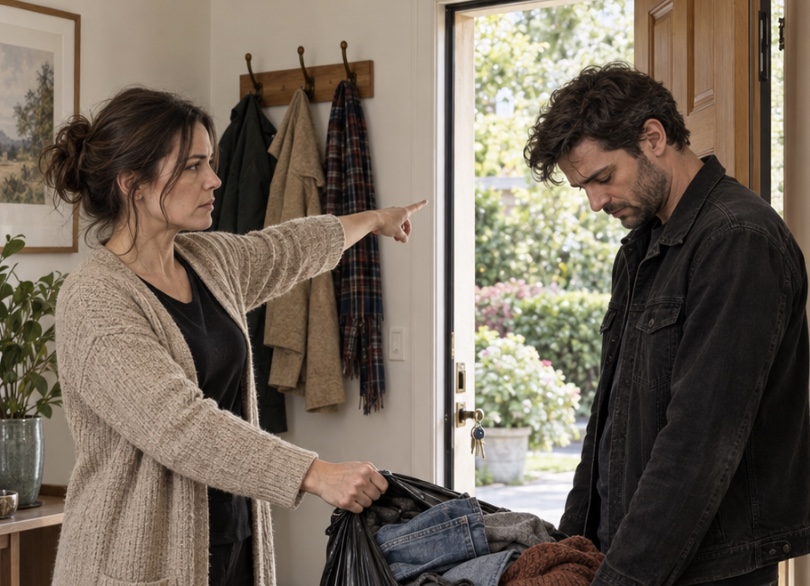
The oppressive silence in the apartment was suddenly shattered by the loud crackle of thick plastic. Polina stood in the middle of the living room, using both hands to open an enormous black construction-waste bag.
Bending down, she picked up an old microwave whose casing had yellowed with age and lowered it into the bottom of the bag with some effort. Several other once-useful household items were already scattered across the pale laminate floor: a ceramic soup tureen with a chipped rim and faded roses, a warped aluminum baking pan, and a bright burgundy synthetic blanket that seemed to generate static electricity at the slightest movement.
Meanwhile, Denis paced nervously from one end of the room to the other, nearly wearing a path into the carpet. His thumb kept scrolling through the messages on his phone. His breathing was heavy and uneven, as though he were reading not another set of instructions from his mother, but his own guilty verdict.
“All right, the blender is next. Did you pack it?” Denis stopped abruptly and looked anxiously at his wife. “Mom says you need to find the whisk attachment too. She wants it.”
“Denis, the second speed on that blender stopped working ages ago,” Polina replied with an unsettling calm that stood in sharp contrast to his agitation. “And the cat pushed the whisk behind the stove last year. Am I supposed to move the entire kitchen unit and retrieve it along with all the dried-up flies? Or does your mother specifically need a whisk covered in several years’ worth of archaeological dust?”
 
“Polina, stop mocking this!” her husband snapped, waving his phone irritably. “You’re the one who turned everything into complete absurdity! Mom called half an hour ago in tears. Her blood pressure is all over the place, and she’s taking sedatives! Couldn’t you have given in just once and let Pasha and Ilya stay with us for two weeks? What would you have lost?”
Polina straightened and folded her arms across her chest.
Only the previous evening, an enormous family argument had erupted in that very living room. Tamara Ilyinichna, Denis’s mother, had not even considered asking their permission. She had simply informed her son and daughter-in-law that her two teenage grandsons from her elder daughter would be moving into their apartment for the next two weeks.
Denis’s sister and her husband had begun a major renovation, and according to Tamara Ilyinichna, there was no reason for the boys to “poison themselves with paint fumes.” Therefore, Pasha and Ilya were expected to stay with Polina and Denis for free, receive proper meals and, naturally, enjoy round-the-clock care.
Polina had firmly rejected the idea.
She worked from home and spent as many as five hours a day in demanding video conferences with clients. When she was asked to turn the apartment into a free boarding house for two teenagers, she said no.
But Tamara Ilyinichna was not accustomed to hearing that word.
In her mind, a daughter-in-law was little more than a free accessory that came with her son—someone expected to obey every demand made by the family. The moment Polina refused, her mother-in-law transformed into a deeply offended benefactor.
Then came the ultimatum.
If Polina was truly so selfish and ungrateful, she could return every single item Tamara Ilyinichna had given the couple during their five years of marriage.
“She’s part of our family! She gave us all these things sincerely, from the bottom of her heart! How can you even think of bringing them all up and counting them now?” Denis angrily jabbed a finger at his phone, refusing to listen to his wife’s reasoning. “Fine, next item. Where’s the crystal salad bowl? Mom wrote that one in capital letters. You know—the bowl with the nickel-silver rim. Find it.”
Polina gave a humorless smile.
Tamara Ilyinichna’s celebrated generosity had long seemed like a carefully disguised trap.
Calling those items gifts was generous in itself.
They were more like loans with enormous emotional interest.
A carpet, a discounted kettle, a set of bed linen, some dishes—every new object that entered their home seemed to arrive with another invisible string attached. Tamara Ilyinichna inevitably pulled that string whenever she wanted them to work at her country house for free, run another errand, or, as in this case, provide accommodation for other relatives.
“I threw that salad bowl away three years ago, Denis,” Polina said calmly.
 
Her husband froze as if a concrete wall had suddenly risen in front of him.
“Wait… What do you mean you threw it away? Mom’s crystal salad bowl?”
“In the usual way. It split in two after you came home from the New Year’s office party and decided to help me wash the dishes. Remember how you dropped it straight into the sink? What exactly am I supposed to return to your mother now? Fond memories of your hangover? Or should we go to the landfill, hire an excavator, and start searching for the pieces?”
Denis turned pale.
Real panic appeared in his eyes.
He seemed completely unaware of how ridiculous the situation had become. What frightened him far more was imagining his mother’s reaction when she discovered that the salad bowl had been broken.
The confidence Denis usually displayed at work and around other people crumbled away like old, unstable plaster.
“All right, this is what we’ll do…” He nervously wiped his forehead, where beads of cold sweat had appeared. “Get dressed. We’ll go to the shopping center and find a housewares store. We’ll buy the same crystal salad bowl with that cursed rim. We’ll pay for it ourselves, take it to Mom, and tell her we simply cleaned the old one really well.”
Now Polina stared at him in genuine disbelief.
She had been prepared for more shouting, accusations, and complaints.
But she had not expected a suggestion quite this absurd.
“Are you seriously proposing that we buy a brand-new salad bowl and pretend it’s the old one just so your mother won’t throw a tantrum over the phone?”
“Yes!” Denis nearly shrieked. “Because I need some peace! I just want all of this to end! We’ll buy the bowl, give it to her, and that will be it!”
Polina silently studied her husband as a cold emptiness slowly formed inside her.
The man standing before her no longer resembled the responsible thirty-year-old with whom she had planned to take out a mortgage, build a future, and have children.
She saw a frightened little boy who would agree to any foolish scheme as long as his mother did not raise her voice at him.
At that exact moment, Denis’s phone vibrated again.
The screen lit up.
“Mommy” was calling.
Denis immediately straightened like a soldier facing a strict commander.
He hurriedly answered and switched on the speaker.
 
Tamara Ilyinichna’s heavy, deliberately dramatic breathing filled the living room.
“Yes, Mom. We’re… we’re at home. We’re gathering everything, just as you told us to,” Denis said quickly in a conciliatory voice, repeatedly casting pleading looks at Polina.
Tamara Ilyinichna’s drawn-out, artificially gentle voice came through the phone. She spoke slowly, pausing heavily between phrases as though she had just undergone major surgery and barely had enough strength to continue the conversation. She played the role of the generous sufferer flawlessly.
“Denisochka, my son… Listen to me,” she began with a sigh, followed by a meaningful pause. “I lay down for a while and thought everything over. Forget about those things.”
Denis became completely still, almost afraid that breathing might ruin the unexpected truce.
“Keep the blanket and use it in good health,” Tamara Ilyinichna continued with theatrical bitterness. “I understand that money must be difficult for you right now if you can’t even take in two boys from your own family for a couple of weeks. Why would I need all those old boxes back? Don’t return anything. Keep it all. I forgive you.”
Denis exhaled loudly. His tense shoulders relaxed immediately, and the joyful smile of a man who had unexpectedly been pardoned appeared on his face.
“Mom, thank you! Honestly, thank you so much! We really appreciate—”
“But,” Tamara Ilyinichna interrupted sharply.
Steel suddenly entered her voice. Her previous weakness and painful helplessness vanished without a trace.
“There is one small condition.”
Denis tensed again.
Polina stood beside the tied black bags without moving. She knew perfectly well what was coming.
“Your wife must come to my home this evening,” her mother-in-law continued. “Alone. She will look me directly in the eyes and apologize for her disgraceful behavior yesterday. After that, we’ll consider everything forgotten. We’ll put this unpleasant incident behind us and continue living like a normal family. I expect her at seven.”
There was a short click.
Then came the steady dial tone.
Tamara Ilyinichna had ended the conversation without even considering that her condition might be open for discussion.
Denis instantly brightened. He turned toward Polina with such genuine, almost childish relief that one might have thought his wife had just saved him from financial ruin.
“Did you hear that?” he whispered excitedly as he hurriedly slipped the phone into his pocket. “Mom agreed to a compromise! This is the perfect solution! All you have to do is go there and say one simple word: ‘Sorry.’ Then it will all be over! We won’t have to carry those cursed bags across the city, and we won’t need to find that miserable crystal bowl. Come on, Polina, get dressed!”
 
Tamara Ilyinichna knew perfectly well that she had no use for an old microwave, a broken blender, or any of the other junk. Those objects had lost their practical value long ago.
What mattered was power.
She had realized that demanding the return of her old gifts had failed to make her disobedient daughter-in-law surrender. Polina had packed the unwanted belongings far too calmly.
So Tamara Ilyinichna had simply changed the terms.
Instead of reclaiming household junk, she now demanded a humiliating apology because Polina had dared to establish boundaries in her own home.
“No,” Polina said clearly.
The happy smile disappeared from Denis’s face.
He blinked several times as if someone had suddenly thrown ice-cold water over him.
“What do you mean, no?”
“Exactly what I said. I’m not going to her house, and I’m not apologizing.” Polina walked over to the table and rested both palms on its surface. “Your mother hasn’t met us halfway. She has simply chosen another way to pressure me. I will not apologize for refusing to turn my own apartment into a free hostel, cafeteria, and laundry service for somebody else’s children. She demanded her gifts back, so we’ll return them. I’ll call a courier.”
“Do you even hear yourself?” Denis shouted, his voice rising to an almost hysterical pitch. “Do you have any common sense left, or is there nothing inside you except stubborn pride?”
“My common sense is perfectly fine. That is why I understand the difference between a genuine compromise and obedience training,” Polina replied evenly.
“What training? This is called respecting your elders!”
Denis angrily kicked one of the black bags.
The chipped soup tureen made a pitiful clinking sound inside it.
“You’re destroying our family because of your cursed pride! Is it really so difficult to swallow your pride once and apologize? Do it for me, at least! For my peace of mind! Because of your principles, I constantly feel as if I’m living on top of a powder keg! I work all day, come home, and want to relax in silence. Instead, I’m constantly forced to reconcile the two of you!”
Polina did not answer.
She simply watched her husband wave his arms and make her responsible for everything that was happening.
“For your peace of mind,” she repeated at last. “So I’m supposed to visit your mother, let her humiliate me, and admit that my time, work, and comfort mean nothing—as long as you can continue sitting comfortably between us without ever upsetting Mommy?”
“What does Mommy have to do with this?” Denis grabbed his head with both hands. “This is about making a normal compromise between spouses! Don’t you understand? If you refuse to go, she’ll make my life a nightmare! She’ll keep calling me, pressuring me, and complaining endlessly! Polina, you’re selfish! You think only about yourself!”
At that moment, Polina finally understood something.
Tamara Ilyinichna’s most significant “gift” had always been Denis himself.
He was a mama’s boy who had never learned to stand up to his mother. Now he was willing to sacrifice his wife’s dignity simply to protect his comfortable existence.
Polina turned and walked toward the bedroom.
“Where are you going? We haven’t finished!” Denis shouted after her. “Get dressed right now! We’ll call a taxi and go to Mom’s together! Do you hear me? Polina!”
He remained in the middle of the living room, breathing heavily and clearly preparing to continue the argument.
Denis expected his wife to return in tears after a few minutes, begin making excuses, or, in the best possible outcome for him, silently put on her coat and agree to visit Tamara Ilyinichna.
But three minutes later, Polina returned looking nothing like the woman he had expected to see.
With her right hand, she rolled a large black suitcase into the room.
It was the same sturdy suitcase they had taken on vacation the previous year.
Polina wheeled it directly toward her bewildered husband, opened the fasteners, and lifted the lid in one swift motion.
Then, without saying a word, she walked to the wardrobe.
She removed several neatly ironed men’s shirts and tossed them into the suitcase.
Jeans followed.
Then several sweaters.
A package of underwear.
Denis suddenly fell silent.
His mouth hung slightly open.
“Hey… What are you doing?” His voice rose to an almost comical squeak. “Polina? Have you lost your mind? Why are you touching my things?”
“I’m only following the instructions, Denis,” Polina replied.
 
She took his expensive leather toiletry bag from the shelf and carefully placed it on top of the carelessly packed shirts.
“Your mother is absolutely right. If an owner demands the return of their property, everything should be given back. So I’m returning it all to her. Every last item. You most of all.”
“What do you mean, me?” Denis stepped backward, staring at his wife in shock.
“Exactly what you heard.”
Polina closed the suitcase lid and pulled the zipper around it with some effort.
“You still belong to your mother, Denis. You’re her most valuable and untouchable possession. It’s as if I was once allowed to borrow you indefinitely under one unspoken condition: I had to obey every rule imposed by your family. Both of you somehow believed that I would tolerate this arrangement forever and continue paying for your peace of mind with my own comfort and dignity.”
The zipper reached the end with a dry rasp.
In the silence that followed, the sound seemed especially loud.
Polina straightened and looked directly into her husband’s eyes.
There was no anger or resentment left in her expression.
“But the lease has expired. I will not apologize for wanting to protect my own home. I’m not going to buy new salad bowls to replace the ones you broke. And I no longer intend to pay for your inability to grow up. Take the old microwave, take your suitcase, and go back to your mother.”
Polina grabbed the suitcase’s extended metal handle and began rolling it toward the entryway. Its wheels whispered quietly across the smooth laminate floor.
Denis followed almost automatically, still unable to comprehend how, in only a few minutes, he had gone from being the man who intended to dictate terms to his wife into another possession marked for return.
“Polina, stop! Wait! Let’s talk about this properly! This is ridiculous! We’re a family!” Denis cried, hurrying after her and trying to hold the front door open with one hand.
Real fear appeared on his face. The prospect of returning to his mother not as her beloved and successful adult son, but as a husband whose wife had thrown him out, clearly terrified him.
Polina opened the door wide and rolled the suitcase onto the landing.
Then she carried out the two heavy black bags filled with old belongings and placed them on the cold concrete floor.
Denis tried to say something else, but Polina did not allow him to continue.
“Give your mother my regards. And remind her to check everything carefully against her list.”
Then Polina closed the door.
 
Almost immediately, she called a locksmith and arranged to have the lock cylinders replaced as soon as possible.
She had no intention of allowing her apartment to remain a free storage facility for other people’s unwanted possessions—or their weakness.
Suddenly, it seemed as though even the air inside the apartment had changed.
It felt lighter.
Freer.
It was as if the oppressive tension that had accumulated within those walls had been left outside along with the black bags and the suitcase.
A gift accompanied by a long list of obligations can hardly be called genuine generosity. It resembles an emotional loan with enormous interest—one that is repaid not with money, but with personal boundaries and dignity.
People who are accustomed to manipulating their loved ones often turn gifts into invisible leashes. As long as everyone obeys their rules, their past “generosity” is never mentioned. But the moment someone refuses a request or attempts to defend their personal space, the leash is pulled tight. They are reminded of everything that was supposedly done for them, every present they received, and every obligation they allegedly owe in return.
Yet the most disturbing part of Polina’s story was not Tamara Ilyinichna, her old microwave, the broken blender, or her detailed inventory.
 
Something else was far worse.
Polina had a husband who was willing to sacrifice his wife’s dignity for the sake of his own comfort. Denis did not care whether his mother’s demand for a humiliating apology was fair. His main concern was whether Tamara Ilyinichna would stop calling, pressuring him, and creating scandals.
When a husband demands that his wife tolerate humiliation simply so that his own life can remain peaceful, he has already become part of that unhealthy family system.
Polina decided she would no longer participate in it.
Sometimes the best way to rid yourself of a gift burdened by endless conditions is to return it to the person who still considers themselves its rightful owner.
Polina packed the family’s most valuable “asset” into a suitcase and sent him back to Tamara Ilyinichna.
No exchanges. No second chances.
Have your relatives ever given you “generous” gifts that they later brought up at every opportunity—or even demanded that you return? Share your experiences in the comments. Let’s discuss them.