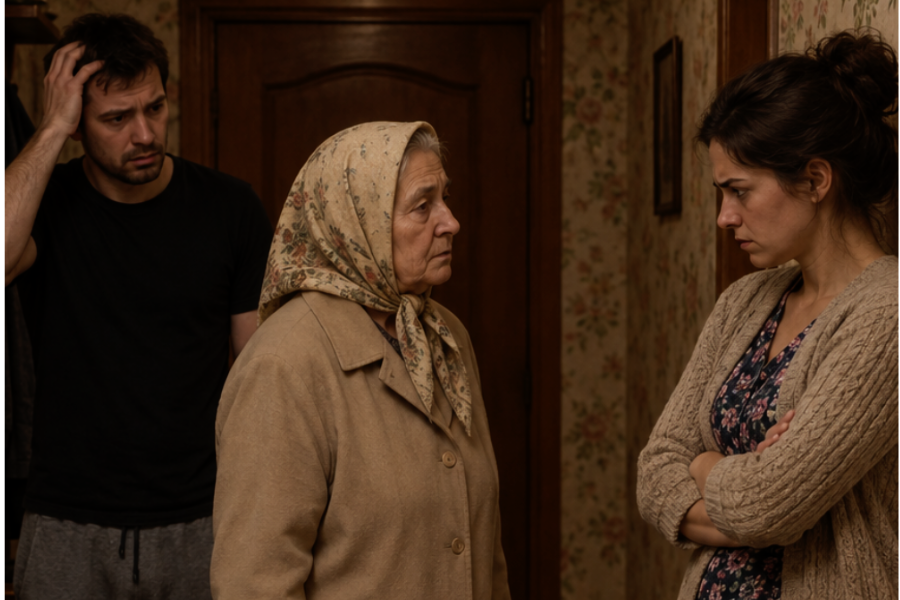
Kostya’s mother-in-law arrived to stay with them, carrying a plaid suitcase and her own slippers tucked in a plastic bag. It was those slippers that kept Alisa awake all night.
But first came the doorbell — long and confident, at half past seven in the evening. That October had been wet: it was the third week of constant drizzle, the heating hadn’t been switched on yet, and everyone at home wore woolen socks. Alisa was just stirring the base for borscht when she heard Kostya’s confused voice from the hallway:
“Mom? Why didn’t you call first?”
Nadiya Yuriyivna stood on the threshold in a beige coat and a light scarf, rain-darkened on the shoulders. Petite and trim, with the direct gaze former math teachers use on students at the blackboard. At her feet was a brown-and-red plaid suitcase. Alisa recognized it from photos in Kostya’s album: with this suitcase, her mother-in-law used to take the kids to the sea every summer.
“Good evening,” said Nadiya Yuriyivna, as if she had been expected. “I’m here. I’ll stay with you for a while.”
Alisa turned off the stove, left the kitchen, and leaned against the wall with her arms crossed. The wallpaper in the hallway was a holdover from the previous owners — covered in tiny pink flowers, which she and Kostya had meant to replace for three years and kept postponing. Above the coat rack hung a painting of an autumn street — also inherited, also in the “we’ll take it down later” pile.
“Why did you come to us in particular, Nadiya Yuriyivna?” Alisa asked calmly. “You have a favorite daughter. The one you gave an apartment to.”
Kostya put his hand to his forehead and stared somewhere toward the light switch.
* * *
They found out about the apartment a month ago, and purely by accident. Kostya’s cousin called to wish him a happy birthday, and, in passing, asked: “Aren’t you upset that your mom signed the three-room flat over to Tanya?”
Kostya replied that he wasn’t upset. Then, he spent the rest of the night taking apart the shower faucet in the bathroom — a perfectly good faucet that didn’t need fixing. Alisa didn’t ask a thing. She already knew this was his way of keeping silent with his hands.
That day, Nadiya Yuriyivna didn’t call her son herself. She sent a message: “Happy birthday. Wishing you happiness.” Two periods. Not a single “son.”
That’s how it had always been in their family. Tanya was six years older and could do no wrong: dropping out of university in her third year, changing jobs three times in a year, relationships that never worked out. When guests were over, their mother would say, “My Tetyanka is sensitive, life is hard for her.” But about Kostya, she’d say, “Kostya is independent.”
He became independent early. At seven, he walked to school alone. At fifteen, he went to technical college because they offered a scholarship and a dorm room. By twenty-two, he was already sending his mom money for utilities from his own salary, and he never heard a thank you — only, “well, you’re a man.”
He and Alisa bought their two-room apartment on the fourth floor of a five-story building three years ago. Alisa’s brother lent them part of the money, so now Kostya fixed washing machines at a service center by day and delivered furniture from the store in the evenings. He came home at ten, ate dinner standing up, and fell asleep before finishing a single page of his book.
* * *
“Tetiana doesn’t have time for me right now,” said Nadiia Yuriyivna as she unbuttoned the top button of her coat. “She’s busy with renovations. But you two, you have two rooms. Surely a mother can find a little corner with her children?”
“A corner?” Alisa repeated. “Nadiia Yuriyivna, our bedroom is so small you have to squeeze sideways between the bed and the wardrobe. And the living room doubles as a dining room, and Kostia’s workshop, and even a spot to hang our laundry. Where are we supposed to put you? On the couch, right under the spot where his work pants are drying?”
“Alisa, come on, don’t start,” Kostia said quietly. “Mom will just stay for a bit. Just until Tanya finishes her renovations.”
Alisa turned to look at her husband.
“A bit? Kostia, do you actually believe that? Let me tell you what will really happen. The renovations will end, then Tanya will suddenly need to do something else. And then something else will come up. Mom will end up staying here. Forever. On our couch.”
Nadiia Yuriyivna clasped her hands together:
“How can you be so cold-hearted! Kostia, say something to her! I raised you, I sat by you every night…”
“And yet the apartment went to Tanya,” Alisa interrupted. “Not half of it. The whole thing. And who is Kostia to you? A son? Or just the one you call when you need someone to hang a shelf or move a wardrobe?”
Kostia stayed silent. He’d been tired of this conversation even before it started. Alisa could see the tension in his jaw—it was the look of someone upset with himself, yet still unable to say ‘no’ to his mother after all these years.
“Let me at least sit down out of the way,” his mother-in-law asked in a completely different, quiet voice. “I’ve just come off the bus and my legs are giving out.”
Kostia quickly picked up her suitcase and set it against the wall. Alisa stood motionless for a few seconds longer. Then she exhaled:
“Come to the kitchen. I’ll pour us some tea. But I want to know what really happened.”
* * *
Nadiia Yuriyivna took off her shoes, pulled out a plastic bag from her purse and took out her slippers—gray ones, with little pom-poms. She slipped them on, neatly folded the bag four times, put it back in her purse, and only then went to the table. She sat up straight, folded her hands on the oilcloth, faded lemons decorating the surface.
Alisa set out three cups and poured tea. Her fingers trembled a little, and she was annoyed at herself for it.
“So did you sell the apartment or give it away?”
“I gave it away. In August, at the notary’s office,” her mother-in-law said, staring into her cup. “Tanya promised I’d live in the small room, the one with a window to the quiet courtyard. She said she’d take care of me. But as soon as I signed the deed, she changed the locks. Told me she needed her own space. Said I was getting in the way.”
“Are you at least registered there?” Alisa asked. “If you are, she can’t make you leave, no matter what she says.”
Nadiia Yuriyivna blushed.
“No. I deregistered last spring. Tanya asked—it makes the utilities easier to handle.”
“Unbelievable,” Alisa covered her face with her hands. “You even did that. She threw you out like an unwanted old chair, and now you want us to take you in.”
Kostia set his teacup down so abruptly that tea spilled onto the tablecloth.
“That’s enough. Mom is staying. That’s my decision.”
Alisa stared at him for a long time.
“Your decision. Does what I think matter at all?”
“Where is she supposed to go, Alisa? Out on the street? In October?”
Alisa stayed silent. Then she stood up.
“Alright, let her stay. But, Nadiya Yuriyivna, let’s set some ground rules right away. I’m letting you in for Kostya’s sake. Not for yours. This is our apartment, and we still have two years left to pay off the debt. You’re a guest here, so please act like one.”
Her mother-in-law pressed her lips together and didn’t reply. She headed to the living room, and a minute later, the sound of the couch springs echoed through the hallway. Kostya walked up behind his wife and wrapped his arms around her shoulders.
“Thank you,” he whispered softly into her hair.
“Don’t thank me,” Alisa answered in the same quiet tone. “I’m not doing this for her.”
* * *
Sleep wouldn’t come. Kostya lay turned to the wall, breathing evenly—like someone who’s finished two shifts and finally gets to stop thinking. Alisa stared at the ceiling, watching headlights from the street drift across it again and again.
She couldn’t stop thinking about the slippers.
Someone was put out on the street, the locks changed. She—humiliated and confused—grabbed her things. But, in the middle of all that, she packed her slippers in a separate bag, so as not to dirty the rest? Then even folded that bag into four?
That’s not how you pack when you’re kicked out. That’s how you pack when you’ve been thinking for a long time about where you’re going.
And there was something else. At the door, her mother-in-law had said, “Tetyanka can’t have me, she’s doing renovations.” At dinner, it was about locks and “getting in the way.” Two different stories in fifteen minutes.
At three in the morning, Alisa gave up and went to the kitchen for some water. She didn’t turn on the foyer light—not to wake her mother-in-law—and accidentally stumbled over the suitcase. It wobbled, tipped onto its side, the broken lock clicked open, and the lid flipped back.
Alisa knelt down to put everything back. And froze.
There was hardly any clothing inside. Two blouses, a warm cardigan, a woolen scarf. The rest of the space was filled with other things.
A shoebox tied with a satin ribbon. Inside: children’s drawings, signed in clumsy handwriting, “Kostya, 5 years old.” A sun with stick rays, a yellow house, and three little figures: big, medium, and small. Over the middle one was carefully written, “MAMA.” A third-grade school diary. A certificate for second place in the district physics olympiad. A half-knit dark-blue scarf with needles still stuck in the ball of yarn.
And a photograph.
Alisa held it up to a strip of light coming from under the bathroom door. Kostya was in the picture—nineteen, so young, in a borrowed jacket, holding a diploma on the steps of his technical school. The photo was taken from far away, a little from the side, as if shot from behind a fence. The frame was off-kilter, with lilac branches filling half the photo.
Alisa knew this story. Kostya had told it to her once, at the very start of their relationship, and never brought it up again. At the graduation, everyone’s parents had come, but nobody showed up for him. His mother was at Tanya’s that day—Tanya was having her engagement party.
But now, holding this photograph, Alisa realized someone had actually been there after all.
Under the photograph was a thick envelope. On it, written in that same neat teacher’s handwriting as on the shoebox, were the words: “For Kostya. For the dacha.”
“Don’t count it,” a voice came from behind. “There’s seven thousand. Dollars.”
* * *
Nadiya Yuriyivna stood in the living room doorway, wearing Alisa’s cozy home blanket over her nightgown.
“I didn’t open it, it just fell over by itself,” Alisa blurted out, trying to explain herself.
“I know. The lock hasn’t worked for a while,” my mother-in-law said as she slowly sat down on the shoe bench. “Please don’t tell Kostya yet. I’m asking you.”
They sat together in the kitchen until five in the morning. Alisa made some mint tea, and for the first time that night, Nadiya Yuriyivna wrapped her hands around the cup, as if she was warming them.
“Tanya never kicked me out,” she finally admitted. “She never changed the locks, either. I lied.”
Alisa didn’t reply. She just waited.
“She’s expecting a baby. At forty-two, can you imagine? Oleg’s with her now, and he’s actually become a good, quiet husband. They’re turning that little room facing the yard into a nursery. Bought wallpaper with teddy bears. And they put a fold-out bed for me in the kitchen. Just for now.”
She turned the cup in her hands.
“A week ago, I went to get some water in the evening, and I heard them talking in the hallway. Oleg asked, ‘Is your mom staying long?’ And Tanya answered, ‘Well, where am I supposed to put her?’ She didn’t say it nicely—she sounded so tired. Like she was talking about a piece of furniture you can’t find a place for.”
“So you decided to leave.”
“I decided I’d had enough of being someone there’s no place for. In the morning, I packed up while they were sleeping. Left a note saying I was going to my sister’s in the village. Tanya probably still thinks I’m there.”
“But why didn’t you actually go to your sister’s?”
For the first time, Nadiya Yuriyivna looked up.
“Because I was coming to see my son.”
Alisa leaned back in her chair. Outside, the misty drizzle rustled quietly.
“Then why did you tell that story about the locks on the doorstep?”
“What else could I say?” her mother-in-law gave a bitter smile. “‘Kostya, I ignored you all your life, and now I just want to be near you’? You’d have kicked me out yourself, and you’d be right to do so. But this way—poor me, I got thrown out, easy to pity. Of course it’s a lie. I’m so ashamed, Alisa. You can’t imagine how much.”
“What about the money? Why didn’t you give it right away?”
“I sold the summer house back in the summer. The one where Kostya, when he was little, planted a walnut tree with his father. I thought: the apartment for Tanya, the money for Kostya. For the first time in my life, I wanted to do the right thing.” She traced her finger over the lemon print on the tablecloth. “But then I stood at your door, thinking: if I come in with the envelope, what if you only let me in because of the money? Then I’d never know if you would have let me in on my own.”
“And what if they hadn’t let you in?”
“I’d have left the money at the door and gone to my sister’s. I’m not lost, Alisa—I do have somewhere to go. I just wanted to come here.”
Alisa picked up a photo with lilacs from the table.
“And this?”
Her mother-in-law was silent for a long time.
“That day was Tanya’s first engagement. Guests, a big table, and I’d been at the stove since six in the morning. Around noon I said: ‘I’ll be gone for an hour, need to buy some bread.’ And I took the bus. When I arrived, they were already on the porch with their diplomas. I had a soap case in my bag—I’d removed it from behind the fence and… I didn’t go up to them.”
“Why not?”
“Because he looked so grown up. On his own. And suddenly I thought: he really has managed without me. What would I have said? That I ran over for ten minutes because my sister was having a celebration?” She pressed her hand to her lips. “My whole life, I thought Kostya was strong. And that Tanya couldn’t make it without me. So I kept giving everything to the weak one, and the strong one only ever got, ‘You’re a man, you can handle it.’ Only now did I realize that strong ones get cold, too. They just stay quiet about it.”
“And the scarf?”
“I started it when he got into trade school. Wanted him to have it for his first winter. I didn’t finish. And then he started buying everything for himself.”
* * *
Kostya woke up at seven, just like always. He walked into the kitchen, yawning, and stopped by the table. Next to his mug was a photograph. Lilacs, a porch, a boy in a borrowed jacket.
He picked it up and stared at it for a long time. Then he slowly turned it over. On the back, written in pencil: “Kostya. June 28. I was there.”
“Mom,” he said, not turning around, his voice sounding strangely unfamiliar. “Where did this come from?”
Nadiya Yuriyivna stood in the doorway. Alisa could see how tightly she was gripping the doorframe with her fingers.
“I was there, son. I stood behind the fence. Forgive me.”
Kostya didn’t say a word. He set the photograph on the table, stepped out onto the balcony, and closed the door behind him. He stood out there for ten minutes in just his t-shirt, in the October wind. Alisa didn’t follow him. She knew: now was not the time.
When he came back, his eyes were red, but his voice was finally his own.
“Come have breakfast,” he said. “Both of you.”
After the syrniki, Alisa put an envelope on the table. Kostya pushed it aside without even looking at it.
“I won’t take it. That’s your money, Mom. Your dacha.”
“You will take it,” Alisa said calmly, and both of them looked at her. “You’ll pay back the debt to my brother. And you’re done with your evening furniture jobs. From now on, you’ll come home at six like a normal person. Your mom has spent seventeen years trying to do something for you. Don’t take that away from her.”
Kostya was silent for a long while, then gave a single, short nod.
“And another thing,” Alisa poured more tea for her mother-in-law. “Nadiya Yuriyivna, you won’t be living on the couch. Kostya and I will move into the living room, and you’ll take the bedroom. The window looks out onto the yard. It’s a quiet yard, with a rowan tree. You were promised a room like that.”
Her mother-in-law opened her mouth to object, but said nothing. She just nodded several times in a row, staring into her plate.
* * *
That same day, closer to lunchtime, Tanya called Kostya. She was crying so hard into the phone he could barely make out her words: their aunt from the village said their mother hadn’t come, and Tanya had already called everyone they knew. Kostya listened, paused, and replied: “She’s with me. At home.”
He said the word “home” so naturally, as if there was no other way it could be.
Nadiya Yuriyivna finished knitting the scarf by New Year’s. Dark blue, a bit too long—seventeen years is enough time to forget how tall Kostya is. He wears it every day and already twice this winter has turned down a new one.
In March, Tanya had a daughter. Nadiya Yuriyivna went to stay with her for two weeks—to help with the baby. She came back in the evening, put her plaid suitcase on top of the wardrobe, sat in the kitchen, and said, to no one in particular:
“Well then. I’m home.”
The flowery wallpaper—they finally replaced it, all three of them, in one Saturday, arguing over every strip. And the photo with the lilacs now hangs on the fridge, held up by a magnet from the sea. Alisa once noticed that every time Kostya walks by, he touches it with his fingers for a moment. As if making sure it’s still there.