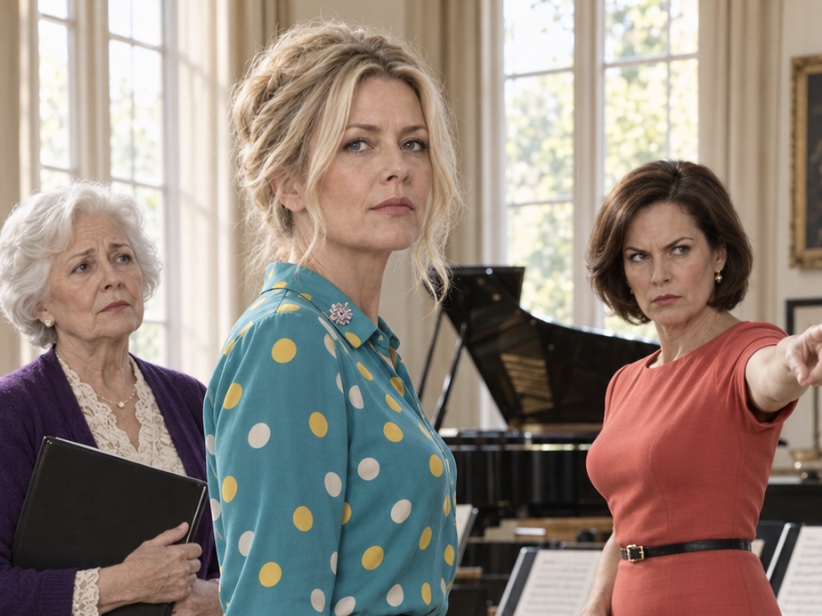
Marina dramatically slapped a printed sheet of paper onto my kitchen table. It was Mom’s schedule for the week—meticulously organized, color-coded with highlighters, and apparently even laminated by Marina herself.
My sister pulled a thick red marker from her enormous leather handbag, snapped off the cap, and aggressively crossed out Tuesday and Thursday evenings. Two bold red Xs appeared directly over the neatly written words: “Choir rehearsal—Community Arts Center.”
“You’re taking Mom out of the choir,” Marina ordered, replacing the cap with a click that sounded like a wax seal being pressed onto a court sentence. “At her age, she has no business traveling around to rehearsals.”
“She’s seventy-four. It’s time for her to rest, check her blood pressure regularly, and stay at home instead of howling at the local arts center.”
I looked at the ruined schedule, where the writing was still visible beneath the red ink.
 
“Marina, she sings second soprano. You can’t simply cross a soprano out of existence. They have their annual City Day concert this Sunday.”
“I already did. And I’ve spoken to Valery Eduardovich,” my sister announced smugly, straightening her cardigan. “I told him that we made a family decision to put an end to these amateur tours. Her health isn’t what it used to be. Her joints hurt, her blood pressure fluctuates. He understood perfectly. All you have to do is go to the arts center and collect her sheet music so she won’t even be tempted to show up. That’s it. The matter is settled.”
Marina had always loved conducting other people’s lives. Ever since childhood, she had preferred standing on an imaginary stool and waving her arms, expecting everyone around her to obediently follow her score.
But this time she was striking a painfully false note. She was trying to remove someone from a beloved role—someone who, unlike Marina, possessed a clear voice of her own.
And all of it was being served beneath a thick, suffocating layer of supposed daughterly concern. Marina had already begun speaking for the entire family, depriving our mother of one of the few truly meaningful and independent parts of her life.
As soon as Marina left, I didn’t even bother clearing the dirty dishes from the table. I picked up my phone and found the choir director’s number.
“Valery Eduardovich? Hello. This is Antonina Vasilyevna’s younger daughter.”
“I’m listening,” he answered.
His voice sounded dull and endlessly tired, like that of a man who had spent his entire life trying to make people sing in harmony while they stubbornly wandered off in different directions.
“Valery Eduardovich, please don’t remove Mom from her part. There was no family meeting. This was entirely my sister’s personal initiative. Please don’t make any decisions about Mom’s participation until she speaks to you herself.”
The conductor released a relieved breath.
“Thank you. For a moment there, I truly thought we were about to lose our loud little chipmunk. Tell Antonina Vasilyevna we expect her at Thursday’s warm-up.”
That same evening, I went to see Mom. She lived alone in a spacious two-bedroom apartment where everything was kept in perfect, almost museum-like order.
Mom looked nothing like a helpless old woman who needed to be wrapped in a blanket and protected from every draft. She greeted me in elegant house trousers, her hair carefully styled. Even at home, she never allowed herself to look untidy. Open musical scores rested on the old piano, which she still had professionally tuned on a regular basis.
 
Yet tension hung in the air. Mom moved around the kitchen more than usual, shifting plates from one place to another and avoiding my eyes.
“Marina called me three times today,” she finally said, placing a saucer of homemade cookies in front of me. “She said my blood pressure rises because of the high notes and that riding the bus in the evenings will finish me off. She shouted so loudly that I had to take a sedative.”
“And what did you tell her?” I asked, watching Mom nervously straighten an already perfect stack of napkins.
“I didn’t say anything. You know, maybe she’s right. Perhaps it really is time for me to give up my place. I’m the oldest person in my section.”
She hesitated.
“At the last rehearsal, we had to stand for a long time, and my lower back started aching. Marina says I’m becoming a burden on the family with all these trips.”
I looked at her and finally understood the sophisticated game my sister was playing. Mom hated open conflict. She had spent her life smoothing things over, trying not to sing out of tune in our family choir even when everyone else was hopelessly off-key.
But she did not look like someone who genuinely wanted to leave the stage.
The choir was not merely a hobby for her. It gave her the discipline to straighten her back twice a week. It gave her friends who addressed her respectfully by her first name and patronymic instead of calling her “Grandma,” as people did at the clinic.
Among women who were no longer young but still deeply alive, she had the right to use her own voice. There, her existence was not reduced to her age, her diagnoses, or waiting for calls from children who were always busy.
“Mom, everyone over thirty gets lower back pain sometimes,” I said gently. “You saw your doctor recently. He didn’t forbid you from singing. He only told you to monitor your blood pressure, take your medication on time, and avoid standing too long without a break. If your health changes, we’ll make a decision together with your doctor—not with Marina.”
Then I smiled.
 
“And Valery Eduardovich asked me to tell you that they won’t manage the second part without your soprano. He expects you on Thursday.”
Mom immediately brightened. The familiar spark returned to her eyes, although she quickly sighed and lowered her gaze again.
The following day, the second act of Marina’s private performance began. Its title might have been: “I Carry This Burden Entirely Alone.”
My sister launched a frantic campaign. Mom’s longtime friend, Aunt Valya, called me and breathlessly began explaining what a saint Marina was.
“Oh, your Marina is simply priceless! She called me yesterday in tears. She said she was fighting desperately to protect Tonya’s health, while Tonya keeps rushing onto the stage like a young girl. Marina brings her groceries, washes her floors, and carries everything on her own shoulders!”
I listened to this inspired aria in disbelief.
Mom had been ordering her own groceries through an app for a long time, having learned to use it faster than I had. Her floors were cleaned by a robot vacuum that we had bought together for her last New Year.
The domestic hardships Marina described existed only in her vivid imagination. What she truly needed was an audience willing to applaud her performance as a long-suffering martyr.
By Tuesday evening, the situation became more serious. Mom called me herself. Her voice sounded lost and almost childlike.
“Sweetheart, do you happen to know where my concert blouse is? The white one with the high lace collar. And my black velvet skirt?”
“In your wardrobe, inside the garment bag, where they’ve always been?” I suggested, although an unpleasant suspicion had already begun forming inside me.
“They’re not there. Marina came over yesterday to ‘help me sort through my clothes.’ I looked for them today, but the bag was gone. I called her, and she said…”
Mom fell silent, apparently too embarrassed to repeat her older daughter’s words.
“She said, ‘I took that old junk to the dry cleaner. We’ve already decided you aren’t going anywhere, so why would you need to sit around the house wearing velvet? It’ll be ready in a month.’ But our full dress rehearsal is on Saturday!”
This was no longer ordinary control. It was shameless sabotage. Marina had confiscated Mom’s stage clothes and dragged them away to her own hiding place.
Without that uniform, Mom physically could not appear onstage. The choir had strict rules about concert attire, and Valery Eduardovich would remove anyone who failed to follow them.
 
I immediately called my sister. She took her time answering, and when she finally picked up, her voice was saturated with condescending exhaustion.
“Yes, I took her ridiculous clothes,” Marina declared before I could even ask. “And don’t start shouting at me. I’m saving our mother from having a stroke onstage.”
“She doesn’t understand what’s best for her. Who’s going to take care of her if she collapses from exhaustion? Pushkin? Or that conductor of hers? I’m acting in her best interests!”
“Give the clothes back, Marina,” I said firmly. “You’re overstepping every boundary.”
“If you don’t believe me, come over and search the apartment yourself. You have a key. I won’t be home until evening anyway. But you’ll only waste your time because I really did take everything to the dry cleaner. Goodbye. My soup is boiling.”
Marina had turned the volume of her false concern up so high that it drowned out all common sense. She genuinely expected me to join the chorus of her supporters and sing along with her absurd melody.
I had no intention of remaining a passive listener.
It was time to act. There was no point negotiating with someone who could hear only her own voice.
Marina had personally given me permission to enter her apartment, so on Wednesday morning, while she was at work, I let myself in with my spare key.
I wasn’t planning to conduct a full search, but my instincts told me no dry cleaner had ever been involved. Marina was far too thrifty to spend money cleaning clothes she intended to hide.
I was right.
The thick black garment bag containing Mom’s concert outfit hung inside the hallway closet, pushed behind several old winter coats. I carefully lifted it from the rail, draped it over my arm, and left.
Nothing had been broken. I had simply returned illegally seized property to its rightful owner.
Now I needed to solve the transportation problem.
Marina’s strongest argument had always been the journey.
“How will she travel after dark? The buses are unreliable. The roads are slippery. She’ll fall!”
 
A retired man named Uncle Misha lived on the ground floor of our building. He was sensible, sober, and the proud owner of an immaculately maintained older foreign car that he drove only on special occasions.
I went downstairs and explained the situation honestly.
“Mikhail Borisovich, I have a business proposal. Twice a week, on Tuesdays and Thursdays, my mother needs to be driven from her apartment building to the Community Arts Center and brought home two hours later. You know the route, and it takes about fifteen minutes. I’ll cover the fuel and compensate you for your time.”
Uncle Misha, who clearly needed a legitimate excuse to take his beloved car out for a drive, agreed enthusiastically.
“You’ll offend me by calling it business! What kind of accounting is there between neighbors? But I won’t refuse the fuel money. Prices are painful these days. Your mother will be delivered in perfect condition, door to door!”
The transportation issue was settled. Mom now had a safe and reliable way to travel.
On Thursday evening, I arrived at her apartment carrying the garment bag. When she saw her velvet skirt and perfectly pressed white blouse, her lips trembled. She quickly regained control of herself.
We went outside, where Uncle Misha’s gleaming car was already waiting.
Together, we drove to the local Community Arts Center.
I had always liked that building. It smelled of old parquet flooring, theatrical dust, violin rosin, and an elusive sense of creative tension.
Behind the heavy doors covered in burgundy vinyl came the muffled sounds of vocal exercises. Someone was stubbornly running through scales, while someone else practiced a complicated musical passage.
 
We entered the rehearsal hall. Valery Eduardovich stood beside the piano, wearily rubbing the bridge of his nose. When he saw Mom, he threw up his hands in delight.
“Antonina Vasilyevna! We thought we had lost our loud little chipmunk forever.”
Mom approached him with her back perfectly straight. She no longer resembled the uncertain elderly woman I had seen in her kitchen. Here, she stood on her own territory.
“Valery Eduardovich,” she said loudly and clearly, making sure the choir members in the front rows could hear her. “I am not leaving. My older daughter became confused and took on responsibilities that did not belong to her.”
“I apologize for the misunderstanding. Here is my personal telephone number. From now on, please discuss every organizational matter directly with me. If I am unavailable, you may contact my younger daughter.”
The conductor gladly wrote down her number, nodded, and tapped his baton against the music stand to call the room to order.
Direct communication had been restored.
Marina, however, was not prepared to surrender so easily.
After losing her position as Mom’s sole rescuer—and learning from the ever-informed Aunt Valya that Mom was being driven around in “some strange car”—my sister decided to risk everything.
Convinced that her authority was unquestionable, she appeared at Saturday’s final rehearsal to publicly announce her infamous “family decision.”
She arrived in the middle of a complicated polyphonic section.
The doors flew open with a crash. Marina marched inside with the confidence of someone accustomed to kicking down every door that stood in her way. She wore an expensive coat and an expression of tragic determination.
Without hesitation, she strode down the center aisle toward the stage, ignoring the fact that the choir was singing.
“Antonina Vasilyevna!” she shouted, overpowering all thirty voices. “Pack your things! This has gone far enough!”
The music stumbled and stopped.
Valery Eduardovich froze with his arms raised, like a conductor suddenly turned to stone. Thirty pairs of eyes fixed themselves on the woman who had disrupted their rehearsal.
Realizing that she now had an audience, Marina raised her voice.
“As the eldest daughter, I am officially declaring that this circus is over! She has hypertension, and you’re torturing her here! The family is against it!”
She expected confusion, apologies, or at least a few sympathetic nods.
But she had badly underestimated those women.
The amateur choir consisted of retired teachers, accountants, doctors, and engineers—women who had survived enough in their lives that the tantrum of a self-important “eldest daughter” failed to impress them.
Zinaida Pavlovna rose from her seat. She was a large woman with an extraordinarily powerful contralto, capable of stopping not only a galloping horse but probably an entire freight train with a single glance.
“Madam,” Zinaida Pavlovna rumbled, “you are standing directly on an acoustic point. Move one step to the left. You’re ruining the sound.”
Then she gestured toward the entrance.
 
“And while you’re at it, close the door from the other side. We’re rehearsing. Audience members will be admitted tomorrow—with tickets.”
“You don’t understand!” Marina tried to protest, but her outraged voice rose into a ridiculous squeak.
The trap had closed around her.
For once, she was in a place where she could no longer speak on someone else’s behalf. Nobody here knew her as the “self-sacrificing daughter.” To them, she was simply an interruption.
Mom stepped out of her row.
She did not shout or argue. Standing on the choir steps, she merely looked down at Marina.
“Go home, Marina,” she said quietly, although there was steel in her voice. “Do not embarrass either of us.”
Valery Eduardovich finally recovered and politely pointed his baton toward the door.
“Please leave the hall, miss. We are losing valuable time.”
Marina gasped in outrage. Her supposed right to command had been taken away from her in front of everyone.
She spun around on her heels, stormed out, and slammed the vinyl-covered door behind her.
The concert took place the following day.
The Community Arts Center was filled with festive commotion, the scent of hairspray, the rustle of dresses, and nervous excitement spreading through the spacious foyer.
Mom looked magnificent in her crisp white blouse with its lace standing collar and her black velvet skirt. Her eyes sparkled, and her back was as straight as a string. She appeared at least fifteen years younger than the age printed in her passport.
 
Just before the performance, as the choir members lined up in the corridor to enter the stage, Marina appeared again.
She had come after all.
Apparently, her pride could not accept defeat, and she had decided to make one final, desperate attempt to interfere.
She hurried toward us, seized Mom by the elbow, and whispered sharply:
“Have you lost your mind? Look at the way you’re dressed! Take that off immediately. I’ve called a taxi. Just look at yourself—your hands are shaking!”
Marina tried to physically pull Mom out of the line. It was her final attempt to reclaim the role of manager.
But Mom calmly and firmly freed her arm.
She was no longer interested in smoothing over the conflict. The time had come for her to defend herself.
“My hands are shaking because I’m excited to go onstage, Marina,” she said in a low, perfectly controlled voice. “Remember one thing. You are my daughter. I gave birth to you and raised you. But I never hired you to be my director, and I certainly never appointed you as my guardian.”
“I’m only trying to take care of you!” Marina protested, attempting to restart her familiar speech. But panic had entered her voice. Her carefully constructed image as the family’s only caring relative was collapsing in front of everyone.
“This is not care, Marina. It is a suffocating grip,” Mom interrupted firmly. “I am going to sing my part. If you want to hear me, go into the hall, take a seat, and listen. If you cannot bear to watch, the exit is over there.”
“But you will never manage my schedule again. I am alive, and I will decide for myself when I want to sing and when I choose to remain silent.”
Valery Eduardovich was already hurrying toward us, concerned about the disturbance in the line.
“Is everything all right, Antonina Vasilyevna?” he asked, giving Marina a severe look.
The conductor was speaking directly to Mom. As far as he was concerned, her self-appointed representative no longer existed.
“Everything is perfectly fine, Valery Eduardovich. We are ready,” Mom replied.
She nodded to him, turned her back on Marina, and returned to her place in the line.
The concert was wonderful.
 
I sat in the third row and watched Mom sing. She was not an insignificant figure hidden in the crowd. She was an essential part of a large and intricate mechanism that created something beautiful.
She sang every note clearly and confidently, with the joy that belongs only to people who have discovered where they truly belong. No concern about age or blood pressure could silence that happiness.
After the performance, the brightly lit foyer buzzed with excitement. Choir members accepted flowers, embraced their relatives, and laughed together.
I gave Mom a small bouquet of autumn flowers. She was tired after the concert, but her face shone with complete happiness.
Marina stood alone beside the coat check, tightly gripping her claim ticket. She looked defeated and strangely lost. Nobody approached her, and nobody praised her imaginary sacrifices.
Her power over another person’s life had disappeared, leaving behind nothing but a bitter aftertaste. She had been forced to witness someone else’s triumph—a triumph in which there was no place for her solo performance.
 
When Mom and I approached the coat check to collect our coats, Marina finally lost control. She glared at me, angry and wounded. She needed someone to blame for her public humiliation.
“You simply allowed her to make a fool of herself,” Marina snapped as she wrapped her scarf around her neck. “You encourage all her ridiculous whims.”
I looked at my sister.
There was no remorse in her words and no sign that she understood what she had done. She was still clutching the broken remains of her imaginary conductor’s baton.
“No, Marina,” I replied calmly as I accepted Mom’s coat from the attendant. “She simply sang her part beautifully.”
I paused and met my sister’s eyes.
“And you—once again—were completely out of tune.”