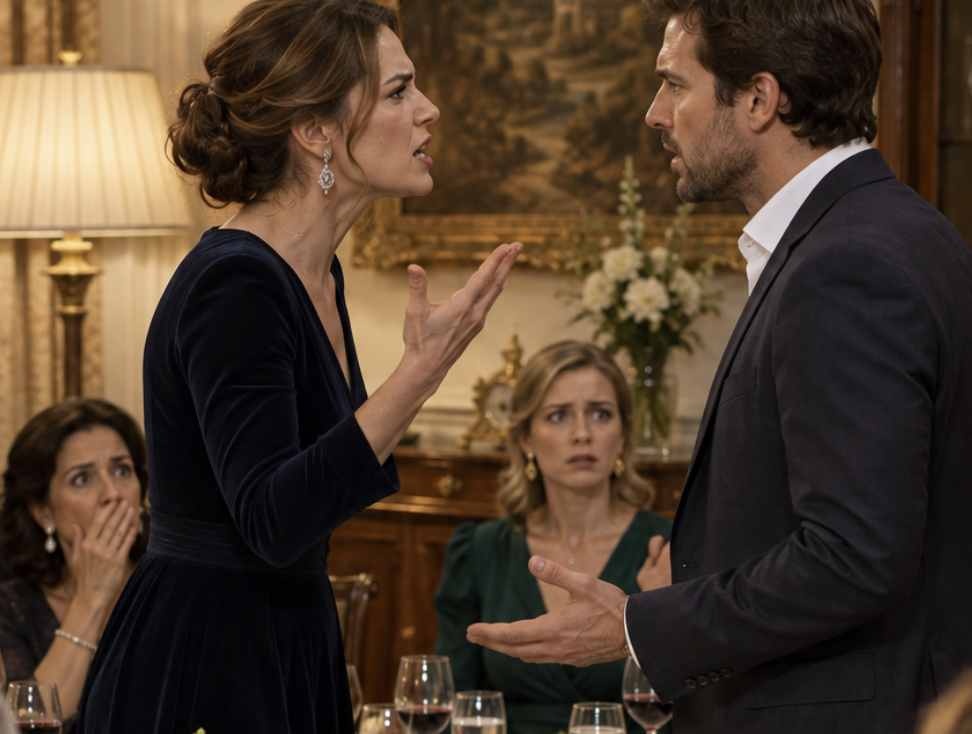
— Vlad, stop it already. I’ve asked you three times: please don’t talk about that at the table.
Ksenia said this quietly, but just loud enough that Vladislav could hear her. Andrey heard it too. He was sitting across from them and immediately averted his eyes, suddenly finding what was left on his plate very interesting. An awkward silence fell over the table for a moment. Just before, everyone had been chatting and laughing, talking over each other, passing bottles around, reminiscing about old times. It was a typical birthday in an ordinary apartment—no fancy restaurant, no waiters. Andrey had expanded the table, pulled together a mix of different chairs, and the backs of the sofa held guests’ coats. No one had planned to start any arguments.
But Vladislav, as he sometimes did, was getting carried away.
— Why are you getting upset? — he smirked. — I didn’t say anything bad.
— You know exactly what I mean.
— So you came here with just one suitcase. Big deal, is that a secret?
Ksenia slowly set her wine glass down on the table.
— It’s not a secret. But every time you bring it up, you make it sound like I spent six years living off you.
— Oh, here we go, — Vladislav said, turning to Andrey. — Seriously, look at it yourself. She came here from a small town, lived in a company dorm, then met me. Everything worked out fine. We got an apartment, the living conditions are good. Am I lying?
Andrey didn’t say anything. He’d heard this story before—except Vlad had told it shorter, and it sounded more like a joke back then. Tonight, his tone was different. And Ksenia felt it more than ever.
When they met, Ksenia was twenty-five. She really did move from a small town and spent her first days living in a dorm given by the company to new employees. The room was simple: a narrow bed, a wardrobe, a desk, and a shared hallway. Ksenia was never ashamed of it. In fact, she was proud of managing everything herself—moving on her own, finding a job without any help. She didn’t have her own place, or well-off relatives nearby, or any ready-made city life. But she never saw herself as someone who needed rescuing.
At first, Vladislav even liked this about her for a different reason. He used to say that Ksyusha was determined and tough, and he admired that she wasn’t afraid to start over in a new place. After their wedding, Ksenia moved in with him. The apartment was Vladislav’s, and she never claimed any part of it—not even in the early years when she earned less. She never talked about shares of the apartment, transferring ownership, or saying that half should be hers now. To her, it just felt natural: they were married, so they lived together, paid together, built their life together.
That’s exactly how it was. Ksenia regularly bought groceries, covered some everyday expenses, contributed to big purchases, and invested in their trips. As time went on, her situation at work changed. She didn’t stay in one position, took on more responsibility, grew professionally, and eventually became the deputy head of her department. By then, her income was at least equal to Vladislav’s. Sometimes, she was the one to handle major family expenses, and neither of them ever thought to keep track of who owed what for every transfer.
Well, Ksenia never thought about it.
Vladislav, for some reason, still clung to their old story. At first, it genuinely seemed like a running joke he loved to repeat. When with friends, he’d say things like, “I rescued Ksyusha from her dorm,” or bring up the suitcase she arrived with. Ksenia would laugh along, but she found it less funny every time. Then, his comments became more unpleasant. He claimed she would’ve lived in her dorm for much longer if it weren’t for him, or that she got a ‘normal city life’ only because of him, or that she quickly got used to the good life.
The first time Ksenia asked him to stop, there was no drama.
“Vlad, it makes me uncomfortable when you say things like that in front of people.”
“What am I even saying?”
“That you basically picked me up.”
“Oh come on, Ksyusha, it’s a joke.”
“Then it’s funny only to you for some reason.”
“Everyone knows it’s just how we met, that’s all.”
“A story about how we met can be told differently.”
Vladislav brushed her off. A while later, it happened again. Then again. Ksenia started speaking more firmly, but he always replied the same way: stop imagining things, nobody is humiliating you, you’re overreacting. The better things went for her at work, the more this stuck image annoyed her—as if she was always just that girl from the dorms, and Vladislav the benefactor who gave her a “real” life.
In reality, almost everything had changed in the last six years—except for his favorite story.
Ksenia felt this especially strongly in the past two years. At work, she was responsible for more than her own tasks; she was trusted with people, deadlines, and decisions that determined the results of the whole department. She was used to being consulted, her opinion mattered, she managed her earnings and planned expenses with confidence. At home, she never split purchases into “mine” and “yours.” If groceries needed buying, she bought them. If they were taking a trip and it was easier for her to contribute more, she did. If there was a big family expense, it was solved from their joint resources. Vladislav had no problem accepting this and never said, “No, that’s too much, you used to live in a dorm.” The past only came up when he wanted to play the part of the guy who once lifted his wife to a better standard of living.
Sometimes Ksenia tried to explain it exactly like that. No shouting, no resentment.
Vlad, you can tell people how we met. I really don’t mind. Just don’t keep acting like I had no life at all before you.
I don’t say that.
You do say it. You always add that, without you, who knows where I’d be.
That’s just a bit of exaggeration to make the story funnier.
Well, it’s humiliating for me.
Ksyusha, people aren’t idiots. They know I’m joking.
I’m not an idiot either. And I know you repeat it on purpose.
By then, Vladislav was already getting annoyed just by the conversation itself. He felt like his wife was making him defend himself for saying something meaningless. He could go silent for a week or a month, but then at some new gathering, the suitcase, the dorm, and his so-called ‘rescue mission’ would come up again. Sometimes he’d say it softer, sometimes harsher, but the point always stayed the same. Every time, Ksenia felt stupid: if she kept quiet, it was like she agreed; if she objected, then she was accused of ruining the evening over a joke. That’s exactly what Vladislav relied on. He knew perfectly well that she hated public scenes and would almost certainly just wait until they got home.
What irritated her most was that he never connected this old story to their current finances. Ksenia could pay for most of a trip, cover a major family expense, or be the one handling groceries for weeks—none of that seemed unusual family life to him. But the moment Vladislav brought up the past in front of friends, she was turned into that girl with just a suitcase again. He never saw any contradiction in that.
That’s why, at Andrei’s birthday, Ksenia first tried to stop her husband quietly. She didn’t want to ruin the celebration. Andrei was a mutual friend, the guests were all mature, familiar faces. She wasn’t there to air out their relationship. But Vladislav, having had enough to drink that he was louder than usual, started right in with exactly what she’d asked him not to mention.
I remember her back then, he continued as if Ksenia hadn’t said a thing. Just one suitcase, living in the dorm. So independent.
Vlad.
Wait, let me finish. I’m telling a good story here.
I said: stop it.
He looked at her and smiled, but now it was an irritated smile, not a happy one.
What’s bothering you again? Is it the facts?
It’s the way you tell those facts that bothers me.
How else am I supposed to tell it? You came from the provinces, didn’t have a place to live here. Then you married me and moved in. That’s what happened.
And what then?
Nothing. You just ended up with a good life.
Ksenia felt herself getting angry. She noticed that a few people at the table had already stopped participating in the conversation. Andrei clearly wanted to change the subject, but Vladislav wouldn’t let him.
Vlad, we’ve talked about this at home. More than once.
Why do you always have to turn this into a problem?
Because it is a problem for me.
Well, I think you’ve started thinking a bit too highly of yourself lately.
After that line, Ksenia couldn’t hold back anymore.
What do you mean by that?
Exactly what I said. Your career’s going well, your salary is decent now, and suddenly the past is uncomfortable to remember?
It’s not uncomfortable for me to remember my past. I’m not ashamed of it.
Then what are you making a scene for right now?
I don’t want my husband to act like I’m someone he once saved, especially in front of others.
“Who did I save?” Vladislav smirked again. “Honestly, without me, who knows how long you’d have stayed in that dorm. Maybe you’d have gone back to your small town ages ago. And who knows what you would have achieved there.”
A few people at the table fell completely silent now—it was impossible not to notice.
Ksenia stared at her husband, in shock that he was saying this after all their talks. Not at home, not in a kitchen argument, not just slipping up. Here. At the table. In front of people. With that same smirk that always came right before, “Come on, I’m just joking.”
“Are you finished?” she asked.
“What, you don’t like hearing the truth?”
“The truth? What truth?”
“That you’re lucky to have me.”
“I’m lucky to have you?”
“Well, aren’t you? I brought you here, gave you registration, an apartment, a good living situation. You got used to it fast.”
Finally, Andrei stepped in:
“Vlad, maybe that’s enough. Let’s talk about something else.”
“I’m perfectly calm,” Vladislav waved him off. “It’s Ksyusha who’s worked up again.”
“I’m worked up?” she repeated.
“Just look at yourself.”
Ksenia stood up from the table. She stopped caring that it wasn’t her party, that everyone was watching, or that she might feel embarrassed tomorrow. All of that faded into the background. For six years, she’d heard the same story in so many versions. She had asked her husband several times to stop telling it like her achievements only started with his apartment. He never promised to stop, because he didn’t even think it was wrong.
And now, he was proving that once again.
“So I’m some penniless bride, is that it? You’re telling everyone here that you basically rescued me from the street? Go ahead, keep your registration! I provide for myself, and I pay for half of our expenses! You will not humiliate me in front of people anymore!”
Vladislav stood up too.
“Are you serious right now? Why are you screaming?”
“Because I’ve already told you quietly!”
“I never humiliated you!”
“You literally just said I wouldn’t have achieved anything without you!”
“Because that’s just the truth! Who were you back then? A girl from the dorms coming from a small town!”
“And who am I now?”
“Ksyusha, don’t start tallying up achievements now.”
“I’m not counting achievements. I’m telling you that you’ve been telling this same convenient story about me for six years! Like everything I have only happened because you let me move in with you.”
“And did that apartment just appear out of nowhere?”
“The apartment is yours! I never said it was mine!”
“Then why are you yelling about it now?”
“Because you just used it as proof that I owe you something!”
Vladislav threw his hands up in frustration.
“Nobody’s saying you owe me! You’re making things up and now you’re causing a scene here.”
“Vlad, stop,” Andrei spoke up again. “Seriously.”
But by now, Vladislav was only looking at his wife.
“So what’s the big scandal? Just some old story? Everyone here is an adult, everyone gets a joke.”
“If someone asks you, several times, not to joke about them like that, a normal person would stop.”
— Don’t tell me what a normal person should do.
— Looks like someone needs to be told.
— Of course. Now that you’re deputy director, you think you can boss everyone around.
Ksenia picked up her glass from the table. There was a little wine left at the bottom. Vladislav kept going on about her attitude, saying she thought too much of herself, and how quickly she’d forgotten the beginnings of her city life. Then, in a sudden move, Ksenia threw what remained of her wine right onto his white shirt.
The red stain immediately spread across the fabric.
Vladislav froze.
— What did you just do?
— Exactly what I need to in order to actually leave this place, — Ksenia replied.
She set her empty glass down, grabbed her things, and started for the door. Andrei made to follow her, but Ksenia just said:
— Don’t, Andrei. It’s your birthday. I’m sorry things turned out this way.
— Ksenia…
— It’s okay. I’ve got this.
Of course, things were anything but okay. She left the apartment alone, still angry, confused, and yet surprisingly together. She didn’t want to go back home. That was Vladislav’s apartment—his things, his habit of saying he gave her a normal life. After what happened at that table, the thought of going back there like nothing happened felt impossible.
Outside, for the first time all evening, Ksenia stopped dwelling on what Vladislav had said and considered how everyone else reacted. No one laughed when he made that last joke about her provincial roots. Andrei tried to intervene. A couple of people just went silent. That was uncomfortable, but it proved she wasn’t imagining things. His words really sounded demeaning. All these years, Vladislav convinced her she was too sensitive, that she took jokes too seriously, creating problems where others saw only smiles. But tonight, no one was smiling.
This made things both easier and harder. Easier, because Ksenia finally stopped doubting her own feelings. Harder, because she had to accept that her husband didn’t just not understand her concerns—he heard them, and still went on. For him, telling an entertaining story about himself was more important than the fact that, every time, his wife felt like some poor relative lucky to get into a nice apartment.
Ksenia’s employer had a few rooms for visiting employees. She’d known about them for ages—she’d even looked into them before the wedding. That night, she managed to arrange a temporary stay. The room was much simpler than the apartment she’d shared with Vladislav. Nothing extra, just the basics. But Ksenia immediately realized that this was exactly what she needed right now, way more than going back to that home.
Vladislav was absolutely sure that his wife would calm down in a few days. To him, everything that happened seemed like an overreaction to a failed joke. He couldn’t imagine why Ksenia would actually end a six-year marriage over just one evening. He thought the awkward temporary room and the lack of their usual home comfort would speak for themselves. Ksenia would cool off, remember their normal life in the apartment, and come back.
But for Ksenia, it hadn’t been about just one evening for a long time.
In those first days, she kept replaying the conversation at the table in her mind. She felt a bit embarrassed about the wine—that had been a dramatic move, and she didn’t try to excuse herself for it. But every time she started to doubt herself, she remembered not the stain on Vladislav’s shirt, but his confident voice: “Without me, who knows how long you would’ve stayed in that dorm.” And the way he told her she thought too highly of herself.
It wasn’t even about the past. It was about the role Vladislav still assigned her in their marriage. She was supposed to be the lucky one, the one he moved in, the one whose current status could always be dismissed with a reminder about the dorm she came from. That’s when his jokes still made sense; that’s when he was still the guy who had ‘given her a start,’ as if all her six years of work, growth, and commitment were just extras on top.
The temporary room threw the difference between what Ksenia had in her marriage and what she was left with now into sharp relief. But even this didn’t make her waver like before. In fact, in these humbler surroundings, she could finally put away—both literally and figuratively—everything she’d brushed off for so long as ‘just her husband’s jokes.’ She wasn’t ashamed of the dorm, or of her small hometown, or of moving into Vladislav’s apartment after the wedding. The real shame and humiliation was that her own husband used these facts as a way to position himself above her in public.
Ksenia compared it to how they split expenses in day-to-day life. Vladislav never brought up her ‘poor past’ when it came time to pay for groceries or big family purchases. He never said that since it was his apartment, Ksenia didn’t need to spend her money. Even when they traveled, it didn’t bother him if she sometimes covered a significant part of the costs. There, she was an equal, independent woman with a decent salary. But in front of others, she turned into that girl from out of town whom he supposedly rescued into a better life.
That’s exactly why Ksenia decided to collect her things.
When she went back to the apartment, Vladislav still acted like everything was just temporary. He didn’t try to stop her from packing, but it was clear from his face that he thought she’d change her mind. Ksenia only took what was truly hers—her clothes, her personal belongings, the things that belonged to her alone. So much was left in that apartment, things she’d spent money on over the years. Some expenses couldn’t even be ‘taken back’—the groceries, the trips, the shared life, the big family purchases. Ksenia wasn’t trying to make her leaving into some accounting exercise.
“Are you really serious about all this?” Vladislav asked as it became increasingly obvious there were fewer and fewer things left in the apartment.
“Yes.”
“Because of Andrei’s birthday?”
“No. Because it’s been six years of the same story.”
“You’re exaggerating again.”
“Maybe so.”
“So what now?”
“Now, I’m filing for divorce.”
This time, Vladislav didn’t answer right away. He probably realized for the first time that life wouldn’t just snap back to normal. But even then, this didn’t change Ksenia’s mind.
She filed for divorce, just like she said she would.
Her standard of living noticeably shrank right away. Marriage had meant a comfortable routine, Vladislav’s apartment, belongings accumulated over years, trips together, and not having to start every household need from scratch. Now, some of that comfort was just gone. At first, Ksenia had to put her life back together piece by piece. It wasn’t pleasant, and sometimes it was downright hard. She didn’t tell herself a fairy tale that freedom would automatically make everything easier.
What really bothered her wasn’t counting the money, but counting the years. How many times had she calmly paid for what both of them needed? How many times did she never question who actually owned the apartment when it came to family expenses? Back then, it never crossed her mind to say, “This isn’t my place, so I’m not going to spend money on our home.” She lived like a wife. But whenever it suited him, Vladislav would dig up her old dorm room as if it forever meant she was second best.
Ksenia didn’t want to rewrite history to suit herself now. Yes, after the wedding she did move in with Vladislav. Yes, living in his apartment was more comfortable than the temporary staff room she’d had before. Yes, the marriage brought her certain stability in everyday life. But that didn’t erase the other half of the story: for six years she worked, grew, earned, and invested in their life together. That was the part Vladislav always left out when he wanted to impress people.
But still, she didn’t want to go back.
Things were different for Vladislav. The apartment stayed with him. His standard of living didn’t really change. There was no financial penalty for the divorce. Only after some time did he realize their old group of friends had started gathering without him.
At first, it just seemed like a coincidence. Then it became clear: their mutual friends had stopped inviting Vladislav. Not because they’d all suddenly taken Ksenia’s side in the divorce. After that one evening, people started remembering other jokes of his—comments they used to ignore or just chalk up to an unpleasant sense of humor. It turned out Ksenia wasn’t the only one he’d offended, only to later explain that everyone was an adult and should be able to take a joke.
For Vladislav, this turned out to be more uncomfortable than he’d expected. He’d always thought of himself as outgoing and witty, not as someone people had to brace themselves around, worrying the next joke could be humiliating. But now it wasn’t so easy to change how people saw him.
After Andrey’s birthday, people started remembering past conversations differently. What used to be brushed off as part of Vladislav’s personality now looked like one unpleasant habit: he’d make a cutting remark, then claim it was just a joke. The incident with Kseniya was the most talked about, since this time it happened right in front of everyone, and she didn’t pretend everything was fine.
Gradually, mutual friends stopped inviting Vladislav to hang out with the group. It wasn’t about the divorce itself, or needing to pick sides with Kseniya. That night just made everyone remember his other humiliating jokes they used to ignore. No one wanted to sit at the table wondering who he’d target next.
Kseniya’s life became much simpler compared to her time married. Most of her previous comforts were gone. She knew she’d lost a lot, in practical terms. The money spent on shared expenses over the years was never coming back. And you can’t just pack up six years of marriage into a suitcase and take it with you.
Sometimes, she felt the absence of that old life most acutely: not having to buy every little thing for the house again, not squeezing into a temporary room, not worrying where to put her things. But Kseniya no longer confused convenience with someone’s right to put her down. Now, she truly understood the price of comfort. If having it meant going back to playing the grateful “girl from the provinces” who should thank her lucky stars, she wasn’t willing to pay that price anymore.
But one thing did disappear—something that had poisoned nearly every introduction Vladislav had with new people in recent years: the moment he’d inevitably bring up how he once “rescued” a girl from a student dormitory.
Now she didn’t have to cut him off, ask him to stop, or fake a polite smile to avoid drama. She no longer had to listen to him tell her she thought too highly of herself. There was no need to prove the obvious: that her job, her title, her salary, and her share of expenses belonged to her own life—not just perks from marrying into his address and apartment.
The hardest part for Vladislav came later. Their friends stopped inviting him—not because of the divorce, but because that night reminded everyone of his other humiliating jokes. Kseniya started over, living much more modestly than she had in the marriage. But she refused to ever again be the person Vladislav once supposedly did a favor for…