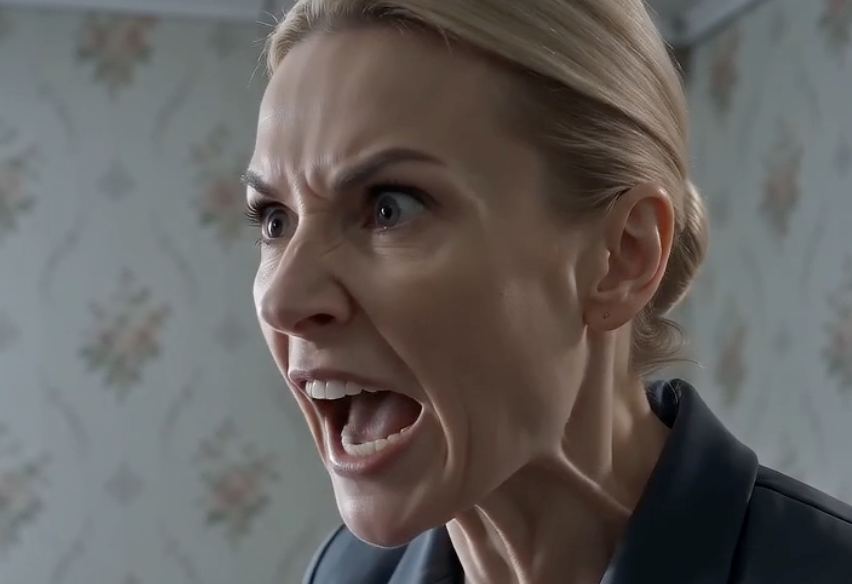
Tamara Ivanovna entered their rented one-room apartment for the first time as though she had come to inspect the work of incompetent employees. She ran a finger along the edge of a shelf, looked at her finger, and then at Vera. Her smile came out sour, like an unripe plum.
“Well, so this is how you live,” she said. “Someone else’s wallpaper, someone else’s sofa, someone else’s dishes. You’ve arranged things nicely for yourselves.”
“At least our conscience is our own,” Vera replied. “It came with the package, free of charge.”
Artyom laughed from the hallway, and his mother sharply turned toward her son. Her glance was brief and angry, like a mousetrap snapping shut. Artyom swallowed his laughter, but his eyes remained amused.
“I told you from the very beginning,” Tamara Ivanovna said, sitting on the edge of the sofa without taking off her coat. “You got married right after university without a thing to your names. No home, no money, no sense. Romance on a rented mattress.”
“The mattress, by the way, is orthopedic,” Vera remarked. “It’s the only thing in this house that actually supports anyone’s back.”
Artyom had suggested something else at the time. He wanted them to spend their first few months living with his mother in the same two-room apartment where an old car beneath the windows had been slowly dying ever since his father left the family.
Vera refused immediately, firmly, without taking offense or slamming doors.
“Artyom, if we move into her apartment, we’ll stay there until retirement,” she said. “Hardship isn’t a curse. It’s exercise. Muscles only grow when things are difficult.”
image
“Do you understand how much rent is going to eat up?”
“I do. Which is exactly why we’ll both have to grow faster than the rent does.”
He agreed reluctantly, as though he were signing an unfavorable contract.
His mother, however, was almost indecently pleased. Her daughter-in-law wouldn’t be walking across her parquet floors or opening her refrigerator. She even called to congratulate them on their independence, and the relief in her voice was obvious.
And now she was sitting on someone else’s sofa, explaining to them how they should live.
“Don’t have children,” she said. “Do you hear me, Vera? This is not the time. Don’t even think about it.”
Vera placed the vase she had been holding on the table and calmly looked at her mother-in-law.
“Straight to the point. Will there be any arguments, or is this like a weather forecast—no explanations necessary?”
“Arguments?” Tamara Ivanovna flared up. “And who is going to help you? Who? Me? Whose neck are you planning to sit on? Diapers, strollers, doctors! You can barely support yourselves!”
“You may be surprised, but a child usually has a mother and a father. A grandmother is a pleasant addition, not a load-bearing wall.”
“Think you’re clever, do you?”
“I try. It’s not hereditary. I acquired it.”
Artyom stepped into the room.
“Mom, enough. We’ll decide for ourselves when and what we do.”
“And you should start thinking with your own head!” she snapped at him so sharply that he stopped mid-sentence. “You already thought for yourself once—you got married. That’s enough heroics.”
Vera learned about his sister later.
Yulia had been married for ten years, was paying off a mortgage, and had no children. Artyom once mentioned that his mother had pressured her, insisting that she first get firmly established in life before having children.
“Wait,” Vera had said, confused. “Yulia has a husband and her own apartment. What does your mother have to do with any of it?”
“Vera, don’t stick your nose into someone else’s life. Let them deal with it themselves.”
“I’m not sticking my nose in. I’m just observing that someone else’s nose has been living there permanently for years.”
At the time, Artyom was learning to operate a new machine—a piece of equipment whose control panel was more complicated than an airplane’s. He spent more time writing programs than standing beside the machinery, and the job paid well.
Vera worked with technical texts. There was no room for elegant deception in that kind of work. One inaccurate phrase could lead someone to assemble a component incorrectly.
Her salary was modest but steady, like a metronome.
And they really were beginning to come out ahead financially. Slowly, little by little, nibbling away at the burden of rent.
Then one day Vera came home and stopped in the hallway with a bewildered expression.
“What is it? Another difficult text?” Artyom asked.
“No. I’m pregnant.”
He froze.
One second.
Two.
Three.
Then he hugged her, kissed her temple, said something excited and incoherent, and when Vera went to wash her face, he sat down and lowered his head.
Goodbye, Paris.
Goodbye, Egypt, which they had been talking about for six months.
They were finally making more than they spent, but their margin was razor-thin. Rent consumed money. A child would consume even more.
Their youth had ended today, at approximately seven in the evening.
Vera saw him through the crack in the door and understood everything without words.
She called her parents the next day, and within an hour they were already sitting in the apartment.
Larisa Petrovna gasped and kept touching her daughter’s hands. Oleg Sergeyevich heard the word “pregnant” and smiled so broadly that it became obvious he had been waiting to hear it for at least five years.
“Grandchildren,” he said, rubbing his hands together. “Between us, I was already beginning to suspect that you two had decided to live only for yourselves until your hair turned gray.”
“Dad.”
“I’m quiet. Rejoicing silently.”
“But how are you going to manage?” Larisa Petrovna asked quietly. “Vera, you’re renting. Everything will fall on Artyom’s shoulders. You’re young. It will be difficult for you.”
“Mom, things are already difficult. Now at least the difficulty has meaning.”
It took Artyom two weeks to gather the courage to tell his mother.
He called her, delivered the news in an even voice, heard silence on the other end, and then a short reply:
“I’ll call you back.”
She didn’t.
That evening, she was standing on the threshold of their apartment.
Artyom wasn’t home.
“Have you completely lost your mind?!” his mother shouted at Vera from the doorway without taking off her shoes or even saying hello. “No money, no proper job. You are not having this baby!”
“I have a job,” Vera said. “It just doesn’t make loud noises, so you apparently don’t hear it.”
“Your pennies! You’ll buy one week’s worth of diapers with them!” Tamara Ivanovna marched into the room, her hands trembling. “You haven’t got a penny to your name, you’ve barely started working, and you’re already pregnant! What are you going to do with a baby? What will you feed it? Dreams?”
“You know, somehow people have managed to do it for thousands of years. Even without your approval.”
“Don’t get sarcastic with me!” Her voice rose to a shriek. “Go and deal with the problem! Do you hear me? While it’s still early—go and get an abortion! You’ll thank me later!”
Vera stepped backward.
Not out of fear, but out of sheer astonishment that someone could actually say such words aloud.
“Say that again. I want to remember the exact wording, so later you can’t claim I made it up.”
“I’ll say it again! Abortion! A baby right now would be a stone around your neck. And around mine! I’m not going to become your babysitter. I didn’t raise a son for this!”
“No one invited you to. You came here yourself, without an invitation and without tact. You didn’t even take off your shoes.”
“Impudent girl!”
“Efficient. I save time by skipping the curtsies.”
Her mother-in-law yanked at her scarf as though it were choking her, then stormed out, slamming the front door so hard that the glass in the balcony door rattled.
Artyom came home and found his wife sitting on the sofa with red eyes.
He listened in silence, his jaw muscles tightening.
Then he picked up his phone and dialed a number.
“Mom. I know everything. Today you told my wife to get rid of my child.”
“I told her the truth!” his mother shouted so loudly through the phone that Vera could hear every word. “Someone had to!”
“The truth about how she should dispose of someone else’s life?” Artyom’s voice was calm, and its calmness made it almost frightening. “Then listen to my truth. The baby will be born. I have one wife, and that wife is Vera. I don’t need your money—not one ruble, not for diapers, not even for a monument to my shattered nerves. And you are not coming here anymore. Not with permission and not without it.”
“How dare you speak to me like that?!”
“Respectfully. Notice that I haven’t even raised my voice. I’m simply putting boundaries back where you drove a bulldozer through them.”
She gasped and hung up.
Twenty minutes later, Yulia called.
“Artyom, have you gone insane? What kind of baby can you possibly afford?” his sister began rapidly, as though reciting something memorized. “It’s all going to fall on Mom! She’s alone, she has that two-room apartment and a piece of junk sitting beneath the windows!”
“Yulia, stop,” he said. “That isn’t your voice talking. It’s hers, just with a higher pitch.”
“I’m saying sensible things!”
“You’ve been saying sensible things for ten years. You listened to her, and now you have a mortgage, a perfectly tidy apartment, and a husband who has spent the last two years looking straight past you. One more year of being sensible and he’ll leave. Right on schedule.”
“Don’t you dare!”
“I do dare. Because you called me to interfere in my life while you’re too afraid to live your own,” Artyom exhaled. “And remember this: you do not call my wife about this subject. Ever. No hints, no sighs, nothing.”
He ended the call.
Vera looked at him in such a way that he became uncomfortable.
“What?”
“Nothing. I’ve just never seen someone hold a phone in one hand and defend a fortress with the other.”
Two days later, her parents came over in the evening.
Oleg Sergeyevich sat down and placed a folder on the table. Vera had just enough time to wonder whether it contained documents for a car.
“We sold the house,” he said simply. “Grandmother’s house in the village. And we scraped together everything else we could find. Three million.”
“Dad…”
“Quiet. The money is yours. We’ll formalize it as a gift through a notary, in your name, so no one can ever have anything to say about it later. Buy yourselves a home.”
Vera covered her face with her hands and laughed, and there were more tears than amusement in that laughter.
Artyom stood up and shook Oleg Sergeyevich’s hand.
His voice came out hoarse.
“I will never forget this. Never.”
“Better make sure you never forget her,” the older man said, nodding toward his daughter. “We’ll manage.”
“It’s enough for a one-room apartment,” Larisa Petrovna calculated aloud. “Nothing fancy, but it would be yours.”
“Two rooms,” Artyom said. “We’ll buy a two-room apartment and cover the difference with a mortgage. The baby needs a room, not a corner behind a wardrobe. I can handle it. My income is growing, and not every workshop has a machine like the one I operate.”
“A mortgage is a long commitment,” Larisa Petrovna said cautiously.
“So is a child’s room.”
Artyom didn’t tell his mother a single word.
Not about the money.
Not about the mortgage.
Not even the address.
But the world is small.
Tamara Ivanovna accidentally ran into Larisa Petrovna, began with some poisonous sympathy, and within a minute discovered everything for herself.
She arrived at their apartment that evening while Vera was packing their belongings into bags and labeling them with a marker.
Artyom opened the door and remained standing in the doorway, blocking the corridor with his shoulder.
“Let me in,” his mother said. “I want to look that… that woman in the eyes.”
“You’re not going farther than the hallway.”
“You’ve put yourself in bondage!” she immediately began shouting. “A mortgage! For twenty years! With a pregnant wife! Do you understand what you’ve done?!”
“I do. I bought my child a bedroom. Expensive, but it comes with a window.”
“Idiot! Those people have trapped you! Your mother-in-law and her husband gave you three million just so they could put you on a hook!”
“Three million isn’t a hook, Mom. A hook is when someone offers to let you live in their home and then spends twenty years reminding you who owns the place.”
Vera didn’t interfere from the room.
She folded sweaters, sealed bags with tape, and wrote “bedding” on one of them.
She heard every word and remained silent—not because she was afraid, but because her husband was handling it himself.
“And her?!” his mother-in-law pointed toward the room. “She’s silent! Clever little thing! Climbed onto your neck and now she sits there silently!”
“She’s packing our belongings. For our apartment. Strange way of sitting on someone’s neck—carrying bags.”
“I am your mother!”
“You are my mother. And that is exactly why I am going to say this once. You demanded that my child be killed. That wasn’t advice. That wasn’t concern. That wasn’t ‘I only meant well.’ That was a sentence you passed on yourself. You will not have a grandson. You will not have a granddaughter. You chose that yourself.”
She opened her mouth to answer, but Artyom raised a hand.
“And one more thing. You call this concern about money. It isn’t. It’s greed, Mom. Ordinary greed. You’re afraid that you might have to give something—time, effort, rubles. So from your point of view, it’s cheaper if no one is born at all.”
Tamara Ivanovna recoiled as though he had physically pushed her.
“You… you people!” She searched for words and couldn’t find them. “Yulia is the smart one! She refused! Once they finish paying the mortgage, then they’ll think about children!”
“Right. At sixty. Brilliant idea.”
She turned around and marched down the stairs, loudly and indignantly listing everyone responsible for the disaster: the mother-in-law and her husband who had interfered with their money, the son who had completely lost his mind, and the daughter-in-law who would now sit on his neck permanently.
Her voice could still be heard from the third floor.
And at that exact moment, everything was collapsing in the life of her beloved, sensible, reasonable daughter.
Denis placed a bag beside the door and said simply:
“Yulia, I want a divorce. There’s no point anymore. We spent ten years waiting for permission. I don’t want to wait anymore.”
Artyom closed the door and turned the lock.
He leaned against it with his back and exhaled.
Vera walked over and hugged him so tightly that he grunted.
“You’re a knight,” she said. “Just without the horse and wearing a house T-shirt.”
“A knight with a mortgage. A new genre.”
“You’re going to be the best dad in the world. I know that for certain. I proofread texts for a living—I have an eye for accuracy.”
He smiled, placed his palm against her still almost-flat stomach, and held it there—large, warm, and trembling slightly.
“Listen here, little guy,” he said, looking downward. “Your room will have a south-facing window. And you’ll have relatives—the kind who love you, not the kind who keep count.”
“And what if it isn’t a little guy, but a little girl?”
“Even more so. Then I won’t let a single person tell her when she has the right to live.”
Vera buried her face against his chest and finally cried—softly, without anguish, the way people cry when the frightening part is already behind them.
“Are we going to manage?”
“We already are,” Artyom said. “We just haven’t labeled all the bags yet.”