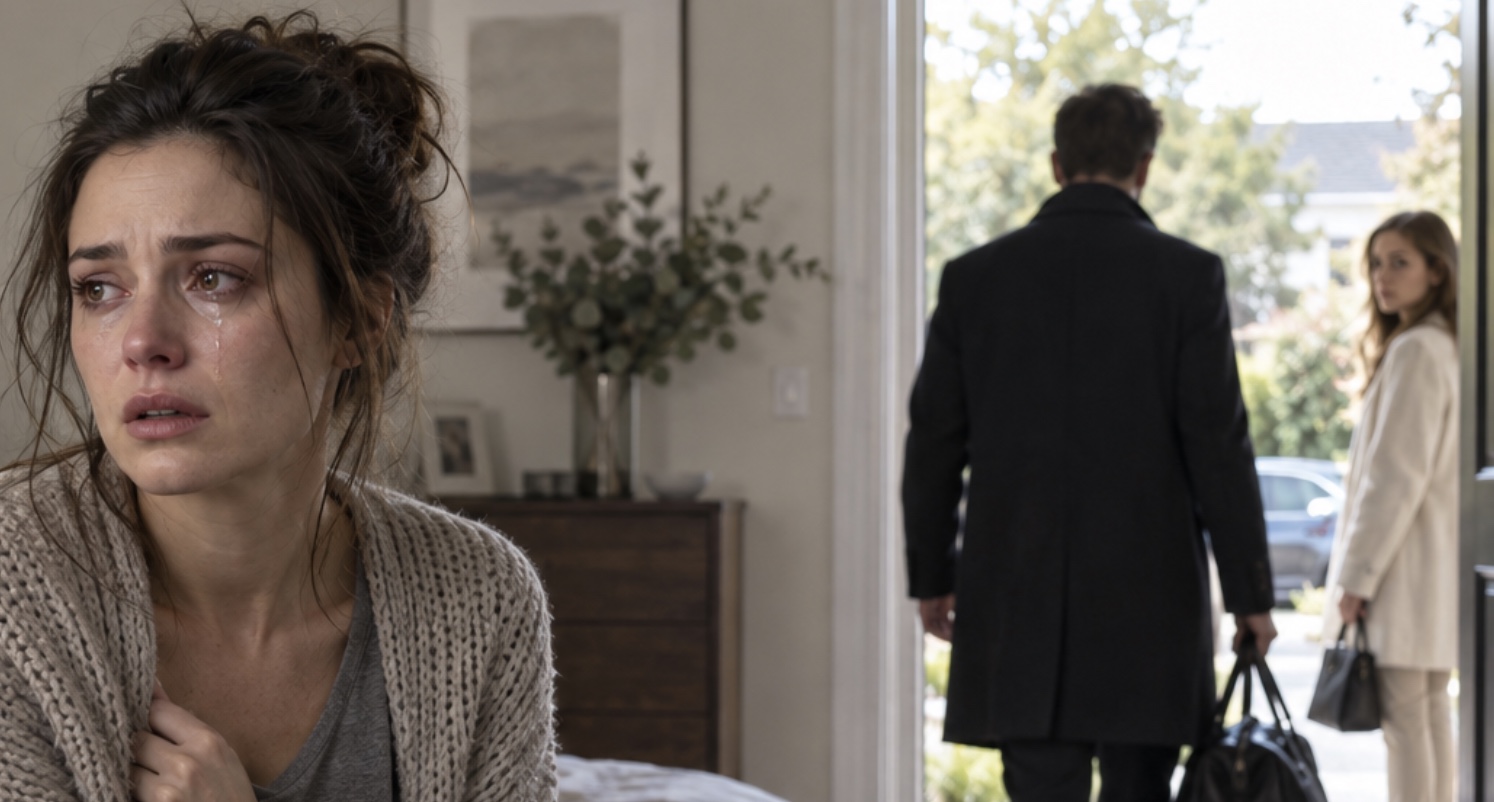
That day, Anna wore a backless dress for the first time in five years. The illness that had slowly and mercilessly drained the life from her body was finally gone. At her last examination, the doctor had smiled and spoken the words she had longed to hear.
“You’ve made a complete recovery, Anna. You’re free now.”
She practically flew home.
Candles were already burning in the living room, and dinner from their favorite restaurant was waiting on the table. Mark sat silently in an armchair. When Anna entered, he did not smile. He did not embrace her or spin her around the room as he used to do on the rare days when she had felt well enough to laugh.
He looked pale, and dark shadows lay beneath his eyes. Anna assumed he was exhausted. Recently, Mark had been spending an enormous amount of time at work.
“Anna, we need to talk,” he said, his voice strangely distant.
“Mark, look at me!”
 
Anna twirled around, making the hem of her dress rise gracefully around her legs.
“My love, the doctor said my test results are excellent. I’m free! I’ve completely recovered! I’m so happy!”
Mark did not raise his eyes. He stared at his hands resting on his knees.
His silence frightened her, but she continued smiling, still glowing with happiness.
“That’s wonderful,” he finally said. “I’m glad you’re better. Because I’m leaving. This dinner is my farewell gift to you.”
The air in the room suddenly became unbearably heavy.
Anna froze, convinced that he was making some cruel, ridiculous joke. Then she noticed the large suitcase standing near the front door.
“What? Where are you going? Mark, what’s happening?”
He rose from the armchair. His movements were stiff and strangely cautious. When he looked at her, his eyes were cold and unfamiliar. Not a trace remained of the tenderness that had carried her through the five most painful years of her life.
“I’m tired, Anna,” he said, carefully pronouncing every word as though he had rehearsed the speech dozens of times. “You were ill for too long. Five years of my life disappeared into an endless cycle of pharmacies, hospitals, tears, and the smell of medicine. I want to live normally again. I want to enjoy myself, go to parties, and travel. I’ve met someone healthy—a young, cheerful woman who doesn’t need me to be her caretaker. I’m sorry. My lawyer will send you the divorce papers.”
He picked up his suitcase and headed for the door.
 
Anna stood completely still. She wanted to scream, block his path, and demand a real explanation. This was the man who had carried her outside in his arms when she was too weak to walk. He had spent every bonus he received on expensive medication for her. How could he simply abandon her now?
The door slammed shut.
In the silence of the apartment, Anna could hear only the faint hiss of a candle burning itself out. Slowly, she lowered herself onto the sofa.
His betrayal hurt more than any physical illness ever had.
That night, the trusting woman she had once been died. In her place, someone new was born—hurt, proud, and fiercely determined to survive. She would rebuild her life in spite of the man who had remained beside her during the darkest years, only to leave when she had needed him most.
A year passed.
Anna poured all her unused strength into her career. The pale, exhausted woman shaped by years of illness transformed into the successful head of a marketing department. She changed her hairstyle, replaced her old wardrobe, and taught herself how to laugh again.
Yet beneath the armor of confidence and success, a deep and stubborn resentment remained.
Mark disappeared from her life entirely. Their divorce was handled from a distance, with an attorney representing him throughout the proceedings. Anna refused to seek him out.
She saw him from afar only twice in the city center. It seemed strange that he wore a windbreaker and a baseball cap pulled low over his forehead despite the warm weather. He also walked unusually slowly, dragging his right leg slightly behind him.
Of course, Anna thought bitterly. He probably spends every night partying with his young, healthy girlfriend. No wonder he looks exhausted.
 
She eventually convinced herself that she had forgotten him.
Then an ordinary Saturday trip to the supermarket turned her entire world upside down.
Anna was choosing fruit when a young woman accidentally bumped into her with a shopping cart. The woman wore a plain tracksuit. Her hair had been gathered into a careless bun, and her face looked gray from chronic lack of sleep.
“I’m so sorry,” she said quietly. “I wasn’t paying attention.”
Anna looked at her—and felt the blood drain from her face.
She recognized the woman from a photograph that a so-called well-wisher had sent her on social media shortly after the divorce.
It was Alina.
The same young and healthy replacement for whom Mark had supposedly destroyed their marriage.
Anger flared inside Anna. She wanted to tell this woman exactly what she thought of her, but pride stopped her. Straightening her shoulders, she spoke with deliberate coldness.
 
“It’s all right. You don’t look very well, though. Does my former husband keep you awake at night?”
She could not resist the bitterness in her voice.
Alina flinched. She stared at Anna with wide eyes. Instead of triumph or hostility, genuine horror flashed across her face. Her fingers slipped from the handle of the shopping cart.
“You’re Anna?” she whispered, her lips beginning to tremble. “My God. It really is you.”
“Yes, it’s me. Disappointed?”
Anna turned to leave, but Alina suddenly caught hold of her coat sleeve.
“Anna, please wait!”
Alina looked around nervously and took a deep breath.
“I can’t keep this secret any longer. I promised your husband I wouldn’t say anything, but I can’t continue watching him suffer. He’s getting worse because he misses you every single day. He needs you, Anna. You’re the person he needs.”
“What kind of nonsense is this?” Anna pulled her arm away in disgust. “If he needed me, he wouldn’t have traded me for someone younger and healthier. Those were his exact words. I shouldn’t have spoken to you in the first place.”
“We were never together!” Alina cried loudly enough to make several shoppers turn toward them.
She muttered an embarrassed apology before looking directly into Anna’s eyes.
“I’m his rehabilitation therapist. The company he worked for hired me. If you can give me a little time, I’ll explain everything—but not here. Please, just give me the chance to tell you the truth. Mark believed he was helping you, but all he has done is destroy himself.”
Anna could hardly remember how they ended up sitting in a nearby café. She listened to Alina while the world she had known crumbled around her, breaking into thousands of sharp fragments.
 
“Three years ago, while you were still seriously ill, there was an accident at one of Mark’s construction sites,” Alina began quietly, stirring sugar into her drink with a trembling hand. “A section of scaffolding collapsed. Mark managed to push a young trainee out of the path of a falling steel beam, but he couldn’t get away in time. He suffered a spinal injury.”
Anna remembered that day.
It had happened during the year when her condition was at its worst. Mark had come home looking pale, with a scrape across his cheek. He claimed that he had stumbled at work and insisted it was nothing serious. Whenever she questioned him, he dismissed her concerns and immediately changed the subject to her health.
“At first, it appeared that he had been lucky,” Alina continued. “But the doctors told him to rest and undergo treatment. He refused to take time away from work. He said he needed to earn more money and that he felt perfectly fine. According to him, his responsibility was to take care of his wife, not waste time worrying about himself.”
Anna felt a suffocating knot form in her throat.
“The injury eventually caused delayed complications,” Alina said. “About a year ago, just as your health was improving, Mark began suffering from terrible pain. His legs would suddenly go numb. After a full examination, the doctors told him he needed an extremely complicated operation. They gave him only a fifty-percent chance of walking afterward. There was a serious risk that he would be permanently paralyzed from the waist down. Even if the surgery succeeded, he would face months—possibly years—of painful rehabilitation, with no guarantee of a full recovery.”
Anna listened in silence, barely able to breathe.
“Mark came to me for a consultation,” Alina continued, finally looking up. “He was desperate, but he wasn’t frightened for himself. He told me, ‘My wife has only just escaped from hell. She spent five years in hospitals. If she learns that I may become disabled, she’ll lock herself away again and devote her life to caring for me. The stress will destroy her. Her illness might return. I won’t allow her to sacrifice the rest of her life for me.’”
 
Soft music played somewhere in the café, but Anna could hear nothing except the pounding of her own heart.
“He planned everything,” Alina said, wiping a tear from her cheek. “He knew you too well. He knew that if he told you the truth, you would fight for him until you had nothing left. You would never abandon him. So he decided to turn himself into a monster in your eyes. He wanted you to hate him because he believed hatred would set you free. He thought he was giving you a chance to live a healthy, independent life instead of becoming the full-time caretaker of a disabled man.”
“Where is he?” Anna’s voice fell to a broken whisper. “Where is Mark now?”
“He’s at a rehabilitation center outside the city. The operation was partly successful. He isn’t paralyzed, but there was significant nerve damage. He’s learning to walk again, and every session causes him terrible physical pain. But the depression is even worse. His progress has been slow, and he seems to have lost the desire to fight. He no longer sees any purpose in recovering because he believes he has lost the only person he ever wanted to live for.”
The rehabilitation center stood in peaceful countryside surrounded by pine trees. Its corridors smelled faintly of antiseptic and fresh wood.
Anna walked down a long, bright hallway, each step feeling more difficult than the last.
A storm of emotions raged inside her. She was furious at Mark for his foolish, stubborn act of self-sacrifice. At the same time, her heart was breaking with tenderness and guilt.
How could she have believed his lie?
How had she failed to recognize his suffering?
“He’s at the parallel bars at the end of the corridor,” Alina said, accompanying her part of the way. “I had to trick him into attending today’s session. I told him a new professor had come to examine him. Go to him.”
Anna rounded the corner and stopped.
 
The rehabilitation hall was spacious, with enormous windows flooding the room with daylight. Two long metal rails stood in the center.
Mark was between them, gripping the bars tightly with both hands.
He wore gray sweatpants and a loose T-shirt that seemed too large for him. He had lost a great deal of weight. Sweat covered his face, and his teeth were clenched so tightly that the muscles in his jaw trembled.
He tried to move his right leg forward.
The leg shook violently and refused to obey him. His knee buckled. A low, desperate sound escaped his throat as his strength failed. He hung heavily between the bars, breathing hard, his forehead pressed against the cold metal.
“And how much longer are you planning to lie around doing nothing?” Anna asked quietly.
Mark froze.
He would have recognized that voice among thousands.
Slowly, as though terrified that she might be a hallucination, he turned his head. The eyes that had once been bright and confident now stared at her with fear and raw, unguarded pain.
“Anna?” he whispered. “What are you doing here? How did you—? Go away. Alina! Alina, take her away!”
He tried to turn from her and hide his face, ashamed of his weakness before the woman he had always tried to protect.
The sudden movement caused one of his hands to slip from the rail.
He began to fall backward.
Anna did not stop to think. Five years of illness had taught her to react quickly in an emergency. She rushed forward and caught him beneath the arms, taking the weight of his body against her own.
They staggered together but remained standing.
 
Mark leaned heavily against her shoulders, his labored breath hot against her neck.
“Please leave, Anna,” he begged, trying unsuccessfully to pull away. There was no strength left in his arms. “Why did you come? I ruined everything. You’re supposed to be happy now. You’re healthy.”
“Yes, I am healthy.”
Tears streamed down Anna’s face, but her voice remained remarkably steady. She wrapped one arm more firmly around his waist and helped him regain his balance.
“I’m alive and healthy because of you and everything you sacrificed for me. And now I have enough strength for both of us.”
She made him look into her eyes.
“You’re such a fool, Mark,” she said through her tears, a faint smile touching her lips. “The kindest, noblest, most ridiculous fool in the world. You held my hand for five years. You refused to let me give up, even when I begged the doctors to stop treating me. Did you truly believe I would leave you here alone, halfway through your own recovery? Did you really think one terrible lie could make me stop loving you?”
Mark stared at his former wife.
For an entire year, darkness had filled his eyes. Now, for the first time, a weak but unmistakable spark of hope appeared within them.
“It’s going to be difficult for you,” he whispered. “I may always walk with a limp. I might never become the strong, successful man you married.”
“I don’t care.”
Anna pressed her forehead gently against his.
“I want my husband. I want you alive. And we’re going to walk again, do you hear me? First, you’ll walk down this corridor. Then we’ll walk through the park. And after that, we’ll travel to the mountains, just as you always dreamed. But we’ll go together.”
Mark did not answer.
 
He simply closed his eyes. Anna felt the tension slowly leave his shoulders—the shoulders that had carried the unbearable weight of pain and loneliness for an entire year.
With what little strength he had left, he wrapped his arms around her and held her tightly.
Behind the glass door, Alina watched them. Smiling through her tears, she understood that Mark’s most powerful rehabilitation had just begun.
This form of therapy—love, hope, and the return of someone worth fighting for—would achieve more than any machine in the building.
A long and difficult year still lay ahead of them. There would be exhausting exercises, painful setbacks, old wounds to heal, and countless obstacles to overcome.
But Mark and Anna were holding hands again.
And beside the strength of a love that even pain, separation, and bitter resentment had failed to destroy, every illness suddenly seemed small.