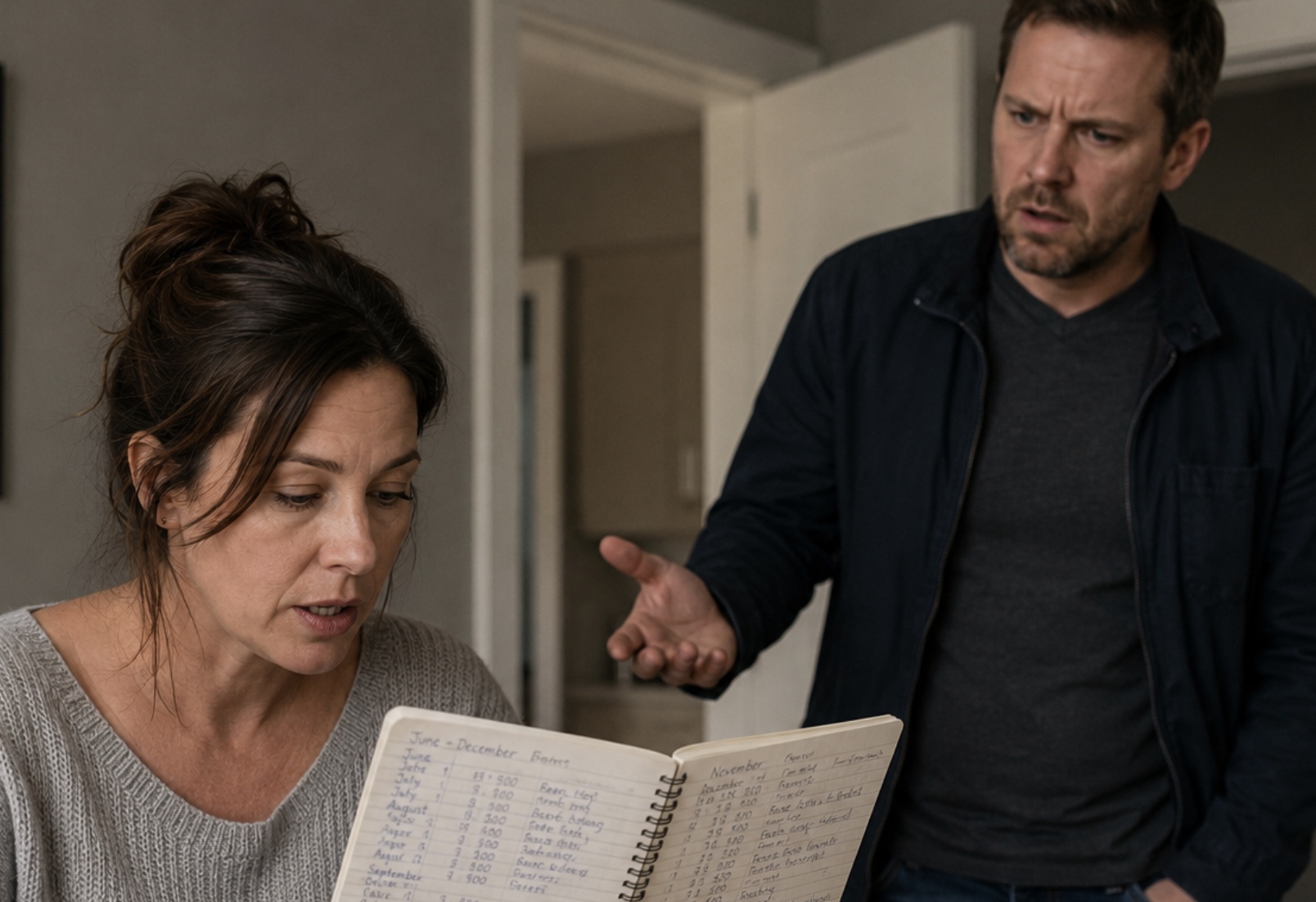
“Mom says you owe her money,” Igor announced the moment he stepped through the door.
He leaned heavily against the doorframe without even taking off his jacket. There was no accusation in his voice, only the dull confusion of a man who had just come home after an exhausting shift at the factory and been handed a problem he could not make sense of. The hallway smelled of wet pavement, autumn air, and fatigue.
Nina, who was standing at the stove in the kitchen, did not flinch or drop the spatula in her hand. She calmly finished frying the onions for the soup, turned off the burner, wiped her hands on a dish towel, and walked into the bedroom.
She opened the bottom drawer of the dresser and took out a thick notebook with a worn blue imitation-leather cover.
Without a word, she returned to the kitchen, sat down at the table, opened the notebook, and began reading aloud.
“April 14, 2019. Payment for dental treatment for your mother, Zinaida Petrovna. Two implants and additional dental work. Sixty-eight thousand rubles. Paid from my debit card.”
Igor froze, one boot still laced.
 
“August 20 of the same year,” Nina continued in the same flat, emotionless tone. “Purchase and installation of a new gas water heater in your mother’s apartment. Thirty-two thousand rubles, including the technician’s fee. Money transferred from my account.”
“Nina, wait…” Igor tried to interrupt as he finally took off his shoes and came into the kitchen.
“No. Listen. Since we’re talking about debts, you should hear all of it.”
She turned the page, every line covered in her neat handwriting.
“November 10. A full set of winter tires for your sister Oksana’s car. Forty-one thousand rubles. Your mother’s exact words were, and I quote: ‘Poor Oksana has it so hard. She’s raising a child alone. Driving on bald tires is dangerous, and you’re family. You should understand her situation.’ I paid with my credit card. I spent six months paying the bank interest myself.”
Igor slowly sank onto a kitchen stool.
He worked as a process engineer and earned a respectable salary, but he and Nina saved most of their money toward buying a larger home. They were living in a cramped two-bedroom apartment Nina had inherited from her grandmother, and they dreamed of moving to a spacious apartment in a newer neighborhood.
Igor had always assumed his mother and younger sister lived modestly but managed on their own. Occasionally he gave his mother a little money for holidays or bought her groceries. He had never realized how much financial support Nina had quietly provided over the years.
Nina owned a small flower shop.
Calling herself a business owner sounded impressive, but in reality it meant waking up at five in the morning, driving to wholesale flower markets, working with her hands constantly soaked in cold water, getting scratched by rose thorns, and carrying heavy buckets full of flowers.
Five years earlier, when she had first rented the shop, money had been desperately tight.
That was when Zinaida Petrovna had ceremoniously handed her daughter-in-law a thick envelope, tears of affection shining in her eyes.
“Take it, sweetheart,” she had said. “Starting your own business is important. I would never spare anything for family.”
There had been fifty thousand rubles inside.
Nina had been genuinely touched.
She worked seven days a week, took late-night wedding decoration orders, and returned every ruble exactly four months later by transferring the full amount to Zinaida Petrovna’s bank card.
And now, five years later, the entire illusion of family generosity was collapsing.
Nina closed the blue notebook and looked straight at her husband.
 
“In total, over the past several years, the so-called voluntary family support that was never officially recorded but was constantly expected from us has exceeded seven hundred thousand rubles. That includes tutors for your nephew, repairs to your mother’s country-house roof, and Oksana’s endless ‘lend me something until payday’ requests that were never repaid.”
She paused.
“So tell me, Igor. What exactly do I owe your mother?”
Igor covered his face with both hands.
He felt physically ashamed.
Then he looked at his wife’s hands—the short nails, the rough skin hardened by cold water, soil, and years of physical work.
“Mom called me during lunch today,” he said quietly. “She said she gave you fifty thousand five years ago to open the shop. She claims she desperately needs the money now for medical treatment. According to her, you’ve ‘started thinking you’re some great businesswoman, turned your nose up at everyone, and conveniently forgotten her kindness.’”
He hesitated.
“She wants the money back. With inflation.”
“How much?”
“One hundred and fifty thousand.”
Nina gave a bitter laugh.
There was no anger left inside her. Only a deep, heavy exhaustion from years of giving while pretending not to notice that everything went in one direction.
She stood, took two soup bowls from the cupboard, and began serving dinner.
“I transferred the fifty thousand back to her in October 2019,” she said calmly, setting a bowl in front of Igor and placing a slice of dark bread beside it. “I still have the bank statement. It’s saved in my digital archive. I can print it if necessary.”
Igor looked up.
There was no anger toward Nina in his eyes. What she saw instead was the painful disappointment of a man finally seeing his relatives clearly.
He had always known his mother favored Oksana, pitied her, and treated her as someone helpless and incapable of handling ordinary life.
But he had never realized that Oksana’s carefully protected irresponsibility had been financed through his wife’s money, health, time, and energy.
“I’m getting dressed and going to Mom’s place right now,” Igor said firmly, pushing away his untouched soup. “This is beyond anything acceptable. People can walk all over me if they want, but they are not doing it to you.”
“Sit down and eat.”
 
Nina placed a hand on his shoulder. Her touch was gentle, but her voice allowed no argument.
“We’re not going there in the middle of the night to start a shouting match. Your mother invited us to lunch on Sunday. We’ll talk then. I want to look both of them in the eye.”
On Thursday, Nina had to go to the neighborhood where her mother-in-law lived.
Zinaida Petrovna had complained earlier in the week that her blood pressure had been unstable and asked Nina to buy an expensive imported medication that was difficult to find.
Out of long-established habit, Nina had taken care of it.
She found the medicine, paid for it herself, and now climbed the stairs to the third floor of an aging apartment building.
The stairwell smelled of fried fish and old dust.
Zinaida Petrovna’s door was slightly open.
Oksana had probably gone outside for a cigarette and failed to close it properly, something that happened often because the lock was old.
Nina was about to press the doorbell when voices drifted from the kitchen.
She had no intention of eavesdropping.
But the words she heard stopped her cold.
“Mom, what did Igor say?” Oksana asked, panic trembling beneath her voice. “The bank called again this morning. I’m two months behind now. They said they might hand the debt over to collectors. If they start calling my workplace, I could get fired!”
“Oh, stop shaking,” Zinaida Petrovna replied calmly.
A teaspoon clinked against porcelain.
“I explained everything perfectly to Igor. I told him Nina never repaid that old debt. I demanded one hundred and fifty thousand. That should cover most of what you need, and maybe you’ll even have something left for your manicure.”
“What if she remembers paying you back?” Oksana asked nervously. “She keeps records of everything.”
“Oh, please,” her mother scoffed. “It’s been five years. Who remembers every bank transfer after that long? We’ll say she gave me that money for my anniversary and that the debt is still unpaid.”
She gave a dismissive snort.
 
“Nina is soft. She hates confrontation. She’ll swallow anything for Igor if she thinks it will keep peace in the family. She might cry and look hurt, but she’ll send the money. Besides, her business is busy right now—graduations, weddings. They’re making a fortune from those flowers.”
“Mom, I actually need two hundred thousand to close the consumer loan completely. Otherwise, if it goes to court, they could take my car.”
“Then we’ll say interest accumulated. And inflation. The important thing is to make her feel sorry for us. Tell her Nikita has stomach problems and needs private medical tests. She always gives money when it’s about the child. She doesn’t have children of her own, after all.”
Nina stood silently in the hallway.
Something inside her snapped.
It felt as though an invisible rope that had held years of obligation, guilt, and the need to be a “good daughter-in-law” had finally broken.
She remembered the photos Oksana had posted online that winter from a luxury resort in the United Arab Emirates.
Cocktails beside a swimming pool.
A yacht.
New designer sunglasses.
Oksana had vaguely hinted that a “generous admirer” had decided to give her the world.
Apparently, the admirer had been imaginary.
The vacation had most likely been financed with a high-interest loan.
And now, when the bill had arrived, Oksana and her mother had simply decided that Nina and Igor should pay it.
Using a child’s invented medical condition as emotional blackmail was the final straw.
Carefully, without making a sound, Nina placed the bag of medication on the crooked shoe cabinet in the hallway.
Then she stepped outside and quietly closed the door behind her.
That evening, when Igor returned from work, Nina sat him down and repeated the entire conversation word for word.
She expected him to hesitate.
Perhaps he would defend his mother.
Perhaps he would say Nina had misunderstood or heard something out of context.
But Igor remained silent.
His face slowly hardened. His jaw tightened. A cold, unfamiliar expression appeared in his eyes.
“So she’ll swallow anything for Igor,” he said slowly. “That’s what they said.”
His voice was dangerously calm.
“They decided my wife, who works seven days a week, should finance their Dubai lifestyle.”
He shot to his feet so suddenly that his chair crashed backward into the wall.
Igor pulled out his phone.
“I’m calling them right now. I’m going to give them inflation and interest…”
 
“Put the phone down,” Nina said quietly.
He looked at her.
“I said we are going to lunch on Sunday. We’ll show up with facts. We’ll end this once and for all while looking them directly in the face. Are you with me?”
Igor slowly lowered the phone onto the table.
Then he walked over to Nina, crouched in front of her, and took both her hands in his.
With his thumb, he gently brushed the callus on her palm from years of using heavy florist shears.
“I’m with you,” he said hoarsely. “All the way.”
He swallowed.
“Forgive me, Nina. Forgive me for being blind for so many years and letting them climb onto your shoulders. It will never happen again.”
Sunday lunch began according to the family’s usual routine.
There was herring salad smothered in cheap mayonnaise, thin slices of dried-out smoked sausage, and a mountain of mashed potatoes.
Zinaida Petrovna moved around the table pretending to be the warm, generous hostess.
Oksana sat with a gloomy, tragic expression, as though the entire burden of human suffering rested on her shoulders.
Fortunately, her son Nikita was staying with his other parent, so only adults were present.
“Eat, children, eat,” Zinaida Petrovna cooed as she piled mashed potatoes onto Igor’s plate.
“Ninochka, have some salad. You’re getting so thin. And pale too. You must be exhausting yourself at that shop.”
Nina pushed her empty plate gently toward the edge of the table.
“Thank you, Zinaida Petrovna. I’m not hungry. Let’s not waste time pretending everything is normal. Igor told me you say I owe you one hundred and fifty thousand rubles.”
 
The atmosphere changed instantly.
Oksana swallowed hard, lowered her eyes, and began violently tearing at a paper napkin with her fork.
Zinaida Petrovna sighed theatrically, pressed one hand to her chest, and put on a sorrowful expression.
“Oh, Ninochka… I really didn’t want to discuss money during a family meal, but circumstances leave me no choice. You know how difficult things are for us. I have only my pension, and Oksana has her salary. Raising a boy alone is very expensive.”
She shook her head sadly.
“And a debt is a debt. I gave you the last money I had when you were opening your business. I practically took food off my own table for you.”
“Fifty thousand?” Nina asked coldly.
“With interest, sweetheart. Interest,” Zinaida Petrovna quickly replied. “Five years have passed. Inflation. Look how much prices have risen. If we calculate properly, even two hundred thousand would be fair. For you, that’s nothing. Your bouquets cost a fortune, and people still buy them.”
She sighed again.
“We desperately need the money now. Poor Nikita needs private medical tests. His stomach hurts terribly…”
Without saying a word, Nina opened her large leather handbag.
She removed the blue notebook.
Then she took out a neat stack of printed online banking statements, complete with official stamps.
“October 14, 2019,” Nina said clearly as she placed one of the documents in front of her mother-in-law. “Transfer to your bank card, Zinaida Petrovna. Exactly fifty thousand rubles. And under ‘payment purpose,’ it clearly says: repayment of debt.”
Zinaida Petrovna stared at the paper as though Nina had placed a poisonous snake in front of her.
Red blotches spread across her cheeks.
“That… that must have been for something else,” she muttered. “Maybe it was an anniversary gift?”
“No. It was repayment of the loan.”
 
Nina placed one hand on the blue notebook.
“And this is a detailed chronological record of every other payment that left Igor’s and my household budget for your family.”
She began listing them.
“Dental treatment. Winter tires. Roof repairs. Tutors. Emergency transfers. All together: seven hundred and fourteen thousand rubles.”
She paused.
“Without inflation, Zinaida Petrovna. And without interest.”
Oksana’s face turned bright red.
Fear of exposure quickly transformed into anger.
“You kept track?” she shrieked, throwing down her fork. “You wrote down every kopek you spent on your husband’s relatives? What kind of person does that? You’re so petty! So calculating! We’re family! Family members are supposed to help each other without demanding repayment!”
“Family doesn’t lie.”
Igor’s voice cracked across the room like a whip.
He slowly pushed back his chair and stood.
“Family doesn’t call my wife a pushover behind her back. Family doesn’t invent fake debts to cover overdue loans for luxury vacations in the Emirates.”
Oksana went pale.
 
She pressed herself against the back of her chair, staring at her brother in horror.
Zinaida Petrovna gasped dramatically.
“My son! Igor! Who told you such nonsense?” she cried, grabbing her chest. “Who is turning you against your own mother? Her? Was it her?”
“Mom, stop acting.”
Igor’s voice was hard.
“Enough of the performance. This isn’t some comedy where you can cry and shout until everyone gives you what you want.”
He pointed toward Nina.
“She was here on Thursday. She brought you the expensive medication you asked for—medicine you didn’t even offer to pay her back for. And she heard your entire conversation.”
His expression hardened further.
“You both planned to scam us out of two hundred thousand rubles to stop Oksana’s car from being seized. And you used a child’s health as part of the lie.”
Zinaida Petrovna made a choking sound and collapsed dramatically against the back of the sofa.
“Water!” she moaned, rolling her eyes. “I’m sick! Call an ambulance! You’ve driven your own mother into an attack!”
Igor calmly picked up the glass pitcher, poured water into a glass, and placed it in front of her.
“Drink.”
She stared at him.
“I’m not calling an ambulance. Your blood pressure is fine, and you’re taking those expensive pills regularly.”
He leaned forward, placing both fists against the edge of the table.
“Now both of you listen carefully.”
The room went silent.
“There will be no more money. Ever.”
He looked from his mother to his sister.
“No winter tires. No vacations. No loans. No ‘just until payday.’ The family bank is permanently closed.”
Oksana opened her mouth.
Igor did not let her speak.
“My wife worked seven days a week to build her shop and create a decent life for us. Meanwhile, you, Oksana, changed boyfriends and flew to resorts on borrowed money.”
His voice was cold.
“You made the debt. You deal with it.”
“You’ve traded your own mother for that shopkeeper!” Oksana screamed. “You’re weak! A traitor!”
Nina stood calmly.
She gathered the bank statements, slipped them back into her bag together with the notebook, and zipped it closed.
“Goodbye, Zinaida Petrovna.”
Then she looked at Oksana.
 
“And good luck with the debt collectors.”
They put on their coats in the hallway while Zinaida Petrovna sobbed behind them, cursing the day her son had met “that calculating snake.”
Oksana shouted insults from the kitchen.
Igor opened the front door, let Nina step out first, and then closed it firmly behind them without looking back.
It felt as though he had shut the door on an entire world of manipulation, entitlement, and endless demands.
Several months passed.
By then, the air carried the unmistakable scent of real spring.
Inside Nina’s flower shop, Orchid, the air was rich with the sweet fragrance of blooming hyacinths, fresh greenery, and coffee.
Nina stood behind the florist’s worktable, trimming the stems of beautiful Dutch tulips with practiced precision.
Her movements were easy and confident.
A peaceful smile rested on her face.
A great deal had changed.
Through mutual acquaintances, Igor eventually learned that Oksana had been forced to sell her expensive foreign car to pay off the bank and avoid legal proceedings.
She now took the bus to work.
According to rumors, she had also found a second job as a weekend administrator at a beauty salon.
At first, Zinaida Petrovna tried repeatedly to break through Igor’s new boundaries.
She called him crying, complained about unstable blood pressure, accused Nina of being heartless, and claimed that his wife was destroying their family.
Igor did not give in.
Once a month, he transferred his mother a fixed amount of five thousand rubles, strictly for basic groceries.
Nothing more.
Whenever the crying began or Zinaida Petrovna started insulting Nina, Igor ended the call.
Eventually, when she realized the old manipulation tactics no longer worked, she switched to offended silence.
Igor and Nina found that arrangement surprisingly peaceful.
The old blue notebook went into the trash that same Sunday evening.
Nina no longer needed to keep a record of resentment, unfairness, and other people’s expenses.
She no longer had to defend her boundaries alone.
Now someone stood beside her, guarding those boundaries with her.
 
The little bell above the flower shop door rang cheerfully.
Igor stepped inside.
Spring sunlight caught in his hair.
He carried two cardboard cups of hot latte from the bakery next door in one hand, while a large glossy catalog was tucked beneath his other arm.
“Look what I brought,” he said with a smile.
He walked to the counter and placed one of the coffees in front of Nina.
“I picked up a catalog of interior materials from the home-improvement store. It has that exact shade you wanted for the walls in the living room of the new apartment.”
He opened the catalog.
“Light pistachio.”
 
Nina stared at him.
“And there’s more,” Igor continued. “The mortgage was approved this morning. We get the keys next week. We can start choosing paint.”
Nina set down her pruning shears, wiped her hands on her apron, walked around the counter, and wrapped her arms tightly around her husband.
She buried her face against his warm shoulder.
A quiet, comforting warmth spread through her chest.
She no longer had to hide from conflict.
She no longer had to buy anyone’s affection.
She no longer had to sacrifice herself just to keep an artificial peace in the family.
Now she knew that the person standing beside her would choose her whenever it mattered.
And light pistachio really was the perfect color.
The color of peace.
The color of security.
The color of an entirely new life.