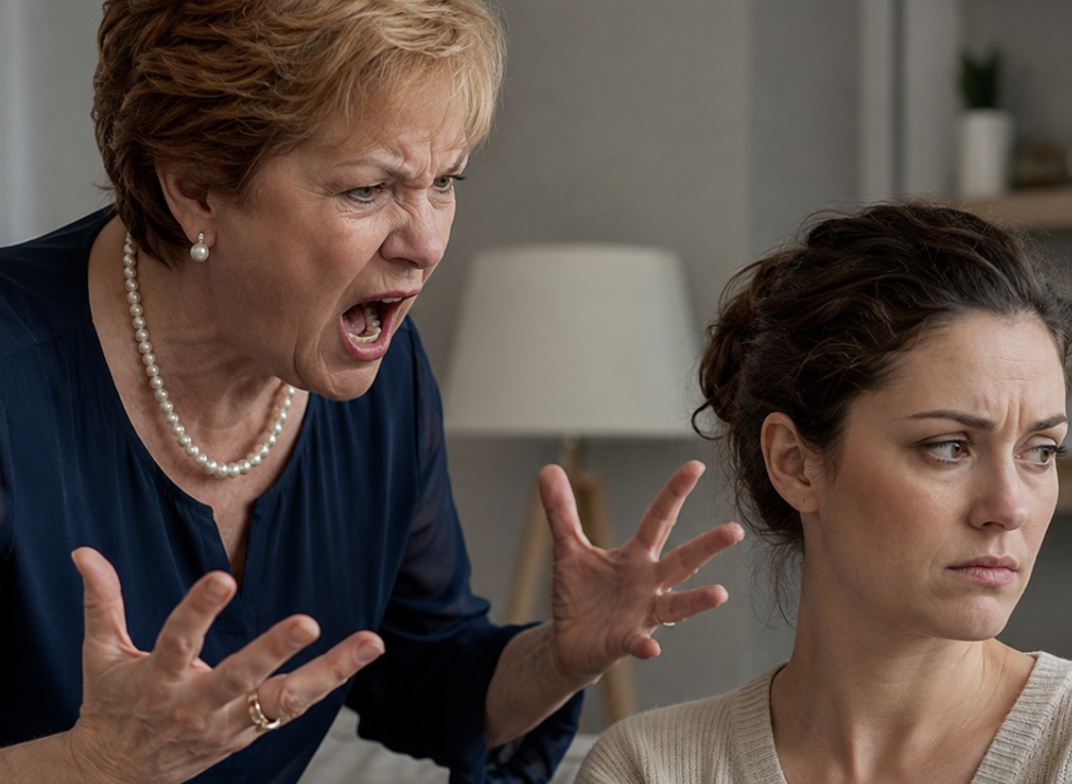
“How could you block your husband’s card?! He’s a man—the head of the family!” her mother-in-law shouted, pounding her fist against the kitchen table.
Lyudmila Pavlovna had stormed into the apartment exactly an hour after her son called her. Her cheeks were flushed, and her voice kept breaking with outrage. She stood in the middle of the kitchen staring at her daughter-in-law as though Natalia had committed some terrible crime.
Natalia did not look away.
Slowly, she opened her wallet, took out her new bank card, slipped it neatly between the bills, and snapped the wallet shut.
“Exactly,” she said in an even voice. “So let the head of the family learn how to put money onto a card before he gets used to emptying one.”
Silence fell over the kitchen.
Lyudmila Pavlovna opened her mouth, but for once, no words came out.
Oleg stood beside the refrigerator, staring at his wife. The color gradually drained from his face.
 
He had already understood.
The life he had grown comfortable with had just come to an end.
They had been married for nine years.
Sometimes Natalia would take out their old wedding photographs and study them for a long time. In those pictures, Oleg seemed like a completely different person—energetic, ambitious, full of life.
Back then, they both worked.
Together, they paid the mortgage on the apartment Natalia had purchased and registered in her own name before the marriage. In the evenings, they discussed what curtains to hang in the living room and argued playfully over the color of the kitchen cabinets.
Everything felt shared.
Their plans. Their responsibilities. Their future.
Then, three years earlier, something changed.
Oleg quit his job at a car dealership.
He said he was tired of making money for someone else.
Natalia tried to be understanding.
“I’m going to open my own repair shop,” he announced one evening, spreading printouts and notes across the kitchen table. “Give me six months. It’ll pay for itself.”
The repair shop never opened.
Three months later, Oleg became interested in trading.
 
“This is real money, Natasha. You just have to understand the strategies.”
Trading eventually gave way to cryptocurrency.
After that came the idea for a mobile app, which Oleg explained at great length but never clearly enough for Natalia to understand what it was actually supposed to do.
Not one of those projects earned a single ruble.
Almost without realizing it, Natalia gradually took responsibility for everything.
The mortgage.
Utilities.
Groceries.
Clothes.
Household expenses.
And because she wanted her husband to be able to pay for things conveniently, she ordered an additional bank card linked to her own account.
At first, Oleg used it carefully, almost as if he were borrowing money.
That hesitation disappeared quickly.
Soon, Natalia’s banking app began sending notifications every day.
Restaurant delivery.
Coffee shops.
Taxi rides to places he could easily have walked to.
Gaming subscriptions.
New headphones.
Online electronics stores.
His days settled into a comfortable routine.
In the morning, he drank coffee while scrolling through his phone.
Later, he went to the gym using the membership Natalia paid for.
 
Then came meetings with friends.
In the evening, he played video games.
Whenever Natalia tried to talk to him about the situation, the conversation went nowhere.
“We’re a family,” Oleg would say without looking away from his screen. “What difference does it make which one of us is earning right now?”
“The difference is that I’m the only one earning,” Natalia would answer carefully.
“I can’t just work for some boss,” he would reply, putting his phone down with an offended expression. “I need a project that can make millions. You know that.”
His mother always defended him.
“A man shouldn’t grab the first job he sees,” Lyudmila Pavlovna would say with authority. “He needs to find something worthy of him. Your job is to support your husband.”
Natalia would nod.
And continue putting up with it.
At the end of February, Natalia stayed late at work.
On the way home, she sat in a freezing bus, staring through the dark window and thinking about the fact that she had forgotten to eat lunch again.
The apartment was quiet when she arrived.
Oleg was asleep.
An empty takeaway cup sat on the kitchen table.
She did not wake him.
 
Instead, she made herself some tea, opened her phone, and almost absentmindedly checked her banking app.
She spent nearly forty minutes going through the statement.
Then she closed it.
A moment later, she opened it again, as though the numbers might somehow have changed.
They had not.
In a single month, Oleg had spent almost as much on entertainment as Natalia paid toward the mortgage.
Food delivery.
Taxis.
Subscriptions.
Coffee shops.
Electronics.
 
One purchase after another.
The total made her stomach tighten.
But one entry hurt more than all the others.
The date was her birthday.
That day, Natalia had been stuck in a meeting, apologizing through messages because she would be late getting home.
While she was still at work, Oleg had used her card to buy himself a gaming steering wheel, wireless headphones, and a restaurant dinner for one.
He had not bought Natalia a birthday present at all.
She sat for a long time in front of her untouched tea.
Outside the window, snow was falling.
“So that’s how it is,” she whispered to herself.
And suddenly, everything became painfully clear.
The real problem was no longer money.
For three years, she had been supporting a healthy, able-bodied adult man who genuinely believed there was nothing wrong with it.
He did not feel embarrassed.
 
He did not feel grateful.
He did not even think the situation required an explanation.
The next morning, Natalia went to the bank.
She had her card reissued.
She changed the password to her mobile banking account.
And she blocked Oleg’s additional card.
That evening, Oleg opened his food delivery app as usual, selected a burger and fries, and tapped the payment button.
The transaction was declined.
He tried again.
Declined.
 
“Natasha, something’s wrong with the card,” he called from the other room.
“I know,” Natalia replied from the kitchen. “I blocked it.”
Oleg appeared in the hallway.
Natalia was standing at the stove, calmly making soup without turning around.
“Is this some kind of joke?”
“No.”
She stirred the pot.
“I’m going to manage my own account from now on.”
The argument was loud.
Oleg talked about trust.
About marriage.
About family.
About how she was humiliating him as a man.
Natalia listened without interrupting.
Half an hour later, he disappeared into the bedroom and called his mother.
Lyudmila Pavlovna arrived quickly.
 
The moment she entered the apartment, she began lecturing Natalia about how a wife was supposed to support her husband during difficult times.
She said a real woman did not count every penny.
She said humiliating the family breadwinner was shameful.
“What breadwinner?” Natalia asked quietly.
Her mother-in-law either did not hear the question or chose to ignore it.
She continued speaking louder and louder.
Natalia waited until the woman finally ran out of breath.
Then she opened a drawer and took out a notebook.
One page was completely covered in figures, divided into careful columns.
Three years of expenses.
Mortgage payments.
Utilities.
Groceries.
Appliances.
Subscriptions.
Taxis.
Food deliveries.
Oleg’s purchases.
Natalia placed the page in front of her mother-in-law.
“If you believe your son needs all of this,” she said calmly, “then starting tomorrow, you can pay for it.”
Lyudmila Pavlovna stared at the numbers.
 
Oleg stared at his mother.
The kitchen became very quiet again.
Lyudmila Pavlovna studied the page for a long time, running one finger down the columns and pressing her lips together.
“Well,” she finally said uncertainly, “these are still family expenses. There are groceries here, utilities…”
“I separated those.”
Natalia pointed toward the lower part of the page.
“These are only Oleg’s personal expenses.”
Her mother-in-law looked down again.
“I’m retired,” she muttered at last. “My pension isn’t very large. I can’t afford that.”
“What about your savings?” Natalia asked.
“I’m not touching my savings. Those are for emergencies.”
Natalia paused for a second.
“Then why was it acceptable to spend my money without limits, but not yours?”
Lyudmila Pavlovna opened her mouth.
Then closed it.
Oleg stood against the wall, watching his mother.
Something shifted in his expression.
It was as if, for the first time, he was seeing the contradiction clearly.
 
For three years, his mother had insisted that Natalia should feed him, support him, and finance his lifestyle.
Yet the moment she was asked to do the same thing herself, she refused.
Lyudmila Pavlovna picked up her handbag and left without saying goodbye.
Natalia waited until the apartment door slammed shut.
Then she walked into the bedroom.
She took a large travel bag from the wardrobe and began neatly packing Oleg’s belongings.
T-shirts.
Jeans.
Chargers.
Headphones.
Oleg stood in the doorway watching her.
“Natasha, wait…”
“Learn to live on your own money,” she said without turning around. “You won’t be living on mine anymore.”
She did not cry.
 
She simply zipped the bag closed and placed it in the hallway.
Oleg moved in with his mother that same evening.
For the first few days, he messaged Natalia constantly.
The messages were long and confused.
Sometimes angry.
Sometimes apologetic.
Sometimes affectionate.
He promised to find a job.
He said he had reconsidered everything.
He admitted that she had been right.
Natalia read the messages but did not reply.
By the tenth day, they became shorter.
On the fourteenth day, Oleg appeared outside her apartment building.
Natalia saw him when she came home from work.
He stood near the entrance with his hands in his pockets and his shoulders slightly hunched.
He looked different.
Gone was the relaxed confidence of a man who had spent years behaving as though the entire apartment—and everything inside it—existed for his comfort.
“Can we talk?” he asked.
Natalia stopped.
“I’ve realized a lot,” Oleg began.
Even his voice sounded different now—quieter, stripped of the old assumption that everyone around him owed him something.
“Mom makes me buy groceries. She makes me clean and cook. I’m looking for work. I’ve already been to several interviews.”
He hesitated.
“Natasha, I really have changed. Let’s start over.”
He kept talking.
He admitted that he had been wrong.
That he had taken her for granted.
That things would be different now.
Natalia listened carefully.
She did not interrupt him.
For the first time in years, there was something alive in his face again.
 
But this time, it had not come from another grand idea or fantasy about becoming rich overnight.
It came from effort.
When he finally stopped talking, Natalia answered quietly.
“Now you’re finally living the way every adult lives.”
Oleg looked at her in confusion, clearly waiting for something more.
There was nothing more.
Natalia gave him a small nod, entered the intercom code, and disappeared into the building.
The divorce was surprisingly quiet.
Natalia had expected arguments, property disputes, maybe even court hearings.
None of that happened.
There was almost nothing to divide.
The apartment had belonged to Natalia before the marriage, so it remained hers.
Several months later, a mutual acquaintance casually mentioned that Oleg had found a job as a warehouse worker at a large trading company.
The work was ordinary.
The salary was modest.
Oleg reportedly told people that his ex-wife had ruined his life and never gave him the chance to reach his full potential.
He was now looking for a woman with an easier personality.
Natalia heard the story without anger.
She did not even laugh.
She simply moved on.
Living alone brought an unexpected sense of lightness.
In the mornings, the apartment was quiet, but the silence no longer felt empty.
 
She paid off her car loan three months ahead of schedule.
She bought a new sofa and an armchair, choosing both entirely by herself.
For the first time in years, Natalia began saving money not for someone else’s ambitions, fantasies, or endless desires, but for her own future.
She saved slowly.
A little at a time.
She had not yet decided exactly what she wanted to spend it on.
And that was fine.
Because whatever she chose next would be her decision.
For Natalia, that was more than enough.