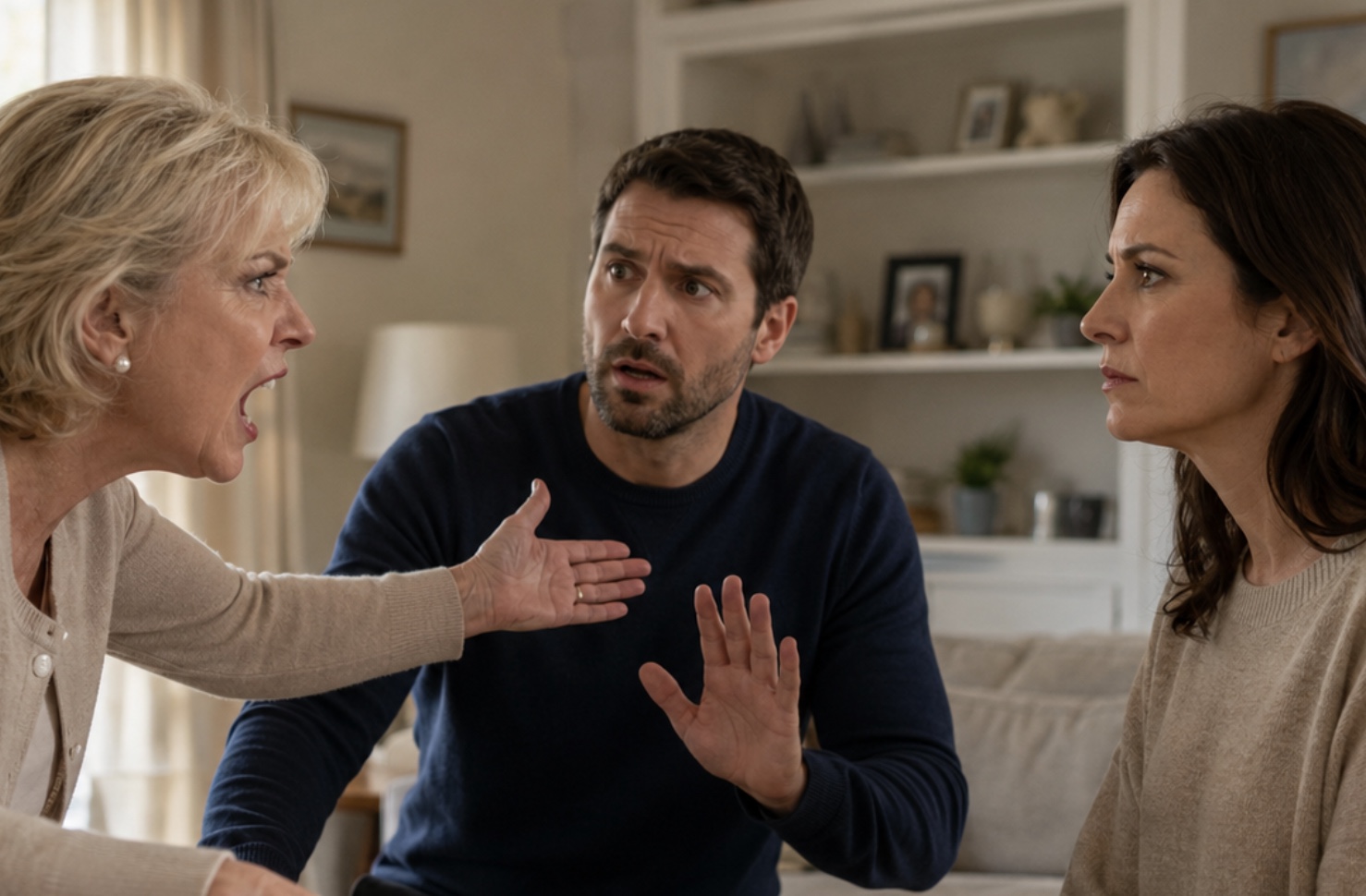
Olya was chopping salad when the doorbell rang without warning. Standing on the doorstep was Aunt Valya—her mother-in-law’s sister—and right behind her squeezed in their neighbor, Zinaida Petrovna, wearing the expression of someone arriving for an official hearing.
“We’ll only take five minutes,” Aunt Valya announced without even taking off her shoes. “We need to talk.”
Igor, Olya’s husband, came out of the bedroom in his socks, his hair still messy from an afternoon nap. He gave the unexpected visitors a confused nod.
“Aunt Valya, hi. What happened?”
Zinaida Petrovna settled into an armchair, folding her hands neatly in her lap like a judge waiting for the proceedings to begin. Olya wiped her hands on a kitchen towel and sat on the arm of the sofa, already feeling anxiety tightening inside her.
“Valentina and I have discussed the situation,” Aunt Valya began, “and we decided that since your grandmother’s country house is officially registered in your name, Olya, that should be corrected. Family property should stay in the family.”
Igor blinked in surprise.
 
“Aunt Valya, that was Olya’s grandmother’s house. She inherited it personally.”
“Exactly!” Zinaida Petrovna immediately joined in. “One granddaughter gets everything, while there are so many relatives. How is that fair?”
Olya felt her fingers go numb.
The country house outside Tver had belonged to her grandmother and had passed to Olya three years earlier. Olya had spent every summer there as a child. After her grandmother died, she had handled all the paperwork herself, visited notaries, sorted through documents, and dealt with everything connected to the inheritance.
And now, suddenly, it had become “family property” that supposedly had to be shared with people who had never once shown up there with so much as a shovel.
“Aunt Valya,” Olya said, forcing herself to keep her voice steady, “the house is legally mine. Grandma made that decision herself.”
“Then at least transfer part of it to Igor,” Aunt Valya replied with a shrug. “He’s your husband. And if he’s your husband, then half the house should be his. That would mean the rest of the family could use it too. We were thinking of building a shared bathhouse there. There’s plenty of room.”
Then came the emotional pressure.
Aunt Valya began recalling how she had supposedly “helped Grandma around the house her whole life.” She talked about her bad back, how difficult life had become, and how she could never afford a plot of land of her own.
Finally came the accusation Olya had expected.
 
“You know, it just doesn’t look good,” Zinaida Petrovna said with satisfaction. “Your own relatives are asking, and you’re acting as though you’d rather die than give up a penny.”
Olya refused to argue endlessly.
She repeated one thing: she had no intention of dividing the property. It was a memory of her grandmother, and only Olya would decide what happened to it.
Aunt Valya eventually stormed out, slamming the door and promising that she would “have a proper talk with Igor, man to man.”
But what happened afterward hurt Olya much more.
“Maybe we should at least think about it,” Igor said uncertainly, staring somewhere past her. “She is family, after all. It feels awkward to refuse.”
Olya reminded him that the property was hers alone, inherited from someone she loved deeply.
Igor answered with the sentence that wounded her more than all of Aunt Valya’s accusations.
“What difference does it make whose name is officially on the papers? We’re married. Everything is shared. And anyway, it’s just a house. Just walls. This whole fight over a summer house isn’t worth anything.”
Olya took a step back as though he had physically struck her.
“To you, the memory of my grandmother is just walls?”
Igor said nothing.
He simply looked away.
And somehow, that silence told Olya more than any explanation could have.
Without another word, she grabbed her car keys and left the apartment. For the first time in four years of marriage, she had no idea where she was going.
A Friend Who Called Things What They Were
Nastya opened the door ten minutes after Olya called her. One look at her friend’s pale face was enough. She pulled her inside and led her straight to the kitchen.
“My husband’s aunt came with her neighbor demanding a share of my grandmother’s country house,” Olya blurted out as she sat down. “And Igor told me I should think about it.”
Nastya put the kettle on the stove with a loud clatter.
 
“Is what they’re asking even legal? You inherited that house. It belongs to you.”
“Exactly. But Igor said the house is ‘just walls,’ and that since we’re a family, everything should be shared.”
Nastya gave a sharp laugh.
“You do understand that if you give them even an inch now, next time they’ll be discussing your apartment, your car, and then probably deciding how your salary should be divided ‘fairly.’”
She told Olya about her own mother-in-law, who two years earlier had tried to move into their apartment “temporarily.” Nastya had only managed to regain her privacy after several extremely firm conversations.
Igor called throughout the evening—nearly ten times.
Olya finally sent one short message.
“I’m at Nastya’s. I need time to think.”
She barely slept that night.
One thought kept circling in her mind: how had it happened that, instead of standing beside her against people making outrageous demands, her husband had somehow placed himself in the middle?
The next morning, Olya’s mother called.
 
Olya told her everything without leaving anything out.
Her mother listened, sighed heavily, and then said something Olya would remember for a long time.
“Olenka, I’m not going to tell you what to do. You’re an adult. But remember this: if your husband doesn’t stand next to you at a moment like this, then he still hasn’t decided who his real family is—you, or his mother and aunt along with everyone else. Ask yourself whether you’re ready to spend your whole life proving that you have the right to what is already yours.”
That evening Olya returned home to collect some clothes.
Igor looked as though he had not slept all night.
“I’m sorry,” he began, trying to catch her eye. “I said something stupid yesterday.”
“Something stupid? You dismissed the memory of the person I loved more than anyone.”
He hesitated.
Olya could see that deep down he still believed Aunt Valya was family and that perhaps they should have found some peaceful compromise.
Olya packed a bag without arguing and went back to Nastya’s place.
The next few days passed in a heavy, numb fog.
On Wednesday, Olya was sorting through some of her grandmother’s old papers that she had brought home from the country house the previous autumn. Among them she found a worn notebook.
Most of the pages contained ordinary household notes—money spent on seeds, phone numbers of neighbors, reminders about repairs.
 
But then she found several entries written in her grandmother’s familiar handwriting.
“Valyusha asked for money for her husband’s operation. Gave her thirty thousand. She returned only ten.”
Another entry read:
“Valya asked to borrow money against the country house again. Refused. I don’t want her making claims on it later.”
Olya froze with the notebook in her hands.
Her grandmother had already dealt with exactly the same kind of pressure.
And she had clearly rejected it.
Olya called Dima, Igor’s cousin, who knew Aunt Valya well through her side of the family. Olya only wanted to understand the situation better.
During the conversation, Dima casually mentioned something that changed everything.
“Oh, sure,” he said with a dry laugh. “Aunt Valya actually bought herself a plot of land two years ago. Not far from your country house, by the way. She sold it about six months later because she couldn’t manage the expenses of developing it. Ever since then, she’s been dreaming about getting something already finished.”
 
Olya sat motionless, holding the phone.
So all those speeches about her bad back and her inability to afford land were misleading.
Aunt Valya had already owned property.
She had simply failed to maintain it.
And now she wanted someone else’s finished house instead.
The Conversation at the Café
Olya sent Igor a message.
“We need to meet. Just the two of us.”
When they met at a café, Igor looked exhausted and ashamed.
“Before you say anything, listen,” Olya told him.
She placed her grandmother’s notebook on the table and told him about the conversation with Dima.
“Your aunt already owned land. She sold it because she couldn’t manage it. Now she wants a ready-made property at my grandmother’s expense.”
Igor remained silent for several seconds, slowly turning the notebook pages.
“She never told me she had her own land.”
 
“Call Dima. Right now.”
The conversation lasted only a few minutes.
Olya watched Igor’s expression change—first disbelief, then confusion, and finally quiet anger.
“So all this time…” he said slowly after ending the call. “She was asking us to build a bathhouse for her while knowing she had already had her own place and gave it up?”
“Looks that way. Igor, I’m not against helping your aunt if she genuinely needs help,” Olya said more gently. “But I am not giving her part of my grandmother’s property. And you need to learn how to say no—not to me, but to your relatives.”
That same evening, Igor went to speak to his aunt alone.
Later he told Olya how it had gone.
At first, Valentina became angry. But when she realized the truth had come out, she immediately changed tactics.
She claimed her previous plot had been “a bad one, so it didn’t count,” and insisted that “family members are still supposed to help each other.”
Then Igor asked her a simple question.
“And where was your help when Olya and I were saving every possible ruble for renovations?”
For once, Aunt Valya had no convincing answer.
 
Igor finally drew a clear boundary.
His wife’s inherited country house was not family property. It was not a shared asset. It belonged to Olya, and only she had the right to decide what happened to it.
If Aunt Valya wanted a country house of her own, she could save for one herself. If she genuinely needed assistance, she could ask for specific help.
But she had no right to demand someone else’s inheritance.
Two months later, Olya and Igor returned to the country house together.
It was a Saturday, and they spent the day repainting the fence and repairing the porch.
While Igor worked with the boards, Olya weeded the garden beds, remembering how her grandmother had once shown her exactly where to plant dill and where radishes grew best.
Her phone suddenly chimed.
A message from Aunt Valya appeared on the screen.
“Come by later. We’ll have some tea and finally make peace.”
 
Olya looked at the message and then at Igor, who raised his eyebrows questioningly.
“We can go,” she said. “But on our terms. Not another word about the country house.”
Igor nodded and gently squeezed her hand.
On the drive home, they barely spoke.
But this time, the silence between them carried more understanding than all the excuses and arguments of the previous weeks.
Olya had finally understood something important: protecting your boundaries does not mean cutting people out of your life.
Sometimes it simply means being honest about what belongs to you, what matters to you, and what you will no longer allow others to take away.