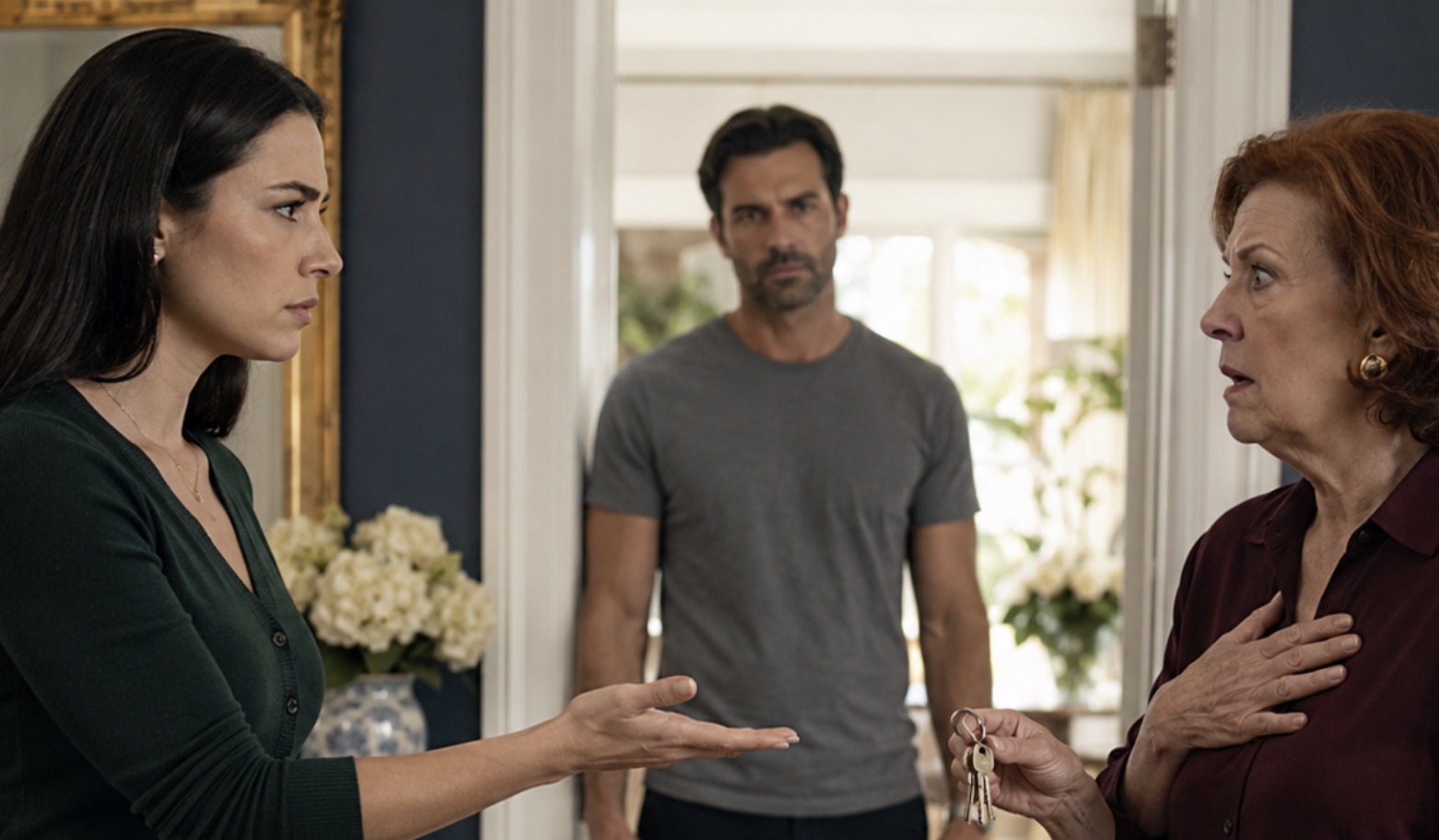
“Are you serious right now? So, according to you, I’m supposed to ask permission before I come to see my own son?” Nina Petrovna’s voice rang through the entryway, bouncing off the expensive wallpaper and returning like a poisonous echo. She stood with her hands planted on her hips, still wearing her outdoor shoes and leaving damp footprints across the polished parquet floor.
“I’m not asking you to get permission, Nina Petrovna,” Alina replied quietly, but there was more steel in that quietness than in any shout. Leaning one shoulder against the kitchen doorway, she looked at her mother-in-law with icy composure. “I’m asking you to let us know before you come. Even an hour in advance would be enough. It’s basic respect for personal boundaries.”
“Boundaries?” Her mother-in-law threw up her hands theatrically, nearly striking the large wrought-iron-framed mirror hanging in the hallway, the one Alina had brought back from her latest business trip to St. Petersburg. “Roma! Do you hear your financial genius? She’s going to lecture me about boundaries! I gave birth to you in agony. I stayed awake night after night when you had chickenpox. And now, apparently, you two have ‘boundaries’!”
Roman emerged from the living room with his head lowered. He wore old sweatpants and a stretched-out T-shirt, and he was still holding the television remote, as though he had merely been watching football instead of listening to his wife and mother have the same argument for what felt like the hundredth time.
He looked pathetic—like a cornered animal whose only wish was to be left alone.
 
“Mom, why are you starting again? And Alina, why are you getting worked up first thing in the morning? It’s Sunday. Can’t we just have breakfast?” he muttered, carefully avoiding eye contact with either woman.
Alina looked at her husband. For one brief moment, something close to despair flashed in her eyes, but she immediately buried it beneath a mask of detachment.
She knew Roman’s favorite strategy.
Whenever he said, “Can’t we all just get along?” what he really meant was, “Alina, back down. Don’t rock the boat.”
After nine years of marriage, that boat was covered in barnacles made from all her compromises, yet somehow it had never sailed anywhere.
“I’m not worked up, Roma.” Alina straightened and adjusted the sleeve of her soft cashmere cardigan. “I’m simply stating a fact. Last Tuesday your mother came in without warning while I was in an online conference with suppliers from China. She walked straight into my office carrying a pot of borscht and started loudly whispering about why we didn’t have sour cream in the refrigerator. A deal worth one and a half million rubles almost fell apart because you couldn’t explain to your mother what a closed door means.”
“Oh, please. Listen to the great businesswoman!” Nina Petrovna curled her lips into a contemptuous smile as she marched into the kitchen without being invited and began opening cupboards as if the apartment belonged to her. “She acts like she’s moving millions around. Roma and I both know how you got that business. If my late brother Grisha hadn’t left you that garage full of spare parts, you’d still be sitting in that bank earning thirty thousand rubles a month.”
It was the same old song.
 
Alina had heard it for nine years, in dozens of variations, but always with the same refrain: everything she had accomplished was somehow worth less than it seemed.
She inhaled deeply as a bitter lump rose in her throat.
The story about the garage was Roman’s family’s favorite myth.
In reality, Uncle Grisha had not left her a profitable garage. He had left her a pile of rusting scrap metal and overdue land-rental debts. At the time, Alina had been working as a credit analyst. She poured every ruble of her savings into the so-called inheritance, took out a loan that took three years to repay, and spent five years transforming the failing operation into a network of auto-parts stores with its own warehouse.
She had worked sixteen-hour days while Roman calmly kept his stable sales-manager job at a construction company, earning fifty thousand rubles a month.
But his relatives preferred the fairy tale about the miraculous inheritance.
“Nina Petrovna,” Alina said, her voice becoming even quieter—a sure sign that a storm was approaching. “Let’s settle this once and for all. Uncle Grisha left me two hundred thousand rubles in debt and a mountain of rusty metal. I never asked for it, but I accepted it. And everything you see now—this apartment, your trips to the health resort that I paid for, the new roof on your country house—none of that fell out of the sky. I earned it. With my own hands and my own brain.”
“Oh, look how proud we are!” her mother-in-law sneered.
 
She had finally found what she was looking for: a tin of expensive tea Alina bought from a specialty shop.
“Earned it with her brain, she says. And where’s the happiness? Look at poor Romochka. He’s thin, exhausted. Maybe instead of running around with your business, you should look after your husband. You can’t earn all the money in the world. Keep going like this and you’ll lose your family.”
Roman, who had been standing in the kitchen doorway like a guilty schoolboy, finally forced himself to intervene. He walked over to his mother and gently, almost apologetically, took the tea tin from her.
“Mom, enough. Alina really does work hard. We live well. You can see that. We even bought you a new phone recently.”
“Bought me one!” Nina Petrovna snorted. “She threw that phone at me like a bone to a dog. The buttons are tiny. It takes me half a year to figure out how to dial a number. I bet she has the newest possible iPhone, while I get whatever is worse.”
She paused, then suddenly remembered her true reason for coming.
“And anyway, that’s not why I’m here. The Petrovs’ grandson started music school. He plays the piano. Vera from the shop has a son who already plays guitar. When am I going to have grandchildren? Or are you, Alina, planning never to have children because of your selfish ambitions?”
There it was.
The main subject.
The climax of nearly every family gathering for the last three years.
 
Alina clenched her jaw so tightly that the muscles in her cheeks tightened visibly. She had lost count of how many times she had explained that she was undergoing difficult treatment, that the situation was painful and emotionally exhausting, and that she and Roman still hoped to have children.
But medical facts meant nothing to Nina Petrovna.
In her mind, there was only a wicked daughter-in-law who refused to give her grandchildren because she was too busy making money.
“Mom, we’ve talked about this!” Roman said weakly. “Don’t pressure her.”
“I’m pressuring her?” Nina Petrovna shrieked. “I don’t sleep at night because my heart hurts, while she runs around on business trips! Oksana, your friend Dimka’s wife, already has three children and she’s perfectly happy. But this one—”
“Then go live with Oksana!” Alina suddenly snapped.
She turned sharply toward the stove, grabbed the cezve, and set it down on the burner with a loud clatter. Her hands were shaking.
“Compare me with Oksana as much as you want. Just don’t forget that her husband gave her a frying pan for her birthday, and Dimka has been ‘looking for work’ for two years because they barely have enough money to survive. Meanwhile, I’m the one paying for wedding gifts for Oksana and helping your entire family maintain a decent standard of living.”
Roman flinched.
 
The words had landed below the belt.
Alina regretted them instantly, but they were already out.
She had never wanted to humiliate him over money. What she wanted was for him to understand the price she paid for their comfortable, peaceful life. She wanted him, just once, to stand beside her instead of playing the role of neutral mediator—a mediator who, in reality, always bent under pressure from his mother rather than defending his wife.
Nina Petrovna’s face turned crimson.
“How dare you! Roma! Did you hear that? She’s throwing every piece of bread she’s given us back in our faces! I lived to see the day when helping family becomes a crime. She’s been looking down on us our whole lives because we’re simple people. You think because you have an apartment downtown and a mink coat you’re suddenly the center of the universe?”
She snatched her handbag from the stool and stormed toward the hall without even looking at her stunned son.
The front door slammed so hard that the glass panel in the wardrobe trembled.
A ringing silence filled the apartment.
Roman stood there with his shoulders drooping.
Alina remained by the stove, staring at her own reflection in the dark screen of the switched-off range hood.
She did not cry.
She had stopped crying in front of her husband a long time ago.
 
“So why did you have to say all that?” Roman finally asked.
He did not sound angry. Only tired. Defeated.
“Say what?” she asked without turning around.
“That stuff about Oksana and the frying pan. It was unnecessary. Mom is just worried about us.”
“Your mother is worried that I might have one healthy nerve left.”
Alina quickly turned off the burner beneath the coffee that had already boiled over and faced him.
Her beautiful, well-cared-for face now looked like a stone mask.
“Tell me honestly, Roma. Right now. Do you understand why I lost my temper? Do you understand that she insulted me in front of you? She insulted my work, my health, me as a person. Do you understand that?”
“She’s from another generation,” Roman said helplessly, spreading his hands. “You know she doesn’t mean it badly. She loves us. She just doesn’t know how to express herself differently. Don’t take it personally. We had a fight. We’ll forget it.”
Alina gave a bitter laugh.
 
“Forget it. That’s always your solution. Forget how two years ago, on my birthday, she announced in front of all our guests that I smelled of ‘other people’s money.’ Forget how, at your father’s anniversary, she asked whether I was ashamed to wear skirts that short in my ‘financial swamp.’ Forget how today she called me selfish because I haven’t had a child.”
She took a breath, and her voice cracked with suppressed fury.
“What else am I supposed to forget, Roma? Tell me. How many more tons of this garbage am I supposed to swallow in the name of loving you?”
Roman said nothing.
His face had become gray and strangely blank.
He simply stood there.
And suddenly Alina understood that he genuinely did not know what to say.
Not because he was stupid.
Because he truly did not understand the depth of her pain.
To him, this was just another case of “Mom getting carried away.”
To Alina, it was another battle in a nine-year war she could never win, no matter how successful she became.
She would always be the arrogant outsider who “got lucky.”
They would always be the “ordinary people” who believed they had the right to judge her.
His silence was the most eloquent answer she had ever received.
 
Two weeks passed.
Life continued as usual. Alina buried herself in preparations for opening a second warehouse in the eastern industrial district, while Roman took a short vacation to do minor repairs on the balcony.
The atmosphere at home was strained but outwardly peaceful.
They barely spoke beyond practical phrases.
“Buy bread.”
“Pay the utilities.”
“Are you coming with me to my parents’ place or not?”
The need to “go to my parents” arose unexpectedly when Nina Petrovna’s birthday arrived.
Despite everything, Alina agreed to attend.
She chose an expensive, elegant Austrian dinnerware set as a present—the same set Nina Petrovna had been admiring at the market for months.
Alina rarely bought such things even for herself without a special occasion, but she decided not to be stingy when choosing her mother-in-law’s gift.
The celebration was held at Roman’s aunt’s house, with around ten relatives gathered around the table.
At first, everything remained civilized.
There were toasts to the birthday woman, polite compliments, Olivier salad, herring under a fur coat, and all the familiar rituals of a family gathering.
Alina tried to remain courteous, although she could feel the tension around her.
People glanced at her and whispered.
 
She caught fragments of conversation.
“There she goes, earning barrels of money.”
“And what good does it do? Her husband is practically her servant.”
When the main course arrived, Nina Petrovna, flushed from cognac, apparently decided that her moment had come.
She stood up with a small glass in her hand and addressed the table.
“My dears, thank you all for coming. Romochka and Alina gave me such a beautiful gift—foreign dinnerware. Expensive, probably.”
She paused and searched the table for Alina’s eyes.
“But I have a little request for Alina. Forgive me, dear, but you throw money around. I know you do. Maybe instead of buying plates, you could help Genka? Roma’s brother is sitting at home without work, while the two of you are living like millionaires.”
Alina felt heat rush into her face.
It had not been said in private.
It had been announced publicly.
In front of everyone.
Genka, sitting in the corner, lowered his eyes, but there was not a trace of embarrassment on his face.
Only expectation.
“Nina Petrovna.” Alina carefully dabbed her lips with a napkin, making every effort to keep her voice steady. “I have already helped Gennady twice. I hired him last year. He quit after three weeks because, according to him, selling auto parts was ‘beneath him.’ Then I offered him professional training through our company’s learning center. He didn’t even show up for the first lesson. Help has to work both ways, don’t you think?”
“There you go again!” her mother-in-law shouted, waving her hands and spilling cognac onto the tablecloth. “All you can do is lecture people! It never occurs to you that Genka needs a position that suits him. But you wouldn’t understand that. You’re simple. You climbed from the dirt into wealth. We are educated people. We have sensitive souls!”
Alina’s mouth went dry.
 
She looked around the table.
Roman’s sister’s husband, his aunt, his uncle—everyone was watching her with hidden hostility or cold curiosity.
And Roman.
Her husband sat beside her staring down at his plate, pretending he did not exist.
He slowly dragged his fork across a piece of meat without looking up.
“Maybe that’s enough,” Alina said quietly.
The silence around the table made her words sound thunderous.
“Maybe it’s time to stop pretending that I owe all of you something. I’ve supported this family for nine years. I paid for your husband’s heart surgery, Nina Petrovna. Two years ago, I bought Roman a new car because his old one was falling apart. A month ago, I quietly gave three hundred thousand rubles for your niece’s wedding, and no one even said thank you.”
Her breathing grew heavier.
“What exactly do I owe you? What else am I supposed to do before you stop treating me like an ATM and an outsider?”
She fell silent.
 
Only the old wall clock continued ticking.
Nina Petrovna slowly rose.
Her face, red only moments before, had turned deathly pale.
She pressed both hands against the edge of the table and spoke each word as though she were spitting poison.
“And do you really think we don’t know what you used to earn all that money?”
That was the final blow.
Low.
Cruel.
Deliberate.
In that moment, the last barrier of basic decency collapsed.
Alina no longer saw a mother-in-law, a husband, or relatives.
She saw a woman who hated her simply because she existed.
Because she was young, attractive, successful, and refused to bend.
“This conversation is over,” Alina said in a strange metallic voice she barely recognized as her own. “Keep the gift, Nina Petrovna. Eat from those plates and think about what you have done for your son’s family.”
She looked toward Gennady.
“And Gennady can find his ‘perfect job’ somewhere else. I will not give him another ruble. Not one.”
She stood, picked up her handbag, and walked toward the hallway.
“Roman, call a taxi,” she said without turning around.
They rode home in silence.
Alina watched the city lights glide past the window and felt nothing inside herself but scorched emptiness.
Roman sat beside her, hunched over.
Only after they entered their apartment did he finally speak.
 
“Why did you have to do that, Alina? In front of everyone? You humiliated Genka. You made Mom cry. They just wanted to talk.”
“Talk?”
Alina spun around so sharply that Roman stepped back.
“What your mother said was ‘talking’ to you? She publicly accused me of God knows what while you sat there poking at your meat! Roma, what is wrong with you?”
“What was I supposed to do?” he suddenly exploded. “Start a fight with Genka? Throw my mother out on her birthday? You always turn everything into some giant catastrophe! She was offended. She didn’t actually mean to insult you. And then you immediately start saying, ‘I’m not giving you any more money.’ Why do you always throw money in people’s faces? You think that because you earn more, you can do whatever you want?”
Alina stared at him as though she were seeing him for the first time.
The man in front of her suddenly seemed like a frightened, resentful boy.
Resentful because she was wealthier.
Stronger.
More decisive.
He was not defending her.
 
He was defending the comfortable swamp in which he never had to make a difficult choice.
He always asked her to compromise because asking her was easier than confronting anyone else.
“Are you actually serious?” she whispered. “You have never supported me. Not once in nine years. You have never told your mother, ‘Mom, stop. Alina is right.’ Every single time, you tell me to apologize. To step back. To surrender. You sacrifice me every damn time, Roma.”
“Because you’re always provoking people!” he shouted desperately. “Just go tomorrow and apologize. Tell them you lost your temper. Genka is offended, Mom is taking heart drops. We can buy them a weekend stay at a boarding house, let them relax and cool down. Don’t destroy everything over one argument.”
A vacation.
Buy it.
Pay for being insulted.
Pay for slander.
Pay for having her dignity torn apart.
Buy peace.
Alina suddenly felt so exhausted that she wanted to lie down on the floor of the hallway and close her eyes.
Everything became clear.
The problem had never really been her mother-in-law.
Nina Petrovna was simply the concentrated expression of everything rotten in Alina’s marriage.
The real problem was Roman.
His weakness.
His refusal to grow up.
His willingness to remain forever the obedient son hiding behind his mother.
Alina walked into the bedroom, pulled a small travel bag from the shelf, and began packing.
“Where are you going?” Roman asked, suddenly frightened as he appeared in the doorway.
“To Lena’s. I need time to think.”
“Alina, don’t be ridiculous. Everything will be fine tomorrow. I’ll call Mom…”
“You’ll call your mother?”
She turned sharply, and something in her eyes made him genuinely afraid.
It was the look of someone who had just made a final decision and closed a door behind herself.
“Of course you will. Call her. But I’m done being the one everyone blames.”
She slammed the front door behind her.
The sound echoed through the apartment building.
It sounded like a house collapsing.
The three days at Lena’s passed in a blur.
Lena was a psychologist by profession, but she gave no advice.
She simply listened.
Alina went through every memory: every humiliation, every “ignore it,” every “Mom meant well.”
It was like assembling a puzzle.
 
And for the first time, she finally saw the entire picture.
Gray.
Joyless.
Hopeless.
She returned home early Thursday morning while Roman was at work.
She walked through the empty apartment and ran her fingers across the dining table where, in recent months, they had barely managed a single dinner without tension.
Roman did not own many things.
His presence in the apartment had always seemed somehow temporary and uncertain despite the marriage certificate.
It was Alina’s fortress.
She had built it.
And somehow Roman had remained a tenant inside it, paying for his place with loyalty to his mother.
That evening, the lock clicked and Roman entered.
Alina was already sitting in the living room.
A teapot stood on the table, and a single sheet of paper lay in front of her.
“Oh, you’re back. I missed you so much,” Roman said, moving toward her with a guilty smile and attempting to hug her. “I’ve thought about everything. Let’s really try to—”
“Sit down,” Alina said quietly.
He sat, still expecting the usual reconciliation.
 
Instead, she pushed the document toward him.
“This is a divorce application. And a property settlement proposal. The apartment is legally mine. I paid off the mortgage before we married, so there’s nothing to dispute there. The car is yours. I’m giving it to you. We’ll divide the bank account equally even though I contributed almost all the money. I’ve prepared an agreement. Read it.”
His hands began to shake.
He stared at her, his face twisting with confusion and horror.
“You can’t do this to me,” he whispered. “You love me. I’ll fix everything. I’ll talk to my mother. I’ll forbid her from coming here, I swear. I’ll choose you.”
“It’s too late to choose, Roma.”
Alina looked at him gently, almost with maternal pity.
“Adults don’t wait until someone finally chooses them like an item on a shelf. You should have chosen every time your mother insulted me. Every time you remained silent, you made your choice.”
She looked exhausted rather than angry.
“I’m tired of pulling this entire cart alone. I’m tired of being afraid whenever I hear the front door opening. I don’t want to live with someone who cannot be my support. This is not about your salary. It’s not even about your mother. It’s about you.”
She paused.
“I don’t feel like a woman beside you. I feel like a bulldozer with people standing behind me shouting, ‘Keep going. Push harder.’”
Roman cried.
He begged forgiveness.
He promised he would change everything.
But Alina did not change her mind.
She could see that his tears came not from real understanding, but from fear.
Fear of a life without her money.
Without her strength.
Without the person he had always depended on.
 
The divorce was surprisingly quiet.
At the registry office they even exchanged a few neutral words about paperwork.
Alina felt empty.
But free.
Six months passed.
Alina sat in her office on the second floor of the auto center, reviewing the quarterly report.
Business was booming.
The new warehouse had paid for itself within three months.
She had changed her hairstyle and lost weight, but the biggest change was in her eyes.
The hunted, exhausted expression was gone.
Unexpectedly, someone appeared in the doorway.
It was Roman’s sister, Katya, who worked remotely as an accountant for Alina’s company.
She entered carrying documents, placed them on the desk, then hesitated.
“Alina, I want to apologize to you.”
Alina looked up.
“For what?”
“For everything. For Mom. For that birthday dinner. For all the things she did to you. And for the times I supported her because I was afraid to disagree.”
Katya lowered her eyes.
“I know it probably sounds stupid now, but… you were right. About everything.”
Alina set down her pen and raised an eyebrow.
“Why are you telling me this now?”
“Because I’m ashamed.”
Katya swallowed.
“Roma is living with Mom now. Nina Petrovna is practically losing her mind. You probably know he quit his job a month ago because he said his boss was an idiot. He spends all day on the sofa playing video games and waiting for Mom to bring him food. She’s supporting him on her pension.”
Katya sighed.
 
“It’s reached the point where even Genka took a job at a tire shop, but Roma still won’t work. Mom cries constantly and doesn’t know what to do. She always believed you were the problem.”
Katya looked directly at Alina.
“But you weren’t. His weakness was.”
Alina said nothing.
Outside the window, gray drizzle blurred the city.
She felt no satisfaction.
No triumph.
Only a quiet, aching sadness.
She had never wanted Roman to fall apart.
Once, she had wanted him to rise beside her.
“You know, Katya,” she finally said, standing and walking toward the window, “for a long time I thought your mother caused our divorce. Or maybe my pride did. Or money.”
She shook her head.
“But none of that was the real reason.”
Katya remained silent.
“That dinner wasn’t the reason. Neither was the argument about the keys. Those moments only revealed something I had refused to see for years.”
Alina turned slightly.
 
“My husband was never on my team. I was his sponsor, his therapist, and his mother. I wanted to be a woman beside a man who wouldn’t leave me standing alone when everyone started shooting at me.”
Katya nodded quietly and left, gently closing the door behind her.
Alina remained by the window for another few minutes, watching the evening settle over the city.
Then she picked up her phone and reserved a table at a new restaurant she had been wanting to visit for months.
She had a business deal worth celebrating.
Alone.
And suddenly she realized that, for the first time in many years, being alone did not frighten her.
It felt peaceful.
Clear.
Earned.
The war she had been fighting for so long was finally over.
And she had won it in the only way that truly mattered.
By refusing to fight anymore.