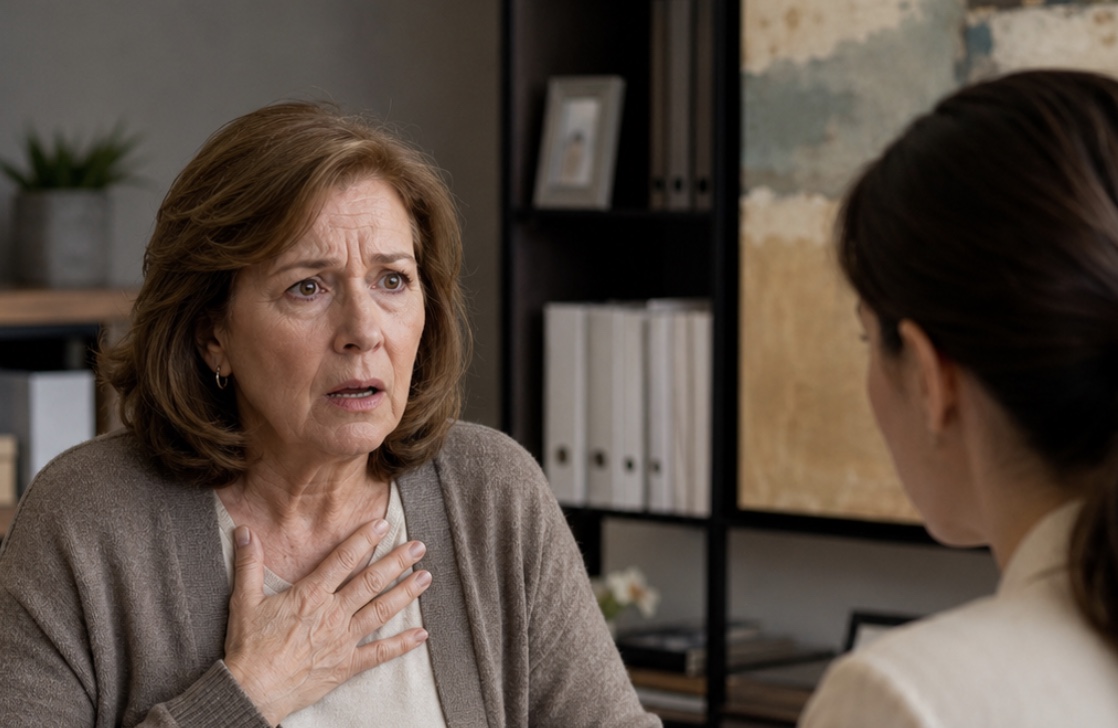
“Are you saying that for forty years I was your wife, but on paper I was nothing more than a tenant?” Lidia Andreevna asked quietly.
Silence fell over the festive table.
Her grandson Alyosha slowly lowered his fork and stared down at his plate. Their daughter Marina froze with the teapot in her hands, while hot water continued to hiss softly into an empty cup. Nikolai Stepanovich went pale—so suddenly and visibly that it seemed as though someone had drained all the color from his face in a single instant.
He had noticed the folder of documents his wife had placed beside the birthday cake decorated with pink frosting roses.
“Don’t put on a performance in front of the children,” he hissed through clenched teeth without looking at her.
But it was already too late.
The family secret he had hidden for more than twenty years had finally surfaced—quietly and inevitably, like something that had been held underwater for far too long.
 
They met in 1982 at the Elektropribor factory.
Nikolai was a design engineer then—serious, reserved, always wearing a neatly pressed shirt. Lidia worked in the accounting department of one of the production shops.
One day he brought her a cost estimate to check. He remained beside her desk longer than necessary, and a month later he invited her to the movies.
“You spend all day counting numbers,” he said with a grin. “Don’t you ever get tired of them?”
“Numbers don’t lie,” she replied. “That’s what I like about them.”
He laughed.
A year later, they were married.
They went through the turbulent years of perestroika together—with empty store shelves, delayed salaries, and the constant anxiety of not knowing what tomorrow might bring.
Their daughter Marina was born.
Then the factory began to fall apart, and in 1993 Nikolai was among the first employees to be laid off. For several months he walked around gloomy and withdrawn, barely speaking. He spent hours reading newspaper job advertisements before folding the pages and setting them aside.
Lidia never reproached him.
Instead, she began taking accounting work home. She prepared reports for small business owners and stayed up late over documents while Marina slept.
 
It was during that period that Lidia sold the room she had inherited from her grandmother. With that money, they bought an apartment on Sadovaya Street.
“This is our foundation,” she said when she received the keys.
“I’ll pay you back,” Nikolai replied shortly.
He never did.
And she never reminded him.
Later, they bought a small country house in the village of Krutovo for almost nothing.
Lidia put up wallpaper, painted the window frames, and planted currant bushes. Nikolai installed electricity and built a stove. Little by little, the neglected cottage became a comfortable family retreat.
All those years, Lidia saved money by sacrificing things for herself.
She continued wearing an old coat long after it needed replacing. She postponed buying a new sofa. She even turned down a trip to a health resort that a friend had suggested.
“This isn’t the time for sanatoriums,” she would say. “Everything has its proper time.”
Nikolai, meanwhile, was meticulous about money.
He kept every important document in a metal safe, checked receipts after every shopping trip, and arranged utility bills into carefully labeled folders.
“The person who counts money is the person who keeps it,” he liked to say with satisfaction.
Every New Year, the family held what had become an unofficial “budget inspection.”
They would sit around the table while Nikolai spread out sheets covered in figures and methodically listed the year’s expenses, drawing special attention to anything he considered unnecessary.
“Why did you buy this tablecloth? The old one was perfectly fine.”
Lidia would remain silent or give a brief explanation.
Back then, she thought his behavior meant that he was responsible and practical.
She even considered it a virtue.
 
The ambulance was called on a Wednesday morning.
Nikolai was sitting in the kitchen, holding the back of his head and struggling to speak clearly.
His blood pressure was 210 over 120.
A hypertensive crisis.
As the paramedics took him away, Lidia stood in the hallway wearing her house slippers and watched the elevator doors close.
Then she picked up her phone and called Marina.
“Mom, stay strong. I’m coming right now,” her daughter said.
At the hospital, the staff explained that they needed Nikolai’s insurance papers, medical policy, passport, and documents proving property ownership in order to process an additional benefit.
 
Lidia nodded and returned home.
It was the first time she had ever opened the safe herself.
Nikolai had always handled it personally. He disliked having anyone nearby when he opened it.
Lidia knew the combination only because she had once seen him enter it by accident and somehow remembered the numbers.
The lock clicked.
Inside were neatly organized folders with labels written in pencil.
She found the insurance documents quickly.
But beside them was another folder—worn, light brown, and clearly older than the others.
Lidia pulled it out and opened it.
A prenuptial agreement.
The date was twenty-two years earlier.
Her signature appeared on every page—careful, familiar, unmistakably hers.
Next came documents showing that the apartment was registered solely in Nikolai’s name.
Then there was a deed transferring the country house as a gift to Nikolai’s nephew, Igor.
There were also bank statements for accounts Lidia had never seen before.
She read the marriage contract twice.
According to its terms, almost all the family property belonged exclusively to her husband.
 
Then the memory of that day at the notary’s office came back to her.
Nikolai had been rushing her. They were supposedly late for something. He stood beside her holding her coat, impatient to leave.
“Just sign it quickly. It’s only a formality. We need it for taxes and inheritance. I’ll explain everything later.”
She had signed.
He had never explained.
That evening, Lidia sat in the kitchen peeling potatoes.
Her movements were automatic. The knife slid over the potatoes, the peelings dropped into a bowl, and the cleaned potatoes went into a pot of water.
Her mind wandered through memories she had once considered ordinary.
The time Nikolai had refused to let her replace the washing machine without his approval.
The time he had taken a pair of boots she bought for herself back to the store.
The countless times he had said:
“Ask me first.”
Back then, she had thought it was simply order and discipline.
Now it looked like something very different.
She called her daughter.
“Marina, come over. I need your help. Professionally.”
Marina arrived an hour later.
They sat at the kitchen table until half past midnight.
 
Marina read every document carefully, making notes in a notebook and sometimes falling silent for long stretches.
“Mom, do you understand what this says?” she finally asked without lifting her eyes from the papers.
“I do. But explain it to me as a lawyer.”
Marina put down her pen.
“This agreement is written so that if you divorce, you leave with practically nothing. The apartment has been completely excluded from marital property—it belongs to him alone. The country house legally isn’t yours anymore either. Here’s the gift agreement. It was transferred three years ago. Igor is now the owner.”
She tapped the bank statements with her finger.
“And these deposits… they aren’t even in Nikolai’s name. The money has been placed in accounts belonging to relatives.”
Lidia stared at her daughter without speaking.
“Mom, do you even remember signing the agreement?”
“He told me it was just a formality.”
Marina slowly closed the folder.
Two weeks later, Nikolai returned from the hospital.
He had lost weight and moved carefully.
 
Lidia welcomed him home, prepared food for him, and made his bed.
That evening she served baked fish, potatoes with herbs, and homemade blackcurrant drink made from berries grown at the country house that, legally, no longer belonged to them.
After dinner, she placed the folder in front of her husband.
Nikolai looked at it.
He was silent for several moments.
Then, instead of denying anything, he said calmly:
“Any sensible man has a duty to protect his property.”
“Our property,” Lidia corrected him. “The apartment was bought with the money from my grandmother’s room. We built the country house together. I worked while you were unemployed for three years.”
“You took care of the home and the family,” he replied. “That’s important, but don’t exaggerate your contribution.”
Lidia looked at him.
 
At the familiar face she had known for four decades.
At the hands holding the fork exactly the same way they had forty years earlier.
And something inside her finally settled into place.
It wasn’t anger.
It wasn’t even resentment.
It was clarity.
He had never truly considered her his partner.
To him, she had been part of the household—useful, familiar, indispensable in everyday life.
But never equal.
And for the first time, she understood that completely.
Marina worked methodically.
 
She found the paperwork documenting the sale of Lidia’s grandmother’s room. She discovered old receipts that Lidia had kept for years in a cardboard box under the bed without ever quite knowing why.
Their neighbor from the country house, Valentina Petrovna, provided a written statement confirming that it was Lidia Andreevna who had bought construction materials, negotiated with workers, and personally painted the fence in late autumn after Nikolai had already returned to the city.
Nikolai came to court wearing a suit.
He looked confident, almost condescending.
By then, his nephew Igor had already commissioned plans to renovate the country house.
The judge, an older woman wearing glasses, spent a long time studying the documents.
Eventually, she looked at Lidia.
“Tell me, why did you spend so many years without checking what exactly you had signed?”
The courtroom became silent.
Nikolai lifted his chin slightly.
Lidia paused for a second.
“Because I trusted my husband more than I trusted myself,” she said evenly.
She added nothing else.
It was enough.
The court declared the prenuptial agreement invalid because it had been executed improperly and placed one spouse at a serious disadvantage.
The transfer of the country house was reversed.
The property was ordered to be divided.
Nikolai left the courtroom without saying a word.
For the first time in forty years, he looked genuinely lost.
Not angry.
Not confident.
Lost.
Like a man who had suddenly discovered that the ground beneath his feet was gone.
 
The system he had spent more than twenty years constructing had collapsed in a single day.
Lidia chose her new apartment herself.
It was a two-bedroom place on the fourth floor overlooking a quiet courtyard, with old linden trees growing beneath the windows.
She chose the furniture herself too.
She walked through stores for hours, touched upholstery samples, changed her mind, reconsidered, and then returned to things she had rejected earlier.
“Mom, have you finally decided on the sofa?” Marina asked over the phone one afternoon.
“I’m getting the light gray one. And I’m buying a proper mattress too. A good one.”
She bought the mattress.
It was firm, expensive, and exactly the kind of purchase she had once dismissed as an unnecessary luxury.
She enrolled in watercolor classes at the local cultural center.
She booked herself a stay at a health resort near Voronezh—simply called, made the reservation, and did not ask anyone’s permission.
She replaced her old push-button phone with a smartphone, and Marina spent an hour teaching her how to use it.
Several months later, Nikolai called.
“Lida,” he said after a long pause. “I miss you.”
She waited for him to continue.
“I don’t really know how to cook. I’ve already had three housekeepers in two months. They all quit. And the apartment feels so quiet now.”
“Kolya,” she replied calmly, “those aren’t my problems anymore.”
He was silent.
 
“You’re not coming back?”
“No.”
She wasn’t angry.
She simply knew the answer with absolute certainty—the same way she had once known the figures in her accounting reports.
For her sixty-sixth birthday, Lidia Andreevna set the table in her own home.
Marina came with her husband. The grandchildren were there too—Alyosha and little Sonya—along with three women from the art studio whom Lidia had met during her watercolor classes that autumn.
Four of her paintings hung on the living-room wall.
A winter courtyard.
A blackcurrant bush.
A river disappearing into the morning mist.
And an old country-house fence with peeling paint.
“Grandma, did you paint this yourself?” Sonya asked, studying the picture of the fence.
“I did.”
“It’s beautiful,” the little girl said seriously.
The room was warm and lively.
Alyosha was telling a funny story. Lidia’s friends were laughing. Marina kept adding salad to everyone’s plates.
At one point Sonya tugged gently at her grandmother’s sleeve.
“Grandma, are you happy?”
Lidia looked through the window.
 
The first snow of the season was falling outside—slowly and quietly, settling on the windowsill and covering the branches of the old linden trees.
“You know,” she said with a smile, “I think happiness is when you finally know where you belong.”
The guests raised their glasses.
Across the courtyard, lights began appearing one by one in the windows of the neighboring building.
It was the beginning of an ordinary winter evening.
But this time, Lidia was meeting it as a free woman.