Victoria had bought the three-room apartment on the avenue long before she met Ivan. At the time, she worked as a senior manager at a logistics company and had saved money for nearly seven years, starting with a one-room apartment she had inherited from her grandmother, which she eventually sold and added the difference to buy the larger place. By the time she got married, the apartment had long been entirely her property, with no mortgage, purchased during peaceful years when no one had any claim to it.
The couple had no children. They both agreed that it was still too early, that they first wanted to become more financially secure, make their home comfortable, and take a couple of long-awaited trips. Of the three rooms, only the bedroom and living room were actually in use. The third room, at the far end of the apartment, served as something between a home office and a storage room for things they did not want to throw away but had nowhere else to put.
Ivan’s mother, Veronika Maksimovna, had divorced his father about six years earlier. The divorce had been difficult, involving the division of property and court disputes over their shared country house. In the end, Veronika Maksimovna was left without a home of her own and had to rent an apartment on her modest pension, supplemented by a little money she earned tutoring. Every time she visited her son, she inevitably began talking about how difficult it was to live alone, how exhausting it was to constantly search for rental housing, and how unfairly life had treated her after the divorce.
“You have three rooms here,” Veronika Maksimovna said during one of her first visits, looking around the living room, “and there are only two of you. You certainly have plenty of space.”
“Yes, we have enough room,” Victoria answered cautiously, not yet understanding where her mother-in-law was going with this.
“I keep wondering how I’m going to continue renting an apartment. My landlady raised the rent again after New Year’s, but my pension certainly doesn’t increase that quickly.”
That particular conversation ended without anything specific being decided, but similar hints appeared during every new visit. At first they were careful and almost unnoticeable, but gradually they became increasingly persistent. At first Victoria pretended not to understand what her mother-in-law was suggesting. She changed the subject, offered tea, or asked about her health. She had absolutely no desire to discuss living together and hoped that if she did not encourage the subject, the hints would gradually stop.
Veronika Maksimovna, however, did not give up. Every visit inevitably returned to the same subject, sometimes in the form of complaints about prices, sometimes as direct questions about the unused room.
“Vika, you understand that I wouldn’t bother you at all,” her mother-in-law said one day, settling at the table with a cup of tea. “I’m quiet and tidy. I could help with cooking and cleaning. Life would immediately become easier for everyone—for you and for me.”
“Veronika Maksimovna, we are not considering that option at the moment,” Victoria replied as firmly as politeness allowed.
“Why immediately say you’re ‘not considering it’? You haven’t even discussed it properly.”
“We’ve already discussed this several times.”
“Then you must have discussed it badly, since nothing has come of it,” her mother-in-law shot back, pursing her lips.
At such moments Ivan usually remained silent, absorbed in his phone or pretending to be busy with something important in the kitchen. Gradually, however, his silence turned into agreement. Victoria began noticing changes in her husband’s behavior. He increasingly nodded in response to his mother’s words and made less and less effort to soften the pressure.
“Vika, Mom really is in a difficult situation,” Ivan said one evening after his mother had left. “That divorce, the court cases, that cursed country house. Things really are hard for her right now.”
“I feel sorry for her. I really do,” Victoria replied. “But that doesn’t mean the solution is for her to move in with us.”
“What other solution is there? She hardly has any other options.”
“She could rent a smaller apartment. She could find more tutoring work. There are plenty of possibilities besides moving into our apartment.”
Every such conversation ended in exactly the same way. Victoria firmly refused to discuss her mother-in-law moving in, while Ivan became offended, accused his wife of being heartless and incapable of sympathizing with someone else’s problems, then fell silent for the rest of the evening and deliberately went to bed earlier than usual.
One Friday, Veronika Maksimovna came over again—without warning, as usual, carrying a bag of homemade pies and clearly intending to stay until late. For almost the entire evening she complained about rising rent, about possibly being evicted soon because of a dispute with her landlady, and about the endless exhaustion of moving from one place to another. Victoria listened and nodded politely, but inside she could feel the familiar heavy irritation building.
“You know, I was thinking,” Veronika Maksimovna suddenly said, setting down her cup, “about where I would put my furniture if I did move in. The wardrobe would fit perfectly in the back room, by the window. The bed could go there too. I suppose I’d have to give away the chest of drawers, though. There isn’t quite enough space.”
Victoria froze with the teapot in her hands, unable to believe what she had just heard.
“Veronika Maksimovna, you’re already deciding where to put your furniture?”
“What’s wrong with that? Since that’s where everything is heading anyway.”
“Heading where? We haven’t made any decision.”
“What do you mean?” her mother-in-law asked in surprise, as if the question itself were ridiculous. “We’ve discussed it so many times already. Vanya agrees. You’re the only one being stubborn.”
At that moment Victoria understood with absolute clarity that her opinion had long since stopped being taken seriously. The decision was essentially already being made behind her back, discussed between mother and son as something inevitable, while her refusals were regarded as nothing more than a temporary inconvenience that sooner or later they would overcome through persuasion.
“I have never invited anyone to live in my home,” Victoria said firmly, looking directly at Ivan. “Not once. Not even indirectly.”
“Vika, enough already,” Ivan suddenly cut in sharply, putting down his fork. “Mom is right. How long are you going to drag this out?”
“So you’ve been discussing this with her behind my back too?”
“What is there to discuss? Everything is obvious,” her husband replied, raising his voice.
The conversation quickly turned into a serious argument, growing louder and less restrained with every passing minute. Veronika Maksimovna looked from her son to her daughter-in-law like someone watching a performance whose outcome would suit her either way.
“I’m tired of hearing constant refusals,” Ivan declared, standing up from the table. “I’m tired of having to explain to Mom every time why she isn’t being allowed into her own family. Enough. The decision has been made.”
“What decision?” Victoria asked, feeling an unpleasant knot tightening inside her.
“Mom is moving in with us this weekend!” her husband announced, looking directly at his wife defiantly, as though expecting another objection and already preparing himself for another fight.
Victoria remained silent for several seconds, looking at both of them—her satisfied mother-in-law, who was already mentally arranging furniture around the apartment, and her husband, who for the first time had made a decision completely on his own without even asking his wife.
She did not continue arguing.
She simply gave a brief nod and left the room, leaving Ivan and Veronika Maksimovna to discuss the details of the upcoming move.
Hearing silence instead of the usual objections, Ivan decided that his wife had finally accepted the situation. At least, that was how he interpreted her silence, because for the rest of the evening he behaved with unusual enthusiasm, discussing with his mother which belongings should be moved first and which could wait until the next trip. Veronika Maksimovna smiled with satisfaction as she listed all the things she intended to bring, as though the move had already been settled and everything else was merely a formality.
On Saturday morning Ivan got ready to help his mother pack. He took the car, arranged for movers to come for a couple of hours, and was absolutely certain that by evening he would bring his mother back to the apartment, where she would finally settle into the unused room at the far end.
As he said goodbye to his wife at the door, he gave her a quick kiss on the cheek and promised to be back for dinner.
“Good luck,” Victoria replied evenly, giving no indication that those two simple words concealed an entirely different plan.
Once she was alone, Victoria wasted no time. She went into the bedroom, took two large suitcases from the wardrobe, and calmly, methodically began packing her husband’s things—shirts, work suits, shoes, and documents from the desk drawer.
She worked without haste, almost mechanically, as though she were carrying out a task she had rehearsed long ago.
By lunchtime, both suitcases were packed and standing beside the front door. Victoria had also called a locksmith company and arranged for an emergency visit.
The locksmith arrived two hours later, replaced the lock cylinder, and left Victoria with sets of new keys.
On Saturday evening, Victoria called a lawyer she knew from her previous work. She briefly explained the situation and received an initial consultation about filing for divorce. Fortunately, there was almost nothing to divide: the apartment belonged solely to Victoria and had been purchased long before the marriage.
Victoria spent the rest of Sunday peacefully. She cleaned the apartment, cooked dinner only for herself, and finally watched a movie she had been putting off for a long time.
Her phone remained silent all day. Apparently, Ivan and his mother’s move was taking longer than they had originally planned, and neither of them seemed interested in checking how things were going at home.
On Monday, while Victoria was already sitting at her desk going through her morning emails, her phone began ringing continuously. First came one missed call from Ivan, then another, then a third, followed by a short message containing several exclamation marks.
Victoria ignored the call for ten minutes, calmly finished the email she was writing to a colleague, and only then answered.
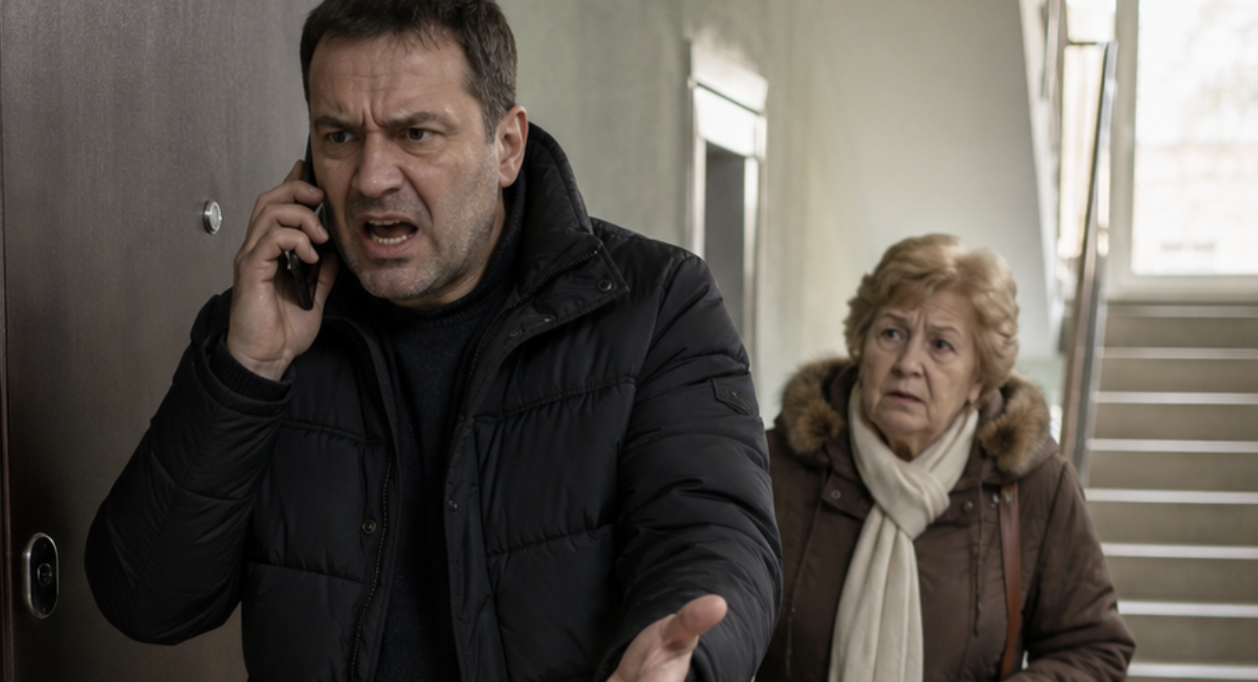
“Vika, what the hell is going on?!” Ivan shouted irritably into the phone the moment she picked up. “Mom and I have been standing outside the door for half an hour! My key doesn’t work at all!”
“I changed the lock,” Victoria replied calmly, almost casually.
“You changed it? Why?!” Ivan’s voice trembled with genuine astonishment.
“Because neither you nor your mother will be living in my apartment anymore.”
In the background, Victoria could hear Veronika Maksimovna demanding an explanation, but she continued speaking evenly, refusing to let herself become emotional.
“Ivan, I’m filing for divorce. My lawyer has already prepared the first documents.”
“Are you serious?! Because Mom wanted to move in?!”
“Because you decided she would move in without me,” Victoria answered. “Your belongings are packed. They’re downstairs with the concierge. I told him to give them to you when you come for them. We have nothing else to discuss.”
After finishing the sentence, Victoria ended the call without waiting for her husband’s response and switched her phone to silent mode.
During the rest of the workday, around fifteen more missed calls appeared on the screen. Some were from Ivan, others from an unfamiliar number that most likely belonged to Veronika Maksimovna.
Victoria answered none of them, firmly deciding to ignore every attempt to contact her until they met through their lawyers.
Apparently, Ivan remained outside the building for quite some time, demanding explanations from the concierge and trying to call neighbors through the intercom, though naturally none of it helped.
As an upstairs neighbor who happened to witness the scene later told Victoria, Veronika Maksimovna began blaming her son right there in the courtyard. She accused him of failing to insist on his position earlier, of failing to keep his wife under control, and of allowing the situation to get out of hand.
Instead of the move they had expected, with Veronika Maksimovna’s furniture arranged neatly in its new places, the mother and son ended up with two packed suitcases waiting at the concierge desk and a firmly locked apartment door—a door to an apartment that had never belonged to either of them.
As the lawyer had warned Victoria, the divorce took some time. There were several hearings, paperwork formalities, and a wait for the official decision.
For a while Ivan continued calling and sending long messages containing explanations and requests to talk. Gradually, however, the calls became less frequent and eventually stopped completely.
Later, Victoria learned through mutual acquaintances that Ivan and his mother had eventually rented a small apartment together—the exact shared living arrangement Veronika Maksimovna had dreamed about for so long, only in a different home and with a different person sharing it.
Despite the paperwork and complications still ahead, Victoria felt genuine, unclouded relief for the first time in a very long while—the kind of feeling that had been missing throughout all those months of constant tension and concessions.
The back room, which her mother-in-law had described in such detail as the future home for her furniture, remained empty.
Victoria hung light curtains there, placed an old armchair beside the window, and slowly began turning the room into a space of her own—without having to consider anyone else’s plans or anyone else’s lists of belongings waiting to be moved in.