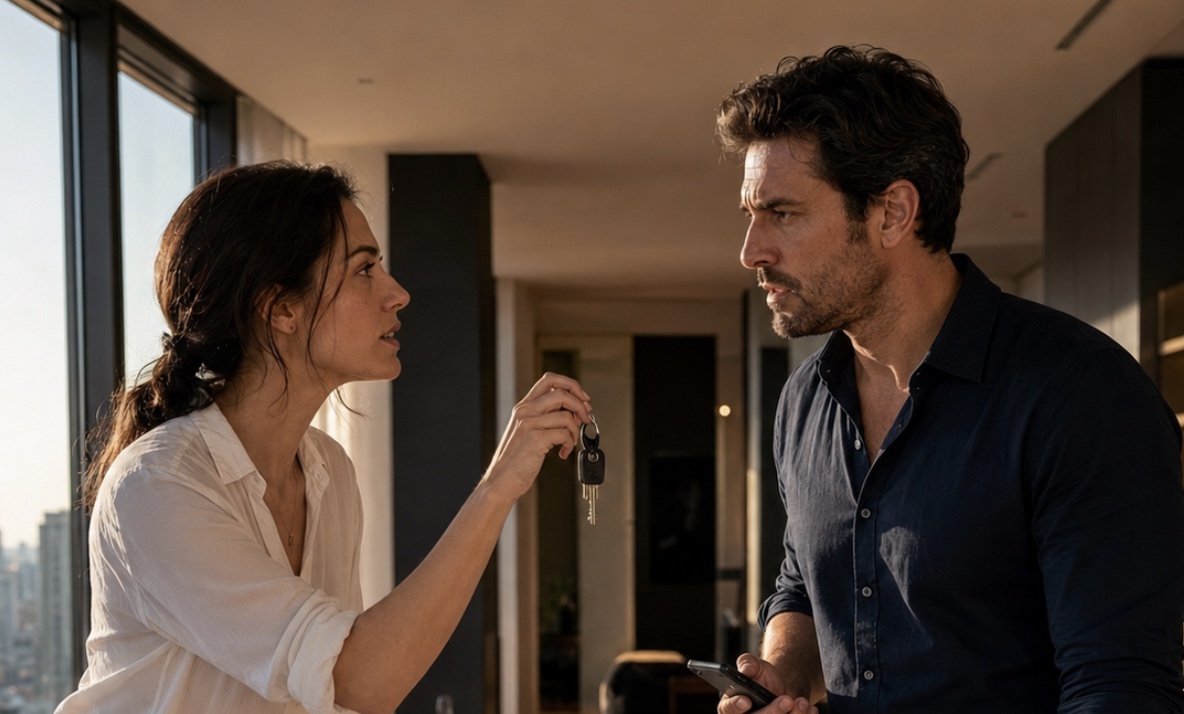
“Tell your mother this: one more visit without an invitation, and the next conversation she has will be with the police,” Victoria said, calmly closing the folder of documents.
Sergey looked up from his phone. He was sitting at the kitchen table in an old T-shirt, wearing the expression of a man who had just been told about unusual weather rather than a serious family conflict.
“Are you actually serious?”
“Completely.”
“Vika, she’s my mother.”
“And this is my apartment.”
Sergey opened his mouth, ready to offer one of his usual soft, smoothing answers, but Victoria looked at him so directly that the words died before they came out. In ten years of marriage, he had grown used to a different version of his wife—the woman who explained herself endlessly, chose her words carefully, tried to reconcile everyone at her own expense. The woman who, after an unpleasant conversation, would go wash cups just to keep her hands busy and stop herself from saying too much.
The woman sitting in front of him now was different.
She wasn’t raising her voice. She wasn’t slamming cupboard doors or demanding promises. She simply opened the folder and showed him the apartment documents, the locksmith’s receipt, and a photograph of the set of keys Tamara Ivanovna had finally left on the hallway table after being asked three separate times.
“Why did you bring out the folder?” Sergey frowned.
“So you can finally look at facts instead of calling everything ‘Mom being upset.’”
He rubbed his face wearily.
“She only came by. Yes, she went too far, but you know what she’s like. She’s from another generation.”
“Being old-fashioned means greeting your neighbors and making preserves for winter, Sergey. It does not mean unlocking someone else’s front door with your own key, bringing strangers into their apartment, and hosting tea in their living room while the owner isn’t home.”
Sergey grimaced.
“It wasn’t exactly a tea party. They just sat around for a while.”
Victoria slowly pushed her phone toward him.
There was a photograph on the screen. Three women were sitting in their living room. One was holding a cup. Another was studying the bookshelf. The third stood beside a partly opened wardrobe in the hallway.
Their neighbor had taken the picture from the landing after noticing that the front door had been left wide open while Tamara Ivanovna loudly explained to someone that “my son’s apartment is spacious, although his wife keeps the place like a museum.”
“They didn’t just sit around,” Victoria said. “They walked through my apartment. One of them opened our wardrobe. Another asked where we keep the property papers because Tamara Ivanovna told them that you and she were planning to ‘sort something out about registration.’”
Sergey’s head snapped up.
“What registration?”
“That’s exactly what I’d like to know.”
He picked up the phone, enlarged the image, then set it down again.
At first, his face showed the usual reaction. He seemed ready to get angry at the neighbor for taking the photograph, then at Victoria for turning everything into an investigation. But his eyes landed on the familiar woman standing beside the wardrobe.
“That’s Nina Petrovna, Mom’s friend,” he said more quietly.
“Wonderful. Now I know the name of the woman who was going through our hallway cupboards.”
“Vika, don’t make it bigger than it is.”
“I’m not exaggerating. I’m documenting.”
The words were spoken so calmly that Sergey flinched.
Victoria had always had one particular quality: the more deeply something hurt her, the more precise her words became. Not louder. Not crueler. Simply sharper and more exact.
And that was far more uncomfortable.
The apartment really did belong to Victoria. She had bought it two years before they married. It wasn’t large, but it was in a good neighborhood, had a practical layout and a long enclosed balcony where she grew herbs in wooden boxes.
Before the wedding, she had lived there alone.
Later Sergey moved in, and at first there had been no problems.
Back then, Tamara Ivanovna had behaved with restraint. She visited on holidays, brought bags of food and sweets, looked around approvingly, and often said that young couples needed to have their own space.
Victoria had even been grateful. Her mother-in-law seemed reasonable. She didn’t interfere with advice, didn’t demand daily calls, and didn’t compare Victoria to women from Sergey’s past.
Everything changed after Sergey’s father died.
Tamara Ivanovna was left alone in her two-bedroom apartment on the other side of the city.
During the first months, Victoria felt sorry for her. She invited her over herself, called regularly, helped with shopping and drove her to medical appointments. Sergey tried to help too, but work, responsibilities and exhaustion gradually pulled him back into his normal routine.
Tamara Ivanovna, meanwhile, started visiting more and more often.
At first, she gave notice.
Then she began calling from downstairs.
Eventually, she stopped calling altogether.
“I’m his mother,” she would say as she stepped into the hallway carrying shopping bags. “I’m not some stranger.”
Victoria didn’t argue.
She asked for only one thing: call before coming.
It wasn’t because she begrudged her tea or a seat at the table. Home was simply the only place where Victoria didn’t have to perform, smile, answer questions or make herself convenient for anyone.
Tamara Ivanovna would agree with the expression of someone granting a ridiculous favor.
“Fine, Vika, I’ll call. Young people today are obsessed with boundaries. We used to live more simply.”
And a week later, she would unlock the door with her own key again.
Victoria discovered that her mother-in-law even had keys by accident.
One afternoon she came home earlier than expected and found Tamara Ivanovna standing in front of the refrigerator.
The older woman didn’t look embarrassed in the slightest.
“I brought soup. And that yogurt on the shelf was expired, so I threw it out.”
“How did you get in?”
“Sergey gave me keys. Just in case.”
Victoria turned toward her husband.
Caught between the two women, Sergey gave a guilty shrug.
“I gave them to her a long time ago. When you went away on that business trip. I forgot to tell you.”
Forgot.
One word, intended to cover an intrusion that had lasted for years.
After that conversation, Victoria asked for the keys back.
Tamara Ivanovna took offense but eventually returned a set. Sergey assured Victoria that the problem was over.
Victoria almost believed him.
Almost.
The reason she didn’t entirely believe it was that Tamara Ivanovna surrendered the keys far too easily and stopped complaining far too quickly.
Then came the day that changed everything.
Victoria was supposed to return late, but her meeting was canceled. She arrived home in the middle of the afternoon, took the elevator upstairs, and heard women laughing before she even reached her door.
For a second, she wondered if she had gotten off on the wrong floor.
Then she noticed unfamiliar shoes on the doormat.
The door wasn’t locked.
Victoria stepped inside and stopped in the hallway.
Tamara Ivanovna stood in the living room as though she were entertaining a delegation in her own home. Two acquaintances were sitting nearby, while a third woman examined framed photographs on the shelves.
“And this is from when they went to Suzdal,” Tamara Ivanovna was saying. “My Sergey has always loved traveling. It’s Vika who drags him to all those exhibitions.”
The woman by the shelf turned first.
“Oh. The lady of the house is home.”
Victoria slowly removed her handbag from her shoulder. Very slowly. Very carefully.
She placed it on the bench instead of throwing it onto the floor.
“Tamara Ivanovna, what is going on?”
Her mother-in-law actually smiled.
“Vika, don’t make that face. We won’t stay long. The girls were nearby, so I invited them in to see how you live. I told them my son and his wife have a cozy place, although everything is so strict here, like a hotel.”
“Are you giving tours of my apartment now?”
One of the women quietly placed her cup on its saucer.
Tamara Ivanovna frowned.
“Don’t start a scene in front of people.”
“These people are going to put on their shoes and leave.”
“Vika!”
“Now.”
Victoria did not raise her voice.
But that single word was so firm that even Nina Petrovna immediately stood up.
The second woman muttered that they probably should be leaving anyway.
The third quickly closed the wardrobe door, but Victoria had already seen her movement.
“What were you looking for in there?” she asked.
The woman flushed.
“I wasn’t looking for anything. The door was already open.”
“In my apartment, even an open cupboard does not require your assistance.”
Tamara Ivanovna’s face turned red.
“You’re humiliating my guests!”
“No. You humiliated them when you brought them into a place where nobody invited them.”
When the women finally left, Tamara Ivanovna spun around.
“Are you happy now? You embarrassed me in front of everyone!”
“You embarrassed yourself when you entered my home without permission.”
“Your home?” Tamara Ivanovna mocked. “Don’t forget my son lives here.”
“He lives here. He does not own it.”
The older woman narrowed her eyes.
“So that’s how it is. A man lives with you for ten years, but everything still belongs to you?”
“The apartment does.”
“And what if something happens with Sergey? Am I supposed to stand outside in the street?”
Victoria looked at her carefully.
There it was.
This was not about loneliness. It was not about missing her son.
Something else lay beneath all those unannounced visits.
Tamara Ivanovna was testing territory.
She was getting herself—and everyone around her—used to the idea that her son’s apartment was a family property where she naturally had a right to enter.
“You have your own apartment,” Victoria said.
“My apartment is old. The neighborhood is bad. The elevator always breaks down. This building is much better.”
“That doesn’t give you the right to mentally move yourself into someone else’s home.”
Tamara Ivanovna snatched up her handbag.
“I’ll tell Sergey everything.”
“Please do. And leave the keys on the table.”
Her mother-in-law froze.
“What keys?”
“The ones you used to open the door today.”
Tamara Ivanovna’s expression changed.
She realized too late that she had given herself away.
“I have a spare set. For emergencies.”
“The keys.”
“Sergey gave them to me himself.”
“The keys, Tamara Ivanovna.”
The older woman dug through her bag, pulled out a key ring and threw it onto the hallway table.
She didn’t place it there. She threw it, clearly hoping for drama—the sound, the gesture, the satisfaction of seeing Victoria react.
Victoria merely looked at the metal keys and then back at her mother-in-law.
“If there’s another set, now would be a good time to tell me.”
“As if I need anything from you or your precious apartment,” Tamara Ivanovna snapped before storming out.
That same evening, Victoria called a locksmith.
No threats. No endless discussions.
She simply found someone who could come over, waited while he replaced the lock, checked the new keys and placed one spare set in the safe.
She kept another.
The third set she handed to Sergey when he came home.
He stared at the new keys as if they were a court sentence.
“You could have waited for me.”
“I waited for you for ten years. That was long enough.”
“Mom is going to lose her mind.”
“That’s her decision.”
“Vika, why replace the lock immediately?”
Victoria opened the folder.
She took out the purchase contract. The property extract. The locksmith’s receipt. The photograph of the women in the apartment.
Everything was arranged neatly.
In order.
“Because asking politely didn’t work.”
At first Sergey tried speaking gently.
Then he became irritated.
Then he switched back to tenderness, as if trying to summon the old Victoria—the one who would compromise just to keep the peace.
But that version of Victoria was not there anymore.
“Tell your mother that if she comes here one more time without being invited, she’ll be speaking to the police,” Victoria repeated. “And tell her exactly that.”
Sergey promised he would.
Three days later, it became clear that he had softened the message.
Tamara Ivanovna called Victoria herself.
Her voice was offended, theatrical and loud.
“Vika, have you completely lost your mind? Threatening your husband’s own mother with the police?”
“I’m giving you a warning.”
“Don’t tell me when I can speak. I gave birth to Sergey, raised him, stayed awake all night when he was sick, and now you’re locking me out?”
“I locked the door against people entering without permission. That is not the same thing.”
“You’re deliberately turning my son against me.”
“Tamara Ivanovna, Sergey is an adult man. He can see you whenever and wherever he wants. At a café, at your home, in a park, at a shopping center. But my apartment is not a public waiting room.”
Her mother-in-law inhaled sharply.
“Yours, yours, everything is yours. We’ll see about that.”
“We’ll see about what, exactly?”
“Life is long.”
Victoria turned on the call recording.
Not because she planned to threaten anyone.
Because she wanted clarity.
For several more minutes, Tamara Ivanovna spoke about ingratitude, manipulative wives, a son’s duty, and how “normal daughters-in-law respect their elders.”
Then she hung up.
That evening, Sergey heard about the phone call and once again tried to smooth things over.
“She’s just upset.”
“She threatened me.”
“That wasn’t a threat. She just talks like that.”
“People tend to change the way they talk when they realize their words can have consequences.”
Sergey sat opposite his wife.
For the first time, he looked less irritated than lost.
“Vika, I feel like I’m caught between two fires.”
“No, Sergey. You’re not between anything. You’re here beside me, in my apartment, in our marriage. The fire is coming from your mother, and for years you’ve pretended it was just a candle.”
He lowered his eyes.
The words hit their mark.
For the next two weeks, Tamara Ivanovna did not visit.
Instead, she called Sergey every evening.
Victoria heard fragments through the apartment: “my heart,” “my son,” “what have I lived to see,” “I’m a stranger now,” “that woman controls you.”
Sergey usually went out onto the balcony to speak with her and came back gloomy and silent.
Several times, Victoria saw him prepare to say something to her, only to change his mind.
She didn’t pressure him.
She asked only once:
“Do you really think I should keep tolerating this?”
Sergey stood by the window for a long time before answering quietly.
“No. But I don’t know how to talk to her.”
“Honestly.”
“She doesn’t hear honesty.”
“Then speak briefly.”
He looked at Victoria and, for the first time, didn’t argue.
It seemed as though the conflict was finally beginning to fade.
But Tamara Ivanovna was not the kind of woman who surrendered territory after one defeat.
On Saturday, Victoria went to meet an artist whose exhibition her cultural center was preparing.
Sergey stayed home.
She returned in the early evening and heard voices on the landing before the elevator doors even opened.
When they did, Victoria saw Tamara Ivanovna.
Her mother-in-law stood outside their front door with a rolling suitcase and two shopping bags.
Beside her was an unfamiliar heavyset woman in a winter coat.
Sergey stood in the doorway, pale and angry.
“I said I’m staying with you for a week,” Tamara Ivanovna announced. “They’re checking the pipes at my place.”
“Who is checking them?” Victoria asked as she stepped out of the elevator.
Her mother-in-law spun around.
For a split second, Victoria saw irritation flash across her face.
She had obviously hoped to get inside before her daughter-in-law came home.
“The management company,” she answered quickly.
“On a Saturday? What kind of work are they doing?”
“Are you going to control everything now?”
Victoria looked at Sergey.
“Did you invite her?”
“No,” he replied immediately. “I told her she couldn’t stay here unless we discussed it with you first.”
It was the first time.
Not perfect. Not confident.
But it was the first time Sergey had refused to hide behind the words, “But she’s my mother.”
Tamara Ivanovna threw up her hands.
“Look at him! He’s making his own mother stand in the hallway! Look what she’s turned you into!”
The unfamiliar woman nodded sympathetically.
“Tamara, maybe you should come stay with us instead.”
“No, Lyuba. I came to my son.”
“Your son has already answered you,” Victoria said. “You don’t enter without an invitation.”
Tamara Ivanovna stepped closer.
“You’re not going to let me in?”
“No.”
“Even with a suitcase?”
“A suitcase does not give you the right to enter.”
Sergey visibly tensed but said nothing.
Tamara Ivanovna reached for the door handle, as though testing whether either of them would give in.
Victoria took out her phone.
“Tamara Ivanovna, I’m calling the police now and reporting that someone is attempting to enter my residence without the owner’s permission.”
“You wouldn’t dare.”
Victoria dialed.
Her mother-in-law continued staring at her in disbelief until she heard Victoria calmly give the address, floor number and explanation.
Tamara Ivanovna’s face changed.
“You’re disgracing this family!” she hissed.
“No. I’m protecting my home.”
The police did not arrive immediately, but they came soon enough.
Tamara Ivanovna remained on the landing the entire time, alternately crying, accusing her son, and gripping the suitcase handle.
Sergey stayed silent.
Lyuba tried to persuade her friend to leave, but Tamara stubbornly refused.
When the officers arrived, they listened to everyone.
Victoria showed the ownership documents and explained that Tamara Ivanovna had previously entered the apartment without permission, brought strangers inside, returned her keys after being confronted, and was now trying to enter again despite not being invited.
One of the officers turned to Tamara Ivanovna.
“Ma’am, the owner does not consent to you entering the apartment. You have not been invited. You’ll need to arrange to stay somewhere else.”
“I’m his mother!” she protested.
“That does not give you the right to enter someone else’s residence without consent.”
Hearing the same simple fact from a uniformed stranger seemed to make something click inside Sergey at last.
His mother had not merely been “dropping by.”
She had been violating boundaries.
And by staying silent, he had been helping her.
Tamara Ivanovna gripped the suitcase so tightly that her fingers trembled.
“Sergey, you’re going to allow this?”
He looked at her for a long time.
Then he said:
“Mom, go home. Or stay with Lyuba. But don’t come here again unless you’re invited.”
Tamara Ivanovna froze.
If Victoria had been the only one saying it, she would have created another scene.
But now it was Sergey.
Her son.
The one who had always backed down.
“So you’ve chosen,” she said.
“I’m not choosing between you and my wife. I’m choosing normal boundaries.”
Lyuba gently took Tamara Ivanovna by the elbow.
“Come on, Tamara. Enough.”
Tamara pulled her arm away, but she finally turned her suitcase toward the elevator.
Just before the doors closed, she looked at Victoria with the wounded expression of someone who believed she had lost not access to an apartment, but an entire life.
When it was over, Sergey walked inside and stood in the hallway for a long moment.
Victoria locked the new door and put away her phone.
“I’m sorry,” he said.
She turned toward him.
“For what, exactly?”
He gave a crooked smile, but there was no humor in it.
“The list is long.”
“Start with the important part.”
Sergey ran a hand through his hair.
“For the keys. For not telling you. For asking you to put up with things because it was easier for me to deal with your anger than with my mother’s tears. For calling intrusion ‘care.’”
Victoria listened in silence.
Part of her wanted to believe him immediately.
But she had already learned how little words could mean in the aftermath of a scandal.
Words warmed quickly.
Habits changed slowly.
“I don’t want an apology if nothing changes,” she said. “I want this never to happen again.”
“It won’t.”
“Sergey.”
“I understand,” he interrupted, but gently. “I really do.”
He took out his key ring, removed one key from an old fob and placed it on the hallway table.
“That’s for the storage room downstairs. Does Mom know about it?”
“No.”
“Good. She won’t.”
Victoria almost smiled for the first time that day.
“That was dramatic.”
“I’m learning from you how to document facts.”
After that Saturday, Tamara Ivanovna vanished from their lives for a month.
She didn’t call Victoria and rarely answered Sergey. Through Lyuba, she passed along messages saying that “my son is alive, but I’ve lost him.”
Sergey still went to see her.
Alone.
Not with Victoria and not for theatrical reconciliation.
He brought groceries, helped around her apartment, took care of practical things.
But he did not invite his mother back to Victoria’s home.
Their first real conversation was difficult.
Sergey came home late, sat beside his wife and said:
“She honestly doesn’t understand what she did.”
“Doesn’t understand, or doesn’t want to?”
“I think she’s afraid to understand. Because if she does, she’ll have to admit that all these years it wasn’t just care.”
“It was control.”
“Yes.”
Victoria felt no satisfaction in being right.
She did not want victory over an older woman.
She wanted a home where only people who were invited crossed the threshold.
Some time later, another detail came to light.
Tamara Ivanovna had indeed been telling friends that “my son has a nice apartment” and that “if my health gets worse, I’ll move in with him.”
Not with them.
With him.
In her version of reality, Victoria was only a temporary obstacle—perhaps the legal owner on paper, but not the true owner according to some imagined family law.
Documents, Tamara Ivanovna apparently believed, could be overcome with enough pressure.
Lyuba was the one who revealed this.
She called Victoria unexpectedly and asked her not to hang up.
“I don’t want to interfere,” she said. “But Tamara is telling everyone you threw her out onto the street. I was there. That isn’t true. And there’s something else. Nina Petrovna wasn’t just opening your wardrobe that day. Tamara told her to check where you kept the apartment documents. Nina later bragged that her nephew works in real estate and could explain how to ‘properly arrange a share for the son.’”
Victoria listened, slowly tightening her grip around the pen in her hand.
Not from panic.
From cold clarity.
“Thank you for telling me.”
“I don’t approve of any of it,” Lyuba continued. “My son is married too. I’d die of shame if I went through my daughter-in-law’s home like that.”
That evening, Victoria told Sergey everything.
He sat very still.
Then he stood, paced across the kitchen, came back and asked for Lyuba’s number.
“Why?”
“I want to hear it myself.”
“You think I made it up?”
“No. I want Mom to have no chance of saying you twisted the story.”
He called Lyuba in front of Victoria.
She repeated exactly the same thing.
No exaggeration.
No hostility.
After the call, Sergey stared into space for a long time.
“She wanted to know where the documents were,” he finally said.
“Yes.”
“Documents about my share that doesn’t exist.”
“Yes.”
He exhaled sharply through his nose, as though holding back words he didn’t want to say aloud.
“I’m ashamed.”
“That’s closer to reality than ‘she just stopped by.’”
The next day, Sergey went to see his mother.
He returned three hours later, looking tired but calm.
“I told her that if she ever discusses your apartment with outsiders again, I’ll end the conversation immediately and only speak to her about practical matters. And I told her she will never live with us.”
“What did she say?”
“First she cried. Then she said I was ungrateful. Then she asked who would take care of her when she gets old.”
“And what did you say?”
“That I’ll help her. But helping her does not mean giving away something that belongs to someone else.”
Victoria looked at her husband and, for the first time in a long while, saw not a boy trapped between his mother and his wife, but an adult man.
Late.
Imperfect.
After plenty of mistakes.
But an adult nevertheless.
That autumn, Sergey’s grandmother—Tamara Ivanovna’s mother—had a birthday celebration.
Everyone was invited.
Victoria didn’t want to go, but Sergey asked her.
“If you feel uncomfortable, we’ll leave immediately. No arguments.”
She agreed, not for her mother-in-law’s sake, but for her own.
She didn’t want Tamara Ivanovna turning her absence into another story about the cruel daughter-in-law who destroyed the family.
The celebration was held at the home of Sergey’s cousin, Irina.
Tamara Ivanovna greeted them coldly.
She spoke to her son and gave Victoria the kind of distant nod one might give a neighbor from another building.
Victoria returned the greeting calmly and took her place at the table.
The first hour passed peacefully enough.
Relatives talked about country houses, health problems and children’s schoolwork.
Then Nina Petrovna—the same friend from the apartment—somehow ended up joining the conversation.
Loudly, she announced:
“I believe a mother has every right to visit her son’s home whenever she wants. That’s what being a mother means.”
Several people became noticeably uncomfortable.
Sergey placed his fork beside his plate.
“Nina Petrovna, it was not my home. It was Victoria’s apartment.”
“Oh, what difference does that make?” she waved dismissively. “A husband and wife are one.”
“Then why were you looking for property documents belonging to someone who isn’t even your relative?”
The room fell silent.
Nina Petrovna turned pale.
Tamara Ivanovna whipped her head toward her son.
“Sergey!”
“No, Mom. Enough.”
He did not raise his voice.
But every word was clear.
“You entered someone else’s apartment without permission. You brought people with you. You discussed my wife’s property. Then you showed up with a suitcase and tried to force your way in through guilt. That is not care. That is a violation of boundaries. And I’m not going to pretend anymore that it’s just some harmless family habit.”
Irina slowly raised her eyebrows.
Someone at the table muttered:
“Wow.”
Tamara Ivanovna sat rigidly upright, but her hands were trembling.
She picked up her napkin, smoothed it over her knees, then crushed it in her fist.
“I only wanted what was best,” she said.
Victoria looked at her.
For the first time, the sentence lacked its former confidence.
Perhaps Tamara Ivanovna really had wanted “what was best.”
Just what was best for herself.
For her fear.
For her need to control her son.
“Best for whom?” Victoria asked quietly.
Her mother-in-law did not answer.
Things did not become perfect after that birthday.
Tamara Ivanovna did not suddenly transform into a warm and wise woman.
She could still take offense if Sergey’s phone calls were too short. She still tried to ask him about their weekend plans. She still believed young people cared far too much about privacy and personal boundaries.
But the decisive line had been crossed.
She never came without permission again.
Sometimes she called and asked stiffly:
“May I come by tomorrow for an hour?”
Victoria did not always say yes.
And somehow, the world did not end.
When they did invite Tamara Ivanovna, the visits happened according to clear rules.
No opening cupboards.
No inspecting the refrigerator.
No remarks about where things were kept.
During the first visit, the effort almost visibly hurt her. Her eyes kept wandering toward the shelves, and her fingers seemed desperate to straighten the vase on the cabinet.
Victoria noticed.
She said nothing.
Tamara Ivanovna said nothing either.
For both of them, that silence was work.
One day, Tamara Ivanovna arrived carrying a small bag.
She took out a box of chocolates and awkwardly held it toward Victoria.
“For tea.”
“Thank you.”
“I’ll stay for an hour. Like we agreed.”
From the other room, Sergey looked at his wife.
Victoria noticed the cautious happiness in his expression but didn’t smile too obviously.
The three of them drank tea together.
They talked about ordinary things: the weather, road repairs near the clinic, a new pharmacy that had opened close to Tamara Ivanovna’s building.
Nothing important.
And yet, for their family, that “nothing” meant more than any dramatic reconciliation.
For once, no one was trying to overpower anyone else.
When Tamara Ivanovna got ready to leave, she paused by the door.
“Vika.”
“Yes?”
Her mother-in-law looked down at the doormat instead of at her.
“That day… when I brought those women… I shouldn’t have done it.”
The hallway became very quiet.
Sergey even stopped fastening his mother’s coat.
Victoria did not make it easier for her.
She didn’t say, “It’s fine.”
She didn’t rush forward to hug her.
It had not been fine.
“Yes,” Victoria replied. “You shouldn’t have.”
Tamara Ivanovna nodded.
Slowly.
Heavily.
“I won’t do it again.”
“Good.”
It wasn’t a beautiful ending filled with hugs and complete forgiveness.
But it was an acknowledgment.
The first genuine one.
After his mother left, Sergey closed the door and turned toward Victoria.
“Do you believe her?”
Victoria listened to her own feelings.
The old anger was gone, but trust could not be restored with a single sentence.
“I believe she understands the consequences now. The rest will take time.”
“That’s fair.”
He stepped closer and gently took her hand.
“Thank you for not throwing me out with her suitcase that day.”
Victoria looked at him carefully.
“I considered it.”
“I know.”
“If you had opened the door for her against my wishes, that conversation would have ended very differently.”
“I know,” he repeated.
She squeezed his fingers.
“A home isn’t protected by keys, Sergey. A lock can be replaced in an hour. A home survives because the person beside you understands what belongs to them, what belongs to someone else, and what truly belongs to both of you.”
He nodded.
“I understand that now.”
Outside, evening was settling over the city.
The apartment was quiet.
Not painfully silent.
Not tense.
Simply peaceful.
Their cups were still on the table. A few chocolates from Tamara Ivanovna’s box lay on the saucer.
Victoria put the folder of property documents back into the cupboard, shut the door, and for the first time in months, did not check whether the keys were still where she had left them.
She had not won a war against her mother-in-law.
Family wars rarely end in victory.
She had simply restored the most important rule of her home:
the door was opened by the person who lived there—not by someone else’s habits, family entitlement, or a spare key handed out years earlier “just in case.”
And Tamara Ivanovna, however unpleasant it was for her to admit, had finally been forced to understand one simple truth:
loving her son did not make her the owner of his marriage.
And being family did not turn someone else’s apartment into shared property.
From then on, before coming over, she called first.
And every time Victoria saw her name appear on the screen, she answered calmly.
Because now the call was no longer a warning that someone was about to walk in without permission.
It was a question.
And sometimes, surprisingly enough, respect begins with learning to ask.