Zinaida opened the door with her own key and knew the moment she stepped inside that something was wrong.
The apartment smelled unfamiliar. Not simply of food, but of someone else’s presence — heavy floral perfume, the kind she would never have bought for herself, mixed with the sharp odor of burnt cooking oil. She slipped off her shoes, automatically straightened them so the toes pointed toward the door, as she always did, and walked toward the kitchen.
A young woman was standing at Zina’s stove with her back turned.
She was wearing Zina’s apron — the one embroidered with cornflowers, the apron Zina saved for Sunday breakfasts. The girl was scraping a burned fried egg from the pan onto a plate. And not just any pan. It was the heavy cast-iron skillet Zina had inherited from her mother, a skillet that required careful treatment. Now it was covered in dried grease, and the stranger was scrubbing it with a metal scourer, carving scratches into the surface that had been seasoned and cared for over generations.
Zina stopped in the doorway.
“Who are you?” she asked quietly.
The girl turned around. She looked about twenty-five, with blonde hair tied into a careless ponytail and lipstick far too bright for an ordinary Tuesday morning.
“Oh! You must be Zina,” she said sweetly, wiping her hands on Zina’s apron. “I’m Lera. Oleg said you wouldn’t be back until this evening. We’re having breakfast.”
“We?” Zina repeated.
Her husband came out of the living room.
Oleg was wearing a freshly ironed shirt. Zina knew immediately that she had not ironed it. She remembered every crease she made, every fold of fabric. This one looked different — sharper, pressed with a heavier hand.
He seemed relaxed. Almost pleased with himself.
“Zina, don’t start making a scene,” he said instead of greeting her. “Lera is going to live here. You’ll have to get used to it.”
Zina leaned her shoulder against the doorframe. A ringing sound filled her ears.
“What exactly do you mean by ‘live here’?” she asked, separating every word. “We have two rooms. Where is she supposed to sleep?”
“In the bedroom, obviously,” Oleg replied. “The sofa in the living room will be fine for you. You’re not demanding. Lera needs comfort. She’s pregnant.”
Zina looked at the young woman.
Lera gently stroked her stomach, and only then did Zina notice the slight curve beneath the apron.
Something collapsed inside her with a deafening crash, although outwardly she didn’t move.
“We tried for three years,” she said quietly to her husband. “For three years you told me children weren’t the most important thing. You said you loved me even if we never had one.”
“It didn’t work with you,” Oleg said with a shrug. “With Lera it happened immediately. Nature, I suppose. Natural selection.”
Zina opened her mouth to answer, but footsteps were already approaching from the hallway.
Heavy steps.
She would have recognized them anywhere.
Her mother-in-law, Tatyana Petrovna, entered the kitchen carrying two supermarket bags and dropped them directly onto the linen tablecloth Zina had embroidered by hand.
“So the tramp finally showed up,” the older woman hissed without even looking at her daughter-in-law. “We’re going to divide the apartment. Oleg has told me everything.”
“The apartment?” Zina repeated. “My apartment?”
“It was bought during your marriage, but the money came from property Oleg owned before the wedding,” Tatyana Petrovna said, finally looking at her. “You contributed nothing. You worked in that miserable library for pennies. You came here with one suitcase and a cat that died a year later. What rights do you think you have to this place? None.”
Zina suddenly remembered her grandmother’s brooch.
An antique piece set with sapphires, made before the revolution.
She remembered walking into the pawnshop with the brooch pressed tightly against her chest. She remembered begging the appraiser to give her at least another month before selling it. She had brought the money home to pay for new electrical wiring because the old system kept sparking.
At the time, Oleg had been lying on the sofa, claiming he was “trying to find himself.”
“I’ll pay you back a hundred times over,” he had promised. “You’re pure gold, Zinaida.”
“I put my grandmother’s brooch into this apartment,” Zina said. “I paid for repairs. I carried bags of plaster up five flights of stairs with my own hands while Oleg was supposedly away on business.”
“Supposedly?” Oleg smirked. “I was building a business. You simply never appreciated anything I did.”
“You built your businesses from the sofa and quit every job after a month because apparently every boss you ever had was an idiot,” Zina replied, her voice trembling. “I supported this household. Me. And you are not throwing me out.”
“No one is throwing you out,” Oleg said, lifting his palms in a gesture of fake reconciliation. “You’ll simply have to live under different conditions from now on. Lera officially moves in tomorrow. She needs to be registered here, and the baby deserves to be born into normal living conditions. Either accept it or pack your things. We’ll give you two hundred thousand rubles. That should be enough to get started. Rent a room somewhere.”
“Two hundred thousand?” Zina gave a short laugh. “This apartment is worth seven million. Half of it belongs to me.”
“Your share,” her mother-in-law said, stepping closer, “is the bowl of soup we allowed you to eat out of pity. You’re infertile, Zina. A barren flower. Lera is going to give my son an heir. So get out while we’re still asking nicely.”
Zina said nothing.
She left the kitchen and walked into the bedroom.
Someone else’s nightgown was lying on her bed. Lera’s makeup bag stood on the bedside table.
Zina opened the wardrobe.
Half of her clothes had been pushed into one corner. Strange blouses now hung on the empty hangers.
She closed the wardrobe, sat on the edge of the bed and covered her face with her hands.
She wanted to scream.
But she knew screaming would only give them satisfaction.
The evening passed in a haze.
Lera cooked dinner — pasta boiled until it had the consistency of glue. Tatyana Petrovna ate it enthusiastically and praised every bite. Oleg talked about turning the living room into a nursery.
No one invited Zina to the table.
She made herself a cup of tea, carried it to the narrow space by the balcony and stood there looking down at the courtyard as evening settled over the buildings.
Slowly, like an old computer starting up, something began working inside her mind.
She could not simply leave.
Leaving without a fight would mean betraying herself.
“How long are you planning to stand there?” Oleg’s voice came from behind her. “Go to sleep. Tomorrow will be a difficult day.”
“I’m off work tomorrow,” she answered automatically.
“Tomorrow you’re packing,” he corrected her. “And don’t even think about becoming hysterical. We’ll handle everything like civilized people.”
Zina said nothing.
She waited until the apartment became quiet.
From the bedroom she heard Lera laughing. Then the bed creaked.
Zina clenched her teeth.
Eventually silence fell.
She waited another half hour until she was sure Oleg was deeply asleep, then quietly walked into the hallway, where his work desk stood.
The drawer was locked.
Zina knew where the key was hidden — inside an old shoe-polish boot that Oleg considered a brilliant hiding place.
She unlocked the drawer carefully.
Inside were folders, contracts and old receipts.
She searched quickly but methodically, photographing documents on her phone with the flash switched off. Her hands trembled. The light from the screen seemed unbearably bright in the dark hallway.
And then she found the purchase agreement.
The same agreement she had signed several years earlier when Oleg arranged the apartment purchase.
Back then, he had pushed a pile of papers toward her and she had barely looked at them.
She trusted him completely.
Now Zina studied every line under the faint light of her phone.
Purchase agreement.
Her signature.
And beneath it, another signature supposedly belonging to her — on an additional agreement she had never seen before.
Zina looked closer.
The signature resembled hers, but the letter “S” in the surname Semyonova was angular.
Wrong.
She always wrote that letter with a smooth, rounded movement. Here it had a sharp break in the middle.
She photographed the document several times.
Her heart was pounding so loudly she was afraid someone would hear it from the bedroom.
Suddenly, the bedroom door creaked.
Zina froze.
Heavy, sleepy footsteps approached.
Oleg walked to the bathroom without looking in her direction.
She pressed herself against the shadowy corner beside the balcony and remained perfectly still until he returned to bed.
Then she carefully closed the drawer, leaving everything exactly as she had found it, and went back to the sofa.
She couldn’t sleep.
Her mind kept circling around the lines in the agreement, the oddly shaped letter “S,” and a section of the Criminal Code she vaguely remembered from her student years.
At dawn, Zina dressed and left the apartment.
Her mother-in-law muttered something after her, but Zina didn’t turn around.
She needed an expert.
A private handwriting specialist.
She found one online whose office was located in an old building on the outskirts of the city.
Professor Gromov was an elderly man with thick glasses. His office was overflowing with folders, magnifying equipment and microscopes.
“This document,” Zina said, placing a printed copy in front of him. “I never signed it. But my signature is there.”
The professor spent a long time examining the paper under magnification. He clicked his tongue occasionally and wrote notes in the margins.
“My dear,” he finally said, “this is actually quite straightforward. The signature was written by another person. Look at the pressure here.”
He pointed to a monitor displaying an enlarged image.
“Your natural pressure is consistent. Here, the pressure changes twice within the lower loop. The person who wrote this stopped and adjusted their hand. They were copying your signature from a sample, but they didn’t know your natural motor pattern. Your letter ‘S’ is smooth and rounded. This one is angular. The ink also appears to come from two different batches. It is a forgery, and not even a particularly sophisticated one. If this were examined in court, I doubt there would be much disagreement.”
“Could this become a criminal case?” Zina asked.
“Absolutely,” the professor replied. “Article 327 — document forgery. And if the document was used to register ownership or obtain a secured loan, there could also be fraud charges involving a particularly large amount. Your husband has taken an enormous risk.”
Zina took the expert report.
Her hands were no longer shaking.
Something inside her had straightened.
It wasn’t rage.
It wasn’t revenge.
It was cold, steady certainty.
She returned home around lunchtime.
Lera was once again behaving as if the apartment belonged to her. This time she was washing the floors, splashing water everywhere.
“Where’s Oleg?” Zina asked.
“He went with his mother to see a realtor,” Lera replied, straightening up. “They’re going to sell the apartment. It doesn’t concern you. You’re moving out.”
“It concerns me,” Zina said and walked into the living room.
She sat down in an armchair and waited.
An hour later the front door slammed.
Oleg and Tatyana Petrovna returned accompanied by a man in a suit — an appraiser.
He walked from room to room, making notes on his tablet.
“Three-room apartment in an older building,” he muttered. “Needs substantial work. Mostly cosmetic renovation, old plumbing. Six and a half million at best. If you want a quick sale, around five-point-eight.”
“We’re not desperate for an immediate sale,” Oleg said dismissively. “We need to structure the exchange properly. My wife can get a share in a communal apartment, while Lera and I take a decent two-room place.”
“I have not agreed to any exchange,” Zina said calmly from her chair.
The appraiser turned and looked at her with interest.
“And you are?”
“The owner,” Zina answered. “The second owner, to be precise. And I haven’t signed anything agreeing to a sale or exchange.”
“Zina, don’t start!” Oleg shouted. “We already discussed this!”
“We discussed nothing.”
She stood.
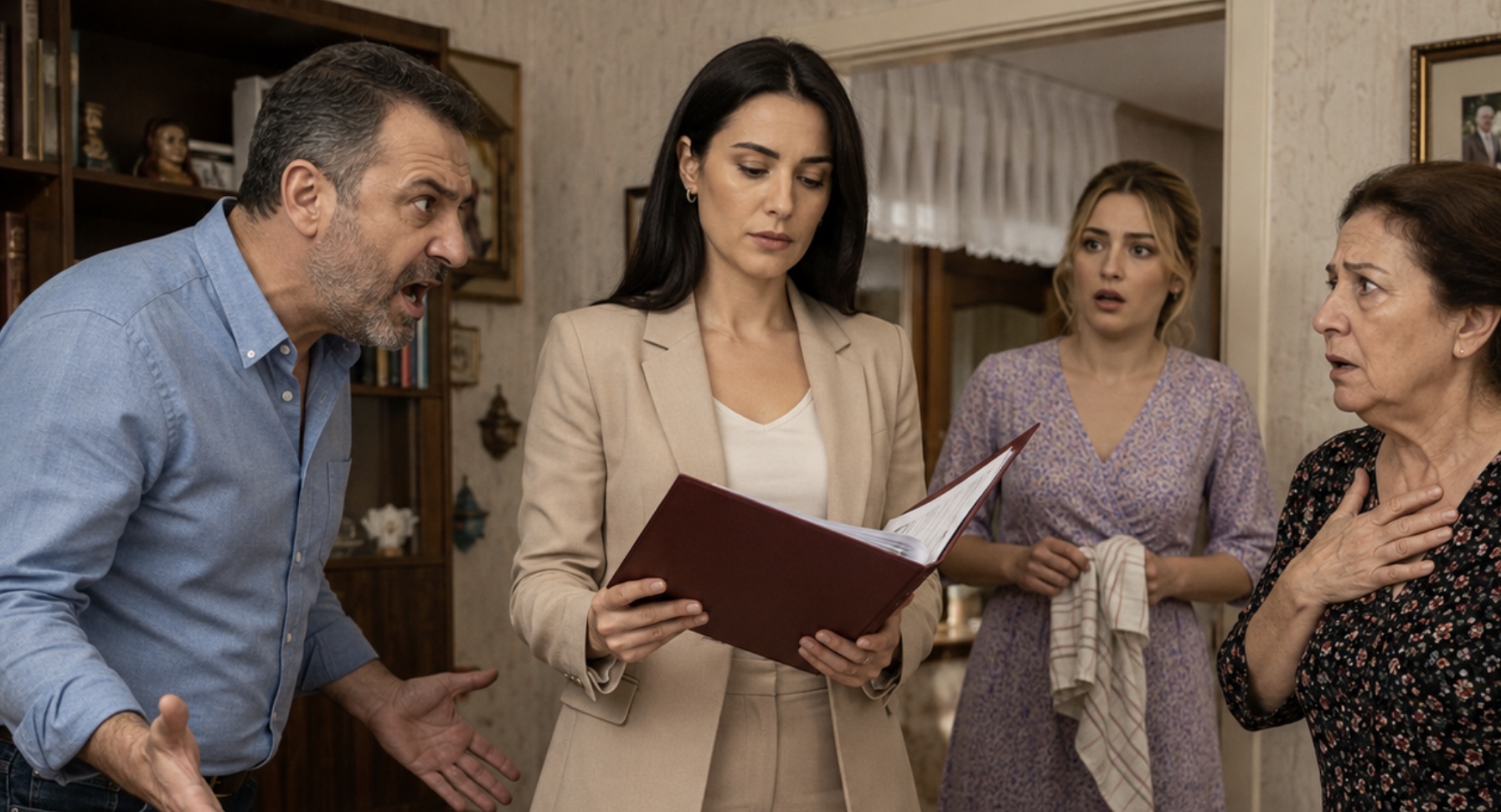
“You brought another woman into my home. You moved my belongings. You’re trying to deprive me of my property. So tell me something, Oleg. Right now, in front of a witness. Did you forge my signature on the additional agreement to the purchase contract?”
Silence swallowed the living room.
The appraiser took a cautious step backward, suddenly realizing he had walked into the middle of a family disaster.
Oleg went pale but quickly tried to regain control.
“What nonsense are you talking about? What forgery? You signed everything yourself!”
“Then show me the original,” Zina said. “Right now. You must have your copy.”
“I don’t have to explain myself to you!”
“What about a court?”
She reached into her bag and pulled out a thick folder carrying the official stamp of the forensic examination office.
“This is a handwriting expert’s report. The signature on the additional agreement was not written by me. Article 327 of the Criminal Code — falsification of documents. And Article 185 — fraud. Do you understand that you could go to prison?”
Her mother-in-law gasped and grabbed her chest.
The appraiser immediately started backing toward the exit, muttering that he urgently needed to call his office.
Hearing the shouting, Lera rushed out of the kitchen with a wet cleaning cloth in her hand.
“What’s happening?” she cried.
“What’s happening is that your Oleg may be facing criminal charges,” Zina said calmly. “And by the way, I wouldn’t celebrate that ‘heir’ too soon. He’s infertile. I have his medical records. So there is a very interesting question about who the father of that baby actually is.”
Lera froze.
The cloth slipped from her hand and landed on the floor.
Oleg slowly turned toward her, his face twisting.
“What?” he whispered. “What is she talking about?”
“She’s lying!” Lera shrieked. “Of course she’s lying! She’s jealous!”
“I’m not lying.”
Zina placed a second document on the table.
“Here’s a copy of your semen analysis from the private clinic, Oleg. You were treated two years ago, when we were still trying to have a child. The doctors told you the chances were practically nonexistent. You didn’t tell me because you didn’t want to hurt me, did you?”
Oleg grabbed the document.
His hands shook as he read.
The color slowly drained from his face.
Tatyana Petrovna sank onto the sofa.
“Olezhek…” she whispered. “How could this be?”
Lera tried to snatch the paper from him, but Oleg pushed her away.
She stumbled against the wall and screamed.
What followed was ugly.
Oleg shouted at Lera, demanding to know who the baby’s real father was. Lera cried and screamed that the baby was his and that she had never cheated on him.
Meanwhile, Tatyana Petrovna apparently forgot all about her heart and lunged toward Zina with raised fists.
“This is your fault!” she screamed. “You filthy creature! You found some fake expert report! You’re trying to destroy us!”
“I want you out of my home,” Zina said.
Then she took out her phone.
“Hello, police? I’d like to report document forgery and threats of physical violence. The address is 15 Stroiteley Street, Apartment 47.”
“You wouldn’t dare!” Oleg roared, rushing toward her.
But Zina had already ended the call.
She looked calmly at her husband.
“I already did. The local officer should be here soon. I suggest you compose yourself.”
Crying, Lera ran into the bedroom and started packing.
Oleg paced through the living room, repeatedly picking up his phone and throwing it down again.
Tatyana Petrovna sat on the sofa, staring at Zina with cold hatred.
“You’ll regret this,” she hissed. “You’ll regret it very badly.”
“I already regret something,” Zina replied. “I regret wasting six years of my life on your family.”
The district police officer arrived about fifteen minutes later.
He was a middle-aged captain Zina knew from the neighborhood. He lived in the next entrance, and years earlier she had helped his daughter prepare for exams at the library.
He stepped inside, assessed the scene and silently accepted Zina’s statement.
“Mr. Semyonov,” he said to Oleg, “it would be better if you left the premises for now. Investigators will be arriving shortly. A review will be conducted regarding the forged documents.”
“This is my apartment!” Oleg shouted. “I’m registered here!”
“We’ll sort out the ownership issue,” the officer replied calmly. “Pack what you need. The pregnant woman should leave as well. Everyone, keep this peaceful.”
Tatyana Petrovna tried to argue. She shouted that she knew people in the city administration and threatened to make phone calls.
The officer remained unmoved.
An hour later, the apartment was silent.
Oleg, Lera and Tatyana Petrovna had left, slamming the door so hard that dust and flakes of whitewash fell from the ceiling.
Zina was finally alone.
She walked slowly through the rooms.
Strange belongings were still scattered across the bedroom. Dirty dishes filled the kitchen.
She opened every window to let the smell of unfamiliar perfume disappear.
Then she sat down at the table and, for the first time in several days, took a full breath.
The court hearing took place two months later.
Oleg was found guilty of forging the signature, although he received a suspended sentence because the apartment had never actually been sold to a third party and no formal financial loss had occurred.
Still, the conviction destroyed his reputation.
He lost his job at the bank.
Lera disappeared as soon as she realized Oleg no longer had money.
Tatyana Petrovna suffered a minor stroke, and Oleg ended up caring for her in a rented two-room apartment on the outskirts of the city.
Zina remained in her home.
The court confirmed her legal right to half of the property.
More importantly, circumstances now gave her the opportunity to buy out her husband’s share at a significantly reduced price because his finances had collapsed.
One evening, Oleg came to see her.
Zina opened the door and found him standing on the landing.
He seemed years older. There were dark circles beneath his eyes, and his shirt was badly wrinkled.
He stared at the floor.
“Zin…” he began.
“What do you want?” she asked.
There was no anger in her voice.
But there was no warmth either.
“Forgive me,” he said quietly. “I understand everything now. I was an idiot. I don’t know what came over me. Maybe we could start again? I’ll change. The apartment can be yours, I swear. Just let me come back. I’m exhausted, Zin. Mom is sick. I have no money. No job.”
Zina looked at him.
Once, she had loved this man.
Once, he had promised to carry her in his arms for the rest of his life.
Now he stood before her tired, defeated and pathetic, asking for forgiveness.
But when she looked into his eyes, she didn’t see true remorse.
She saw exhaustion.
She saw a man longing for the comfort he had lost.
Oleg hadn’t really changed.
He had simply run out of opportunities to behave as arrogantly as before.
“We can’t start over, Oleg,” Zina said. “You taught me something important yourself. Everyone has to answer for their own signature. And for their own decisions. You made your decision the day you brought Lera into our home and told me I was nothing. Now you have to live with it.”
“What am I supposed to do?” he whispered.
“I don’t know.”
Zina shrugged.
“But I know what I’m going to do. I’m going to live in my apartment. Alone. Without shouting, forged documents or someone else’s perfume. And you know what? It’s the best thing that has happened to me in years.”
She closed the door and turned the lock.
Then she walked into the bedroom.
Only her bed stood there now.
Only her clothes hung in the wardrobe.
The folder containing the handwriting examination and the court decision was still lying on the table.
Zina picked it up and put it away in the cupboard.
Then she walked to the window.
Beyond the glass, lights glowed in neighboring buildings while the evening city murmured below.
She poured herself a cup of tea, picked up a book and settled comfortably into her armchair.
The apartment was quiet.
The air smelled clean.
And beneath that freshness was another scent, impossible to describe but unmistakable — the quiet smell of peace that exists only in a place where, at last, a person truly feels at home.