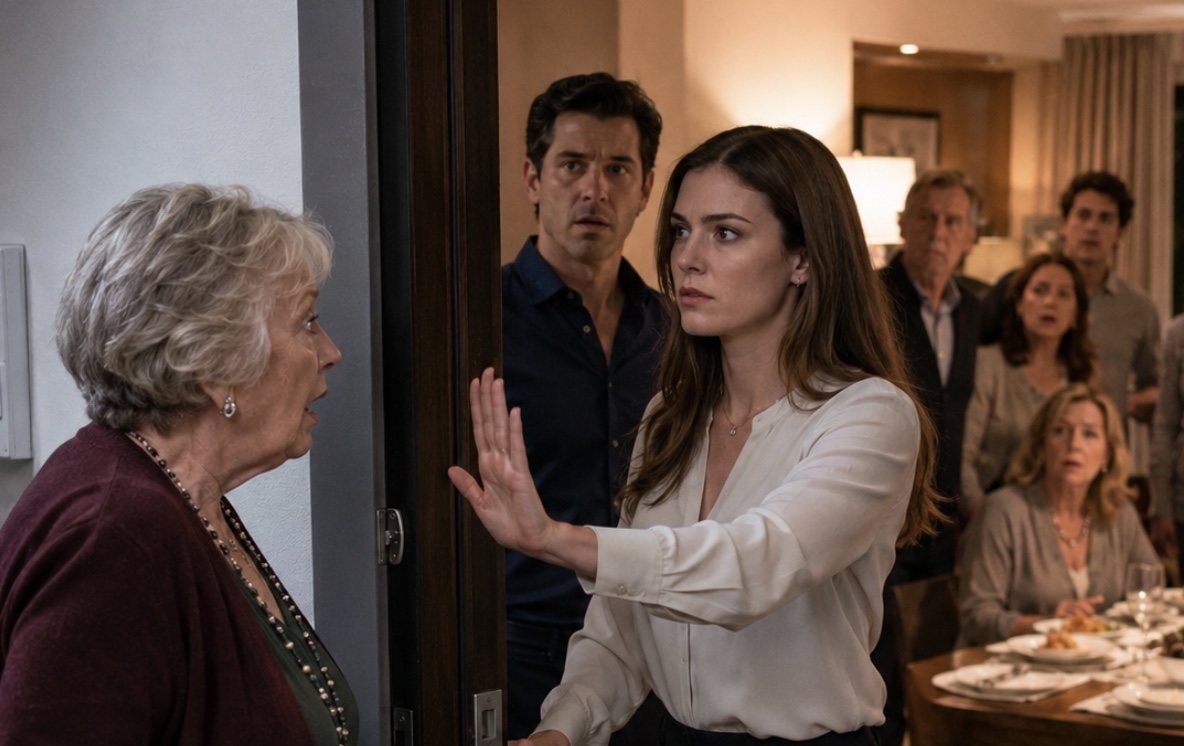
The bag rustled. My mother-in-law placed it in the middle of the table and began taking out little boxes, one after another, lining them up neatly like cartridges.
“Katya, move the salad over,” she said without even looking at me.
I moved it.
It was March 8th, International Women’s Day, at her apartment on Timiryazeva Street. The table had been extended from the wall all the way to the display cabinet. Every year, Igor’s relatives gathered at Rimma Zakharovna’s place, and every year I arrived before everyone else—to peel, chop, cook, and set the table.
That day, the entire spread was mine.
The aspic had been made the night before. There were two salads, chicken roasting in the oven, and a Napoleon cake I had assembled close to midnight because the layers needed time to cool before the cream could be added, and then the whole cake had to sit overnight.
While I worked, my mother-in-law watched a TV series in the living room, occasionally shouting instructions down the hallway not to use too much pepper because “Lyusya has a sensitive stomach.”
“Girls, I brought presents for everyone,” she announced once we were all seated.
She lifted the first little box between two fingers.
“Perfume. Good perfume too, not some market rubbish.”
Zhanna got hers first. Daughters always came first.
Then Aunt Valya, who had traveled overnight from Ryazan.
Then their neighbor Lyusya, who was invited every year because “poor Lyusya is alone, where else would she go?”
Then Zhanna’s mother-in-law, who somehow seemed more at home in that apartment than I had ever been.
The boxes made their way around the table.
I sat at the far edge, near the table leg, counting them simply because I needed something to occupy my hands.
There were ten boxes.
There were eleven women at the table.
The final box was placed beside Lyusya’s plate.
My mother-in-law folded the shopping bag and tucked it beneath her chair, carefully, the way people put away something they know they will no longer need.
“Mom, what about Katya?” Igor asked.
The room fell silent.
So silent I could hear the kitchen faucet dripping. I had asked Igor to fix it the last time we visited.
Rimma Zakharovna wiped her hands on a napkin and finally looked at me.
For the first time that evening.
“Well, Katya isn’t really a woman yet,” she said calmly, as though commenting on the weather. “A child makes a woman a woman. Until then, she’s still a girl. And perfume like this is too grown-up for girls.”
Someone giggled.
Zhanna suddenly became deeply interested in examining her perfume bottle.
“Rimma Zakharovna, come on,” Aunt Valya began.
“What? I’m only telling the truth. I’ve spoken plainly my entire life. I don’t mean anything bad by it.”
My mother-in-law spread her hands and looked around the table for support.
She found it.
Zhanna’s mother-in-law nodded sympathetically.
“Married five years. Five years, girls. At her age, we were already getting children ready for school, not running around cafés.”
I held my fork and stared at the display cabinet.
Behind the glass were photographs.
Zhanna holding little Timosha.
Zhanna leaving the maternity hospital.
Zhanna beside a stroller in front of the apartment building.
There was one photograph of Igor as a child, wearing shorts and holding a toy hoop.
There had never been a photograph of me inside that cabinet.
I had stopped noticing sometime during the second year of our marriage.
“Don’t take it personally,” she added more softly. “Once you give birth, you’ll get everything. Perfume too. Everything.”
“Mom,” Igor said.
“What do you mean, ‘Mom’? I’m telling the truth.”
She raised her shot glass.
“To real women. To mothers. Anyone who has spent sleepless nights with a child understands what I mean.”
Everyone drank.
I drank too.
Leaving a full glass untouched after a toast like that would have created another performance, and I wasn’t interested in giving them one.
Then everyone went back to eating.
They praised the aspic.
They praised the chicken.
Lyusya asked twice for the aspic recipe, and twice I explained it to her, listening to my own voice as though it were coming from another room.
Under the table, Aunt Valya touched my knee.
That was the full extent of the family’s support.
Then my mother-in-law pulled the Napoleon cake toward herself.
“Well, cut your cake, Katyusha.”
Your cake.
I stood, picked up the baking dish with both hands, and carried it into the kitchen.
I opened the refrigerator, put the cake on the top shelf, and shut the door.
Then I returned and stood in the doorway.
“Dessert is for women,” I said. “And apparently I’m only a girl. Girls don’t serve cake.”
Every head at the table turned toward me at once.
Zhanna opened her mouth and forgot to close it.
Aunt Valya stared down at the tablecloth.
“Oh, seriously?” Rimma Zakharovna laughed and slapped the table hard enough to make the forks rattle. “Would you look at that? She’s offended over a bottle of perfume. A three-hundred-ruble bottle!”
“I wouldn’t get up from the table over three hundred rubles,” I replied.
Then I went to the hallway for my coat.
Igor caught up with me on the stairs.
Inside the car, he sat for a long time without starting the engine, blowing warm air onto his fingers.
Then he said,
“Why did you get so worked up? She didn’t mean anything by it.”
A week later, she came to our apartment.
Without calling first.
Nine in the morning on a Saturday.
“Open the door. I’m standing on the landing,” she said through the intercom.
We lived twenty minutes away from her, and she seemed to consider those twenty minutes part of her personal territory.
She didn’t have a key.
That was the one boundary I had managed to defend during five years of marriage, and even that had required a serious argument.
My mother-in-law came inside, took off her shoes, walked straight into the kitchen, and sat down the way an owner would sit—back to the window, facing the doorway.
“Igorek, make me some tea,” she told her son.
To me, nothing.
On her way in, she had already inspected the bathroom and judged the shower curtain I had bought in January.
“Looks like plastic sheeting. Zhanna has a proper fabric one.”
Then she opened the refrigerator, picked up a container of sour cream, checked it, and put it back.
“Two days past the date. Is this what you feed my son?”
Igor silently switched on the kettle.
She reached into her handbag and took out a folded sheet of paper and a thin brochure covered with little daisies.
“Here. There’s an old woman in Kovylkino. A real healer, not some fraud. People travel to her from three different regions. Valya’s daughter-in-law’s relative went, and a year later she had twins.”
“Mom,” Igor said.
“What, ‘Mom’? I’m trying to help instead of sitting around doing nothing.”
She unfolded the paper and placed it on the table, smoothing it with her palm as though it were an official document.
“You should go, Katya. You need to stay there for two weeks. Drink herbs, pray, bow properly. Igorek can drive you. He goes in that direction anyway.”
I stood by the stove and said nothing.
“It isn’t Igorek’s fault he ended up with someone like this,” she said into her cup. “A man needs a son. A man without a son is only half a man.”
Someone like this.
I picked up the little daisy-covered brochure, walked to the trash bin, pressed the pedal with my foot, and dropped it inside.
The lid snapped shut.
“This is my home,” I said. “In my home, nobody discusses my womb. Not with herbs, not without them. Never.”
My mother-in-law lowered her cup onto its saucer as if putting a period at the end of a sentence.
“Igor. Do you hear how she speaks to me?”
He heard.
He stood beside the refrigerator with the kettle in his hand, staring at his sock.
“Mom, enough, okay?” he finally managed.
“Fine,” she said, rising and straightening her cardigan. “Fine. I’ll never set foot here again. Live however you want.”
She stayed away for three weeks.
Igor visited her alone, brought home jars of food and silence.
Then Aunt Valya called me.
“Katyusha, just don’t get upset,” she said over the phone. “Stay strong. We’re all on your side.”
“On my side about what?”
Aunt Valya sighed the way people sigh when it is already too late.
“Well, Rimma told everybody. Me, Lyusya, Natasha. She said you two had been seeing doctors. That there’s nothing there for you, the doctors have given up, and there’s nothing to be done. She says Igorek is healthy as an ox, but apparently you just weren’t meant to have children. What is he supposed to do now, divorce you? Don’t be angry with her. She worries about her son.”
I was sitting on the floor in the hallway between the washing machine and the laundry basket.
I held the phone with both hands because one wasn’t enough.
“Aunt Valya. Thank you for telling me.”
We really had gone to a doctor.
Together.
The previous autumn.
And I remembered every word on the report they had given us because I had read it four times in the car while Igor stood outside the clinic smoking and refusing to meet my eyes.
The problem wasn’t me.
That evening, I put the medical report on the table in front of him.
He didn’t even lean closer to look.
Which meant he remembered exactly what was written there.
“Did you tell your mother?” I asked.
He said nothing.
“Igor. Did you tell her?”
“I did,” he said. “In December. At her kitchen table, after her birthday.”
“And what did she say?”
He rubbed his face with both hands.
Then he answered quietly.
But I heard every word.
I still hear them.
“She said, ‘Don’t humiliate yourself. Let everyone think it’s her. You’re a man.’”
That was it.
She hadn’t misunderstood.
She hadn’t mixed anything up.
She hadn’t accidentally blurted out something in the heat of the moment.
She had known since December.
For three months.
Including that dinner with the perfume boxes.
Including the toast to “real women.”
And she had still deliberately decided who would carry the blame.
Not because she was confused.
Not because she was ignorant.
Because it suited her.
She wanted to protect her son by using someone else as a shield.
Me.
I picked up my phone, found Aunt Valya’s number, pressed call, switched on speakerphone, and placed the phone in the middle of the table, exactly between my husband and me.
It began ringing.
Igor went pale.
“Katya. Don’t. Please.”
One ring.
Two.
Three.
“Katya, you’ll ruin my life. Everyone in Ryazan will know.”
Four.
I ended the call.
“I’ll keep quiet,” I said. “But not because you’re asking me to. And not because your mother is trying to protect you. I’m keeping quiet because I’m not her.”
He exhaled and reached for my hand.
I pulled it away.
“Say thank you and go to bed,” I said.
A month later, at Easter, he walked into the room holding his phone against his ear and covering the microphone with one hand.
“Mom’s inviting everyone over. We’re family, after all.”
A pause.
“She asked if you could make that Napoleon cake.”
That Napoleon cake.
Not, “Tell Katya to come.”
Not, “I was wrong.”
Not, “I’m sorry, Katya, I said too much.”
An order.
Like calling a bakery, except the baker worked for free and delivered.
I wiped my hands on a towel and hung it back on its hook.
“Igor, sit down.”
He sat on the edge of the sofa like someone prepared to jump up again.
“I will never enter her home again,” I said. “Never. Not this year, not in ten years, not for her anniversary and not for her funeral.”
“Katya, come on.”
“I’m not finished. And if we ever have children, they won’t enter that apartment either. She will not see them. Not in a stroller, not on their first day of school, not at graduation. Never.”
He stared up at me.
I could see him searching for words and failing to find them.
“You can visit her,” I continued. “Every Sunday if you want. Every other day. I won’t say a word or resent you for it. But she will never have a key to our place, she will never cross our threshold, and she will never meet our children. This isn’t a request. It’s a condition.”
“You’re making decisions for a child who doesn’t even exist yet,” he said.
“Yes.”
“You don’t have the right. That child will grow up and ask where his other grandmother is. What will you say? That Mommy didn’t get a bottle of perfume?”
“I’ll tell the truth.”
“She never hit you, Katya. She just says stupid things. She doesn’t mean it. She’s getting older. That’s just the way she is. You want to give her a life sentence because of words?”
“Yes. Because of words,” I said. “Words were the only weapons she had. Look at what she managed to do with them.”
“She could help with the baby,” he said. “You’ll go back to work eventually. Who’s going to look after the child? A paid nanny?”
“A nanny, then. At least when you pay a nanny, she knows when to keep her mouth shut.”
“You’ve become cruel, Katya.”
“I’ve become observant. Those aren’t the same thing.”
He stood up, picked up his jacket, put it back on the sofa, then picked it up again.
“She’s old,” he said from the doorway. “She’ll end up alone.”
“She isn’t alone. She has Zhanna, Timosha, Lyusya, half of Ryazan, and an entire display cabinet full of photographs. She has everyone except the people she chose to erase herself.”
“You’re putting me in the middle.”
“Your mother put you there. In December. At her kitchen table.”
The door closed behind him.
He drove to see her.
Alone.
Exactly as I had told him he could.
I stood in the silence for a while.
Then I opened the refrigerator and pulled out the Napoleon cake.
I had baked it after all.
My hands had simply done it automatically. Five years of habit don’t disappear overnight.
I sat down on the kitchen floor beside the open refrigerator and ate the cake straight from the baking dish with a spoon.
Cold.
Heavy.
Absurdly sweet.
I ate while listening to the refrigerator motor hum.
I wasn’t in a hurry.
For the first time in five years, I didn’t need anyone’s permission to have dessert.
Our daughter, Asya, was born two years later.
I found out that Zhanna was moving away from Igor.
He mentioned it casually while we were driving somewhere.
Her husband had been transferred to Kaliningrad, and she was going with him.
She took Timosha, the dogs, and the new sofa they were still paying off.
Apparently the whole courtyard came out to say goodbye.
Rimma Zakharovna was left alone in the three-bedroom apartment on Timiryazeva Street.
Alone with her display cabinet.
Her photographs.
And the television she switched on the moment she woke up every morning.
She called me on March 6th.
At first I didn’t recognize the number because she had changed it.
Her voice sounded quieter too.
“Katya. Happy upcoming Women’s Day.”
I was standing in Asya’s room holding a pair of tights with little rabbits printed on them.
“Thank you.”
“I knitted something for Asenka. A little jumpsuit. Pink, with ears. I asked Igor what size she wears. He said one-oh-four.”
“We don’t need it.”
“What do you mean, you don’t need it?”
She didn’t even sound angry.
She sounded genuinely surprised.
“I’m her grandmother.”
“No. You’re not her grandmother. You’re Rimma Zakharovna. Goodbye.”
I ended the call and helped my daughter into her tights.
Asya asked who had called.
I told her it was a wrong number.
That was the first lie I ever told my daughter.
Four days later, one of the kindergarten teachers stopped me in the changing room.
“Ekaterina Sergeyevna, there was a grandmother here asking about you. Gray-haired woman, green coat. She was standing outside the fence calling Asya by name and trying to pass her candy through the bars. I went over and asked who she was. She said she was Asya’s real grandmother and that you wouldn’t let her see her granddaughter. Asya was already running toward her, but I stopped her.”
I began fastening my daughter’s jacket.
The zipper jammed.
I was grateful.
It gave my hands something to do.
“Thank you for telling me. I’ll file a written notice.”
“Maybe that isn’t necessary?” the teacher said, glancing toward the door. “She is the grandmother. She was crying.”
“It’s necessary.”
At home, I filled out the kindergarten authorization form.
I listed exactly two people who were allowed to collect my daughter.
Me.
And Igor.
I brought it back to the kindergarten and asked the teacher to show me exactly where they filed it.
Then I called Rimma Zakharovna.
“If you come near that fence again,” I said, “I will go to the police. I’m not threatening you. I will actually do it. And you can explain to the local officer who you are and why you are trying to lure someone else’s child toward you with candy.”
“Someone else’s child?!”
Her voice broke.
“What are you talking about? She’s my blood!”
“You’ve never even met her. Blood isn’t an argument. It’s a laboratory result.”
“I only wanted to look at her! Just once! I barely saw her through the fence—only her hood and her back. All I ever see are photographs, and even then Igor shows me his phone for three seconds and takes it away!”
“Look at Timosha’s photographs. You have an entire cabinet full of them.”
The next day, Igor came into the kitchen wearing the expression he always wore whenever he had already made up his mind before starting the conversation.
“What about somewhere neutral?” he asked. “A park. Half an hour. She can see Asya and then leave.”
“No.”
“Katya, it’s half an hour. What does it cost you?”
“It isn’t about what it costs me. I can’t allow it.”
I began putting Asya’s building blocks into their box.
“Within ten minutes, your mother will tell her Mommy is bad. Or that being a girl doesn’t count and we need to give her a little brother. Your mother doesn’t know how to behave differently, Igor. She proved that in front of your entire family six years ago. I’m not putting my daughter in front of that.”
“She wouldn’t dare.”
“She already dared. At the kindergarten fence.”
That night, she called Igor.
He went out onto the stairwell with the phone and came back forty minutes later.
His face was gray and his eyes were red.
“She’s crying,” he said.
“I heard her. These walls are paper-thin.”
“Katya. She’s sixty-three.”
“She was fifty-seven when she arranged those perfume boxes,” I replied. “Her age didn’t stop her then.”
At eight in the morning on March 8th, the intercom buzzed.
I went downstairs.
I didn’t let her in.
I went down to her.
Those were two different things, and I wanted the difference to be clear.
She stood outside the entrance wearing the same green coat.
She had lost weight.
She seemed shorter.
People shrink as they age. I noticed the same thing with my own mother later.
“Hello, Katya.”
“Hello.”
She reached into her handbag and pulled out a small box.
Flat cardboard.
Gold embossing around the edges.
The corners were worn, and there was a pale faded stripe along one side where sunlight must have reached it through the display cabinet glass over the years.
That perfume.
The eleventh bottle.
The one that hadn’t been given to me.
“I didn’t throw it away,” she said, holding the box out on her palm. “I kept it all these years. It sat there the whole time. I’ve never even opened it. You’re a mother now. Now you can have it.”
I stared at her open palm and said nothing.
“Take it,” she said. “I didn’t mean anything bad back then. That’s just my personality.”
“You didn’t mean anything bad,” I repeated. “You bought it. You bought eleven bottles. Counted the money. Stood in line. Then you took one bottle out and put it back into your bag before the guests arrived. You didn’t forget. You didn’t make a mistake. You deliberately removed one.”
She blinked.
“I didn’t want to hurt you. I wanted you to think.”
“I did think,” I said. “For six years.”
Then I looked at the box again.
“And you just finished explaining everything yourself, Rimma Zakharovna. Back then, I wasn’t allowed to have it. Now I am. Which means this was never about perfume. It was about you deciding whether I counted as a woman or a girl. And you’re still doing it now. You simply changed the verdict and expect me to be grateful.”
She continued holding out the box.
I never took my hands out of my coat pockets.
“I’m alone now,” she said. “Zhanna moved away. She took Timosha with her. Now I only see him on video, and he never sits still. He runs around and all I see is the back of his head. Igor comes by, stays an hour, brings me cottage cheese, then goes home. There’s nobody here all day. I don’t even have anyone to call, Katya.”
And suddenly everything fit together.
All the separate pieces I had been carrying for six years became one complete picture.
“You were the one who taught me,” I said. “You said a child is what makes someone a woman. You have two children, a grandson, and an entire cabinet full of family photographs. According to your own rules, you should be the most complete woman on this street. And yet here you are, standing outside someone else’s apartment building asking to be let in.”
I paused.
“So you lied back then. A child doesn’t make a woman. Children stay or leave depending on how you speak to them.”
She stood there looking up at me.
Once, I had been the one looking up at her.
“Igor stayed,” she finally said, her voice trembling. “He still visits me. So I couldn’t have done everything wrong.”
“He visits. Alone. Because that is the arrangement I gave him.”
I shook my head.
“You hold onto him like a handrail. He brings you cottage cheese and sits for an hour, and then he drives home in silence. That isn’t someone staying, Rimma Zakharovna. That’s a schedule.”
I turned and touched my key fob to the entrance door.
The lock clicked.
“Can’t I at least see my granddaughter?!” she called after me. “Is this going to last until I die?!”
I didn’t turn around.
Two months have passed.
Igor visits her on Sundays.
He leaves carrying a bag with cottage cheese and returns before lunch.
On the drive home, he doesn’t turn on the music.
I don’t ask why.
She took the perfume box back with her.
I watched from the window as she adjusted it inside her handbag before walking toward the bus stop.
Asya will turn four in September.
She has already asked why Timosha has two grandmothers in videos while she only has one.
I told her,
“That’s just how things turned out.”
She nodded and ran off to play.
Next time, I doubt the answer will be enough.
Did I go too far?
Or was I right?
Right now, Asya is standing in the hallway trying on my boots.
She has put both of them on the wrong feet and is wobbling back and forth with an intensely serious expression.
I sit down on the floor beside her.
And I wait for her to figure it out on her own.