“The subscriber you are trying to reach is temporarily unavailable. Please try again later.”
The mechanical voice sounded in my ear for the fifth time that evening. I ended the call and placed my phone on the table. The screen went dark. The kitchen was silent except for the monotonous hum of our old refrigerator.
“So, your best friend is unavailable again?” Vitya said with a smirk, without looking up from his tablet. He was sitting across from me, finishing his reheated dinner. “Who could have imagined that? What an astonishing surprise.”
“Vitya, please be quiet. Her phone might have died. Or broken. Anything could have happened.”
“Of course. And I suppose she also deleted her social media page by accident? Her finger slipped?” My husband pushed his empty plate away and looked at me with that expression of condescending superiority I hated more than anything in the world. “I warned you, Marina. Eighty thousand rubles isn’t a little cash to tide someone over until payday. That was the money we’d been saving since spring to repair the roof at the country house. But you kept saying, ‘Sveta urgently needs it. Sveta is in trouble. She’ll pay it back in a month.’ Well, has she paid it back? Consider it an eighty-thousand-ruble lesson in life.”
Without responding, I pulled the laptop closer and opened the browser tab. Instead of Sveta’s familiar profile, with a photograph of the peonies growing at her country house, there was only a gray message on the screen:
“User has deleted this account.”
Her profile picture had disappeared from the messaging app as well. The messages I had sent that morning were still marked with a single gray check—undelivered.
An unpleasant, nagging feeling began to grow inside me.
Sveta had been my friend for fifteen years. Together, we had survived her divorce from her first husband, my problems at work, and our children’s illnesses. She knew where I kept the spare keys to my apartment, and I knew she was allergic to novocaine.
People who shared that much history did not simply disappear because of money.
At least, that was what I had always believed.
“I’m going to the police tomorrow,” Vitya announced casually as he stood up from the table. “I’ll report her for fraud. You have proof of the bank transfer, don’t you? I’ll print it out and attach it to the complaint.”
“Don’t you dare.” I looked up at him. “The repayment date hasn’t even passed yet. She promised to return the money on the fifteenth. Today is only the tenth.”
“Marina, have you completely lost your mind?” my husband snapped, throwing the dish towel over the back of a chair. “She deleted every way of contacting her! No one has heard from her for three days! Do you really think she’s going to appear at our door on the fifteenth holding an envelope? Take off those rose-colored glasses. Your precious friend cheated us.”
He left the kitchen and turned the television on loudly in the other room.
I remained at the table, staring at the dark screen of my phone. My guilt toward my husband mixed with a growing anger at Sveta.
Why would she do this?
Even if she did not have the money, she could have called and told me. We would have figured something out. We could have postponed that stupid repair.
But hiding from me and deleting her accounts was cowardly.
It was a betrayal.
After work the following day, I went to her apartment.
She lived in an ordinary five-story apartment building in a residential district. I climbed to the third floor and pressed her doorbell.
Silence.
I rang again, holding the button down longer this time. There were no footsteps behind the door.
The door of the neighboring apartment opened, and an elderly woman named Maria Ivanovna peered into the hallway.
“Oh, Marina, hello. Are you here to see Svetlana?”
“Hello. Yes, I am. I can’t reach her by phone. Have you seen her recently?”
The neighbor adjusted her glasses and looked around as though we were discussing a state secret.
“She is hardly ever home these days. She leaves very early in the morning, while it’s still dark. Sometimes she comes back during the day for a couple of hours, and then she runs off somewhere again. Yesterday she left in the middle of the night carrying a large bag. She looked terrible—pale and gray. I asked whether something had happened, but she waved me away. She said she had too much work.”
“Work?”
I frowned.
Sveta worked as an administrator at a private dental clinic. Her schedule was two days on, two days off, from nine in the morning until nine at night.
What night shifts could she possibly have?
And why was she carrying large bags?
“Yes. She’s been acting strangely for the past month,” Maria Ivanovna continued. “She has lost a lot of weight. Her face looks hollow. Marina, perhaps you should find out whether she has gotten herself into some kind of trouble.”
I thanked the neighbor and went outside.
The autumn wind cut through my clothes. Troubling possibilities spun through my mind.
Loans?
A gambling addiction?
Or perhaps some man had appeared in her life and was taking all her money?
Eighty thousand rubles was a substantial amount, but it was not enough to destroy your life and abandon your only close friend.
The next morning, I called the dental clinic where Sveta worked.
A young woman answered.
“Dent-Prestige Dental Clinic. How may I help you?”
“Hello. Could I please speak to Svetlana Anatolyevna?”
“Svetlana Anatolyevna no longer works here,” the woman replied cheerfully. “She resigned voluntarily a week ago.”
I slowly lowered the phone.
She had resigned a week earlier—only two days after borrowing the money from me.
Another argument was waiting for me when I returned home that evening. Vitya had found a police complaint form online and was already filling in the heading.
“I called a lawyer I know,” my husband said without looking at me. The laptop keys clattered loudly beneath his fingers. “Our chances aren’t great because there was no written loan agreement. But there is proof of the transfer. We can make a claim for unjust enrichment.”
“Vitya, wait. I found out that she quit her job. The neighbors say she looks ill and keeps going somewhere at night. Maybe someone in her family is sick. Perhaps she’s staying at a hospital.”
“Of course. She’s relaxing in a private hospital room paid for with your money. Marina, stop making excuses for her! You’re behaving like a gullible fool. She used you. Accept it and let me try to recover at least some of our savings. I’m going to the police station tomorrow.”
We argued terribly.
There was shouting and doors slamming. I slept on the sofa in the living room that night, staring at the ceiling for hours as a heavy, frozen knot formed in my chest.
I was ashamed of my foolish trust.
The destruction of our friendship hurt so badly that it felt physical.
Worst of all, I was beginning to believe Vitya.
The facts seemed obvious.
She had borrowed the money.
She had quit her job.
She had deleted all her accounts.
And now she was hiding.
I spent the next three days searching for her.
I turned into an amateur detective obsessed with a single goal: finding Sveta and looking her directly in the eyes.
I did not want to cause a scandal.
I simply wanted to ask one question.
“Why?”
I called every mutual acquaintance we had. No one knew anything.
Eventually, I found the number of Sveta’s former supervisor at the dental clinic, Irina Pavlovna.
“Oh, Marina, I was shocked too,” Irina Pavlovna said with a sigh. “Sveta came in last Tuesday and placed her resignation letter on my desk. She said, ‘Please let me leave without working my notice. I’m begging you. I urgently need a job that pays cash every day.’ I tried to explain that things weren’t done that way, but she just stood there crying. She said she had found another job that paid her after every shift. Perhaps she became a warehouse worker or something. I paid her salary for the month and even gave her a small bonus from my own pocket because I felt sorry for her. She grabbed the money and ran.”
A job that paid cash every day.
I could not stop thinking about that phrase.
I remembered our last conversation, when she had asked to borrow the eighty thousand.
We had been sitting in a café. Sveta nervously twisted a paper napkin between her fingers. She told me a confused story about an opportunity to invest in a profitable parcel pickup point. She claimed the business had an incredible return but that she had to pay the franchise fee immediately or someone else would take the location.
Even then, I had been surprised.
Sveta had always stayed far away from business and hated taking risks. But she spoke so passionately, showing me charts on her phone and insisting that this was her chance to secure a comfortable retirement.
“Marina, I’ll receive my first dividends in a month and pay you back immediately. The contract guarantees everything,” she had said, looking devotedly into my eyes.
And I transferred the money.
I did not tell Vitya beforehand.
I informed him only after it was done, which had caused another terrible argument between us.
On Thursday, one day before the agreed repayment date, I sat in my car outside Sveta’s building.
It was around ten in the evening. A fine, miserable rain was falling. I had decided to wait for her for as long as necessary.
If she left the building at night, sooner or later she would appear.
At half past eleven, the entrance door creaked open.
A figure in a dark jacket stepped outside with the hood pulled low over her face. She carried a worn sports bag.
I recognized Sveta from her walk and the way she hunched her shoulders.
She hurried toward the bus stop.
I started the engine and followed her slowly, keeping my headlights dim.
She boarded a night bus. I followed it across the entire city until we reached an industrial district on the outskirts. The bus stopped beside a long concrete wall topped with barbed wire.
Sveta got off, glanced around, and slipped through an inconspicuous metal gate.
I parked on the side of the road and stepped into the rain.
A battered sign hung on the gate:
“Bread Factory No. 3 LLC. Security Entrance.”
A bread factory?
I could not understand it.
Sveta suffered from back problems and varicose veins. Had she really taken a factory job?
I pushed the gate, but it was locked. Beside it was a small security window. I knocked on the cloudy glass.
An elderly guard in a wrinkled uniform appeared.
“What do you want? We’re closed. Deliveries are accepted in the morning.”
“Hello. I’m looking for my sister, Svetlana. She just came in. I need to give her the keys she left at home,” I said, inventing the story on the spot. I tried to sound confident and irritated, the way family members often did.
The guard examined me suspiciously and then shrugged.
“You mean Sveta, the new woman? The one in the baking department? Go straight ahead. Second building on the left. Metal door.”
I passed through the turnstile.
The factory grounds were enormous and poorly lit. The air smelled of yeast, dampness, and, strangely, burnt sugar.
I found the second building and pulled open its heavy metal door.
A thick wave of suffocating heat struck me in the face.
The noise was deafening. Ventilation systems roared, conveyor belts clanged, and metal carts crashed against the floor.
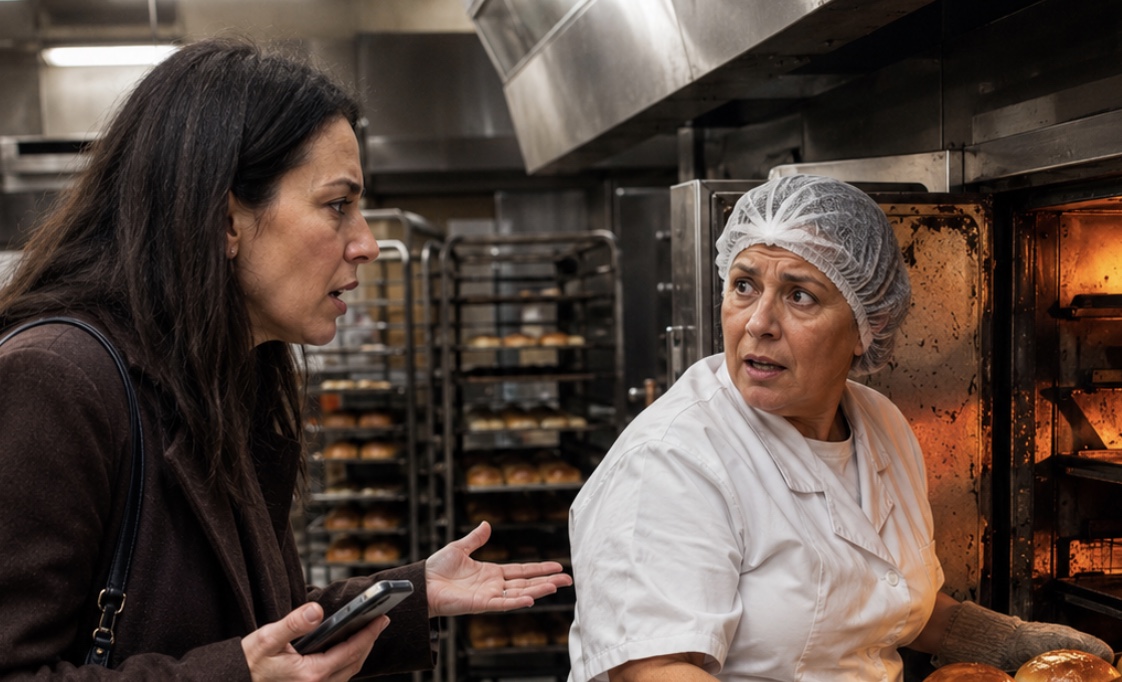
I walked down a long corridor, looking through the open doors. Everywhere, workers in white uniforms rushed around enormous vats filled with dough.
At the very end of the corridor, I saw her.
The baking department was almost unbearably hot. The air felt thick and sticky.
Sveta stood with her back to me. She wore a baggy, stained white coat, and her hair was tightly secured beneath a hairnet.
She was working beside an enormous industrial oven. Heat poured from the open hatch like breath from a volcano.
Wearing thick canvas gloves, Sveta lifted heavy, burning trays of bread and carried them to a tall, multi-level metal rack.
One tray.
Then another.
Then a third.
Her movements were mechanical and uneven. It was obvious that every lift required tremendous effort.
After setting down another tray, she leaned heavily against the rack and lowered her head.
She removed one glove to wipe the sweat from her forehead.
That was when I saw her right arm.
From her wrist to her elbow, the skin was covered with red burn blisters. In several places, she had smeared on some cheap ointment.
Something inside me broke.
All my anger, resentment, and Vitya’s accusations about her cheating us turned to dust.
I realized that something terrible was happening—something I had never even suspected.
I stepped forward.
“Sveta.”
She flinched as though she had been struck by electricity and spun around.
Under the dim factory lights, her face looked gray and hollow. Deep black shadows lay beneath her eyes.
For several seconds, she stared at me, blinking as if she could not believe I was really there.
There was no fear of exposure in her expression. She did not look like a fraud who had just been caught.
There was only unbearable exhaustion and a sudden, piercing shame.
She hurriedly pulled the glove back over her burned hand, trying to hide it from me.
“Marina… How did you get here? Why are you here?” Her voice was hoarse and trembling.
“What are you doing here, Sveta?” I moved closer, ignoring the crash of the carts around us. “Why haven’t you answered my calls? Why did you delete your account?”
Sveta lowered her eyes.
Her shoulders began to shake. She did not sob aloud. She simply stood there, biting her lip while tears silently rolled down her dirty, flour-covered cheeks.
“Marina… I was going to repay you. I swear I was. Tomorrow is the fifteenth. I’ve saved seventy thousand already. I only needed to work two more shifts to earn the rest. I wanted to bring you the entire amount and explain everything afterward.”
“Explain what? Sveta, who did you give the money to? What happened to the parcel pickup point?”
She leaned against the warm oven wall, closed her eyes, and exhaled.
“There is no parcel pickup point, Marina. I’m a fool. An old, gullible idiot.”
She told me everything while we sat in the cold changing room, where her supervisor had allowed her to take a ten-minute break.
A month earlier, a respectable-looking man had come to the dental clinic for treatment. While waiting at reception, he struck up a conversation with Sveta.
He introduced himself as Denis Anatolyevich, a financial consultant representing a major investment company. He was charming and wore an expensive suit.
He learned that Sveta lived alone and earned a modest salary. Then he offered to help her through an investment opportunity supposedly available “only to insiders.”
He claimed that a closed group of investors was purchasing Chinese equipment confiscated by customs and reselling it for three times the original price.
The required investment was three hundred thousand rubles.
The profit, he promised, was guaranteed within two weeks.
Sveta had counted every kopek throughout her entire life, yet for some reason, she believed him.
It had been a moment of madness.
She took out a bank loan for two hundred thousand rubles. Because of her salary, the bank refused to lend her any more.
She scraped together twenty thousand from her own savings.
Then she borrowed the remaining eighty thousand from me.
She lied about the parcel pickup point because she was ashamed to admit that she had become involved in a suspicious investment scheme.
Sveta transferred all three hundred thousand rubles to an account specified by Denis.
He sent her an attractive electronic contract decorated with official-looking stamps.
One week later, when she called to ask about the first payment, his phone number had been blocked.
The company website had vanished.
He never returned to the dental clinic.
“I went to the police,” Sveta said, staring at her hands with her fingers tightly intertwined. “They practically laughed at me. They said I had voluntarily transferred the money to an individual. According to the documents, no Denis Anatolyevich even exists. They accepted my complaint, but the investigator immediately said there was almost no chance of recovering anything. It would become another unsolved case.”
She fell silent and struggled to breathe.
“When I realized that I was trapped with a loan I couldn’t afford and owed you such a huge amount of money… Marina, I didn’t want to live anymore. I stood on my balcony thinking that one step would end everything. But I couldn’t do that to you. It was your money. You and Vitya had been saving it for the repairs. He would have made your life unbearable. I knew that if I confessed, you would forgive the debt or allow me more time. But I didn’t want your pity. I didn’t want you to suffer because of my stupidity.”
She wiped her face with the sleeve of her work coat.
“I left the clinic because they only paid once a month. I found this night job because they pay after every shift. During the day, I clean floors at a shopping center. In the evenings, I clean apartment stairwells in another district. I sleep for three hours a day. I deleted my social media accounts and threw away my SIM card because I was afraid you would call, and I would break down and tell you everything. I just wanted to earn the eighty thousand, repay you on time, thank you, and then disappear. I was too ashamed to face you again.”
I sat on the hard bench, feeling my cheeks burn.
My husband had been preparing a police complaint against this woman.
For three days, I had cursed her and considered her a traitor.
Meanwhile, she had been carrying burning trays, working until her hands bled, and sleeping three hours a night just to repay every kopek on time—and to protect me from Vitya’s criticism of my trust and naivety.
“Get your things,” I said, standing up and pulling sharply at the sleeve of her uniform.
“Where are we going? Marina, my shift doesn’t end until seven in the morning. If I leave now, they won’t pay me for tonight!”
“I don’t care about the shift. Get your things. We’re going home.”
“Marina, I’ll repay you. I’ll earn the rest—”
“Be quiet, Sveta. Please, just be quiet.”
I drove her home.
I made her take a shower and drink something to calm her nerves.
She fell asleep right at the kitchen table, resting her head on her arms while I made tea.
I looked at her hollow face and the burns covering her hands.
The heaviness inside me was being replaced by a cold, concentrated fury.
But it was not directed at Sveta.
It was directed at that bastard Denis.
And at myself.
And, to some extent, at Vitya.
While Sveta slept the next morning, I took a folder of documents from her bag.
I found the electronic contract and studied the payment details.
The bank card to which Sveta had transferred the money belonged to an individual entrepreneur named A. V. Smirnov.
I opened my laptop and began searching.
After an hour of searching through databases, forums, and social media, I found something.
A. V. Smirnov was a real registered entrepreneur.
However, he had no business involving Chinese equipment.
What he did have was a small agency offering “legal services to the public” in a shopping center on the opposite side of the city.
On local forums, I found several recent complaints from elderly women who had been cheated by the agency. They had paid money for assistance with “applications for pension recalculations.”
The method was always the same.
A respectable-looking man.
Promises of enormous profits or financial benefits.
A transfer to the entrepreneur’s account.
Then disappearance.
I woke Sveta around noon.
“Get dressed. We’re going to visit someone.”
“Where?” she asked, blinking in confusion.
“To get our money back.”
“Marina, it’s useless. The police said—”
“The police don’t want to waste time on small cases. We do. Do you still have screenshots of your messages with him? And the bank receipts?”
“Yes. Everything is on my old phone.”
“Excellent. Bring it.”
Before leaving, I called my cousin Katya.
Katya worked as an auditor for a major division of the Federal Tax Service. She was loud, hard, and knew the law so thoroughly that factory directors turned pale merely from hearing her tone of voice.
I briefly explained the situation.
Katya gave a satisfied hum.
“I’ll meet you there in forty minutes. I’ll bring a few official forms from the department. I love dealing with clever little men like this.”
The three of us drove to a shopping center on the outskirts of the city.
We went up to the third floor.
In a far corner beside the restrooms stood a glass-walled office with a sign reading:
“Legal Assistance. Investment Consulting.”
Denis was sitting inside.
In person, he looked younger and far more nervous. He was an ordinary, polished con artist in an inexpensive suit.
He was drinking coffee from a paper cup and scrolling through his phone.
We entered.
I closed the door firmly behind us and turned the lock.
Denis looked up. When he saw Sveta, he tensed for a moment, but quickly arranged a professional, artificial smile on his face.
“Good afternoon, ladies. Svetlana… Anatolyevna, wasn’t it? What can I do for you? As I already explained over the phone, we are experiencing temporary logistical difficulties in China. Your investment has been frozen by customs—”
“Shut up,” Katya said calmly and firmly.
She approached his desk and placed her red official identification booklet and a stack of printed documents in front of him.
“Here is what is going to happen, Mr. Smirnov. My name is Ekaterina Viktorovna. Federal Tax Service. We are not going to discuss China. We are going to discuss Article 159 of the Criminal Code—fraud. We will also discuss Article 198—tax evasion.”
Denis swallowed.
The smile disappeared from his face.
“Who do you think you are? I will file a complaint! You have no right—”
“I have every right to call the Economic Crimes Unit and bring officers here immediately,” Katya said, leaning over his desk with both hands pressed against its surface. “We have statements from your business account. We have complaints from three pensioners you cheated with your pension-recalculation scheme. And we have screenshots proving that you solicited investments from private citizens through a personal account while having no license from the Central Bank. That constitutes illegal financial activity, Denis. It carries a real prison sentence. You could receive five years.”
“These are civil-law relationships!” Denis squeaked, although sweat had appeared on his forehead.
“You can explain that to your court-appointed attorney,” I said.
I moved close to the desk.
“Listen carefully, businessman. This woman nearly worked herself to death beside an industrial oven because of your lies. Unless you return every ruble to her account right now, marking the payment as ‘refund of funds transferred in error,’ we will call the police. Katya will contact her supervisor, and tomorrow your business will be subjected to a full field audit. Believe me, they will find every questionable transfer you have ever received. You will go to prison.”
Denis looked helplessly from me to Katya, then at the pale Sveta, who was standing with her fists tightly clenched.
He understood that we were serious.
Small-time criminals like him were always afraid of publicity and official investigations.
Their schemes depended on frightened, submissive victims who cried and quietly disappeared.
Aggressive resistance destroyed their entire operation.
“I don’t… I don’t have the full amount in the account right now,” he muttered, staring at the desk.
“Then borrow it,” Katya replied sharply. “Call your mother, your friends, or take out a high-interest loan. I don’t care. You have ten minutes. Your time starts now.”
We remained inside that hot glass box for exactly forty minutes.
Denis called several people, argued in a low voice, and begged them to send him money.
His hands were shaking.
Eventually, Sveta’s phone made a sound.
One notification.
Then another.
Then a third.
She took out the phone, looked at the screen, and raised tear-filled eyes toward me.
“It’s here. All three hundred thousand.”
Denis collapsed heavily against the back of his chair.
He looked as if he had aged ten years.
“Are you satisfied? Now get out.”
“With pleasure,” Katya said, taking her identification from the desk. “But I am still forwarding those pensioners’ complaints to the proper department. Find yourself a good lawyer, Denis. You’re going to need one very soon.”
We stepped out of the shopping center.
The air seemed unbelievably fresh and clean.
Sveta suddenly stopped, covered her face with her hands, and burst into sobs.
She cried loudly and uncontrollably, without caring about the people passing us.
All the fear, tension, and hopeless exhaustion of the previous weeks poured out of her.
I wrapped my arms around her and stroked her back, feeling tears fill my own eyes.
That same day, Sveta transferred my eighty thousand rubles back to me.
She used the remaining money to repay the bank loan immediately, losing only a small amount in interest for the month.
That evening, I returned home.
Vitya was sitting on the sofa in front of the television.
The printed police complaint against Svetlana was lying on the table.
Without saying a word, I walked over, picked up the document, and tore it into tiny pieces in front of my husband.
I threw the scraps into the trash.
Then I opened the banking application on my phone and held the screen directly in front of him.
The new transaction was clearly visible:
+80,000 rubles from Svetlana Anatolyevna.
Vitya stared at the screen.
Then he looked at me.
His face went blank. He opened his mouth to speak, but could not find the words.
“She returned the money exactly when she promised, right down to the day,” I said in an even, icy voice. “She had serious problems she didn’t want to tell us about because she didn’t want to become a burden. She worked three different jobs, including night shifts, so she could repay the debt on time. And you wanted to report her to the police.”
My husband turned red, looked away, and coughed awkwardly.
“Well… I didn’t know. These things happen. People are different. At least everything worked out. I suppose we’ll be able to repair the balcony after all.”
“We will,” I replied. “But never again—do you hear me?—never tell me who I am allowed to be friends with or whom I am allowed to trust.”
I turned around and went into the kitchen.
I put the kettle on and took two mugs from the cupboard.
ç
Sveta had the next day off, and we had arranged for her to come over so we could bake a pie together.
In a normal home oven.
Without industrial heat or burning metal trays.
Life contains plenty of cruelty, fraudsters, and people who are prepared to condemn you after your first mistake.
But as long as you have someone beside you who is willing to work until their hands bleed just to keep a promise they made to you, you can survive almost anything.
No circumstances would ever destroy our friendship again.
Justice does exist.
Sometimes, however, you have to fight for it with everything you have.