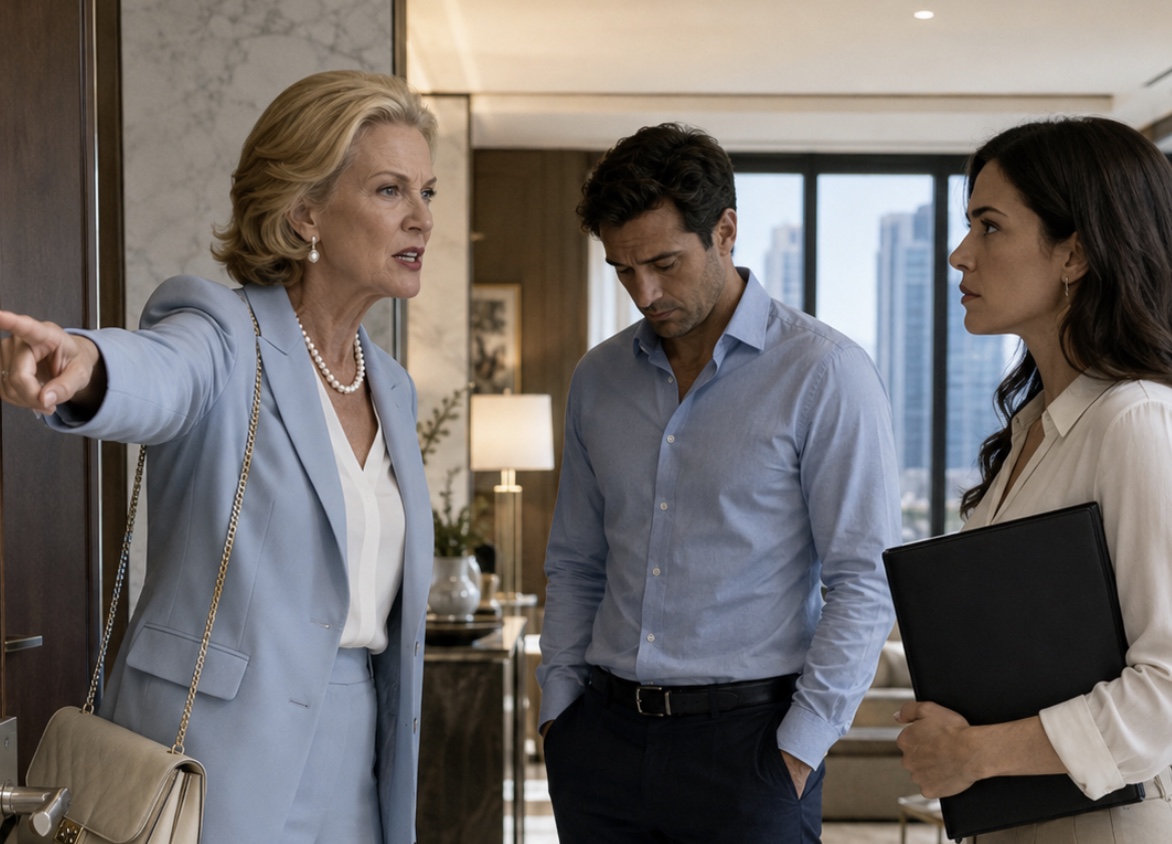
“Now that the apartment is a family home, all decisions concerning it should be made together. And you should start thinking about somewhere else to stay for a while,” Nina Alexeyevna announced as she settled confidently into a chair at the living-room table.
Victoria did not answer immediately. She blinked several times, staring at her mother-in-law as though the woman had confused not only the building and floor, but the apartment itself.
It was a suffocating summer evening. The windows stood open, allowing in the smell of sun-scorched asphalt and the dust left behind by the day’s heat. Somewhere in the courtyard, children shrieked as they raced around on scooters. Inside the apartment, however, it had become so quiet that Victoria could hear the old refrigerator humming steadily in the hallway.
Nina Alexeyevna placed a folder on the table.
Victoria immediately noticed that it did not contain official documents. It was filled with pages printed from the internet, covered with handwritten notes in the margins.
Sergei sat down beside his mother.
Not beside his wife, but closer to his mother.
That small movement said more than any explanation could have.
“Say that again,” Victoria said calmly.
Sergei frowned.
“Vika, don’t become defensive immediately. Mom just wants us to discuss everything properly.”
“I wasn’t speaking to you. Nina Alexeyevna, please repeat what you said.”
Her mother-in-law lifted her chin slightly. She clearly enjoyed the fact that the conversation had begun to resemble an official hearing. Nina Alexeyevna had always liked presenting her opinions as though she were delivering a final ruling at a family council.
“I said that this apartment became a family home a long time ago. Sergei lives here. His belongings are here. He contributes to the household. He and I discussed the situation, and we believe it would be more convenient for everyone if you stayed with your mother temporarily. We need some peace and quiet to decide how the space should be organized from now on.”
Victoria looked at her husband.
“You and your mother discussed it?”
Sergei rubbed the bridge of his nose and turned toward the open window.
“Well, not exactly like that. Mom just thinks…”
“Sergei, I didn’t ask what your mother thinks. Did the two of you discuss making me leave my own apartment?”
He remained silent for too long.
Victoria had already received her answer, but she waited anyway, giving him the opportunity to say it aloud.
He did not.
She leaned back in her chair and studied both of them carefully.
Her phone lay on the warm glass surface of the coffee table. Its screen had gone dark, but Victoria knew the voice recorder had been running since her mother-in-law’s first sentence.
She had not switched it on out of fear. Recording important conversations was simply a professional habit.
Victoria worked as a construction cost engineer, and experience had taught her that people who relied entirely on memory and the other party’s honesty often ended up with nothing.
“Interesting,” she said. “Who exactly is planning to reorganize the space?”
Nina Alexeyevna immediately became more animated.
“At last, you’re beginning to listen. I think the main bedroom should be Sergei’s. He needs proper rest. You can move your belongings into the smaller room. But if that’s uncomfortable for you, your mother has enough space, doesn’t she? I’ll stay here for the time being. Living alone is difficult for me, and my son needs support.”
Victoria nodded slowly.
“So your suggestion is that I leave while you remain here?”
“Not permanently,” her mother-in-law corrected her with exaggerated patience. “Only temporarily, while Sergei and I decide what arrangement would be best. You’re an independent woman. You’ll manage.”
“And what happens if I refuse?”
Nina Alexeyevna smirked.
“Victoria, you’re an adult. Families are built on compromise. You’ve become far too accustomed to controlling everything. It’s unpleasant for a man to feel like a tenant in his wife’s home.”
Sergei finally raised his head.
“She’s right, Vika. I’m uncomfortable whenever you emphasize that the apartment belongs to you.”
“Whenever?” Victoria tilted her head slightly. “Name three occasions.”
“Well… You’ve said it before.”
“Name three occasions, Sergei.”
He hesitated, reached for a glass of water and drank several mouthfuls, even though the water had been sitting there since lunchtime and was already warm.
“That isn’t what we’re discussing.”
“It’s exactly what we’re discussing. My apartment only became a problem when your mother decided she wanted to establish herself here permanently.”
Nina Alexeyevna straightened sharply.
“I’m not some stranger who wandered in off the street. I’m your husband’s mother.”
“Exactly. My husband’s mother. Not the owner. Not a tenant. Not someone with a lifelong right of residence. A guest.”
The word landed in the room with dry, brutal precision.
Sergei grimaced as though Victoria had said something indecent.
“Why would you say it like that?” he asked quietly.
“Because both of you have mistaken politeness for property rights.”
Three years earlier, Victoria would never have believed that such a conversation could take place.
She had met Sergei in June at a city festival beside the river. Her company was installing a temporary exhibition structure, while Sergei had come with a group of friends.
He had an easy smile, good manners and that rare ability to listen that, at first, seemed almost like a special talent. He did not interrupt her, pressure her or pretend to be some heroic rescuer.
Victoria liked that about him.
She was thirty-four at the time. She had already paid off her mortgage ahead of schedule, completed a renovation based not on romantic dreams but careful calculations, and developed a firm understanding that you invited someone into your home only when you were prepared for the possible consequences.
Victoria had purchased the apartment before she met Sergei.
She was its sole owner.
Only one name appeared on the official extract from the Unified State Register of Real Estate: Victoria Andreyevna Rogova.
She knew that name and its significance better than she knew any declaration of love.
At the time, Sergei was renting a room from an elderly man on the other side of the city. The conditions were peculiar. His landlord might begin drilling shelves at seven in the morning, yet forbid Sergei from using the washing machine after eight in the evening.
After they had been dating for six months, Victoria suggested that Sergei move in with her.
She did not do it out of pity. It was convenient for her as well.
He seemed dependable, tidy and calm.
At first, that was exactly how he behaved.
He made breakfast on weekends, bought household cleaning products without being asked and repaired small things without making grand speeches about the importance of having a man’s hands around the house.
Victoria did not lose herself in him, and she did not expect him to lose himself in her.
They lived comfortably together.
Nina Alexeyevna rarely visited during that period. She brought homemade jam, carefully inspected the apartment and always asked the same question:
“Sergei, are you comfortable here?”
At first, Victoria thought nothing of it. A mother worrying about her son was perfectly ordinary.
Eventually, however, the question changed.
“Sergei, do you even have a place of your own here?”
Victoria had replied with a smile.
“He has half the wardrobe, a work desk and his favorite mug. That’s not a bad beginning.”
Nina Alexeyevna smiled back, but her eyes remained cold.
Nothing changed legally after the wedding.
The apartment had been Victoria’s separate property before the marriage, and it remained hers afterward. Sergei knew that.
Before they officially registered their marriage, Victoria had even discussed it with him openly.
“Sergei, the apartment is mine. I don’t intend to sell it, give anyone a share or add another person to the ownership documents. If that bothers you, we should discuss it now.”
He laughed, hugged her in the kitchen and said:
“Vika, do you honestly think I’m marrying you for a few square meters? I need you, not your apartment.”
Victoria believed him.
Not blindly, but enough.
Love was not always foolishness. Sometimes it simply meant giving another person an opportunity to prove themselves.
The first serious warning came a year after their wedding.
Nina Alexeyevna arrived for a three-day stay after undergoing tests at a city clinic. Then she extended her visit by another week because traveling in the heat was supposedly too difficult.
After that, she began arriving every Friday.
Her bag grew larger, her list of requests became longer and her tone became increasingly authoritative.
“Vika, why do you need so many books in the smaller room? It could become a proper office for Sergei.”
“That room contains my workspace and important documents.”
“You can put the documents in a cupboard. Your husband’s needs are more important.”
Victoria did not argue at the time.
She simply locked the smaller room and kept the key with her.
Sergei laughed.
“Mom likes everything to be organized. Don’t pay attention to her.”
Victoria did not.
Not until Nina Alexeyevna’s version of organization began pushing the apartment’s actual owner out of her own home.
Her mother-in-law began entertaining acquaintances in the living room as though she were welcoming guests into her personal residence.
One afternoon, Victoria came home earlier than expected and found Nina Alexeyevna’s cousin and her husband sitting at the table. They were eating watermelon, discussing their country property and enthusiastically praising “Sergei’s apartment.”
“Victoria, why are you home so early?” Nina Alexeyevna asked instead of greeting her.
That was the first time Victoria responded sharply.
“I came home. I wasn’t aware I needed to arrange my arrival time in advance.”
The guests left quickly.
That evening Sergei said:
“You could have been gentler. Mom was only trying to do something nice.”
Victoria looked at him and realized that the phrase “she meant well” had become a universal pass allowing his mother to behave however she pleased.
By the beginning of July, Nina Alexeyevna no longer mentioned returning home.
She owned an apartment in the neighboring district. It was entirely suitable for living, but she alternately described it as stuffy, lonely or inconvenient.
At Victoria’s apartment, she occupied a bathroom shelf, a drawer in the dresser, part of the overhead storage and the unquestioned right to speak louder than everyone else.
Sergei initially dismissed her behavior. Then he began agreeing with her. Eventually, he started looking at his wife as though Victoria were somehow obstructing the natural order of things.
Victoria watched.
She did not cry in the bathroom, complain to her friends in the middle of the night or transform herself into a suffering victim.
She did what she knew how to do best.
She collected facts.
Victoria photographed her ownership documents, saved a current property extract, checked the location of the marriage certificate and recorded the dates of all her mother-in-law’s visits. She noted when Nina Alexeyevna first stayed overnight without arranging it beforehand.
She was not trying to play detective.
Victoria simply understood that when people began discussing your property as though you had accidentally appeared inside it, preparation was essential.
And now her mother-in-law was sitting at her table and suggesting that Victoria move in with her own mother.
“All right,” Victoria said.
Sergei exhaled with visible relief.
“You see? We can discuss things calmly.”
“I said ‘all right’ because everything is clear to me now, not because I agree.”
Nina Alexeyevna narrowed her eyes.
“What exactly is clear?”
Victoria picked up her phone, stopped the recording and placed it on the table with the screen facing upward.
“It’s clear that the two of you discussed making me leave in advance. It’s clear that Sergei did not object. It’s clear that both of you consider my apartment a family asset, even though it legally belongs only to me. And it’s clear that today you crossed a line.”
Sergei leaned forward abruptly.
“You recorded us?”
“Yes.”
“Vika, have you lost your mind?”
“No. I’m thinking very clearly. That’s why I’m going to say this once. Nina Alexeyevna, you will pack your belongings today and return to your apartment. Sergei, you may go with your mother or remain here until we resolve the divorce, but she will not stay in my apartment.”
Her mother-in-law laughed.
It was a short, vicious laugh with an unpleasant metallic edge.
“You’re threatening him with divorce? Do you imagine Sergei will run after you and beg?”
“I’m not threatening anyone. I’m notifying you of my decision.”
“Listen to her. ‘Notifying us,’” Nina Alexeyevna mocked. “Young lady, you think far too highly of yourself. Marriage is not one of your construction estimates where everything fits neatly into little boxes. This is Sergei’s home.”
“Home is not a legal term.”
“It’s a human one.”
“Anything human ended when you told me to start thinking about somewhere else to live.”
Sergei stood up.
“That’s enough, Vika. Mom is staying. She hasn’t been feeling well, and living alone is difficult for her.”
“She has an apartment of her own.”
“You don’t understand what family means.”
Victoria looked at her husband calmly, almost curiously.
That very morning, he had been the man with whom she drank coffee and discussed buying a new fan.
Now he stood before her as someone who had not merely failed to defend her boundaries, but had attempted to pretend those boundaries did not exist.
“I understand perfectly,” she said. “Family means not plotting to remove someone from her own home while sitting at her own table.”
Nina Alexeyevna rose from her chair.
“I’m not going anywhere tonight. It’s already late.”
“It’s seven thirty. The sun is still up.”
“I feel unwell.”
“Should I call an ambulance?”
Her mother-in-law froze.
Sergei glared angrily at his wife.
“Stop mocking her.”
“I’m not mocking anyone. If someone is unwell, we call a doctor. If someone simply doesn’t want to return to her own home, she packs her bag.”
Nina Alexeyevna stepped closer.
Her face had lost its performance of calm authority. Her forehead shone in the heat, and her fingers nervously tugged at the edge of her cardigan.
“You’re going to regret this. I promise you.”
“Should I record the threats as well, or are you finished?”
Sergei moved toward the phone, but Victoria quickly slipped it into her pocket.
“Don’t even think about it.”
He stopped.
For the first time in a long while, Victoria saw confusion rather than irritation in his eyes.
He had grown accustomed to the idea that she could be persuaded, exhausted or pressured into surrendering by endless talk of temporary arrangements.
He had failed to understand that she had never surrendered.
She had been calculating every move.
Nina Alexeyevna did not leave that evening.
Instead, she demonstratively retreated into the room she called “Sergei’s,” although it contained a guest sofa and boxes filled with Victoria’s seasonal belongings.
Sergei followed his mother.
They whispered behind the closed door for approximately twenty minutes.
Meanwhile, Victoria gathered her important papers into a separate folder: the property extract, the purchase agreement, the marriage certificate and copies of receipts for major purchases she had made both before and after the wedding.
They had almost no jointly acquired property worth fighting over.
The car belonged to Sergei and had been purchased before the marriage. The apartment belonged to Victoria. They had no children.
But Sergei had already demonstrated that he was unlikely to separate calmly and voluntarily. If he began avoiding the process or raising objections, the divorce would have to proceed through court.
The next morning, Victoria took one day off work.
Not to cry.
To act.
She called a lawyer who handled commercial disputes for her company. He listened, asked several questions and gave her a concise answer.
“The apartment was purchased before the marriage, and you are the owner. Your husband’s mother has no legal right to live there. Is your husband officially registered at your address?”
“No. He’s registered at his mother’s apartment.”
“That makes matters simpler. As the owner, you may change the locks, but remember that your husband is currently living there and keeps his belongings inside. Act carefully. Offer him the opportunity to collect his things, document any refusal and call the police if a conflict occurs. As for the divorce, if he agrees and there are no children or property disputes, you may file jointly through the civil registry office. If he refuses or fails to appear, you will need to file through the court.”
“He’ll refuse on principle.”
“Then we prepare a claim.”
Victoria wrote down the list of required documents and completed every necessary step that same day.
Sergei called three times, but she did not answer.
Then a message appeared.
“Where are you? Mom is getting nervous.”
Victoria replied:
“The question of your mother residing in my apartment has been resolved. She must leave by nine o’clock this evening. If she refuses, I will call the police so the conflict can be officially documented.”
A minute later Sergei responded:
“You’re humiliating the family.”
Victoria looked at the screen and typed:
“Yesterday you tried to make your wife leave her own home. The humiliation has already happened.”
That evening, she returned with a small camera for the entrance hallway, which she had purchased on the way home.
She did not need an elaborate security system. She simply wanted the entrance area recorded.
The apartment smelled of fried meat, and the television was playing loudly.
Nina Alexeyevna was sitting in the living room wearing Victoria’s robe.
That became the final point of no return.
“Take it off,” Victoria said.
Her mother-in-law did not even turn her head.
“What?”
“My robe. Take it off.”
Sergei came out of the kitchen carrying a plate.
“Vika, don’t start a fight over a piece of fabric.”
Victoria walked to the cupboard, took out a large shopping bag and placed it on the sofa.
“Your mother has twenty minutes. I’ll help pack her belongings so this doesn’t take all evening.”
Nina Alexeyevna jumped to her feet.
“How dare you?”
“You now have nineteen minutes.”
“Sergei!”
He put the plate on the table and moved toward his wife.
“Vika, your behavior is disgusting.”
“No. Wearing someone else’s clothes while planning to force the owner out of her own apartment is disgusting.”
“It happened accidentally.”
“The robe dressed her by itself?”
Sergei clenched his jaw.
“Mom is staying until the end of the week.”
“No.”
“I said she’s staying.”
Victoria took out her phone.
“Then I’m calling the police. I’ll report that an unauthorized person is refusing to leave my apartment and that my husband is preventing her removal.”
Nina Alexeyevna went pale.
“You’re calling your husband’s own mother an unauthorized person?”
“In relation to my property, that is exactly what you are.”
Sergei tried to snatch the phone from Victoria’s hand.
She stepped back toward the door and raised her voice.
“Take one more step, and in addition to refusing to leave the apartment, I’ll report that you attempted to take my phone.”
He stopped, breathing heavily.
At that moment, none of his former gentleness or artificial desire for peace remained. There was only the anger of a man who had suddenly discovered that his usual methods no longer worked.
Nina Alexeyevna surrendered first.
She went to change her clothes, slamming the door behind her.
Ten minutes later, she emerged with a flushed face and an overfilled bag that had not been fastened properly.
“You’ll come crawling back to ask for forgiveness.”
“The keys,” Victoria said.
Her mother-in-law froze.
“What keys?”
“The keys to my apartment. The set Sergei made for you without my permission.”
Sergei turned sharply toward his mother.
From his expression, Victoria immediately knew that the keys existed.
She had suspected it for a week, ever since Nina Alexeyevna entered the apartment one morning while Victoria and Sergei were both at the store. Her mother-in-law claimed that the door had not been closed properly.
Victoria had said nothing at the time.
Now the pieces fit together.
“Mom,” Sergei said through clenched teeth.
Nina Alexeyevna searched inside her bag, removed a key ring and threw it onto the sofa.
“Choke on them.”
Victoria picked up the keys without moving too quickly. She refused to give them the satisfaction of seeing her rush.
“Sergei, your keys as well.”
“Why would I give you mine?”
“Because after what happened yesterday, I no longer consider it safe for you to have unrestricted access.”
“I live here.”
“You’ll stay only long enough to collect your belongings. After that, you don’t.”
He gave a bitter laugh.
“You’re throwing me out?”
“Yes.”
She did not shout.
That unsettled Sergei more than any hysterical scene would have.
“My things are here.”
“You’ll pack them. I’ll give you time. Tonight, you’re going to your mother’s apartment. Tomorrow after work, you can return for everything else while I’m present. We can have the local police officer here as a witness if you prefer. It makes no difference to me. But after trying to force me out, you will not continue living here.”
Nina Alexeyevna grabbed her bag and headed toward the door.
“Come on, Sergei. Let her sit alone with her precious square meters and imagine she’s a queen.”
Victoria opened the door.
“Don’t forget your printed pages. They’re an important historical document explaining how my apartment became family property.”
Sergei gave his wife a dark look but followed his mother.
At the threshold, he turned around.
“You’ll regret this, Vika. I won’t give you a quick divorce.”
“Then I’ll see you in court.”
The door closed.
Victoria turned the lock, walked into the living room and, for the first time in months, saw her apartment without hearing someone else’s voice inside it.
Nina Alexeyevna’s folder had been left on the sofa.
Victoria opened it and smiled.
It contained printed discussions from internet forums, with certain phrases underlined in red ink: “the husband has rights,” “family residence,” “a wife cannot evict him.”
There were no legal provisions and no genuine grounds for any claim.
There were only confident comments written by strangers, from which Nina Alexeyevna had constructed herself a crown.
The following day, Victoria called a locksmith and changed the locks.
She did not submit applications to multiple authorities, run from office to office or ask anyone’s permission to secure her own door.
She showed the locksmith her passport and ownership documents, waited until he finished and received a new set of keys.
She placed the old ones in a bag labeled “For historical purposes.”
Sergei arrived that evening.
He came alone.
He looked tired and angry, although considerably less confident than before.
Victoria had already asked her neighbor across the landing, Valentina Grigoryevna, to remain at home and come outside if she heard any shouting.
The camera in the hallway was also running.
“My key didn’t work,” Sergei said when Victoria opened the door.
“The locks are new.”
“You didn’t waste any time.”
“I don’t like leaving unresolved issues.”
He entered and saw several boxes containing his belongings in the hallway.
Victoria had not searched through his personal possessions. She had packed only the obvious items: clothes, shoes, books, tools, chargers and a folder containing his documents.
He could inspect everything else himself.
“You made every decision for both of us,” he said.
“No. You and your mother made the decision for us yesterday. I made a decision for myself.”
“Mom was wrong, but you could have handled it more gently.”
Victoria looked at him in a way that prevented him from finishing the sentence.
“Sergei, you sat beside your mother while she suggested that I leave my own apartment. You weren’t surprised. You didn’t object. You didn’t tell her to stop. That means the idea wasn’t new. There is nothing more to discuss.”
He sat on the edge of the sofa.
“I’m tired of feeling like I’m nobody in this home.”
“You didn’t become nobody because the apartment belongs to me. You became nobody because you tried to take away my right to be the owner of a home that belongs to me both legally and in reality.”
“I didn’t take anything away.”
“Your mother was assigning the rooms yesterday.”
He remained silent.
“She went too far,” he eventually said.
“And you said nothing.”
Sergei rubbed his face with his palm.
“Let’s not get divorced. I’ll speak to Mom. She won’t visit without permission anymore.”
“She certainly won’t.”
“You see?”
“Because she no longer has a key. Neither do you.”
He looked up.
“So that’s it?”
“Yes.”
“Because of one conversation?”
Victoria laughed quietly, not because she found it amusing, but out of disbelief.
“One conversation? Sergei, your mother spent months taking over my space. Every time it happened, you called it insignificant. She invited strangers into my apartment, and you asked me to be gentler. She occupied shelves, cupboards and an entire room, and you told me she was lonely. She made herself a set of keys, and you remained silent. Yesterday, she suggested that I leave, and once again you said nothing. This isn’t one conversation. It’s the final result of everything that came before it.”
Sergei sat motionless for a long time.
Then he stood and began inspecting the boxes.
Several times he appeared ready to say something, but Victoria did not fill the silence for him.
She stood beside the window, watching the courtyard where the summer evening was once again filled with children’s voices.
All she could think about was how much easier it had become to breathe inside the apartment.
Half an hour later, Sergei carried out the first box.
Then the second.
He stopped beside the third.
“I’ll collect the rest tomorrow.”
“No. Today.”
“Vika, I’m exhausted.”
“So am I. That’s why it will be finished today.”
He pressed his lips together but did not argue.
By ten o’clock, almost none of his possessions remained in the apartment.
The last things he took were his winter coat, a toolbox and an old coffee machine he had supposedly purchased “for both of them” but had always used alone.
At the door, he paused.
“I really did love you.”
Victoria looked at him without anger.
“Maybe you did. But you seemed more certain about your love for the apartment.”
Sergei flinched as though she had slapped him, even though she had not raised her voice.
“You’ve become cruel.”
“No. I’ve become precise.”
After he left, Victoria walked through every room, checked the cupboards, locked the new door and went to bed.
For the first time in a long while, she did not expect to wake to the sound of Nina Alexeyevna’s voice echoing through the apartment.
Sergei truly did decide that he would “refuse to give her a divorce.”
He failed to appear at the civil registry office, although Victoria had offered him a peaceful option. They had no children and nothing significant to divide. They could have submitted a joint application and separated without conflict.
Instead, Sergei sent her a long message accusing her of betrayal and ingratitude and insisting that “this is not how a family is destroyed.”
Victoria did not even read it to the end.
She forwarded everything to her lawyer and filed a claim for divorce in court.
Meanwhile, Nina Alexeyevna attempted to influence her through relatives.
Sergei’s sister, Oksana, called first.
“Vika, why did you have to go so far? Mom is crying, and Sergei is sleeping on her sofa.”
“Sergei is officially registered at his mother’s apartment. He isn’t living at a railway station.”
“But that’s humiliating for a man.”
“And attempting to remove his wife from her own home wasn’t humiliating?”
Oksana fell silent, then changed her approach.
“You could at least have given him some time.”
“I did. He used that time to make an extra set of keys for his mother.”
Oksana did not call again.
Sergei continued writing.
Sometimes he asked to meet. Sometimes he accused Victoria of everything that had gone wrong. At other times, he suddenly recalled their happiest memories.
Victoria responded only when necessary: the time for collecting forgotten belongings, required documents and the date of the court hearing.
There were no late-night conversations, no requests to “discuss everything properly” and no meetings without a practical purpose.
She understood that emotional swings were needed by the person who had lost control, not by the person who had already made a decision.
Sergei arrived at court with Nina Alexeyevna.
When Victoria saw them in the hallway, she was not surprised.
Her mother-in-law wore a pale suit, carried a small handbag and had the expression of a woman who had come not to witness her son’s divorce, but to conduct a formal examination of another person’s morality.
“This is your last opportunity,” Nina Alexeyevna said, approaching Victoria. “Withdraw the claim, apologize, and then we’ll consider how to repair the situation.”
Victoria looked at her almost curiously.
“You still believe you’re in a position to set conditions?”
“I’m protecting my son.”
“From the consequences of his own decisions?”
Sergei stood beside his mother, gloomy and stubborn.
“Vika, I didn’t want this to go to court.”
“You didn’t come to the registry office.”
“Because I hoped you would come to your senses.”
“I did.”
The hearing passed calmly.
There were no dramatic scenes or cinematic revelations.
The judge clarified the circumstances and recorded the absence of common minor children and any property dispute within the current proceedings.
Sergei attempted to say that he wanted to preserve the marriage, but he spoke without confidence.
Victoria’s response was brief.
They no longer lived together, and reconciliation was impossible.
Her voice did not tremble.
She did not look at Nina Alexeyevna, although she could feel the woman staring at her.
After the hearing, Sergei caught up with Victoria near the exit.
“You understand that you’ll end up alone, don’t you?”
She stopped.
“Sergei, I bought the apartment alone. I paid off the mortgage alone. I survived the renovation alone. I dealt with your mother alone, and I came to court alone. Do you honestly believe the word ‘alone’ frightens me?”
His face turned red.
“You always reduce everything to the apartment.”
“No. You reduced our marriage to the apartment. I merely took back what was mine.”
Nina Alexeyevna approached and took her son by the arm.
“Come on. There’s no point speaking to her. She has a calculator instead of a heart.”
Victoria heard the remark and turned back.
“You’re mistaken. The calculator replaced my naivety.”
By then, summer had become heavy and oppressive, with white skies during the day and sticky evenings.
Victoria began restoring order in the apartment, not as a woman dramatically “starting a new life,” but as an owner reclaiming her property after an unlawful occupation.
She asked a specialist to inspect the door fittings, changed the password to the home router, removed the unnecessary kitchenware Nina Alexeyevna had brought and sent her mother-in-law’s remaining possessions by courier to avoid another personal meeting.
In the small room that Nina Alexeyevna had wanted to transform into Sergei’s office, Victoria organized her documents and installed a new metal shelving unit.
Not for decoration.
For order.
The property folder went on the top shelf.
The divorce documents occupied the second shelf.
Her work projects went on the third.
Every section had a label.
Victoria liked things to be called by their proper names.
A month later, the divorce judgment became final.
Sergei sent one last message:
“I hope you’re satisfied.”
Victoria did not respond immediately.
She was sitting on the balcony with her laptop, reviewing a cost estimate for a summer pavilion in a public park and listening to the courtyard caretaker watering the flower beds with a hose.
Eventually, she picked up her phone and wrote:
“Yes. My apartment is peaceful.”
He did not respond again.
In autumn, Victoria unexpectedly encountered Oksana outside a shopping center.
Her former sister-in-law looked uncomfortable but approached her voluntarily.
“Hi, Vika. Can I speak to you for a moment?”
“All right.”
Oksana hesitated before speaking.
“I shouldn’t have called you that day. I didn’t know the whole story. Sergei later admitted what happened with the keys. And he told me Mom really did want you to leave.”
“Now you know.”
“Mom still believes you destroyed the family.”
“That’s the version that’s most convenient for her.”
Oksana nodded.
“Sergei is renting an apartment now. He couldn’t tolerate living with Mom.”
Victoria could not suppress a brief smile.
“How unexpected.”
“He says you were right. He’ll never admit it directly to you, though.”
“I don’t need him to.”
Oksana looked at her with a new kind of respect.
“Do you regret any of it?”
Victoria thought for a moment.
Not because she doubted herself, but because she wanted her answer to be exact.
“I regret spending so much time calling arrogance a temporary inconvenience. Everything else happened when it needed to.”
They parted without embracing or making insincere promises to speak again someday.
Victoria appreciated that kind of honesty.
The conversation had ended, and each woman continued in her own direction.
That evening, Victoria returned home, opened the door with her new key and paused on the threshold.
The apartment welcomed her with the cool air from the conditioner, the scent of freshly cleaned floors and a silence free from anyone else’s resentment.
Several technical drawings were spread across the table. Beside them lay a watermelon she had bought on her way home.
Victoria walked into the kitchen, sliced it open and placed the knife on the cutting board.
Suddenly, she remembered Nina Alexeyevna once saying:
“A woman should be gentler. Otherwise, no one will stay beside her.”
Victoria picked up a slice of watermelon and smiled.
Let those who do not need a woman, but merely a convenient entrance into someone else’s property, leave.
She did not become happy to spite Sergei.
She did not become free for the sake of a beautiful phrase.
She simply understood something before it was too late: when someone begins discussing where you should live while standing inside your own home, it is no longer time to explain the rules for the tenth time.
It is time to show them the door.
And that was exactly what she did.
Without hysterics.
Without begging.
Without wasting sympathy on people who had shown none toward her.
The apartment was her home again.
It was no longer an imaginary family asset, a stage for unwanted advice or a temporary refuge for people who had mistaken kindness for the right to take control.
It was her home.
And from that moment forward, no one inside it made decisions on behalf of its owner.