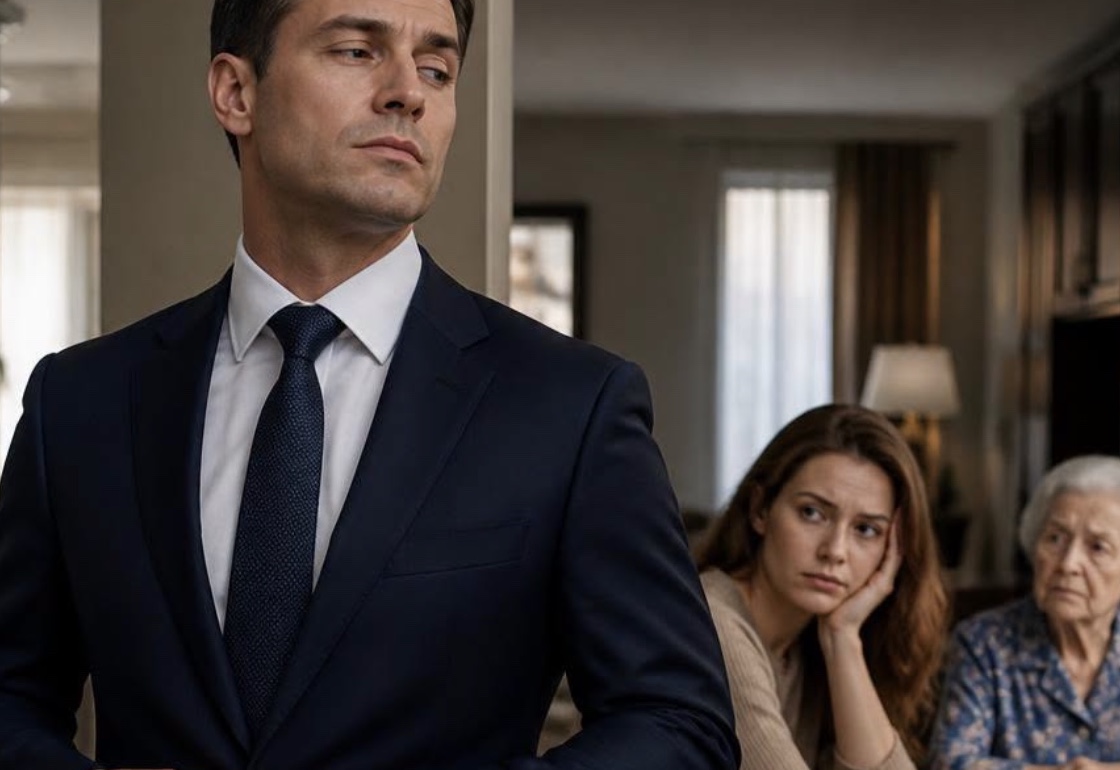
“Tonight I’m going to the restaurant with Mom. You’ll stay home with Grandma,” Maksim said, fastening his jacket in front of the mirror.
Yulia stood by the wardrobe with a pair of earrings in her palm. For a moment, she did not turn toward her husband. Through the open window came the distant hum of passing cars, along with the smell of sun-warmed asphalt and dry August grass. The dress she had chosen earlier that week lay across the bed, beside a small handbag and an envelope containing two tickets for an evening concert.
“Say that again,” she said.
Maksim adjusted his shirt collar and glanced at his watch.
“Mom is alone right now. She’s having a difficult time, so I decided to invite her. We can celebrate our anniversary another day. Nothing terrible will happen.”
He spoke calmly, almost as though discussing a routine trip to the supermarket. There was no embarrassment in his voice and no attempt to explain himself.
Yulia placed the earrings on the dresser.
She had been looking forward to their fifth wedding anniversary all week. She had booked a table in advance at a small restaurant near the waterfront. It was the same place where she and Maksim had once celebrated his promotion, where they had gone after registering their marriage, and where they had promised to return every year.
Their plans had fallen apart the previous two years. The first time, Maksim had stayed late at his mother’s house. The second time, he had decided they could celebrate at home because he did not feel like driving across the city.
Yulia had not argued. She had cooked dinner, bought his favorite dessert, and convinced herself that the restaurant did not matter as much as the way they treated each other.
This year, she had wanted things to be different.
She had chosen an evening concert, arranged for someone to stay with her grandmother, and even taken the following day off so they would not have to rush home. Maksim knew about the reservation. He had seen the tickets. Only a few days earlier, he had asked what time they needed to leave.
And now he stood before her in his new jacket, informing her that his mother would be taking her place.
Yulia and Maksim had met seven years earlier at a mutual friend’s birthday party. At the time, he worked as an elevator maintenance technician. He joked constantly, found it easy to talk to people, and seemed to make friends wherever he went.
Yulia worked in the procurement department of a construction company and had not been looking for a serious relationship.
A few months later, Maksim moved his belongings into her rented apartment. They quickly became used to living together, divided their expenses and household responsibilities, and rarely argued.
A year later, they got married.
They did not own a home. The lease was in Yulia’s name because she had found the apartment and negotiated with the landlord. Maksim transferred his share of the rent every month, but Yulia handled every issue involving the property owner.
The first years of their marriage seemed peaceful. Maksim was not cruel. He did not start loud arguments or demand explanations for every purchase. He simply became accustomed to Yulia handling most of the unpleasant responsibilities.
Whenever a repairman needed to be called, she made the call.
Whenever there was a problem with paperwork, she figured it out.
Whenever his mother asked him to deliver medicine, find a doctor, or collect a heavy purchase, Maksim promised to help and then informed his wife that he was being kept late at work.
Yulia always stepped in.
At first, she believed that was what partnership meant. When one person could not manage something, the other helped.
Over time, however, helping became an obligation that no one even bothered to ask her about anymore.
A year and a half earlier, Yulia’s grandmother, Valentina Stepanovna, had fractured her hip. She lived alone in a small apartment on the other side of the city. After surgery, the doctors warned that her recovery would be long and that she could not be left without supervision during the first few months.
Yulia brought her grandmother home to live with them.
At the time, Maksim supported the decision.
“Of course she should stay with us. She’s practically a mother to you. We’ll help her together.”
During the first few weeks, he genuinely made an effort. He handed Valentina Stepanovna her walker, brought her water, and went to the pharmacy several times.
Then the number of responsibilities increased while his participation steadily declined.
He was always delayed when someone needed to take her to a medical appointment. On weekends, urgent matters suddenly appeared. If Valentina Stepanovna asked for help in the evening, Maksim loudly called for his wife, even when he was standing closer.
“Yulia, Grandma needs something!”
“Can’t you go and see what she wants?”
“I don’t know where she keeps everything.”
Yulia showed him.
A week later, he claimed he did not know again.
She did not reproach him. Her grandmother was her family, and Yulia had no intention of turning her care into an obligation for everyone in the household.
What irritated her was that Maksim continued telling acquaintances how the two of them were caring for an elderly woman together.
“We got her back on her feet,” he would say.
In reality, Yulia arranged the medical appointments, supervised the treatment, helped with exercises, and adjusted her working hours around her grandmother’s routine.
By August, Valentina Stepanovna could move confidently around the apartment with a cane. She could wash, dress, and reheat prepared food on her own. However, she occasionally became dizzy in the evenings, so Yulia tried not to leave her alone for too long.
For their anniversary, she had hired a caregiver through a trusted agency. The woman was supposed to arrive at seven, help her grandmother take her medication, and stay until the couple returned.
Maksim knew all about it.
Three days before the anniversary, his mother called him.
The conversation lasted about half an hour. He stepped onto the balcony and closed the door behind him. When he returned, he seemed unusually cheerful. He was smiling, typing something on his phone, and even offered to buy groceries himself.
“What happened?” Yulia asked.
“Nothing. Mom just called.”
“Is everything all right with her?”
“She’s fine.”
He offered no further explanation.
On the day of their anniversary, Maksim came home earlier than usual. He took a shower, brought out his jacket, and asked Yulia to iron his shirt. She was helping her grandmother and suggested that he do it himself.
Maksim sighed in annoyance but did not argue.
Even then, Yulia had no idea that he had already made arrangements with his mother.
He planned to pick her up, take her to the restaurant his wife had reserved, and perhaps use the concert tickets as well.
To him, the arrangement seemed perfectly convenient. His mother would have a pleasant evening, Yulia would stay with her grandmother, and their anniversary could be celebrated on any other day.
The fact that Yulia had been waiting for this evening, preparing for it, and arranging professional care for her grandmother did not seem important to him.
“Mom said she hasn’t gone anywhere nice in ages,” Maksim continued. “She’s been especially lonely since her friend died.”
“Her friend died two years ago,” Yulia reminded him.
“So what? Loneliness doesn’t disappear just because time passes.”
“You could take her to a restaurant on any other evening.”
“But everything is already booked for tonight. Why let the reservation go to waste?”
Yulia slowly closed her handbag.
“You’re planning to use my reservation?”
“Our reservation,” Maksim corrected her. “We’re married.”
“I made the booking.”
“What difference does it make? I’ll give them the name, and they’ll seat us.”
“And the tickets?”
“If Mom feels like going, we’ll attend the concert. You can’t leave Valentina Stepanovna alone anyway.”
There were no tears on Yulia’s face, not even visible hurt. She simply looked at her husband for several seconds, as though noticing for the first time a part of him she had stubbornly refused to acknowledge.
Maksim had not merely changed their plans.
He had made the decision in advance, kept it from her, claimed the evening she had organized for himself, and waited until the last possible moment to tell her so she would have no time to object.
Her grandmother was watching television in the next room. The caregiver was due to arrive in ten minutes. The restaurant confirmation lay in the kitchen, and the tickets Maksim already considered his were inside Yulia’s bag.
She removed the envelope.
“The tickets are staying with me.”
“What for? You’re not going anywhere.”
“That’s for me to decide.”
Maksim gave a dismissive smile.
“Don’t make a scene. We’ll celebrate this weekend.”
Yulia put the envelope back into her bag.
“Have a pleasant evening.”
He had clearly expected a different reaction. Questions, anger, accusations—perhaps even tears.
His wife’s calmness confused him, but only briefly.
“Good. I’m glad you understand,” he said. “I won’t be home late.”
He picked up his phone and keys and left.
Yulia waited until she heard the entrance door downstairs slam shut, then walked over to the window. Maksim crossed the courtyard, got into the car, and drove away to collect his mother.
He was certain his wife would remain at home.
A few minutes later, the doorbell rang.
A neat woman of about fifty stood outside, carrying a large bag. She had short hair and a calm, professional manner. Yulia had already sent her the doctor’s instructions, a medication list, and Valentina Stepanovna’s daily schedule.
“Good evening. I’m Svetlana.”
“Please, come in.”
Grandma heard their voices and came into the hallway, leaning on her cane.
“Finally,” she said. “Yulia had almost decided not to go anywhere tonight.”
Yulia helped Svetlana arrange the medications, showed her where the first-aid supplies were kept, and explained what to do if her grandmother became dizzy.
Valentina Stepanovna watched her granddaughter carefully.
“Has Maksim already left?”
“Yes.”
“To pick up his mother?”
Yulia nodded.
Her grandmother was silent for a moment, then straightened the collar of Yulia’s dress.
“Don’t stay home because of him.”
“I won’t.”
“And don’t go to the restaurant either, unless you truly want to.”
“I’m not going.”
Valentina Stepanovna smiled.
“Good. I’ll manage perfectly well for a few hours. Svetlana is here, and I have my phone. Go wherever you genuinely need to go.”
Yulia hugged her, changed into a dark trouser suit, and tied back her hair.
The dress remained on the bed.
From a small safe inside the wardrobe, she took out her passport, educational certificates, employment record, and a folder of professional recommendations.
She needed all of them for a meeting Maksim knew nothing about.
Several months earlier, Yulia had been invited to apply for a senior management position at a large manufacturing company. The company was located in another city and was expanding its procurement division.
Applicants were required to attend several interviews, complete a practical assignment, and present a plan for managing the department.
At first, Yulia had declined.
Her grandmother had only just started walking again, and her relationship with Maksim had already become colder. Moving to another city seemed too drastic.
A week later, a company representative called again. He offered to conduct the first stage remotely and told her she did not need to make a final decision immediately.
Yulia agreed.
She told no one. Not because she intended to deceive her husband, but because she did not yet know whether she was ready to accept the position.
The first interview went well. Then came a second one, a meeting with the department head, and a discussion of her future responsibilities.
The company provided staff housing, assisted with relocation, and was willing to accommodate the fact that an elderly relative would be living with her.
Only the final stage remained.
It had been scheduled for the evening of their anniversary. A company representative happened to be in the city on business and suggested meeting after work.
Yulia asked to move the appointment.
She was still hoping to spend the evening with her husband.
The company agreed and scheduled it for later, shortly before the office closed. Until the last moment, Yulia had planned to withdraw. She believed there was no way to attend the interview, make it to the restaurant, and reach the concert on time.
Now, there was no longer a choice to make.
She called a taxi.
As the car moved through the evening streets, her phone vibrated several times.
Maksim had sent her a photograph from the restaurant. In it, his mother sat at Yulia’s table. A bouquet stood beside her, probably something Maksim had bought on the way.
Under the photograph was a message:
“Don’t be angry. Mom is happy. We’ll go somewhere together this weekend.”
Yulia read it and turned off the screen.
At a large business center, an employee from the human resources department met her and led her into a conference room. She offered Yulia water and explained that the director would be a few minutes late.
Yulia sat by the window. Below, lines of cars stretched along the roads, while the sun slowly sank behind the rooftops.
That morning, she had been prepared to reject the position permanently.
She had believed that a family should not be destroyed because of exhaustion, poor communication, and a handful of painful incidents.
She kept telling herself that Maksim would change if they had one serious conversation.
That one day, he would notice how many decisions his wife was forced to make alone.
That he would finally understand how comfortable his life had become because she carried everything.
But he already understood.
He was simply certain that Yulia would never leave.
The director arrived with two department managers. The conversation lasted almost an hour. They discussed her duties, her first assignments, the relocation schedule, and living arrangements for her grandmother.
Yulia answered calmly and confidently. She had prepared thoroughly for this stage and understood the work better than many of the other applicants.
At the end of the meeting, they handed her a folder.
“We’re prepared to offer you the position,” the director said. “The company apartment will be available in two weeks. If you accept, we can sign the contract today.”
Yulia opened the document.
In the past, she would have searched for reasons to delay. She would have asked for a few days, spoken to Maksim, listened to his objections, and most likely turned the offer down.
This time, she picked up the pen.
“I accept.”
After she signed, they gave her a copy of the contract, information about the apartment, and train tickets for both her and her grandmother. The company would cover their travel expenses and the transportation of their belongings.
Yulia left the building after the streetlights had come on.
The concert was due to begin in twenty minutes.
She looked at the envelope containing the tickets, called a taxi, and went alone.
Maksim’s seat remained empty until the beginning of the second half. Then a woman whom the usher had allowed to take the unoccupied seat sat beside Yulia. She quietly thanked her and did not disturb her again.
Yulia listened to the music and, for the first time in a very long while, did not wonder whether Maksim was comfortable, whether he was bored, or whether her grandmother needed help at home.
After the concert, Svetlana messaged to say that Valentina Stepanovna had eaten dinner, taken her medicine, and was preparing for bed.
Yulia returned at around eleven.
Her grandmother was still awake.
“How did it go?” she asked.
“They hired me.”
Valentina Stepanovna’s face lit up.
“So we’re going?”
“In two weeks.”
“It’s about time.”
Yulia helped her into bed, saw Svetlana out, and brought a travel bag down from the wardrobe.
She did not begin packing immediately.
There were many things to arrange over the next two weeks: notifying the landlord, organizing transportation, obtaining her grandmother’s medical documents, gathering her medication, and filing for divorce.
Yulia sat at the kitchen table, opened the folder, and wrote Maksim a short note.
It was not an accusation.
It was not a plea.
It was not an attempt to make him feel sorry for her.
It was simply a decision.
She left the folder on the table. Inside, she placed a copy of her employment contract, the train tickets, and a list of property acquired during the marriage.
They did not own many valuable things: a car registered in Maksim’s name, household appliances, and joint savings in a bank account.
Yulia proposed that they make a complete inventory, determine the value of everything, and settle the matter through the court without accusations or attempts to hide assets.
Because they needed to divide marital property, simply filing through the civil registry office would not be enough.
Maksim returned after midnight.
Yulia first heard his key turn in the lock, followed by his mother’s voice in the hallway.
“I still think she could have come with us. Her grandmother isn’t a little child.”
“Mom, keep your voice down.”
“Why should I whisper? My son was celebrating his fifth wedding anniversary.”
Yulia stepped out of the room.
Galina Sergeyevna stood by the door in a light-colored suit, holding the bouquet.
“So you did go somewhere after all,” she remarked, looking over her daughter-in-law.
“Yes.”
“Maksim said you were staying home with your grandmother.”
“Maksim decided a great many things for me.”
His mother handed the bouquet to her son.
“Well, I’m leaving. Thank you for the evening.”
Maksim walked her to the elevator and then returned to the kitchen. He noticed the folder, opened it, frowned, and quickly began turning through the documents.
“What is this?”
“My employment contract.”
“I can see that. Why is the job in another city?”
“Because that’s where the company is.”
“What is this about a company apartment?”
“The apartment I’ll be moving into in two weeks.”
Maksim looked up.
“Are you joking?”
“No.”
He pulled out the train tickets.
“Two seats.”
“I’m going with Grandma.”
“And what about me?”
“You’re staying here.”
Maksim pushed the chair back sharply but did not sit down.
“So you made this entire decision behind my back?”
Yulia looked at him.
“Today, you informed me that you were taking your mother to the restaurant I chose for our anniversary. You planned to use the tickets I bought, and you were certain I would follow your instructions. Now you’re outraged because I made a decision without consulting you?”
“That’s different.”
“How?”
“I only postponed one evening.”
“No, Maksim. You showed me exactly what place I occupy in your life.”
“Don’t turn a restaurant dinner into a tragedy.”
“This has nothing to do with the restaurant.”
Yulia unfolded the note and placed it in front of him.
“I’ve been taking part in the selection process for some time. Until tonight, I intended to reject the offer. I still hoped our marriage could be saved.”
Maksim scanned the note.
“And because I had dinner with my mother, you’ve decided to divorce me?”
“I didn’t decide to divorce you today. Today, I stopped postponing it.”
“Yulia, you’re emotional right now.”
“If I were acting emotionally, I would have made a scene at the door and demanded the reservation back. Instead, I attended a business meeting, signed a contract, and prepared a list of our assets.”
Maksim opened the folder again.
“You even included the car.”
“It was purchased during the marriage.”
“I’m the one who drives it.”
“That’s why you may keep it by paying me my legal share. Or we can sell it and divide the money. We’ll settle everything officially.”
“You’ve already calculated everything?”
“Yes.”
Maksim paced across the kitchen, stopped beside the window, and then returned to the table.
“Turn down the job.”
“No.”
“We can talk about everything.”
“We’ve had several years to talk.”
“I didn’t realize you were this unhappy.”
Yulia tilted her head slightly.
“I told you repeatedly that I was exhausted from handling Grandma’s care, the apartment, and all our shared responsibilities alone. Every time, you promised to help. Then you found another reason to do nothing.”
“I was working.”
“So was I.”
“Your grandmother didn’t have to live with us.”
Yulia straightened.
“At least now you’ve finally been honest.”
Maksim noticed the change in her face and quickly tried to explain himself.
“That isn’t what I meant. I’m only saying that caring for her had a major effect on our lives.”
“On my life. You hardly participated.”
“I treated her like my own family.”
“Only in words.”
He gripped the edge of the folder.
“So what happens now? You take her away, file for divorce, and begin a new life as though I never existed?”
“I’m not going to pretend the past seven years never happened. But I won’t continue living this way for another seven.”
“I’ll change.”
“This morning, you could have told your mother that you would spend your anniversary with your wife. That didn’t require you to change. It only required you to respect me.”
Maksim sat across from her.
The confidence with which he had left the apartment earlier was gone. For the first time, he could not end the conversation with his usual promise that everything would be sorted out later.
“Mom really is lonely.”
“Then invite her tomorrow, the day after tomorrow, or any other day.”
“She was the one who suggested tonight.”
“And you agreed because you were certain I would give in.”
Maksim said nothing.
Yulia closed the folder.
“We have two weeks. During that time, we need to notify the landlord, divide our belongings, and prepare the documents for court. I’m not going to scream, hide property, or create scenes. I expect the same from you.”
“And what if I refuse to agree to the divorce?”
“Then the court will make the decision anyway. The process will simply take longer.”
“You’re speaking as though you don’t feel anything anymore.”
“I feel enough to stop allowing you to treat me this way.”
The next morning, Maksim did not leave for work on time. He paced around the apartment, began conversations, fell silent, and repeatedly returned to the folder.
He offered to celebrate their anniversary that evening. Then he suggested postponing the divorce until the end of the year. He promised to help care for her grandmother, cook dinner, and visit his mother less often.
Yulia listened, but her decision remained unchanged.
Maksim even tried speaking to Valentina Stepanovna.
“Could you explain to Yulia that she shouldn’t destroy a marriage because of one evening?”
Her grandmother sat in an armchair, checking the list of medications she would need for the move.
“I explained something else to her. That a person should not spend an entire lifetime waiting for someone else to recognize her worth.”
“I do value her.”
“Then why doesn’t she know it?”
Maksim had no answer.
Over the following days, he became unusually attentive. He bought groceries himself, offered to drive Grandma to the doctor, and called Yulia from work.
But his care had arrived too late. It did not look like genuine change. It looked like fear of losing a comfortable life.
Yulia focused on the move.
She contacted the landlord and informed him that she was leaving. The lease required advance notice, and two weeks was just enough time.
Maksim decided to remain in the apartment and transfer the rental agreement into his name.
They divided their belongings without arguments. Yulia took everything that belonged to her and her grandmother. They left the shared appliances with Maksim and included their value in the list of marital property.
They agreed to settle the question of the car through the court along with the divorce.
Galina Sergeyevna visited three days before their departure.
Yulia allowed her inside because the apartment was rented, and she did not consider herself the owner of the property. However, she had no intention of letting her mother-in-law give orders.
“Are you really taking your grandmother away and abandoning Maksim?” the older woman asked.
“I’m moving for a new job and divorcing your son.”
“Because of me?”
“Because of the way he treated me.”
“He only wanted to do something kind for his mother.”
“At my expense.”
“You could have simply stayed home.”
Yulia closed a box of documents.
“That was exactly what he expected.”
Galina Sergeyevna looked around at the packed bags.
“It will be difficult for you alone in another city.”
“I’m accustomed to solving difficult problems.”
“And what if you don’t like the new job?”
“I’ll find another one.”
“Maksim is willing to fix everything.”
“Then he should begin by fixing himself. But he’ll have to do it without me.”
Her mother-in-law had expected a long conversation, but Yulia offered no further explanations.
On the day of their departure, Maksim drove them to the railway station.
Valentina Stepanovna walked slowly with her cane but refused her son-in-law’s help.
Yulia carried the folder of documents and a small travel bag herself. The rest of their belongings had already been sent by a transport company.
Before boarding, Maksim brought up the job once more.
“It still isn’t too late to cancel everything.”
“It is.”
“I’ll come in a week. I’ll see the apartment, and we’ll talk.”
“Don’t come without an invitation.”
He frowned.
“You don’t even want to see me?”
“Not now. We’ll communicate about the divorce and the property.”
Maksim held out an envelope.
“What is that?”
“Concert tickets. I bought seats for next month.”
Yulia did not take the envelope.
“Go with your mother.”
He lowered his hand.
Boarding was announced. Yulia helped her grandmother climb into the carriage, arranged their bags, and only then looked through the window.
Maksim was still standing on the platform.
The useless envelope lay beside him because he had not even put it back into his pocket.
The train began to move.
Their new apartment was located near Yulia’s workplace. It was smaller than their old one, but the building had an elevator, and the bathroom was suitable for an elderly resident.
Yulia had checked every detail in advance, so her grandmother did not have to adjust to high thresholds or narrow doorways.
The divorce proceedings began several weeks later.
At first, Maksim hoped that distance would make his wife reconsider. Eventually, he understood that she was not coming back.
He stopped arguing about the car and agreed to the division of property she had proposed.
Galina Sergeyevna repeatedly told her son that Yulia had acted too harshly.
Maksim no longer agreed with her.
He remembered that August evening too clearly.
Yulia had stood before him with the earrings in her hand. Her dress lay on the bed, the tickets were inside her bag, and a table at the restaurant was waiting for a married couple celebrating their fifth anniversary.
Maksim could have gone with his wife.
He could have told his mother that he would invite her another day.
He could at least have asked Yulia whether she agreed to change their plans.
Instead, he made the decision alone and informed his wife that she would remain at home with her grandmother.
He believed he had merely changed their plans for a single evening.
In reality, that was the evening their marriage ended.
As for Yulia, she finally stopped waiting for someone else to place her first.
She chose a life in which her time, her work, and her decisions mattered even when they were not convenient for everyone around her.