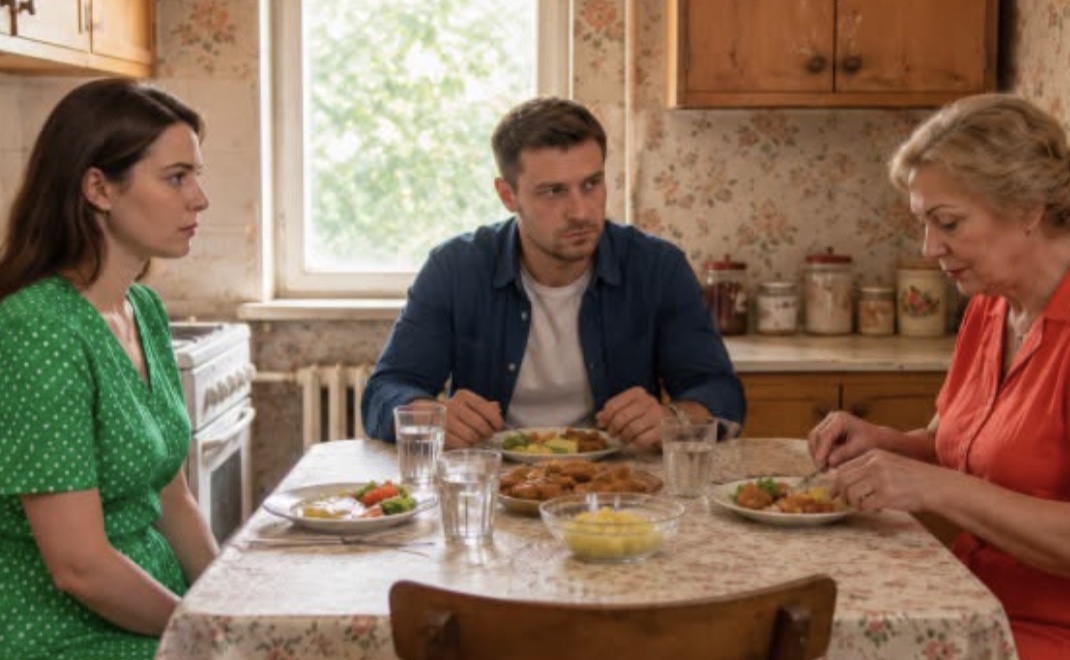
“How long did you cook this shoe leather? It’s impossible to chew. A person could dislocate their jaw trying to swallow a piece.”
The metal prongs of the fork scraped unpleasantly across the expensive porcelain plate. Zinaida Petrovna pushed away her serving of stewed beef, generously covered in a thick mushroom-and-cream sauce, and released a long, suffering sigh. Every gesture suggested that she was enduring unimaginable torment.
Daria froze with a glass of water halfway to her lips. Slowly, she lowered it to the table, doing her best to keep her expression neutral.
She had spent almost three hours preparing that dinner after a long day at the architectural design office. She had deliberately stopped at a farm shop, chosen the best cut of beef, bought fresh mushrooms and expensive cream, all because she wanted to please her husband and his mother.
Zinaida Petrovna had come to stay with them while undergoing a routine medical examination at a city clinic.
The beef had simmered over low heat for hours. It was so tender that it separated into delicate fibers at the slightest touch of a knife.
But facts had never mattered to Zinaida Petrovna when she saw an opportunity to wound her daughter-in-law.
“Mom, come on. The meat is fine,” Ilya muttered uncertainly without looking up from his plate. He chewed quickly, trying to blend into the kitchen furniture and avoid open conflict, as usual. “It’s actually very good.”
“Of course you think it’s good,” his mother scoffed, dabbing her lips with a paper napkin. “You’ve grown used to eating anything, Ilyusha. That’s why this seems acceptable to you. But you only get one stomach. How can anyone abuse good ingredients like this? The sauce is gray, the onions are undercooked, and the meat is dry. It’s a complete waste of quality food. Slop, that’s what it is. Forgive my honesty, but I’m from the old school. I was never taught to lie or flatter people.”
The word “slop” hung in the air, echoing against the kitchen cabinets.
Ilya swallowed nervously and glanced at his wife, but said nothing. Instead, he picked up a piece of bread and carefully used it to wipe the remaining sauce from his plate, pretending nothing had happened.
Daria did not shout.
She did not throw her napkin onto the table or run from the kitchen in tears, as she had during the early years of their marriage, when she had still been trying to earn the approval of her husband’s overbearing mother.
Something inside her simply clicked.
It was as though an invisible switch had permanently turned off the obedient, understanding girl she had forced herself to be.
Without a word, Daria rose from her chair. She walked around the table, stopped beside her mother-in-law, and calmly picked up the nearly untouched plate of meat and buckwheat.
“What are you doing?” Zinaida Petrovna asked suspiciously, narrowing her eyes. “I haven’t finished. I might eat the side dish. The buckwheat is more or less edible.”
“You said yourself that the food was slop, Zinaida Petrovna,” Daria replied in a perfectly calm, icy voice. “I cannot allow my husband’s mother to choke down inedible food and damage her stomach.”
She turned, carried the plate to the sink, and with one sharp, deliberate movement, swept the fragrant, perfectly cooked beef into the trash. The fluffy buckwheat followed.
A deathly silence filled the kitchen, broken only by the steady hum of the refrigerator.
Ilya froze with a piece of bread halfway to his mouth.
Ugly red patches spread across Zinaida Petrovna’s face. Her lips tightened into a thin, furious line.
“You… How dare you behave like that?” she gasped, clutching her chest. “Throwing food into the garbage! In our day, someone would have broken your hands for such waste! Hysterical woman! Ilyusha, look at your wife!”
“I’m behaving logically,” Daria said.
She turned on the tap, ran warm water over the empty plate, and began washing it methodically with a sponge.
“You gave me your expert opinion. I accepted it. From now on, you will no longer have to suffer because of my cooking.”
Ilya released a heavy sigh, dropped the bread onto the table, and rubbed the bridge of his nose.
“Dasha, why did you have to react so dramatically? Mom was only expressing her opinion. Her tastes are different. She’s used to simple, homemade food. You could have put the plate in the refrigerator. I would have taken it to work tomorrow. Why waste perfectly good food?”
Daria turned off the water, placed the clean plate on the drying rack, and wiped her hands on a kitchen towel.
Then she turned to her husband and looked at him for a long time.
“Ilya, if food is slop, it belongs in the garbage. Now excuse me. I still have project work to finish. Have a pleasant evening.”
She left the kitchen without looking back.
Behind her, she could hear her mother-in-law lamenting the disrespect shown by modern young women, while Ilya muttered vague phrases in an attempt to calm her down.
Daria entered the bedroom, closed the door firmly, and sat at her desk.
Her hands trembled slightly from the adrenaline she had been holding back, but her mind was perfectly clear.
She was finished with this exhausting game.
The apartment they lived in had been purchased with a mortgage that she and Ilya paid equally. They also divided the cost of groceries. Yet somehow cooking, cleaning, and serving guests had become exclusively her responsibility, treated as an unquestionable female duty.
The next morning began with bright sunlight pushing through the heavy curtains.
Daria woke earlier than usual. She showered, put on a comfortable lounge outfit, and went into the kitchen. The apartment was silent. Her husband and mother-in-law were still asleep.
She took two fresh eggs from the refrigerator, along with spinach, a slice of lightly salted salmon, and half an avocado.
She turned on the stove, melted a small amount of butter, and poured the beaten eggs into a frying pan.
Five minutes later, a fluffy omelet with greens and salmon sat on her plate. Beside it was a cup of freshly brewed coffee topped with thick milk foam.
Daria sat at the table, picked up her phone to read the morning news, and began eating.
Soon, heavy shuffling footsteps sounded in the hallway.
Zinaida Petrovna floated into the kitchen in her favorite burgundy robe. Her hair was carelessly gathered at the back of her head, and her face wore its customary expression of disappointment with the entire world.
Ilya followed, yawning and scratching the back of his head.
“Morning,” he mumbled, heading directly for the electric kettle.
He pressed the switch, glanced at the stove, and then looked at his wife in confusion.
“Dasha, what are we having for breakfast?”
His mother sat down demonstratively in her usual chair and folded her arms, waiting to be served.
Daria took a careful sip of coffee, finished chewing a piece of omelet, and looked calmly at her husband.
“Good morning. I don’t know what you’re having. Check the refrigerator. I think there’s still some cheese and sausage.”
Ilya stopped with his hand extended toward a mug.
“What do you mean, you don’t know? You cooked for yourself. Why didn’t you make omelets for us? There was a whole carton of eggs.”
“Because I no longer cook slop, Ilya,” Daria replied evenly as she sliced a piece of avocado. “Zinaida Petrovna made it perfectly clear yesterday that my cooking is unbearable for her stomach. You silently agreed with her. I drew the appropriate conclusion.”
She placed the avocado on her fork.
“From now on, I cook only for myself. I will prepare what I enjoy, in the way I enjoy it. You are both free to eat whatever you consider tasty and healthy.”
Zinaida Petrovna sucked in a loud breath. Her eyes widened dramatically.
“What kind of performance is this?” she shrieked. “How dare you speak to your husband in that tone? Are you his wife or not? Feeding your family is your direct responsibility! I came here for medical treatment. I have doctors to visit. I should not be standing over a stove! Ilyusha works hard and comes home exhausted, while you start a rebellion over one harmless remark!”
“I work too, Zinaida Petrovna,” Daria replied without raising her voice. “And I get tired too. My responsibilities are listed in my employment contract. Cooking for dissatisfied relatives is not one of them. The stove is free. The frying pans are in the bottom drawer.”
Ilya looked helplessly from his calm wife to his increasingly purple mother.
He had found himself in the situation he hated more than anything: being forced to take someone’s side.
“Dasha, enough of this circus,” he said, trying to sound authoritative as he frowned. “Mom has practically apologized. Let’s stop making a demonstration out of it. Get up and make us a proper breakfast. I have to leave for work in forty minutes.”
“I am already eating breakfast, Ilya, and I’m not getting up,” Daria said, pushing aside her empty plate and leaning back with her coffee. “The circus ended last night. Real life begins today.”
Realizing that her daughter-in-law had no intention of moving, Zinaida Petrovna groaned theatrically, clutched her lower back, and rose from the chair.
“Look at the woman you brought into this house, son!” she wailed as she moved toward the refrigerator. “She’s starving your own mother! Never mind. I’m not too proud to make myself a sandwich. I’m no fine lady. I won’t die of hunger.”
She flung open the refrigerator door, pulled out a loaf of bread and a piece of cheap sausage that Ilya usually bought, and began angrily hacking at them directly on the countertop, ignoring the cutting board.
Ilya watched with a dark expression, realizing that his comfortable morning routine had been completely destroyed.
Daria finished her coffee, washed her own cup and plate, wiped the sink dry, and went to the bedroom to change for work.
The day promised to be eventful.
That evening, Daria stopped at a supermarket.
She took a basket and began thoughtfully choosing groceries. Previously, she had always based her shopping on her husband’s preferences: plenty of potatoes, fatty pork, mayonnaise, and heavy cheeses.
Today, she bought what she had wanted for a long time.
Arugula, fresh cherry tomatoes, turkey fillet, soft cream cheese, good olive oil, and a package of expensive nuts.
When she returned to the apartment, both her husband and mother-in-law were already home.
A thick, heavy smell of fried onions, pork fat, and something slightly burned drifted from the kitchen.
Daria removed her coat, washed her hands, and carried the bag of groceries inside.
Zinaida Petrovna stood at the stove, wielding a wooden spatula over an enormous cast-iron frying pan. Potatoes and thick chunks of pork sizzled in a lake of hot oil, spitting grease in every direction.
The stovetop, which had been spotless that morning, was now covered in oily droplets. A mountain of dirty dishes occupied the countertop: bowls, cutting boards, flour-covered knives, and empty packaging.
Ilya sat at the table scrolling through his phone, waiting for dinner.
When he saw his wife, he looked up.
“Oh, you’re home. Mom and I decided to fry some proper potatoes with meat, the way food is supposed to be cooked. Want some?”
“No, thank you,” Daria replied, walking to the refrigerator.
She calmly cleared the second shelf from the top, moving her mother-in-law’s pots and her husband’s containers to the lower levels.
Then she began arranging her groceries.
Turkey, greens, cheese, and vegetables took their places on the shelf she had selected.
“What is this supposed to mean?” Zinaida Petrovna demanded, turning from the stove with her hands on her hips. Grease dripped from the wooden spatula onto the laminate floor. “Why did you move my food down there? It’s difficult for me to bend over!”
“This is my shelf, Zinaida Petrovna,” Daria explained calmly as she closed the refrigerator. “I bought these groceries exclusively for myself with my own money. I don’t want them mixed together. If bending is difficult for you, Ilya can move your things to the top shelf.”
Ilya released a weary breath and placed his phone on the table.
“Dasha, are you serious? We’re a family. What’s this nonsense about separate shelves? Are you really going to begrudge us a piece of cheese?”
“A family respects one another’s work, Ilya,” Daria replied, leaning against the counter while carefully avoiding the dirty bowls. “When one person cooks, spends her time and money, and tries to make everyone happy, while the other two call her food slop, that is not a family. That is exploitation.”
She looked directly at him.
“I’m no longer participating. My groceries belong to me. If you want to eat the food I buy, you’ll have to reconsider your behavior.”
Daria filled a small saucepan with water and began cooking one serving of quinoa. Then she prepared a fresh salad and dressed it with olive oil.
The entire meal took no more than fifteen minutes.
Throughout the process, Zinaida Petrovna loudly banged pots and pans while muttering about selfish, calculating young women who cared only about money and created separate refrigerator shelves instead of feeding their husbands.
Daria ignored the stream of insults.
She placed her light dinner on a plate and carried it into the living room to eat in front of the television.
The situation grew worse the following day.
Daria returned from work exhausted, dreaming only of a quick dinner and a hot shower.
She entered the kitchen and stopped in the doorway.
The sink was filled to the top with dirty dishes. The cast-iron pan sat on top of everything, coated with a thick layer of hardened white pork fat.
The stovetop was sticky. Crumbs and oily footprints covered the floor. Two unwashed plates containing yesterday’s potatoes remained on the table.
Zinaida Petrovna sat in a chair, massaging her lower back and watching television at an unnecessarily high volume.
Ilya had not yet returned from work.
Daria approached the sink. She needed to wash tomatoes for her salad, but the water would not drain because the sink was clogged with food scraps.
“Zinaida Petrovna,” Daria said loudly enough to be heard over the television. “Could you please remove your frying pan and wash the dishes? I need to use the sink.”
Her mother-in-law slowly turned her head and examined Daria with open contempt.
“I stood over that stove for two hours yesterday, feeding Ilyusha while you sat there chewing your weeds,” she declared in the voice of a martyr. “My back is killing me, and my blood pressure is unstable. The dishes can wait. You’ll come home, roll up your sleeves, and wash them. You are the woman of the house, after all. Or do modern families expect the husband’s mother to work as a servant?”
Daria felt a cold fury begin to boil inside her.
She inhaled deeply and slowly released the breath.
“There are no servants in this home,” she said clearly. “The rule is simple. Whoever cooks and dirties the dishes washes them. Alternatively, the person who ate the meal can do it. I never touched that frying pan.”
She did not argue further.
Daria put on rubber gloves, carefully removed the dirty pan and greasy plates from the sink, and placed them directly on the dining table, on top of a decorative cloth placemat.
Once the sink was clear, she cleaned the drain, washed her vegetables, prepared a quick meal, and retired to the bedroom.
An hour later, Ilya came home.
When he saw the pile of greasy dishes in the middle of the dining table, he stared in disbelief.
“What is this mess?” he shouted before marching into the bedroom, where Daria was reading. “Dasha, why didn’t you wash the dishes? The entire table is covered. There’s nowhere to sit!”
Daria looked up from her book.
“Those aren’t my dishes, Ilya. That is the pan your mother used to fry potatoes for you. I warned both of you that I was switching to self-service. I washed my own saucepan and my own plate. Everything else is your responsibility or your mother’s. Decide which one of you is on kitchen duty tonight.”
Ilya’s face reddened with anger.
He stepped toward the bed, waving his arms.
“Are you mocking us? Mom is elderly. She came here because she’s ill! It’s difficult for her to stand at the sink!”
“It is difficult for me to listen to insults and work as an unpaid housekeeper,” Daria replied, looking him straight in the eyes. “She had no difficulty chopping meat and frying pork fat. That means she can manage a sponge. And if she truly cannot, she has a healthy adult son who happily ate everything she cooked.”
Her voice remained steady.
“Go wash the dishes you and your mother used.”
Ilya realized that arguing was pointless.
His wife looked at him with such firmness that every objection he had prepared fell apart.
He turned, slammed the bedroom door, and returned to the kitchen.
For the next forty minutes, the apartment was filled with clattering dishes, running water, Ilya’s loud sighs, and Zinaida Petrovna’s theatrical complaints about how her daughter-in-law had reduced her precious boy to scrubbing greasy pans after a hard day at work.
Daria continued reading and did not even consider leaving the room.
Several days passed.
The tension in the apartment had become almost tangible.
The division inside the refrigerator was strictly maintained. Daria ate her own fresh, light meals.
Ilya and Zinaida Petrovna finished the leftover potatoes. Then his mother prepared an enormous pot of thick, fatty bone broth borscht. The smell was so heavy that it made Daria’s throat itch.
The soup was so rich that even Ilya ate it without enthusiasm.
One evening, Daria came home and decided to roast turkey fillet with vegetables.
The aroma of garlic, rosemary, and roasting meat spread through the apartment, making anyone who smelled it instantly hungry.
Ilya sat on the living-room sofa, rubbing his stomach.
Several days of eating nothing but his mother’s greasy cooking had taken their toll. He had developed heartburn and an uncomfortable heaviness after every meal.
He reached for a pitcher, drank some water, and followed the aroma into the kitchen.
Daria was removing the golden-brown turkey from the oven.
Ilya stepped closer and looked over her shoulder.
“That smells incredible,” he admitted sincerely, swallowing. “Dasha, did you make a lot? Mom’s borscht is giving me terrible heartburn. There’s so much fat in it that a spoon could stand upright. Could I have a piece of your turkey? And maybe some vegetables?”
Daria carefully placed the meat on a wooden board and began cutting it into even slices.
Juice ran across the wood. The turkey was cooked perfectly.
She looked at her husband.
There was pleading in his eyes, mixed with a small amount of guilt.
“No, Ilya. You can’t have any,” she replied calmly.
“Dasha, come on. Do you really begrudge me one piece? That’s a large fillet. It’s too much for you alone.”
“I don’t begrudge you anything. But I cooked exactly enough for tonight’s dinner and tomorrow’s lunch at work. Besides, my cooking is slop. Have you forgotten? Why would you risk damaging your stomach? Go eat the borscht. Your mother worked so hard on it.”
At that moment, Zinaida Petrovna appeared in the kitchen doorway.
She had heard the entire conversation and could not resist interfering.
“You poisonous snake!” she screamed, gripping the doorframe. “You refused your own husband a piece of meat! His stomach hurts, he asks for help, and you hold food over his head? Who has ever heard of a wife stuffing herself while starving her husband?”
Daria set the knife on the cutting board.
She wiped her hands with a paper towel, turned toward her mother-in-law, and straightened to her full height.
Her entire posture radiated such unshakable confidence that Zinaida Petrovna involuntarily stepped backward.
“Your son is not starving, Zinaida Petrovna. Half a pot of your wonderful, rich borscht is sitting in the refrigerator. You prepared it especially for him. I have never once forbidden him from eating your food.”
Daria’s gaze shifted to Ilya, who stood between the two women, pale and helpless.
“Furthermore, Ilya is an adult with an income. He can order food from a restaurant, go to a café, buy groceries, or cook for himself.”
She paused before continuing, carefully emphasizing every word.
“What I will no longer tolerate in my home is having my work devalued. You called my food slop. You threw contempt in my face after I spent three hours standing over the stove after work, trying to please you.”
She turned fully toward her husband.
“And you, Ilya, remained silent and supported her rudeness. You thought I would swallow the insult, wipe away my tears, and return to the store the following day to buy you expensive beef, desperate to prove that I was a good wife.”
Her expression hardened.
“You were wrong. The free service is over. Respect works in both directions. When my efforts are not appreciated, I stop providing them.”
Zinaida Petrovna struggled to breathe through her outrage. Her chest rose and fell rapidly.
“Ilyusha!” she shouted at her son. “Do you hear the way she speaks to me? How dare she? You need to put her in her place! Slam your fist on the table! Show her who is the master of this house!”
Ilya flinched.
He looked at his mother, who was demanding that he begin an all-out war with his wife. Then he looked at Daria, who stood calm, proud, and completely unwilling to retreat.
Suddenly, he understood that if he obeyed his mother and began shouting at Daria, he would lose his wife forever.
The certainty was written in her cold eyes.
Ilya lowered his head.
“Mom, stop,” he said quietly but firmly. “Please, just stop. Dasha is right.”
Zinaida Petrovna froze as though she had received an electric shock.
“What?” she whispered, unable to believe what she had heard. “You’re turning against your own mother? For the sake of this… this woman?”
“I’m not turning against you,” Ilya replied, clenching his fists and forcing himself to speak louder. “I’m standing against what you have done in our home.”
He took a breath.
“Dasha cooked good food. You insulted her. I remained silent like a coward. Now I’m dealing with the consequences. My stomach hurts from your greasy borscht. I wash dishes every evening because you refuse to do it. And this apartment has become a constant battlefield.”
His voice gained confidence.
“I don’t want to live like this anymore. Apologize to Dasha.”
Zinaida Petrovna’s face turned pale.
Apologizing to her daughter-in-law would have been the equivalent of a public execution. Her entire understanding of the world rested on the belief that the older woman was always right and the younger woman was expected to endure, obey, and remain silent.
That belief collapsed in a single moment.
She lifted her chin proudly and pressed her lips together.
“I will never set foot in this apartment again,” she announced. “I’m packing my things tomorrow and going home. I’ve lived to see the day when my own son throws his mother out because of some woman!”
She turned sharply, straightened her shoulders, and marched into the guest room, slamming the door as loudly as possible.
Ilya released a long, exhausted breath.
He walked to a chair, lowered himself into it, and covered his face with his hands.
Daria silently took a clean plate. She placed a generous serving of roasted turkey on it and added vegetables.
Then she set the plate in front of her husband, placed a knife and fork beside it, and walked toward the sink.
Ilya lowered his hands.
He looked at the perfect, fragrant slices of steaming meat, then raised his eyes to his wife.
His expression held genuine gratitude and the realization of just how close he had come to destroying their marriage.
The following morning, Zinaida Petrovna truly packed her belongings.
She did it slowly, releasing loud sighs and slamming wardrobe doors, secretly hoping that her daughter-in-law would rush into the room, apologize, and beg her to stay.
Daria did nothing of the sort.
She calmly prepared for work, drank her coffee, and paid no attention to the performance.
Ilya helped his mother carry her bags to the taxi.
Their goodbye was dry and cold.
Zinaida Petrovna left without offering a single word of apology, but Daria no longer needed one.
Peace and quiet returned to the apartment.
From that day forward, Ilya never again remained silent when someone tried to belittle his wife’s work.
Daria eventually returned to preparing her culinary masterpieces, but now she knew that every dinner she cooked would be received not as something automatically owed, but as an act of love and care deserving of respect in return.