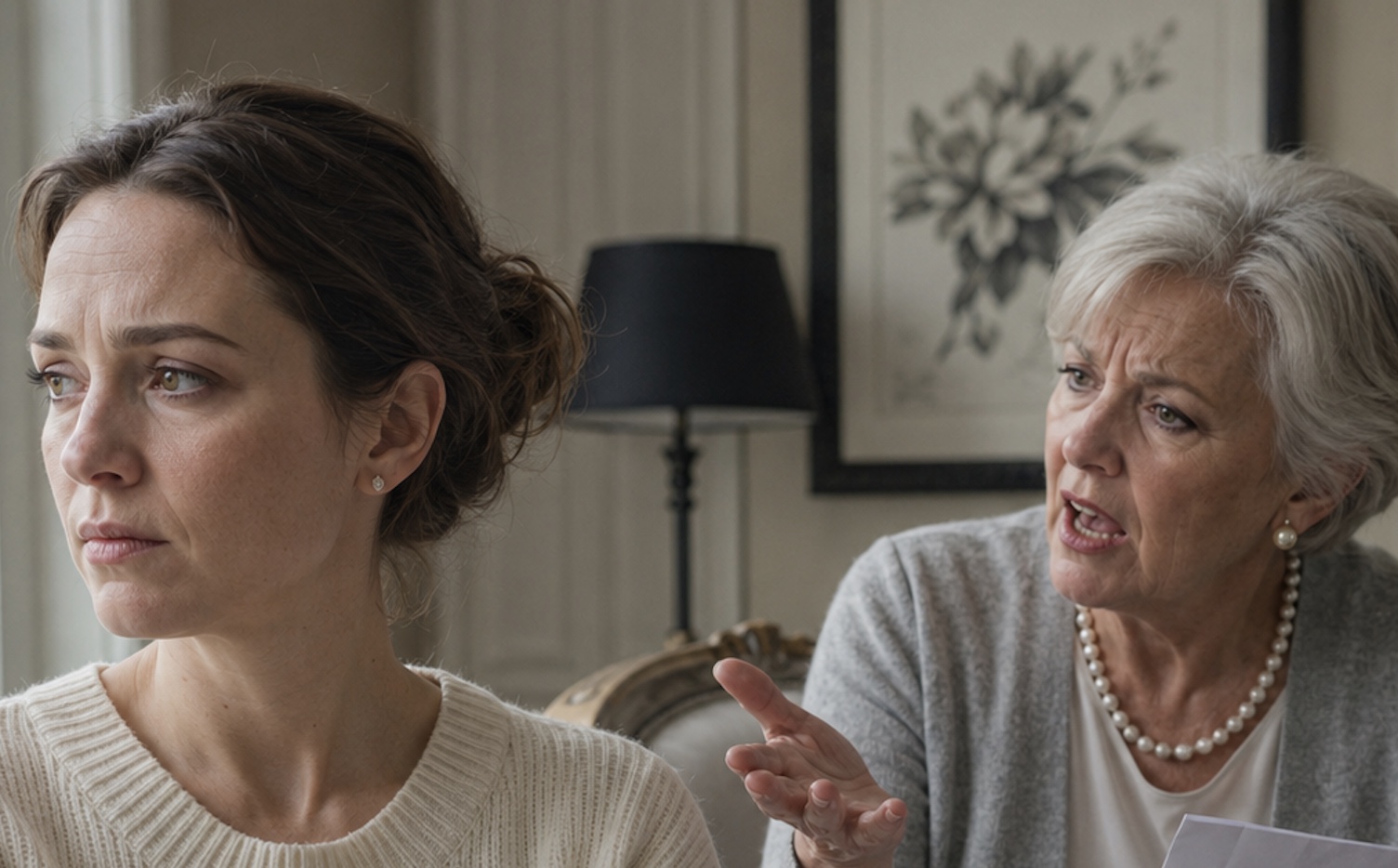
The phone rang on Saturday morning while Vera stood on the balcony watering her geraniums. The number was unfamiliar, but she recognized the voice instantly—a voice that had haunted her nightmares for eight long years. Vera barely had time to say hello before the familiar raspy, demanding tone struck her through the receiver.
“Can’t you answer your phone properly? I’ve already called four times! Come here immediately. I need to speak to you. The address is 12 Maple Street, apartment 41.”
Vera slowly moved the phone away from her ear and stared at the screen as though it might explain more than the voice had.
Eight years of silence.
Not a single call. Not one message. Not even a simple, “How are you?”
And now—come here immediately.
“Kirill,” she called to her husband, who was sitting at the table in the next room. “Galina Petrovna has suddenly remembered she has a daughter.”
Kirill raised his head and frowned.
He remembered everything. He remembered the evening Galina had thrown Vera out of the apartment, and the cruel words that could never be forgotten. He remembered Vera lying awake at night, trying again and again to call her mother. He remembered the letters she sent, all of which came back unopened.
“Are you going?” he asked quietly.
“I am,” Vera replied. “But not because she ordered me to come. I’m going because I need to put an end to this myself.”
The apartment on Maple Street was small and cramped. The walls in the entrance hall were peeling, and the front door creaked on its hinges. Vera pressed the doorbell and heard hurried footsteps inside.
The door flew open.
Her mother stood on the threshold, visibly older, with dull, tired eyes and a faded housecoat.
“What took you so long?” Galina snapped, grabbing Vera by the sleeve and pulling her inside. “I’ve been waiting for two hours! You were always like this—never prepared for anything, always late.”
Vera calmly freed her arm from her mother’s grip and stepped into the hallway.
The place looked poor and neglected. A single pair of shoes stood by the door. The coat rack was empty. Faded wallpaper patterned with sunflowers covered the walls. It bore no resemblance to the luxurious apartment where Galina had once lived with Igor Viktorovich, her second husband.
“Sit down,” Galina said, waving toward the room. “No, wait. Stay standing. Listen to me first. I need help. I need money, and I need an apartment. You’re so independent, aren’t you? You achieved everything on your own. So now you can help your own mother.”
Vera sat down on a chair and placed her handbag on her lap.
Then she smiled.
It was not a warm smile. It held the sharp, polished irony of eight years of silence.
“Eight years,” Vera said. “Two thousand nine hundred and twenty days, not counting leap years. I counted them, Galina Petrovna. Every single one.”
“Don’t call me by my first name and patronymic!” Galina shouted, slamming her palm against the table. “I am your mother! And stop acting like some wounded victim. Life happened the way it happened!”
“Life didn’t simply happen,” Vera replied, shaking her head. “You made it happen. With your own hands. Do you remember what you said to me that evening? ‘I’m starting a new life, and there’s no place for you in it.’ Those were your exact words. I remember every syllable.”
Her mother turned away and began pacing around the room. Her fingers twisted the edge of her housecoat, and her eyes darted nervously from side to side.
She had clearly prepared a speech in advance, but the conversation was no longer following her script.
“You always held grudges!” she burst out. “You’re exactly like your father! Just as stubborn and cold! I was… I was in love back then, do you understand? Igor didn’t want you living with us! I was caught between two fires!”
“Being caught between two fires means getting burned from both sides,” Vera said evenly. “You simply chose the fire that kept you warmer. A man with an apartment and a car, or a daughter who could barely make ends meet. The arithmetic was simple.”
“How dare you speak to me like that!” Galina’s voice rose into a shriek. “You have no idea what I’ve been through! Igor left me! Two years ago! He abandoned me without a single ruble! The apartment was his. Everything was in his name. I ended up on the street!”
“And then there was Oleg,” Vera said, tilting her head slightly. “Then Vitaly. Then someone else whose name I don’t know. Lidia told me. Unlike you, she never forgot to call.”
Galina froze.
Her face twitched, and her lips tightened into a thin line.
“Lidia is a gossip! She knows nothing about my life!”
“Lidia has been my friend since childhood,” Vera corrected her. “And she knows enough. She knows you went through four men in eight years, moving on to the next whenever the previous one ran out of money. She also knows you sold Grandmother’s ring. The one she left to me.”
“The ring!” Galina threw up her hands. “She told you about that too? I had every right to it! I was the primary heir!”
“You were the primary heir,” Vera agreed. “But Grandmother left the ring to me, and you knew that. You sold it anyway. For how much? Thirty thousand? Fifty? Grandmother wore it for forty years, and you traded it for a few months of a beautiful life with some man.”
Galina lowered herself onto the sofa and wrapped her arms around her knees.
She looked pitiful, and Vera could see it.
But the compassion that had once lived inside her had dried up long ago, like a stream under the summer sun.
“You’re cruel,” her mother whispered. “You’re heartless.”
“No,” Vera replied, shaking her head. “I grew up. Heartless is throwing your daughter out of your life for the sake of a man. Heartless is ignoring every letter she sends for eight years. Heartless is refusing to attend her wedding. You knew I got married, didn’t you? Lidia told you. You knew, and you still didn’t come.”
“I couldn’t! Igor wouldn’t have understood!”
“Igor wouldn’t have understood that his wife had an adult daughter?” Vera gave a bitter laugh. “Or did you tell him you had no children? Judging by your face, I guessed correctly. You didn’t just erase me from your life. You erased me from your entire existence.”
Her mother jumped to her feet.
Her eyes were wet, but anger outweighed any shame she might have felt. She pointed a finger at Vera.
“You don’t know what it’s like to be alone at fifty! To lose everything! No husband, no money, no roof over your head! You live comfortably in your cozy apartment with your husband while I rot in this place! You are my daughter! You are obligated to help me!”
“Obligated,” Vera repeated. “Interesting word. Let’s examine it. Obligation usually comes from gratitude. Someone does something for you, and you feel indebted to them. What exactly did you do for me, Galina Petrovna? You threw me out when I was twenty-two. You never gave me a single ruble. You didn’t call when I was in the hospital. Yes, I was hospitalized three years ago. Lidia called you and begged you to come. You said, ‘I’m busy. Give her my regards.’”
“I don’t remember that!” Galina shouted.
“But I do,” Vera said, rising from her chair. “I remember everything. I remember ‘give her my regards.’ I also remember what you told Lidia before that: ‘She’s an adult. She can handle it herself.’ And I did handle it. Kirill stayed beside my hospital bed. Lidia brought me food. And you sent your regards. Such warm regards they were. Almost burning.”
Galina burst into tears.
But even through the sobbing, Vera noticed a flash of calculation—a quick, watchful glance from beneath her wet eyelashes.
She was checking to see whether it had worked.
Vera had known this technique since childhood. Her mother always cried at exactly the right moment, whenever she needed something.
“Tears are one of your oldest weapons,” Vera said calmly. “But they have expired. I’m no longer the little girl who ran to apologize whenever you cried. I can tell the difference between real grief and a performance now.”
“You’re a monster!” Galina wiped her face with her sleeve. “I gave birth to you! I fed you! I stayed awake at night when you were sick!”
“That is called parenting,” Vera replied. “It is not an investment, Galina Petrovna. You weren’t buying shares. You chose to have a child, and that choice does not entitle you to dividends. Especially after you threw that child away like something you no longer needed.”
The doorbell rang.
Galina flinched.
Vera looked at her questioningly.
“That’s Lidia,” she said. “I asked her to come. Just in case.”
A tall, composed woman entered the apartment, her back straight and her eyes alert. She nodded to Vera before looking at Galina.
“Good afternoon, Galina Petrovna,” she said evenly.
“Who invited you?” Galina snapped. “This is a family matter!”
“A family matter,” Lidia repeated. “That’s a strange phrase to hear from someone who spent eight years pretending she had no family. Vera, I can wait in the hallway if you prefer.”
“Stay,” Vera said. “I need a witness. Because I know that within a week, Galina Petrovna will retell this conversation as though I came here screaming and rejected her for no reason. There are reasons. Many of them.”
Her mother pressed her lips together.
Lidia’s presence had clearly disrupted her usual strategy. Galina was accustomed to working one-on-one—to applying pressure, crying, accusing and demanding.
Her tricks were far less effective in front of witnesses.
“Fine,” Galina said, straightening her shoulders as her voice suddenly became businesslike. “Fine. No hysterics. I need money. One hundred thousand rubles. And I need somewhere to live. I’m renting this apartment, and I’ll be evicted in a month. I’m asking you—not demanding. I’m asking you to help me.”
Vera studied her for a long moment.
Then she opened her handbag, removed an envelope and placed it on the table.
Galina’s eyes immediately darted toward it.
“There are twenty thousand rubles inside,” Vera said. “That is all I’m willing to give you. Not because I can’t afford more, but because you will receive nothing more from me. And this is not a daughter helping her mother. This is one human being helping another person in a difficult situation. I would do the same for anyone.”
“Twenty thousand?” Her mother snatched the envelope and weighed it in her hand. “Is this some kind of joke? I need one hundred thousand! You live in a three-bedroom apartment! You have a husband! You own a car! And you give me twenty thousand?”
“How do you know about the apartment?” Vera narrowed her eyes. “And the car? You haven’t shown any interest in me for eight years. Did someone investigate my life for you? Or have you been watching my social media pages? Watching silently without writing a single message. Yet now you know the exact size of my home. What a selective form of maternal love.”
Galina fell silent.
The envelope trembled slightly in her hands.
Lidia remained by the door, watching without saying a word.
“Vera,” her mother said suddenly, adopting a different voice—quiet, gentle, almost affectionate. “My little girl. I understand everything now. I know I was wrong. Terribly wrong. Give me a chance to make things right. Let me stay with you, just for a month, until I get back on my feet.”
“No,” Vera replied without hesitation.
“No?”
“No. Because I know how it works. One month becomes three. Three months become six. You start making rules in my home, fighting with Kirill and complaining about us to the neighbors. I’ve already seen that story. You lived with Grandmother that way during the last years of her life. She cried every evening. I don’t want to cry every evening.”
Galina stood up.
Her face hardened.
The tenderness vanished from her expression as quickly as a mask being pulled away.
“One day you’ll grow old,” she said through clenched teeth. “Then you’ll understand what this feels like.”
“But I won’t grow old alone,” Vera replied. “Because I never betrayed the people who loved me. Goodbye, Galina Petrovna. The twenty thousand is on the table. You will not be getting my new phone number.”
Vera walked out first.
Lidia followed.
The door closed quietly behind them without a slam.
On the landing, Vera stopped and leaned lightly against the railing. Her hands were steady, and her breathing was calm.
She had been preparing for this conversation for eight years.
“Are you all right?” Lidia asked.
“I’m completely fine,” Vera said, smiling. “I just closed the door she opened eight years ago. Only this time, I closed it from the other side.”
They walked downstairs and stepped outside.
Kirill was waiting near the entrance, leaning against the car. He looked at his wife, and she gave him a brief, confident nod.
“Home?” he asked.
“Home,” Vera answered. “Back to our life. The one we built ourselves.”
The car pulled away.
Vera did not look back at the apartment windows.
Behind one of them stood the woman who had once been her mother. A woman who had chosen a stranger over her own daughter and had eventually been left without either of them.
The envelope containing twenty thousand rubles remained on the table.
It was the last money Galina Petrovna would ever receive from her daughter.
And the last words had already been spoken.