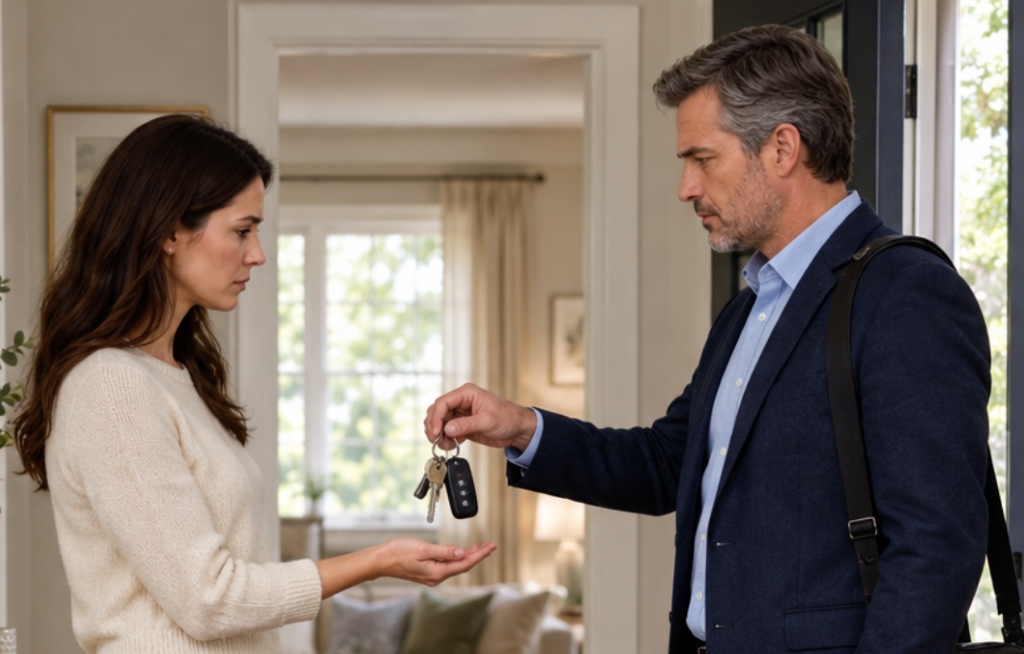
“It’s not what you think,” he started to say.
“Of course. You just went to Vika’s to play chess,” I answered.
Andrey froze in the doorway. His two bags were placed by the door, neatly zipped up. His jacket was draped over the handle, just like you see in a hotel when checking out. He looked at the suitcases, then at me, and I watched his mind quickly switching modes. His prepared speech about “we need to talk” was no longer going to work.
I found out about the cheating in advance, packed my husband’s things, and demanded that he leave the keys to my apartment and car.
“Olya, wait.”
“I’m waiting. Put the keys on the table.”
He didn’t put them down. He stood there in his shoes on the doormat, and you could see it on his face: he liked to control conversations. At work, it’s called ‘leading negotiations.’ At home, he always led, too. Twenty-three years of marriage, and I had never started first. But this time, I did.
“How did you find out about Vika?”
I didn’t answer. I just walked into the kitchen and turned on the kettle. I genuinely wanted some tea. I had been preparing for this night for three weeks, and now that it had come, I didn’t feel empty inside. I felt calm, like after a long sleepless night when you finally make a decision and fall asleep.
I found out about Vika by accident. Andrey left his phone charging and went to take a shower. I’m not the kind of person who checks through messages. But the screen lit up by itself, and there was a voice message. A woman’s voice, warm and confident: “I’m waiting for you, don’t be late.”
I could have made a scene that same evening. But I didn’t.
I sat down at the kitchen table, poured myself a glass of water, and started thinking. This apartment came to me from my father. He passed away seven years ago, leaving me this three-bedroom place on Leninskiy. Andrey moved in even before our wedding, and over time he started calling it “our apartment,” then just “the apartment,” as if it had simply appeared out of nowhere. I bought the car two years ago with my own money after getting a promotion. Andrey drove it more than I did because he “needed it for work.” The metro was good enough for me.
My friend Irina said over the phone back then:
“Are you serious? You’re just going to pack his things for him?”
“What did you expect, that I’d go running after him screaming?”
“No. But at least you could cry about it.”
“Irina, I already cried. On Tuesday. For an hour and a half. That’s enough.”
It took me two weeks to gather all the documents. I double-checked that my name was on the property certificate. Looked over the car purchase contract. Read through the prenuptial agreement we signed twenty years ago at my mother’s insistence. Back then, Mom said, “Olechka, paperwork isn’t about mistrust, it’s about clarity.” Andrey laughed and signed it because he was thirty and thought it was just a formality.
Turns out that formality came in handy.
He walked into the kitchen. Didn’t take off his shoes. That got to me, not because of the hardwood floor, but because he always used to take them off. Now he was just standing there in his shoes, like he already didn’t belong here.
“Olya, can we talk about this like adults?”
“Sure. The keys to the apartment and car. I packed your things—check if you want. I put your winter coat in there, it’s in the left bag.”
He sat down on the stool. It was heavy, the way men do when they don’t know what to do with their hands.
“Are you seriously kicking me out?”
“No. You’re leaving on your own. To Vika. I just helped with your things.”
“How did you…”
“Andrey. It’s been three weeks. You came back at eleven, you smelled like someone else’s perfume, and you deleted messages in the bathroom. I’m not blind or deaf. I’m forty-six, not sixteen.”
He rubbed his face with his hands. I made myself some tea. Teabag, boiling water, spoonful of honey. My hands weren’t shaking. I was proud of that.
“It’s not that simple,” he said.
“It is for me. The apartment is mine, the car is mine, the keys go on the table. What’s unclear?”
“You know I put a lot into this home…”
“I know. You hung the curtain rods in the bedroom and called the plumber twice. I bought everything else myself. We can go through the receipts if you want. I have a folder in the closet.”
He fell silent. Not because he was hurt, no. Andrey was silent because he had gotten used to thinking of this life as his—to living here, to driving my car, to hosting guests in my kitchen. At some point, he stopped noticing that none of this belonged to him.
Vika probably never noticed, either.
His phone buzzed briefly in his pocket. Andrey pulled it out automatically, glanced at it, and I saw his eyebrow twitch a little. He didn’t turn the screen towards me. He didn’t have to. I could read everything on his face.
“Is that her?”
He put his phone away.
“Olya, I don’t want it to end like this.”
“End like what?”
“At the door. With bags. Like I got caught doing something wrong and now I’m being thrown out.”
“What did you expect? You spent three weeks with another woman, and I was supposed to just wait around for you to gracefully announce that we ‘need a break’?”
He opened his mouth, then shut it. Because yes, this was exactly what he wanted. I know him. He would have come in, sat down on this stool and said something like, “Olga, I have to be honest with you.” And then I would be expected to cry, to ask him to stay, and he’d graciously leave, feeling like a complicated man facing a difficult decision. What a scene. For him.
But I rewrote the script.
“Does Vika know the apartment isn’t yours?” I asked.
He didn’t answer. But the way he looked away said it all.
She doesn’t know.
“And the car?”
Silence.
“Andrey, what did you tell her?”
He stood up. The stool scraped against the floor.
“That’s none of your business.”
“Right. Not anymore. Leave the keys on the table.”
His phone buzzed again. This time, he didn’t even take it out.
He walked to the hall. I stayed in the kitchen, sipping my tea and listening. The rustle, the click of his bag’s lock, him checking his things. Then silence. A long one. About twenty seconds.
“Did you pack my blue blazer?”
“It’s in the right bag. And all four of your ties.”
Silence again. I pictured him standing in the hallway, next to the table with the keys, thinking. Not about me. About how he’d look at Vika’s door—with two bags. Taking a taxi.
Vika had seen him at work, dressed well, driving my car, talking about “our apartment’s being renovated” and “I need to drop by the parking garage.” Vika saw a man who had it all. And now that same man was standing in the hallway with just two bags, his phone, his wallet, and a blue blazer.
“Olga.”
“Yes.”
“Maybe I could stay here for a week? Until I find a place.”
I put my cup down.
“No.”
“I’ll sleep on the couch.”
“Andrey. No.”
He paused.
“You’ve gotten tough.”
“I haven’t changed. I’ve always been like this. You just didn’t notice, because I never had a reason to show it.”
He said nothing. I heard the door lock click. I listened as he picked up his bags, and by the sound I could tell: they were heavy. I packed everything. Even his old running shoes, the ones he wore for his morning runs, back when he still used to run.
My phone rang. Irina.
“He left?”
“He left.”
“How are you?”
“I’m fine. Drinking tea.”
“Did you add honey?”
“I did.”
“Good. That’s right.”
I smiled. For the first time that evening. Not out of anger or relief. Just because a friend knows I add honey to my tea when I need to feel warmer.
Twenty minutes later, through the window, I saw Andrey standing outside the building with two bags. The taxi hadn’t arrived yet. He was on the phone. I couldn’t hear the words, but from his gestures, it was clear: he was explaining. Free hand out to the sides, the way people do when they say, “it’s complicated.” Vika was probably asking when he’d arrive and why he wasn’t in the car.
I closed the curtain.
On the table in the hallway lay the keys. Two for the apartment, one for the car, and a keychain with a small compass that I gave him on our fifteenth wedding anniversary. Later, I took off the compass and put it away in a drawer. Not out of sentimentality. It’s just a nice thing—why throw it out.
The kettle grew cold. Outside, a soft rain was falling. Somewhere below, the taxi door slammed shut.
That’s all.