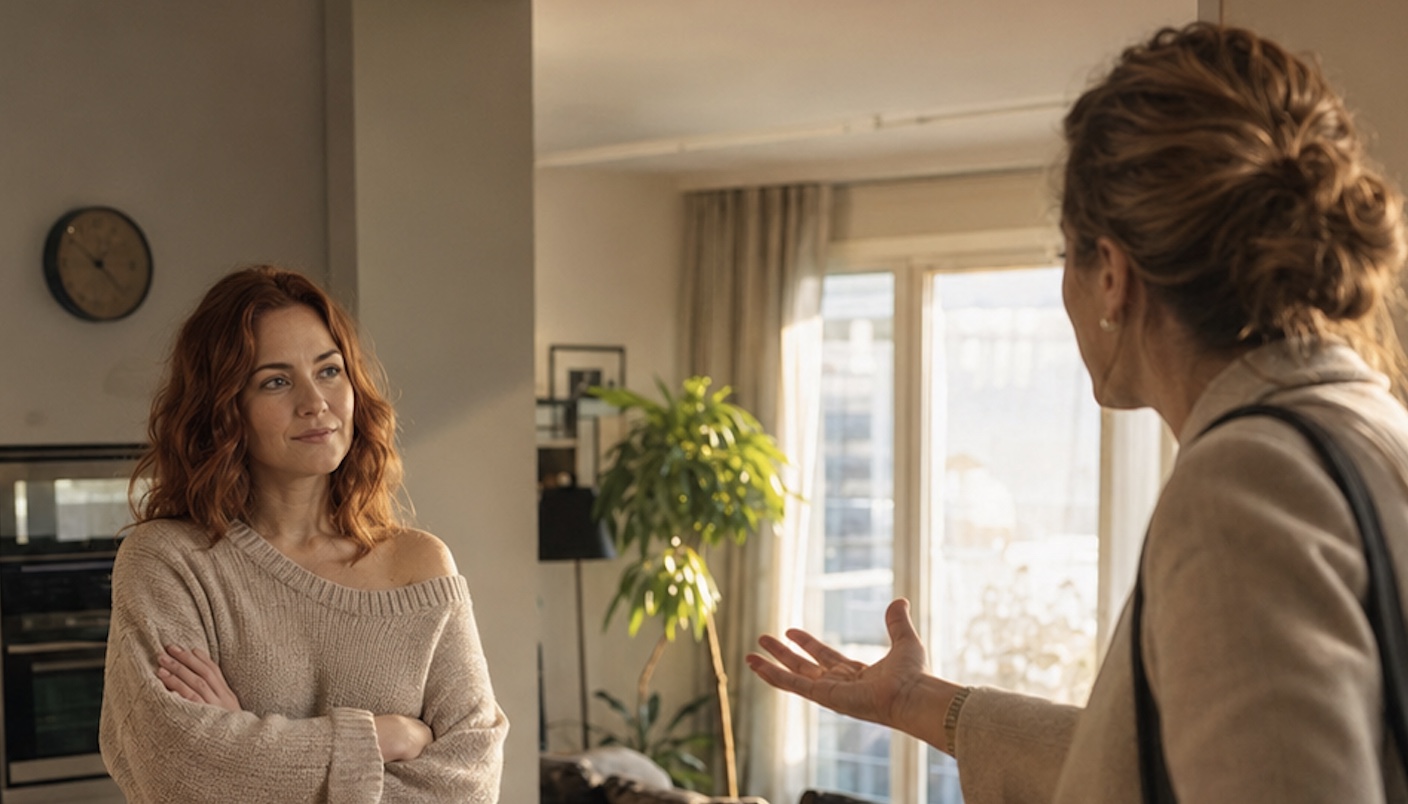
Marina was setting the table, placing exactly three plates on it. Styopa hovered nearby, trying to sneak a piece of bread from the basket. Denis was washing his hands, and the sound of running water from the bathroom blended with the quiet murmur of a cartoon playing in the next room.
“Mom, when are we eating?” Styopa tugged at the hem of her apron.
“Right now, sweetheart. As soon as Dad comes out, we’ll sit down.”
Denis appeared, drying his hands on a towel. He looked into the pot and nodded approvingly. Marina had made chicken stewed with vegetables, following a recipe she had found in her father’s old notebook, covered in his tiny handwriting.
“It smells amazing,” Denis said, kissing her on the temple. “I don’t understand how you manage to make ordinary ingredients taste this good.”
“The secret is simple. Don’t rush, and add a little love,” Marina replied with a smile as she removed her apron.
They sat down. Styopa carefully positioned his spoon. Denis poured fruit drink into the glasses. The first few minutes of a family dinner were always the warmest, when no one was full yet, but everyone was already happy.
The doorbell sliced through the silence like a knife cutting stretched fabric.
“I’ll get it,” Marina said, rising from her chair, although deep down she already knew who it was.
Vera stood outside with Maxim and Sonya. Maxim was holding a bag of toys, while Sonya blinked innocently. Vera smiled broadly.
“Oh, are you having dinner? What perfect timing!” Vera said, stepping into the hallway and removing her shoes. “Maxim, Sonya, go wash your hands quickly.”
Marina remained standing by the open door. She looked at Denis. He sat completely still, his face expressionless, his spoon frozen halfway to his mouth.
“Vera, we weren’t expecting guests tonight,” Marina said gently, taking her sister by the elbow.
“Oh, come on. What guests? I’m your sister!” Vera replied, already peering into the cooking pot. “Chicken! Wonderful. The kids have barely eaten all day, and their father is working late again.”
Marina brought out two extra plates. Everyone’s portions became smaller. Styopa received only half of what Marina had planned to give him. Denis ate in silence, methodically, without raising his eyes.
“Denis, why are you so quiet?” Vera asked as she pulled the salad bowl closer to herself. “You look gloomy.”
“I’m tired,” he answered briefly.
“Everyone gets tired,” Vera said with a shrug before turning to Maxim. “Stop talking and eat.”
Marina sat beside her husband. Under the table, she found his hand and squeezed it. Denis squeezed back, briefly but firmly. It was their private language, silent and honest.
Vera left around ten, taking her well-fed children and the remaining fruit drink in a bottle. Marina cleared the plates while Denis put Styopa to bed.
“Mom, is Aunt Vera coming again tomorrow?” Styopa asked, pulling the blanket up to his chin.
“I don’t know, sweetheart. Go to sleep.”
After Styopa fell asleep, Denis returned to the kitchen. Marina stood by the sink without speaking. Water flowed over the dirty plates, but she did not move.
“Marina,” Denis said, sitting on a stool. “That was the fourth time this week.”
“I know.”
“You spend two hours cooking, and then everything disappears in twenty minutes. Styopa didn’t even get a second helping.”
Marina turned off the water. She faced him and leaned against the sink. Her eyes were dry, but something heavy rested in them, like a stone at the bottom of a river.
“I’ll try talking to her,” she said. “I’ll call her tomorrow.”
“You already talked to her last month.”
“I only hinted at it then. This time I’ll say it directly.”
Denis nodded. He did not pressure her or make threats. But Marina could see that it was becoming harder for him to remain calm. Their evenings were turning into a free cafeteria for her sister, who did not even consider it necessary to warn them before arriving.
The next day, Marina called Vera. The phone rang three times, then four, then five.
“Hello?” Vera answered cheerfully. Children were shrieking in the background.
“Vera, we need to talk.”
“Go ahead, but make it quick. Sonya has smeared toothpaste all over the mirror.”
“Listen, I love you very much. But you can’t keep coming over every evening without warning.”
There was a pause, followed by a short laugh.
“Marina, are you serious? We’re sisters. Or are you upset over one bowl of soup?”
“This isn’t about soup. Denis and I sometimes want to have dinner with our own family. Just the three of us.”
“Well, thank you very much. So now my children are bothering you?”
“Vera, that isn’t what I said.”
“That’s exactly what you meant. Fine. I won’t interfere with your precious ‘family dinner’ anymore. Goodbye.”
The line went dead. Marina lowered the phone and exhaled. She still hoped Vera might think about it and understand. Maybe Vera would call the next day and say, “I’m sorry. You were right.”
For two days, everything was quiet. Marina made Styopa’s favorite meat patties. Denis brought home a bottle of wine. They lit a candle and ate slowly, talking about everything and nothing.
“This is how it should be,” Denis said, raising his glass.
“Every evening,” Marina replied with a smile.
On the third day, at seven in the evening, someone knocked. Not on the door, but on the kitchen window. Their apartment was on the ground floor.
Marina pulled back the curtain. Vera stood outside holding a cooking pot, with Maxim and Sonya pressed close on either side of her.
“Open up! I made borscht!” Vera shouted, waving the lid. “I decided to be fair and bring my own food!”
Marina did not open the window. Instead, she walked into the hallway and opened the front door. Vera was already standing on the threshold, flushed and pleased with herself.
“See? I’m not taking advantage of you. I brought borscht. Let’s combine our dinners!”
“Vera, I asked you to call first.”
“I am warning you. I’m standing right here telling you that we’ve arrived.”
Denis came out of the room. He looked at Vera, then at Marina. Then he did something he had never done before.
“Vera,” he said, stepping between her and the hallway. “Thank you for the borscht. But tonight is a family evening for us. Please call ahead next time.”
“Are you giving me orders?” Vera lifted her chin. “Marina, is your husband blocking my way?”
“Denis is right,” Marina said, stepping beside him. “We’re asking for basic respect.”
Vera’s expression changed instantly. Her cheerful face hardened, becoming sharp and hostile. She grabbed the pot and turned around.
“So that’s how it is. Fine. I’ll remember this. When you need help, don’t call me.”
“Vera…”
“No. You made your choice. Some stranger you married matters more to you than your own blood.”
The door slammed. Maxim glanced back fearfully from the stairwell, while Sonya began to whimper. Marina remained in the hallway, listening to their footsteps fade away. Denis quietly locked the door.
“She’ll tell everyone,” Marina said.
“Let her.”
“She’ll call Dad and say I threw her out.”
“Marina,” Denis said, turning her toward him, “you didn’t throw her out. You asked her to come another time. Those are two different things. At least dinner belongs to us again.”
That evening, Marina’s phone exploded with messages.
Aunt Raya wrote, “How could you do that? Vera is crying!”
A cousin from another city asked, “I heard you chased Vera away from your dinner table?”
Even Marina’s father sent a brief message: “Call me.”
Marina did not put it off. She called him immediately.
“Dad, I’m going to tell you what really happened.”
“I’m listening,” he said evenly, without accusation.
“Vera comes over every day without warning. She sits down at our table. My son doesn’t get enough to eat. My husband stays silent out of politeness. I asked her to call before coming, and she took offense.”
“She told me you shut the door in her face.”
“The door was open. I asked her to come another time. Those are two different things, Dad.”
Her father was silent for a moment.
“I’ll talk to her.”
“You don’t need to defend me. I can handle it myself. I just want you to know the truth.”
After ending the call, Marina felt strangely empty and clean inside, like a room after a thorough cleaning. She was disappointed and angry, but the decision had been made. She would not justify herself to every relative. Those who wanted the truth could ask. Those who did not would believe Vera.
Two weeks of silence felt strange. Marina often caught herself glancing at her phone in the evenings. It was not longing, exactly. It was simply a habit that had not yet died.
Denis noticed.
“Do you miss her?” he asked one night after Styopa had fallen asleep.
“No. But it feels unusual.”
“You know, in this silence, I finally feel like we have a home. Our home.”
Marina nodded. She knew he was right.
She remembered the night three years earlier when she had left Igor. She had escaped with a single bag and taken a taxi to Vera’s apartment. Vera had asked no questions. She had simply opened the door, made up the sofa, and sat beside Marina until she stopped trembling.
That had been real. Honest. Without calculation.
But somewhere along the way, something had changed. Vera began treating Marina’s gratitude like a permanent debt. And that debt, in Vera’s mind, gave her a right to Marina’s refrigerator, her time, and her evenings.
On Thursday, Marina ran into Vera near the entrance of the building. It happened by chance. Marina was returning from the store. Vera sat alone on a bench, without the children and without a cooking pot. She looked different somehow, quieter and smaller.
“Hello,” Marina said.
“Hello,” Vera replied without looking up.
“Are you all right?”
“No. But that’s not your concern anymore, is it?”
“Vera, I didn’t reject you. I asked you to respect our time and my family.”
Vera raised her head. Her eyes were red but dry.
“I got used to you. I got used to you always feeding me, welcoming me, and staying quiet. When you finally said no, it felt like the ground disappeared beneath me.”
“You’re my sister, but you don’t live with me. Do you understand the difference?”
Vera nodded and remained silent for a moment.
“I went too far. I know. It’s just that my home feels empty. My husband is always somewhere else. The children are constantly shouting. Your home is warm and peaceful, and I wanted a piece of that.”
“Then create warmth in your own home. I can help you, but I can’t replace it.”
Vera stood and brushed off her coat.
“I’ll think about it,” she said before walking away.
Three days later, their father called. His voice was tense and hurried.
“Marina, Vera was taken away in an ambulance. She had a heart attack. She’s at City Hospital Number Twenty-Three.”
Marina dropped the bag of grain she was holding. Denis caught the phone.
“What happened?”
Marina was already searching for her keys.
“I’m going to the hospital. Call Aunt Raya and ask her to pick up Maxim from school and Sonya from kindergarten. No, wait. I’ll pick them up myself first, and then I’ll go see Vera.”
“I’ll take Styopa to your father and meet you there,” Denis said, already getting ready.
Marina did not hesitate for a second. She collected Maxim from school and Sonya from kindergarten. She took them home, fed them, and then rushed to the hospital.
Vera lay in a hospital bed, pale, with an IV needle in her arm. When she saw Marina, she turned toward the wall.
“You shouldn’t have come.”
“Don’t be ridiculous,” Marina said, sitting on the edge of the bed. “How are you?”
“Bad. And ashamed.”
“Shame can wait. What did the doctor say?”
“Nervous exhaustion. My heart couldn’t take it. They said I have to stay here for a week.”
Marina took her hand.
“The children are with me. Don’t worry.”
Vera turned to face her. Her eyes glistened.
“I carry everything alone. The home, the children, the cooking, the bills. My husband earns money and comes home half-dead. And I don’t know how to ask for help. I only know how to barge into people’s lives.”
“I know.”
“You were always stronger than me, Marina. Even when you left Igor, you made a decision. I just get stuck, like a fly in jam.”
“You’re strong too. You’ve simply forgotten it.”
For four days, Marina collected Maxim and Sonya, cooked for everyone, and drove the children to school and kindergarten. Denis helped without a single complaint. He drove them around, picked them up, and even washed the floors in Vera’s apartment.
On the fifth day, Marina went to clean Vera’s apartment before her discharge. She was wiping the kitchen shelves when an envelope fell from behind the bread box.
It was a plain white envelope, unsealed. Inside was a thick bundle of cash and a sheet of paper folded into quarters.
Marina unfolded it.
It was a list written in Vera’s careful handwriting.
“What to tell Dad: Marina never helps. Marina refused to feed us. Denis insulted me in front of the children.”
Below that was another note:
“What to tell Aunt Raya: Marina threw a sick child outside into the cold.”
Nothing like that had ever happened.
At the very bottom, underlined twice, Vera had written:
“If Dad takes my side, ask him for help with the apartment. Marina must receive nothing.”
Marina read it again. Then she placed the sheet on the table.
Her hands were perfectly steady. Anger did not come as shouting or tears. It came as clarity, cold and precise as a winter morning.
She photographed the page, placed it back behind the bread box, and drove to the hospital.
Vera was sitting upright in bed, looking healthier and smiling. Their father stood beside her holding a bag of apples.
“Marina!” Vera stretched out her arms. “Thank you for taking care of the children and everything else…”
“Dad, please stay,” Marina said, sitting down and taking out her phone. “There’s something I need to show both of you.”
“What is it?” her father asked, frowning.
Marina opened the photograph and handed him the phone. He put on his glasses and read the page. Slowly, he removed his glasses and looked at Vera.
“What is this?” he asked quietly.
The softness of his voice made the room feel terrifyingly still.
Vera saw the screen. Her smile melted like snow in a warm hand.
“This… You misunderstood.”
“What exactly are we supposed to think?” Marina asked, staring directly at her sister. “You made a written plan describing what lies to tell about me. Point by point. You even decided who should hear each story.”
“I was desperate! I wasn’t thinking clearly!”
“The date on the page is two weeks before our conversation. You wrote this plan before I ever asked you to call before visiting.”
Their father placed the phone on the bedside table. He stood up and stepped closer to Vera.
“I believed you,” he said quietly. “I called Marina and almost accused her. And all that time, you were inventing stories?”
“Dad, I…”
“‘Marina threw a sick child outside into the cold,’” he quoted. “When Sonya was sick, Marina stayed with her for two days because you couldn’t leave work. Did you forget to include that in your little list?”
Vera sank deeper into her pillow. Her eyes darted between her father and her sister.
“And what about the money in the envelope?” Marina asked. “Where did it come from? You said you couldn’t afford bread.”
“I was saving it for an emergency.”
“Four hundred thousand rubles is more than emergency money. That would pay for six months of the dinners you ate at my house. You were saving money while eating our food.”
Their father turned to Marina.
“Forgive me, sweetheart. I should have asked you first instead of believing only one side.”
“It isn’t your fault, Dad. She played her part well.”
Vera began to cry. But her tears no longer affected either of them.
“I’ll continue taking care of your children while you’re here,” Marina said, rising. “Maxim and Sonya are not responsible for any of this. But when you leave the hospital, don’t come to my home without calling. And don’t come with lies.”
“Marina, wait…”
“I’ve waited long enough.”
She walked out of the room. Her father followed her. In the hallway, he placed his hands on her shoulders and pulled her into a tight embrace. For the first time, she truly felt that he was on her side.
“You’re strong,” he said. “You always have been.”
“I just don’t know how to postpone problems.”
That evening, Marina returned home. Styopa was asleep, while Maxim and Sonya watched cartoons in the other room. Denis was waiting in the kitchen with two plates, two glasses, and a pot of stewed chicken.
“How did it go?” he asked.
“Dinner is definitely ours now,” Marina said, sitting across from him.
Vera was discharged three days later. Their father collected her from the hospital alone, silently, without bringing apples. He drove her home, sat her down at the kitchen table, and said only one thing:
“Until you genuinely apologize to your sister, I will not set foot in this apartment again.”
Vera remained alone in her home, with a full bread box.
That same evening, Marina, Denis, and Styopa made pancakes together for the first time in months. Batter splashed onto Marina’s apron, Styopa laughed loudly, and Denis flipped pancakes into the air.
Not a single uninvited guest knocked that night.
Neither on the door nor on the window.