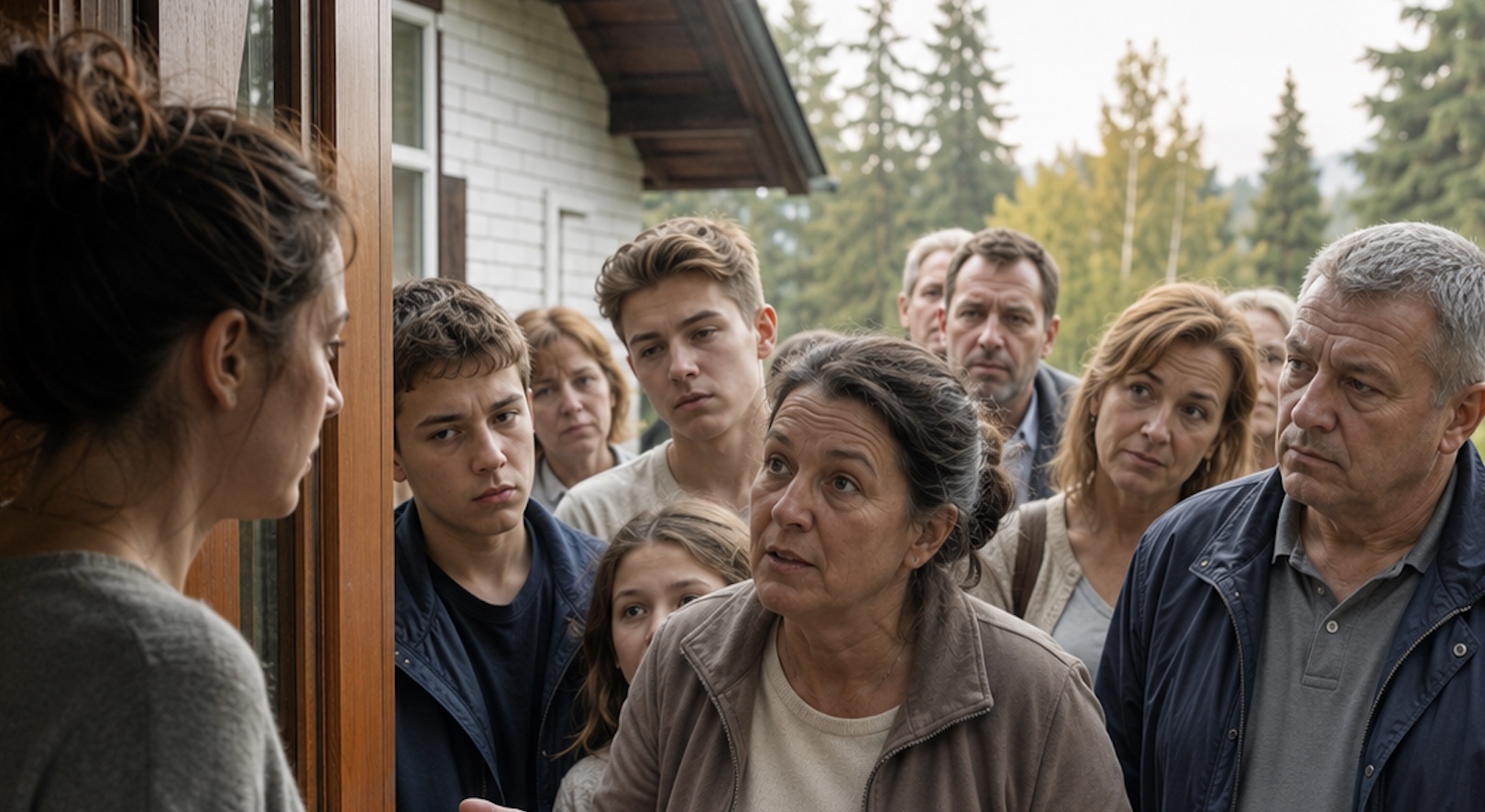
“Come on, Ira, open the gate! We’ve been on the road since five in the morning, and the children are already starving!” Lyudmila Petrovna’s voice carried across the entire property as though it were not her mother-in-law standing outside, but a shift supervisor arriving to inspect a work site.
Irina opened her eyes and stared at the pale bedroom ceiling for several seconds. Warm pine and damp morning air drifted through the half-open window. Somewhere behind the house, a magpie was already chattering, while cars near the gate sounded their horns one after another.
The digital clock read 5:54 a.m.
Beside her, Oleg lay on his side with a pillow over his head. He showed no surprise and made no attempt to jump up and find out who had arrived at such an hour. Only his shoulder twitched slightly when the doorbell rang again.
“Oleg,” Irina said.
“Mmm?”
“There are three cars outside our gate.”
“Probably my family,” he answered sleepily.
Irina sat up and looked at her husband.
“Which members of your family, exactly?”
Oleg removed the pillow and rubbed his face with both hands.
“Mom, Lena and Sergey… Maybe Uncle Kolya. I don’t know who ended up coming.”
He said it so casually that they might have been discussing a delivery driver bringing bottled water.
Irina got out of bed, slipped on a light robe, and went to the window. There really were three cars parked outside the gate. Lyudmila Petrovna and her husband, Viktor Stepanovich, had already climbed out of the first one. Oleg’s sister Elena was emerging from the second with her husband and two children. At the third car, Oleg’s cousin Artyom had opened the trunk, revealing folding chairs, an inflatable swim ring, and several empty food containers.
Irina saw no groceries.
There were plenty of bags, though. Thick plastic bags folded inside one another and secured neatly with rubber bands. The kind people brought not to unpack food, but to carry something home later.
Irina turned toward her husband.
“Did you invite them?”
Oleg was already pulling on a pair of shorts.
“Well, yes. For the weekend. We’ve been planning it for ages.”
“When exactly were you planning to tell me?”
“I wanted to mention it last night, but you went to bed late. What’s the point of discussing it now? They’re already here.”
The bell rang again.
“Irina! The kids need to use the bathroom!” Elena shouted from outside.
Irina did not answer. She continued looking at her husband until he finally stopped pretending to be a man who had simply been disturbed in his sleep.
“How many of them are there?” she asked.
“We’ll count when they come in.”
“You invited them and you don’t even know how many are coming?”
“I texted Mom that they could visit. She passed the message along to everyone else.”
“So you opened my property to your entire extended family without any restrictions?”
“Don’t start first thing in the morning. Normal people are happy to see guests.”
Irina picked up her phone from the bedside table, opened the camera, and returned to the window. She quickly took several pictures of the cars, the relatives, and the empty containers. Oleg noticed and frowned.
“Why are you taking pictures?”
“So no one can later claim they arrived unexpectedly with nothing but a small bag of apples.”
She left the bedroom, walked down the hallway, and unlocked the gate using the remote control. A minute later, Lyudmila Petrovna was already marching into the yard, energetic and elegantly dressed in a pale trouser suit and a wide-brimmed hat.
“Finally!” she declared instead of greeting them. “We were beginning to think you had both gone deaf.”
Viktor Stepanovich followed her, carrying an empty insulated cooler bag. Elena held a stack of food containers nested inside one another, while her husband Sergey carried a folding barbecue grill, even though a permanent brick grill already stood beside the outdoor kitchen.
“Good morning,” Irina said.
“What’s good about it? We’re starving,” Elena replied with a laugh. “The children only had a few crackers in the car. I told them to be patient because Aunt Irina had probably already prepared breakfast.”
Irina looked at the children. Neither appeared to be suffering. The younger one had already run toward the swings, while the older girl took out her phone and settled on a bench.
“What did you bring for breakfast?” Irina asked.
Elena hesitated for a moment.
“We came as guests.”
“I can see that. That’s why I’m asking what the guests brought.”
Lyudmila Petrovna waved dismissively.
“We’ll sort that out later. First, put on some coffee and make something hot. The men had a difficult journey.”
Irina glanced at Viktor Stepanovich. Her father-in-law stood calmly beside the flower bed, examining the currant bushes. Artyom and his wife were unloading two inflatable mattresses, a bag of swimming supplies, and several more empty jars with lids.
Irina counted eleven visitors, not including herself and Oleg.
She had bought enough food for two people: eggs, vegetables, a piece of cheese, chicken fillets, some fruit, and a fish she had planned to cook for dinner. Even with the best intentions, there was no way to feed thirteen people.
But Irina had no intention of improvising a feast or rushing to the supermarket with a full cart while everyone else relaxed on her property.
She stepped aside and let the relatives enter the yard.
“Make yourselves comfortable,” she said. “The bathroom is inside. Don’t leave water on the floor after using the pool. Everyone uses their own towels.”
Lyudmila Petrovna nodded with satisfaction, assuming that the hostess had accepted the situation.
Oleg approached Irina once the others had scattered around the property.
“There, that wasn’t so difficult,” he said quietly. “No unnecessary drama.”
“Of course,” Irina replied. “I don’t like unnecessary things either.”
She went into the kitchen, took two portions of cottage cheese, two cucumbers, and a packet of crispbread from the refrigerator. She arranged the food on two plates and carried them to the small table near the terrace.
Oleg saw the breakfast and frowned.
“What about everyone else?”
“Everyone else can show us what they brought.”
“They didn’t bring anything. The shops were still closed when they were driving here.”
“There’s a twenty-four-hour supermarket on the highway.”
“They were in a hurry.”
“To arrive by six in the morning?”
Oleg sat opposite her but did not touch the food.
A few minutes later, Elena came onto the terrace.
“Where are the cups? Mom says she can already smell coffee.”
“There are two servings of coffee in the pot,” Irina replied. “The cups are in the cupboard.”
Elena looked at the two plates.
“And breakfast?”
“It’s right in front of you.”
“That’s only enough for two.”
“Correct.”
“Ira, there are a lot of us.”
“I’ve already counted.”
Elena smirked, waiting for Irina to continue, but Irina calmly sliced her cucumber.
“Are you serious?” Elena finally asked.
“Completely.”
Lyudmila Petrovna joined them on the terrace.
“What’s going on?”
“Irina only made breakfast for herself and Oleg,” Elena complained.
Her mother-in-law looked at Irina and then at the table.
“Ira, honestly. We drove all this way. You could at least fry some potatoes.”
“You could at least have warned me that eleven people were coming.”
“Oleg said everything had been arranged.”
“Oleg only arranged things for himself.”
Her husband shoved his chair back sharply.
“Stop making me look like an idiot in front of my family.”
“You invited eleven people to arrive at six in the morning, didn’t tell the owner of the property, and promised them food you never bought. I don’t even have to help you look foolish.”
Elena folded her arms.
“So much for hospitality.”
Irina turned toward her.
“What do you call arriving in a large group with empty containers?”
“I brought them for the children during the drive. In case there were leftovers.”
“They’re stacked inside each other and take up half the bag.”
“So what?”
“Nothing. It’s simply interesting how one-sided everyone’s planning was. You planned how to carry food away, but not where that food would come from.”
Lyudmila Petrovna’s face reddened as she removed her hat.
“No one intended to take anything from you.”
At that exact moment, Artyom appeared from behind the house carrying two large three-liter jars.
“Irina, have you started pickling cucumbers yet? Mom said yours were really good last year. We brought jars so we wouldn’t have to drive home with them empty.”
A brief silence followed.
Irina looked directly at her mother-in-law.
“Of course. No one planned to take anything home.”
Artyom stopped, realizing that he had arrived at the worst possible moment.
“I’ll come back later,” he said before disappearing behind the house.
Oleg stood up.
“That’s enough. I’ll go to the store.”
“Excellent idea,” Irina said with a nod.
“Give me your card.”
“No.”
“What do you mean, no?”
“Exactly what I said. You invited the guests, so you buy the groceries.”
“I don’t have much cash with me.”
“Transfer money from your account.”
“Irina, stop turning this into a circus.”
“The circus was arranged without me. I’m simply refusing to buy tickets for everyone here.”
Lyudmila Petrovna intervened.
“Oleg, don’t humiliate yourself. I’ll pay.”
“You don’t need to, Mom.”
“Why not?” Irina asked. “That sounds perfectly reasonable. Several families are here, so each family can buy part of the food. One person handles the meat and charcoal, another buys vegetables, and someone else gets drinks and breakfast. Adults should be capable of arranging their own meals.”
Elena gave a skeptical snort.
“We came here to relax, not run around supermarkets.”
“Then relax without eating.”
Irina’s voice remained even. She did not raise it or try to make herself agreeable. That irritated the relatives more than anything else because their usual method of pressuring the hostess was not working.
Things had always happened differently before.
Oleg would announce on Friday evening that his parents were stopping by the next morning. They would arrive with Elena, and then it would turn out that Sergey had invited a friend and Lyudmila Petrovna had decided to bring a cousin. Irina would drive to the store, cook, clean, and make sure there was enough for everyone. At the end of the day, the relatives would pack up the remaining food, explaining that it would be a shame to let it go to waste.
Once, Elena had taken an entire container of roasted meat, even though Irina had planned to save it for the following day. On another occasion, Lyudmila Petrovna had picked berries from half the bushes and announced at the gate that her grandchildren needed vitamins. Every time, Oleg would pretend to be surprised and insist that he had not noticed.
Irina noticed everything.
She had simply spent too long believing that a small argument would cost more than keeping the peace.
Now her calculations had changed.
“All right,” Oleg said, looking at his wife. “I’ll go by myself.”
“Do you know who’s here?”
“More or less.”
“The exact number is thirteen, including us. One child doesn’t eat fish, Sergey is allergic to nuts, your mother dislikes garlic, and Artyom usually wants lean meat. You took all of that into account when you invited them, didn’t you?”
Oleg remained silent.
Irina took a clean sheet of paper and a pen.
“Then we’ll make it simple. Each family buys its own food and contributes to shared items by agreement. I’ll provide refrigerator space, dishes, and the grill. The people who issued and accepted the invitation will do the cooking.”
Lyudmila Petrovna straightened.
“You expect guests to cook for themselves?”
“I expect adults not to appoint me as their unpaid cook.”
“You cannot speak to your elders like that.”
“But you can decide how I spend my time?”
Her mother-in-law turned toward her son.
“Oleg, are you hearing this?”
“I hear her,” he said wearily.
“And you’re saying nothing?”
“What am I supposed to say? She’s already decided everything.”
Irina put down the pen.
“No, Oleg. You decided everything a week ago. I’m merely returning the consequences to you.”
He looked at her more carefully. For the first time since the relatives arrived, wariness appeared in his expression.
“How do you know it was a week ago?”
Irina took the tablet from a shelf and placed it in front of him. The previous evening, he had left the family chat open after showing her a photograph of a colleague’s new boat. That morning, while the relatives occupied the house, new messages had continued appearing on the screen.
Seven days earlier, Oleg himself had written:
“Come early on Saturday. Ira will set the table, we’ll have meat in the afternoon and fish in the evening. Bring jars. The berries should be ripe by now.”
Not one question to his wife.
Not one mention of the guests bringing groceries.
Elena was the first to see the conversation and immediately looked away.
“You read my messages?” Oleg asked.
“They appeared on our shared tablet. But even without them, everything was obvious. The jars, the bags, and everyone’s certainty that breakfast would be waiting at six in the morning.”
“You could have come to me and asked.”
“You could have come to me and warned me.”
“I thought you’d be pleased.”
“Is that why you hid it until the last minute?”
“I didn’t hide anything.”
“You planned to tell me after they arrived. That is hiding it.”
Oleg had no answer.
Irina turned to the relatives.
“The rules are clear now. The nearest supermarket is ten minutes away by car and it’s already open. You can make a shopping list or go to a café for breakfast. You may stay here until this evening. No one will be spending the night without arranging it with me in advance.”
“We brought mattresses,” Sergey said.
“I can see that.”
“Oleg said there would be enough room.”
“Oleg does not have sole authority over this house.”
The country house belonged to Irina. She had bought the small plot with its wooden cottage several years before the marriage. Oleg had helped replace part of the fence and built a shelter for the car, but that did not make him an owner who could move relatives in without consulting her.
In daily life, Irina had often called the place theirs because she did not divide family life according to every board, room, and garden bed. Oleg had mistaken that trust for permission.
“What do you mean no one can spend the night?” Elena demanded. “We drove here for the whole weekend.”
“Then you should have made arrangements with the owner.”
“Are you throwing us out?”
“Not yet. I’m explaining the conditions under which you may stay.”
“And what happens if we don’t agree?”
“The gate opens from the inside.”
Sergey cleared his throat and looked at his wife.
“Lena, let’s go to the supermarket. Why turn this into a bigger problem?”
“You’re always like this!” Elena snapped. “You’ll do anything to avoid an argument.”
“Because there’s nothing to argue about. The owner didn’t invite us. We brought no food. She’s right.”
Lyudmila Petrovna gave her son-in-law a dark look, but Sergey had already taken out his phone and begun making a shopping list.
Artyom and his wife also decided to leave for groceries. They were not particularly close to Irina and therefore felt no need to act like wounded victims. Artyom even approached her privately.
“Listen, we honestly thought Oleg had discussed everything with you.”
“Now you know he didn’t.”
“I’ll put the jars back in the car.”
“They’ll be leaving empty.”
“Fair enough.”
Twenty minutes later, two cars drove away in search of groceries. Lyudmila Petrovna, Viktor Stepanovich, Oleg, and Elena’s children remained in the yard.
Irina’s father-in-law had barely spoken during the confrontation. He sat on a bench beneath the apple tree and watched everything.
Once the others had left, he called his son over.
“Oleg, come here.”
Oleg approached reluctantly.
“Did you really promise everyone food and a place to sleep?”
“Dad, don’t start.”
“I asked you a question.”
“Yes. I assumed Irina wouldn’t object.”
“Why?”
Oleg shrugged.
“She never objected before.”
Viktor Stepanovich nodded, as though he had heard exactly what he expected.
“So you mistook her patience for an obligation.”
Lyudmila Petrovna threw up her hands.
“Vitya, are you taking her side now?”
“I’m not taking sides. I arrived at someone else’s home at six in the morning without any food, and now I’m embarrassed.”
“Our own son invited us.”
“Our son does not own this house.”
Oleg turned sharply toward his father.
“Has everyone decided to lecture me today?”
“No. Today is simply the first time you’re paying for your own generosity.”
Irina heard the remark from the kitchen but did not interfere.
She packed her groceries into a separate container and moved them to the small refrigerator in the pantry. She emptied the main refrigerator for the visitors so no one could later claim there had been nowhere to store the food.
Then she took out the notebook where she recorded expenses connected to the property.
Over the previous two summers, Oleg’s family visits had cost her far more than groceries. There had been charcoal, gas for the outdoor burner, disposable pool supplies, a broken sun lounger, a damaged cupboard door, and rubbish removal after large gatherings. Each expense had seemed small by itself, but together they added up to a significant amount.
Irina photographed the relevant pages and sent them to Oleg.
He entered the kitchen a minute later.
“What is this?”
“Expenses caused by your guests over the past two seasons.”
“You recorded all of it?”
“I record everything.”
“Why?”
“So decisions don’t depend on memory or someone else’s version of events.”
Oleg scrolled through the photographs.
“You included the repair to the sun lounger.”
“Artyom broke it when he stood on it.”
“He didn’t do it deliberately.”
“That’s why I never demanded money from him. But I still had to pay for the repair.”
“You even included rubbish removal?”
“Yes. After the previous visit, all of you left eight large bags of rubbish. You promised to take them away, then left for work. I had to hire someone.”
Oleg placed his phone on the table.
“What are you trying to achieve?”
“I’ve already achieved it. Today no one is eating at my expense or carrying away half my harvest. Now I have to decide whether I need a husband who gives away my resources to improve his own reputation.”
He frowned.
“You’re questioning our marriage over one breakfast?”
“This isn’t about breakfast. It’s about a system. You want to look generous in front of your family, but you pass the bill to me. You know in advance that I wouldn’t agree, so you hide the invitation.”
“I didn’t hide it.”
“You planned to inform me after they arrived. That counts as hiding it.”
Oleg paced across the kitchen and stopped near the doorway.
“Fine. I was wrong. What else do you want me to say?”
“Nothing. What you do next matters more.”
“I’ll buy the groceries.”
“That isn’t enough.”
“Then what do you want?”
Irina took out a second sheet of paper.
“Rules for the country house. Guests are invited only after we both agree. The exact number of people must be stated. Groceries are divided in advance. No one picks fruit or vegetables without permission. Overnight stays are limited to people I have personally approved. The person who invites guests is responsible for cleaning afterward.”
Oleg picked up the sheet and skimmed it.
“You expect me to sign rules for using my own country house?”
“It isn’t yours. It’s mine.”
“Wonderful.”
“That is an accurate word.”
He threw the paper onto the table.
“I’m not signing anything.”
“Then your relatives come here only when I invite them.”
“This is my home too.”
“No. This is a place I allowed you to use as my husband. You decided that permission was permanent and extended to your entire family.”
Oleg stared at his wife for a long moment.
He was not stupid. He understood that he had already lost the argument over ownership. What he found difficult was admitting it in front of his parents.
“You’re deliberately humiliating me today.”
“No. I’ve simply stopped protecting you from the consequences of your own choices.”
By eleven, the relatives returned from the supermarket.
This time, the trunks were full.
Sergey had bought meat, vegetables, bread, water, and juice. Artyom had purchased fish, charcoal, and fruit. Lyudmila Petrovna had eventually sent her husband to buy dairy products and eggs.
They prepared breakfast themselves.
Elena initially sat on the terrace with a demonstrative expression, but when she saw her husband cutting vegetables and watching the frying pan alone, she joined him. Artyom handled the grill. His wife set the table using the food they had bought.
Irina did not participate.
She watered the plants on the far side of the property and then settled into a sun lounger with a book.
Oleg walked past her several times, apparently expecting her to get up and help eventually. Irina never raised her head.
After the meal, Lyudmila Petrovna attempted to restore the old order.
“Ira, will you wash the dishes later? Lena and I want to walk down to the river.”
“No.”
“What do you mean, no?”
“The people who used the dishes will wash them.”
“I’m a guest in your home.”
“You arrived without my invitation.”
Her mother-in-law frowned but chose not to argue in front of Viktor Stepanovich. Irina’s father-in-law had already gathered the plates and carried them to the sink. A minute later, Sergey joined him.
The group really did relax during the afternoon.
The children played in the small pool, the men grilled meat, and the women sat in the shade. The atmosphere gradually became calmer because no one was hungry anymore, and maintaining outrage required too much energy in the heat.
Toward evening, Elena approached Irina alone.
“You deliberately waited until everyone was here so you could make us look like freeloaders, didn’t you?”
Irina closed her book.
“No. I waited until it became clear that you had genuinely brought nothing.”
“Oleg said everything would be provided.”
“And it didn’t trouble you that one person was expected to buy and cook food for thirteen people?”
“I thought the two of you had agreed.”
“Let’s assume that’s true. Why did you bring empty containers?”
Elena looked away.
“Mom said you had plenty of berries and preserves.”
“And you decided I had grown and prepared them to give away?”
“They’re good for the children.”
“My time is valuable too, but no one seems to care about that.”
“You could have refused without creating a spectacle.”
“I did refuse. The spectacle began when all of you assumed refusing wasn’t an option.”
Elena stood there for another moment before speaking again.
“Oleg is always bragging about how convenient this place is and how you manage everything. I suppose we became accustomed to it.”
“Then become accustomed to something new.”
At six in the evening, Irina reminded everyone that no one would be staying overnight.
Artyom and his wife accepted the decision calmly and began packing. Sergey also loaded their belongings into the car. Elena attempted to argue, but her husband stopped her.
“We didn’t arrange it in advance. We’re going home.”
Lyudmila Petrovna remained displeased.
“It’s already late. Driving in this heat is hard for Viktor.”
“Your house is forty minutes away,” Irina replied. “You managed to arrive here at six in the morning when the road was empty. You can wait until eight if you want the temperature to drop.”
“So your husband’s parents cannot even have a sofa for one night?”
“Next time, Oleg will ask me before making promises. Then you’ll receive an answer.”
Viktor Stepanovich rose from the bench.
“Lyuda, enough. We’re leaving.”
Before departing, Elena reached toward the herb bed.
“I’ll cut a little to take home.”
“Don’t,” Irina said.
Her sister-in-law straightened.
“There’s plenty.”
“I know exactly how much is there.”
“Are you really that stingy?”
“I’m not being stingy. I’m refusing permission.”
Elena withdrew her hand.
There was no scandal and no final sarcastic remark. She understood that the familiar question, “Are you really that stingy?” no longer had any power.
When the last car drove away, the yard became quiet.
Crumbs remained on the table, several plates stood in the sink, and wet footprints surrounded the pool. Oleg stood by the gate, watching his parents disappear down the road.
“Are you satisfied?” he asked without turning around.
“Yes.”
He turned toward her.
“You’re not even trying to hide it.”
“What would I hide? I didn’t spend the entire day at the stove, pay for everyone else’s holiday, or surrender half my harvest. That’s an excellent outcome.”
“My family thinks you’re selfish now.”
“At least they no longer think I’m the staff.”
“You always have to win.”
“No. I need my boundaries not to be tested by a crowd at six in the morning.”
Oleg walked to the terrace and sat down.
“I genuinely thought you would handle it. You always handled everything before.”
Irina looked at him.
“That’s the problem. You saw that I could manage, so you kept giving me more work. Not because it was impossible without me, but because using me was convenient.”
He lowered his eyes toward the table.
“I wanted to make my mother happy.”
“Then make her happy with your own effort.”
“Are you going to keep bringing this up forever?”
“No. I’ve already made a decision.”
Oleg looked up.
“What decision?”
“Until the end of the summer, your relatives come here only if I invite them personally. You no longer have permission to invite anyone. If you ever try to present me with another surprise like this, you’ll be spending your weekends somewhere else too.”
“You would ban me from the country house?”
“Yes.”
He studied her face, searching for any sign that she was bluffing.
There was none.
Irina was not shouting. She was not threatening divorce for dramatic effect or demanding immediate promises. She was simply stating conditions she was fully prepared to enforce.
“You’ve become very harsh,” Oleg said.
“I’ve become precise.”
The next morning, he collected the rubbish, washed the remaining dishes, and cleaned the grill himself.
Irina did not praise him or help.
An adult did not deserve a reward for dealing with the consequences of his own decision.
A week later, Lyudmila Petrovna called her son and suggested that she and Viktor Stepanovich visit again.
Oleg did not answer immediately.
“I’ll ask Irina first.”
His mother said something sharp into the phone, but he did not make excuses.
That evening, Oleg approached his wife.
“My parents want to come on Sunday afternoon. Just the two of them. They’ll bring fish and vegetables, and they’ll leave in the evening. Do you mind?”
Irina checked the calendar.
“I don’t mind. Tell them to arrive at two. And warn them that I’m keeping the berries for myself.”
“I’ll tell them.”
On Sunday, Lyudmila Petrovna appeared at exactly two o’clock.
She carried a bag of groceries, while Viktor Stepanovich brought a watermelon. There were no empty containers.
Her mother-in-law entered the yard, looked around, and said:
“We brought everything. Even bread.”
“Good,” Irina replied.
Neither woman apologized.
Irina did not need formal words, and Lyudmila Petrovna had not yet learned how to offer an apology without adding conditions or excuses.
But the rules had been understood.
During lunch, her mother-in-law offered to help. After the meal, she gathered the dishes and did not place anything in her bag without permission.
When the couple prepared to leave, Irina handed her a small jar of berries.
“This is for you.”
Lyudmila Petrovna looked at the gift in surprise.
“I thought you said you didn’t give them away.”
“I said I don’t allow people to take them without asking. That’s different.”
Her mother-in-law nodded and placed the jar in her bag.
Oleg stood nearby in silence.
He finally understood the difference between generosity and casually giving away what belonged to someone else.
Generosity belongs to the person who chooses to give.
Anything else is merely an attempt to take control of another person along with their time, their home, and everything they have worked to provide.
Irina had not become kinder or more accommodating.
She had simply stopped allowing other people to turn her competence and careful planning into their personal convenience.
From that day forward, the Saturday morning bell at the gate rang only after the owner of the house had received a call in advance.