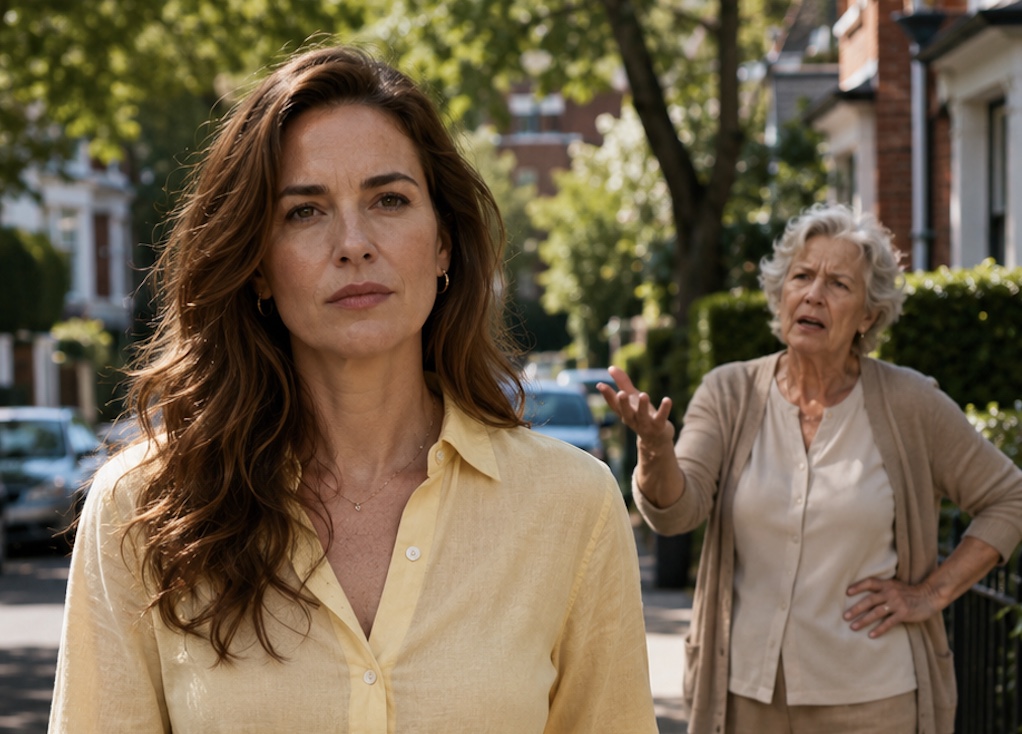
“We’re selling the country house and investing the money in the family,” Vadim announced in the measured tone of a seasoned investor, carefully spreading a thick layer of butter over a slice of toast. “I’ve already thought everything through and calculated the potential return, so the decision has been made.”
Marina froze beside the stove.
The cottage-cheese pancakes hissed angrily in the hot frying pan, spitting tiny droplets of oil, but she did not even flinch. Slowly, she turned toward her husband, still holding the silicone spatula, and felt a heavy, sticky sense of disbelief forming inside her.
“Which country house?” she asked, trying to keep her voice steady even though her heart had already begun to pound.
“Ours, in Sosnovy Bor,” Vadim replied calmly, taking a sip of freshly brewed coffee from the elegant ceramic cup Marina had bought the previous week. “That area is incredibly fashionable now. Clean air, a lake nearby. Land prices have risen sharply over the past year. It would be foolish not to take advantage while the market is at its peak.”
Vadim’s mother, Zinaida Petrovna, was also sitting at the kitchen table. She had arrived early that morning carrying a plastic container of cheap store-bought oatmeal cookies. Now she nodded enthusiastically at every word her son said while adjusting the knitted shawl draped over her shoulders.
“Marina, dear, he’s right. You need to think rationally,” her mother-in-law joined in, dabbing her thin lips with a paper napkin. “Why do you need that old wooden house? You go there twice a summer at most, just to grill some meat. Meanwhile, real money could help the family right now. Oksana is struggling terribly. Her mortgage is suffocating her, her son is growing up, he needs tutors, and university is just around the corner. And Vadik should finally start a serious business of his own instead of breaking his back working for someone else. You’re husband and wife. You’re supposed to support each other in everything.”
Marina was forty-two years old.
For the past fifteen years, she had worked as a private pediatric massage therapist and rehabilitation specialist. Most of her patients were infants with increased muscle tone, torticollis, hip dysplasia, or delayed motor development.
The work was physically and emotionally exhausting.
Every morning, she loaded a fifteen-kilogram folding massage table into the trunk of her modest but reliable crossover, along with a bag of orthopedic cushions, bottles of hypoallergenic oil, disposable changing pads, and other supplies. Then she drove through endless city traffic from one tiny patient to another.
She carried the heavy equipment up five flights of stairs in old apartment buildings without elevators. She spent hours bent over cribs in awkward positions. She soothed babies crying from pain or discomfort, patiently listened to young mothers exhausted from sleepless nights, and carefully explained therapeutic exercises they could continue at home.
By evening, Marina’s hands often ached so badly that even holding a cup of tea became difficult. Her lower back constantly begged for relief.
But the demanding work provided a good and stable income.
Marina supported herself, her husband, and their entire household.
Vadim, by contrast, worked as an ordinary sales manager at a small office-furniture company. His modest salary barely covered fuel for his aging foreign car, lunches at respectable cafés near the office, and the regular purchase of branded shirts, which he considered essential for maintaining the image of a successful negotiator.
The utility bills for their spacious three-bedroom apartment, weekly supermarket shopping, new household appliances, seaside vacations, medical insurance—all of it came exclusively from Marina’s wallet.
She tolerated it.
Vadim knew how to speak beautifully and persuasively. He often talked about future opportunities, drew charts on the whiteboard in their bedroom, and promised that his exceptional talents would soon be recognized. Then, he claimed, they would finally live like royalty.
Marina disliked conflict and genuinely believed that family members should help each other, so she quietly carried the financial burden alone.
But the country house in Sosnovy Bor was an entirely different matter. It had nothing to do with their shared household finances.
It was a sturdy log house built with love by Marina’s late father. It had a spacious veranda decorated with colored glass panels and a large, carefully maintained garden filled with old Antonovka apple trees, red currant bushes, and gooseberries.
The place smelled of pine needles, dried herbs, and wood smoke.
Marina had inherited the property several years before she even met Vadim.
It was hers alone. Her protected place. Her source of strength.
Whenever city life became unbearable, she escaped there to sit on the wooden porch, drink herbal tea, and listen to birdsong.
“Vadim,” Marina said, turning off the stove and removing the frying pan. She slowly dried her hands on a kitchen towel. “The country house isn’t ours. It’s mine. I inherited it from my father, and I have no intention of selling it. Especially not to pay your sister Oksana’s debts or finance your business fantasies.”
Vadim’s face reddened slightly, and the muscles in his jaw tightened. He dropped his half-eaten toast onto the plate.
“What do you mean, yours? We’ve been legally married for ten years! Everything should belong to both of us. I’m planning to open a logistics company. I have the perfect business plan. All I need is starting capital. You’re always complaining that I don’t earn enough. Well, here’s a real opportunity to change everything! Instead, you’re behaving like a selfish, shortsighted woman, clinging to a pile of old logs.”
“Exactly!” Zinaida Petrovna exclaimed, pursing her lips indignantly. “You’ve latched onto that piece of land as though your life depends on it. You’re like those lunatics in the old film Garage, ready to tear your relatives apart over a few square meters. You have no compassion for your own family. Oksana lies awake crying at night because she doesn’t know how to pay the bank. Her former husband is late with child support again. Meanwhile, an enormous asset is sitting there unused when it could save everyone!”
“An asset?” Marina felt a suffocating lump rising in her throat, but with a tremendous effort she forced the emotion back down. “My father built that asset with his own hands, denying himself everything to finish it. This discussion is over. My country house is not for sale.”
She quickly left the kitchen, gathered her heavy work bag, grabbed her car keys, and left the apartment while her husband and mother-in-law whispered angrily behind her.
The entire day passed in a dense, impenetrable fog.
Marina mechanically massaged the tiny arms and legs of six-month-old Ilya, who suffered from severe tension in his neck muscles. She smiled gently at his exhausted mother, offered professional recommendations, and demonstrated the safest ways to hold the child.
But her husband’s words kept circling in her mind.
I’ve already thought everything through.
How casually he had made plans for something that did not belong to him, something he had never invested a single ruble in.
As she drove from one patient to another along crowded avenues, Marina remembered how she had quietly paid nearly eighty thousand rubles to repair Vadim’s transmission the month before.
She remembered buying expensive vitamins for Zinaida Petrovna and replacing Vadim’s entire winter wardrobe because, according to him, he was experiencing temporary financial difficulties.
Those temporary difficulties had somehow lasted throughout their entire ten-year marriage.
Toward evening, Marina’s final appointment was unexpectedly canceled. The child’s mother called to apologize, explaining that the baby had developed a fever.
Marina arrived home two hours earlier than usual.
Vadim had not returned yet, and the apartment was dim and silent.
She went into the bedroom to change into comfortable clothes. She also needed to renew her car insurance the following day, so she opened the deep bottom drawer of the dresser where they kept important documents.
Her hand moved through thick folders of paid bills, medical insurance papers, appliance manuals, and expired warranty cards until her fingers touched a rigid blue plastic binder she had never seen before.
Across its glossy cover, written in large black permanent marker, were the words:
PROJECT S.B.
A chill ran down Marina’s spine.
She opened the binder.
The first document was an official real-estate valuation report.
There were high-quality color photographs of her beloved house in Sosnovy Bor, a detailed description of the land, a list of utilities and communications, and a final market value of eight million rubles.
The report was recent, dated at the end of the previous week and stamped by a professional valuation company.
Marina’s fingertips went cold.
She turned the heavy page and found a printed template for a preliminary sale agreement.
Her full passport details had already been carefully entered in the section marked Seller.
Naturally, the contract did not contain her signature.
But beneath it lay another document, handwritten in Vadim’s familiar clumsy script.
It was a receipt.
I, Vadim Nikolaevich… passport series… confirm that I have received from Albert Viktorovich… a deposit in the amount of 500,000 rubles toward the future purchase of the land and residential house located at…
I undertake to secure the signing of the final contract by the lawful owner within two weeks of the date of this receipt.
Should the owner refuse to complete the transaction, I undertake to return twice the deposit amount in accordance with applicable law.
Marina sank onto the soft carpet beside the open dresser.
For a moment, her vision darkened. It felt as though all the air had disappeared from the room.
Vadim had not merely been discussing vague plans over breakfast.
He had secretly brought a property appraiser to her country house, found a real buyer, accepted half a million rubles in cash, and most likely already spent the money.
He had been absolutely certain that he could pressure his wife psychologically until she signed the sale documents.
With trembling fingers, Marina pulled out the next sheet.
It had been torn from a notebook and covered with small handwritten figures.
Vadim’s brilliant business plan.
Total: 8 million.
Minus 500,000 deposit—already spent on overdue credit-card payments and an advance for renting a prestigious office.
Minus 2.5 million—to Oksana, to pay off her mortgage.
Minus 1 million—to Oksana, for Vlad’s first year at university.
Remaining 4 million—for me, to purchase two delivery vans for the logistics startup.
Marina stared at the numbers, and with every passing second her thoughts became clearer.
Not a single ruble had been allocated to her, the legal owner of the property.
Her inheritance, the cherished memory of her father, had been coldly and cynically divided among her husband and his relatives.
Suddenly, the truth became painfully obvious.
They had been using her.
They had done it slowly and systematically, hiding behind noble speeches about family duty and showing no guilt whatsoever.
The apartment door slammed loudly.
There was movement in the hallway, followed by laughter and several voices.
Vadim had not come alone.
Judging by the sounds, he had brought Zinaida Petrovna and his sister Oksana with him.
Apparently, the extended family council had decided not to delay the matter and intended to continue applying pressure to the disobedient wife that very evening.
Marina slowly rose from the carpet.
There were no tears left inside her. No hurt. No familiar uncertainty.
Only cold, calculated fury burned within her like an icy flame.
She snapped the blue binder shut, took it in both hands, and walked firmly into the brightly lit living room.
“Oh, Marishka, you’re home already! Surprise!” Vadim exclaimed with exaggerated cheerfulness as he removed his fashionable fitted jacket. “We decided to get together this evening. We even bought an éclair cake on the way. We’ll sit down as a family and calmly discuss our shared concerns. You were emotional this morning. You lost your temper before understanding the situation properly.”
Oksana, a heavyset woman whose face always seemed offended and dissatisfied, dropped onto the light-colored sofa without even removing her outdoor cardigan. She folded her arms across her chest.
“Marina, you need to understand a few simple things,” she began in a syrupy, lecturing tone. “Family is the most important thing we have in this harsh world. Today you’ll help me escape my financial crisis, and tomorrow we’ll help you. Vlad is growing up without a father. Raising a teenage boy alone is unbearable. Meanwhile, you have valuable property standing empty and rotting in the rain. It’s practically a crime against common sense.”
Without a word, Marina walked over to the glass coffee table and slammed the blue binder onto it.
The plastic struck the glass with a sharp, frightening crack.
“What’s this rubbish?” Vadim asked cautiously.
His rehearsed smile disappeared at once, replaced by alarm.
“This, Vadim, is your guilty verdict,” Marina said in a flat, lifeless voice that sent a chill through the room. “Open it. Read it together. Out loud.”
Vadim hesitantly reached for the binder and lifted the cover with trembling fingers.
The color drained rapidly from his face until he looked almost gray.
His eyes darted across the lines of the handwritten receipt.
“Marina, wait. Don’t become hysterical. I can explain everything logically,” he mumbled, instinctively backing toward the doorway.
“Explain what?” Marina’s voice rose, filling the entire room. “That you secretly brought strangers onto my property? That you ordered a formal valuation of something that belongs solely to me? Or that you accepted half a million rubles as a deposit for a house you do not own and never will?”
Zinaida Petrovna craned her neck and squinted, trying to read the documents on the table.
“What half a million? Vadik, sweetheart, what is she talking about?”
“She’s talking about the fact that your brilliant businessman has already accepted a huge sum of money from a certain Albert Viktorovich,” Marina replied. “And according to his own calculations, which are right there in the binder, he has already spent it on overdue personal credit-card debt I knew nothing about. He also divided the value of my country house down to the last ruble. Two and a half million for Oksana’s mortgage. One million for her son’s education. Everything else for himself, so he can buy delivery vans.”
Oksana blinked her false eyelashes, looking from her pale brother to Marina.
“Vadik… can you really get me the money for the apartment?” she squeaked hopefully, completely ignoring the fact that the entire scheme amounted to fraud.
“Shut up, Oksana, for God’s sake!” Vadim shouted desperately, realizing that the ground was disappearing beneath him.
He turned back to his wife, trying to look pleading.
“Marina, listen to me. Albert is a very serious and hard man. He loved the property. He’s been searching for something in that area for years. I only took the deposit to secure the deal before he went to someone else. If we back out now, the receipt says I have to return one million rubles. I don’t have that kind of money! He’ll destroy me!”
“What an extraordinary coincidence,” Marina replied with a sarcastic smile, folding her arms. “I don’t have that money either. And I have no intention of solving your criminal problems. You will never get my country house.”
“You can’t do this!” her mother-in-law shrieked, leaping heavily from the armchair.
She grabbed her chest with one hand, staging the beginning of a heart attack.
“You’ll ruin my only son! That criminal Albert will leave him with nothing! You must go to a notary immediately and sign the contract! You’re his lawful wife. You vowed to share joy and sorrow with him!”
“I shared the rising utility bills with him. I paid for all the food, his expensive car repairs, his clothes, and even your dental treatment at a private clinic,” Marina said, articulating every word as though hammering nails into wood.
She pulled her smartphone from her pocket, opened her banking app, and placed it on the table beside the binder.
“Look carefully. These are my actual expenses from last month alone. Groceries: forty-three thousand. Utilities: twelve and a half thousand. New winter tires for your precious son’s car: thirty-five thousand. And here are my husband’s contributions to our so-called family budget: zero rubles and zero kopecks.”
Realizing that begging would not work, Vadim switched to aggression.
It was his favorite tactic whenever he ran out of logical arguments.
“You’ve always used every ruble you earned against me! Yes, you make more because you spend all day rubbing strangers’ backs and doing low-skilled manual labor. But I think on a larger scale. I think strategically! I wanted to pull all of us out of this miserable swamp. Had you signed those damned papers, we would have been rich within a year. You’re destroying our brilliant future with your petty female greed!”
“Your future, Vadim, ended the moment you put another man’s money into your pocket in exchange for my father’s house. You have exactly one hour.”
“One hour for what?” he asked blankly, breathing heavily.
“To gather your grand strategic ideas, your branded shirts, your fishing rods, your laptop, and leave my apartment permanently.”
“I’m not going anywhere!” he shouted hysterically. “This is my home too! I’m registered here! We renovated it together. I hung the wallpaper!”
“I paid for the renovation in full. Every receipt from every building-supply store has been carefully filed in another folder. I bought this apartment before our marriage, and you understand the law perfectly well. If you are still here in sixty minutes, I will call the police and show them this wonderful receipt. It is clear evidence of fraud. You accepted a large sum of money for someone else’s property without a notarized power of attorney. Choose. Either you leave now with a suitcase, or you spend the evening at the police station giving a statement.”
Oksana burst into loud sobs, smearing mascara across her cheeks and wailing about how monstrously unfair life had been to them. She claimed they would now have to sell their internal organs to rescue her foolish brother.
Zinaida Petrovna, realizing that her heart-attack performance had failed to impress Marina, frantically searched her enormous handbag for sedatives while showering her daughter-in-law with insults. She called Marina a heartless materialist and a snake they had foolishly warmed against their chests.
Vadim finally understood that Marina was serious. There was not a trace of pity in her eyes.
He began rushing around the apartment, throwing his belongings into a large travel bag.
One moment, he shouted threats about hiring the best lawyers and taking half of everything she owned. The next, he lowered his voice and tried to appeal to her emotions.
He reminded Marina of their ten years together, their romantic seaside holidays at the beginning of the relationship, and the time he had supposedly taken care of her when she had the flu.
Marina stood against the doorframe with her arms folded, silently watching the pathetic chaos of a grown man.
A remarkable sense of calm spread through her.
She felt no fear of the future and no regret for the years she had lost.
There was only a deep, cleansing sense of freedom, as though she had finally torn open the boarded windows of a suffocating room and allowed fresh winter air to rush inside.
Fifty minutes later, the miserable procession left the apartment.
Vadim dragged two enormous, overfilled bags. Zinaida Petrovna supported Oksana by the arm while Oksana continued to sob theatrically on the landing.
The metal door closed behind them with a dull thud.
Marina turned the key twice, walked into the kitchen, poured herself a glass of cool water, and stood for a long time looking out at the city lights appearing beyond the window.
Several months passed.
The divorce was surprisingly quick and uncomplicated because, legally, the former spouses had nothing to divide.
Both the country house in Sosnovy Bor and the city apartment remained Marina’s sole property.
Vadim did not even attend the final court hearing. Instead, he sent an inexpensive lawyer who signed the necessary papers with a gloomy expression.
Marina’s life changed completely, and only for the better.
Without the permanent financial black hole created by her ambitious husband and his endlessly needy relatives, her savings began to grow rapidly.
She finally replaced her old work equipment and ordered an ultralight professional massage table made of carbon fiber from abroad. It weighed half as much as the previous one and placed far less strain on her back.
She also enrolled in an expensive infant-swimming certification program she had dreamed about for three years.
Her self-esteem, suppressed for years by Vadim’s accusations that she lacked compassion for the family’s problems, fully recovered.
Marina finally understood that her ability to earn an honest living through demanding work and support herself was something to be proud of. It was not a convenient tool for financing other people’s fantasies and laziness.
She permanently rejected the guilt others had imposed on her for wanting to spend her own hard-earned money on herself.
As for her former relatives, Marina occasionally heard news about them through mutual acquaintances.
Their lives unfolded in a predictably miserable way.
The failed buyer, Albert Viktorovich, turned out to be principled, severe, and legally knowledgeable.
When he learned that the profitable transaction had collapsed because Vadim had deceived him despite having no rights to the property, he went to court and demanded the return of twice the deposit.
The court awarded him one million rubles, exactly as Vadim had promised in his handwritten receipt.
Vadim was forced to sell his beloved car for far less than it was worth, take out several predatory short-term loans, and move into his mother’s cramped two-bedroom apartment.
His dreams of a large logistics company and a leather executive chair disappeared forever.
He now worked as a courier, surrendering most of his earnings to debt collectors and court enforcement officers.
Oksana remained trapped alone with her unaffordable mortgage.
Zinaida Petrovna tried calling Marina several times from unfamiliar numbers. She cried, begged her to show Christian mercy, asked her to remember the past, and pleaded for a loan of at least three hundred thousand rubles to help Vadim cover the rapidly growing interest on his debts.
Without saying a single word, Marina blocked every number.
The old, simplistic manipulations built on false obligation no longer had any effect on her.
Her personal boundaries had become an impenetrable concrete fortress.
One genuinely warm autumn weekend, Marina drove to her beloved country house.
She opened the familiar creaking gate, followed the path covered in golden leaves, and climbed the steps to the spacious veranda.
The wooden house welcomed her with its familiar scent, warmth, and comfort.
She brewed strong black tea with thyme in an old earthenware teapot, wrapped a blanket around her shoulders, and went into the garden.
Then she sat on a wooden bench beneath the enormous old apple tree.
Watching the cool wind gently sway the soft crowns of ancient pine trees against the endless blue sky, Marina smiled sincerely.
She had preserved her safe haven.
She had defended the cherished memory of her father, the results of years of hard work, and her unquestionable right to independence.
And now, sipping her fragrant hot tea, she understood one simple truth with absolute certainty.
A real family is made up of people who protect your home and your peace—not those who secretly put your entire life up for sale for their own benefit.