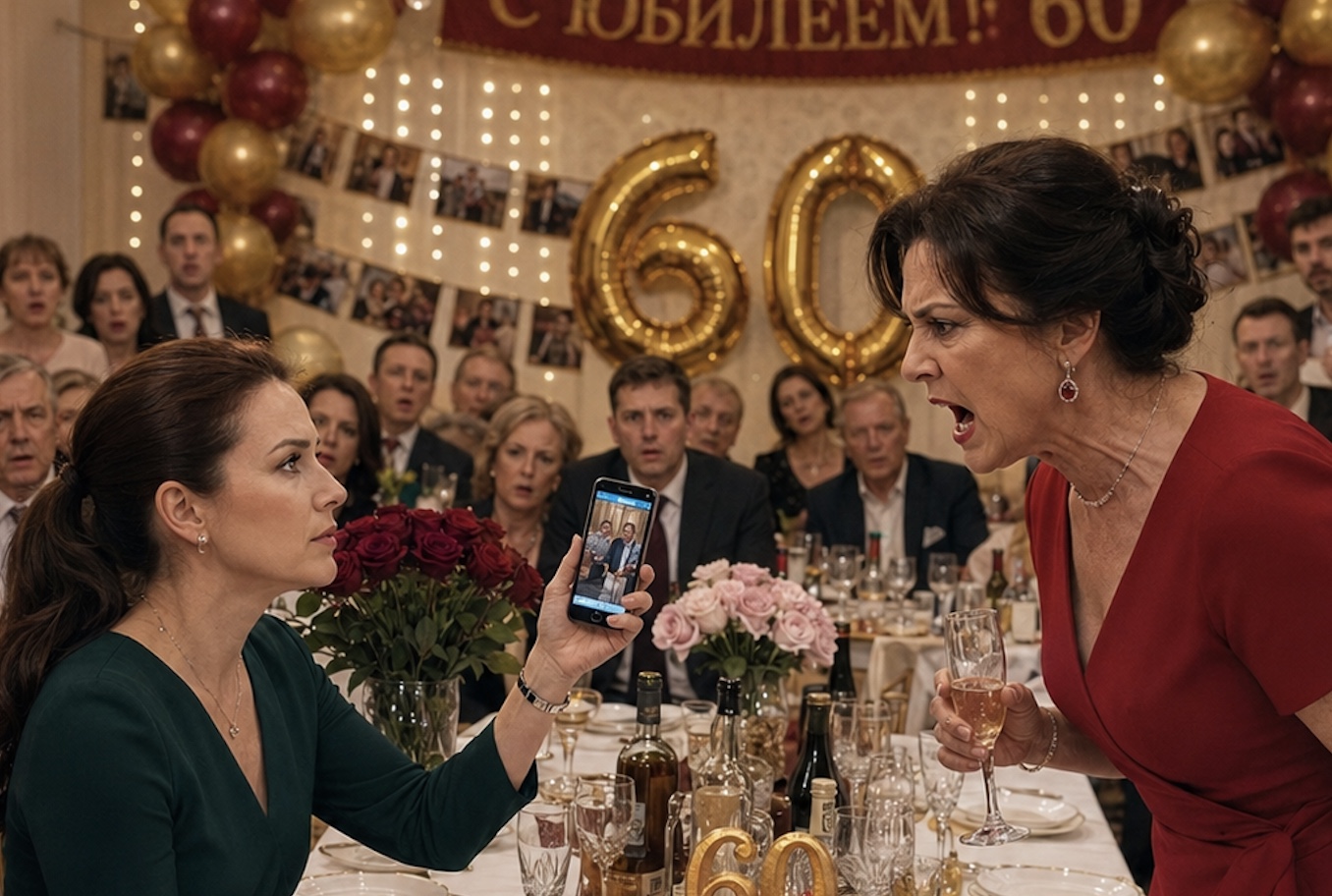
“She ruined my celebration!” Zinaida Fyodorovna shot to her feet so abruptly that champagne splashed across the tablecloth. “Just look at what my daughter-in-law has done, everyone! Look at this disaster!”
All thirty-two guests froze.
The two-man band stopped halfway through a phrase. A waiter carrying a tray came to a halt between the tables as though someone had pressed a pause button.
Margarita sat two seats away from her mother-in-law. Her back was straight, her hands resting quietly in her lap. She did not raise her eyes.
She merely moved her napkin from her left knee to her right.
Carefully.
Diagonally.
“The roses are cheap!” Zinaida Fyodorovna swept one hand around the banquet hall of the Birch Grove restaurant. “The room is cramped! And these tablecloths are some awful gray color! I have lived for sixty years, and this is what you arranged for me? A humiliation!”
The tablecloths were white with cream-colored borders.
Margarita had shown her four different options. Zinaida Fyodorovna had personally approved these exact ones.
Kirill, who was sitting beside his wife, placed a hand on her wrist.
Margarita gently removed it.
Not now.
She was counting.
Not the glasses of champagne her mother-in-law had consumed.
The facts.
“I have devoted my entire life to this family!” Zinaida Fyodorovna’s voice grew louder. “My entire life! And this is what I receive for my sixtieth birthday!”
She pointed toward the garland of photographs stretching along the wall: childhood pictures, school portraits, wedding photographs, images from her youth, and photographs of her grandchildren.
“And these pictures are all crooked! In that school photograph, I look absolutely dreadful!”
In that particular photograph, Zinaida Fyodorovna was smiling more brightly than in any of the others.
That was precisely why Margarita had placed it in the center.
Tamara Lvovna, her mother-in-law’s closest friend, sat to Zinaida’s right and nodded in agreement.
Tamara always nodded.
It seemed to be her only purpose in every family conflict.
Eight months earlier, Kirill had come home later than usual. He removed his shoes, placed his briefcase against the wall, and sat on the edge of the bed.
He had the expression of a man who had been entrusted with delivering terrible news.
“Mom wants an anniversary celebration.”
Margarita put aside the report she had been reading. It was the third one she had reviewed that day.
She worked as a senior auditor for the regional Accounts Chamber in Orenburg. Twelve years of experience. Four hundred and sixteen completed inspections. Not a single complaint against her.
Her professional instinct was to document every number, every statement, and every decision.
“What kind of celebration?” she asked.
“A big one. A restaurant, lots of guests. She wants everything to look beautiful.”
“What is the budget?”
Kirill hesitated.
His silence resembled a financial statement in which the income column was empty while the expectations column had no limit.
“Mom said you would figure it out.”
Margarita understood immediately.
“You will figure it out” meant that she would pay for it.
Kirill worked as a process engineer at the Orenburg Alloys plant and earned forty-eight thousand rubles a month. Zinaida Fyodorovna received a pension of twenty-one thousand three hundred rubles.
A restaurant celebration for more than thirty people would cost at least one hundred and fifty thousand.
Margarita knew that because she knew how to calculate.
It was her profession, her calling, and the only method of self-defense she had ever truly trusted.
She agreed.
The next day, she called her mother-in-law.
“Zinaida Fyodorovna, let’s discuss the details. Which restaurant would you prefer?”
“Birch Grove. Tamara celebrated there. It was lovely.”
Margarita wrote it down in her work notebook.
Then she repeated the decision in a message.
“Zinaida Fyodorovna, just confirming: the Birch Grove restaurant. Correct?”
Her mother-in-law replied:
“Yes, of course. Just don’t make a mistake.”
Margarita did not make mistakes.
During twelve years of auditing, she had learned a rule more valuable than any diploma:
If there is no document, the event never happened.
She recorded every decision her mother-in-law made.
A screenshot.
A date.
A time.
Written confirmation.
It was like reconciling company accounts, except the accounts belonged to a family.
A week later, they discussed flowers.
“Roses,” Zinaida Fyodorovna said over the phone. “Burgundy ones. About fifty. I want it to look expensive.”
Margarita called three florists and found burgundy roses for one hundred and twenty rubles each.
Fifty roses came to six thousand rubles.
She placed the order.
Three days later, her mother-in-law called again.
“No, I want peonies! Roses are too ordinary. Everyone has roses. I’m not everyone.”
Margarita canceled the order and lost the eight-hundred-ruble deposit.
She found peonies instead. In June, they cost two hundred and ten rubles per stem.
Five days later, the phone rang again.
“Peonies fall apart too quickly. Let’s go back to roses. But not burgundy—scarlet. No, wait. Burgundy. Burgundy is better.”
Margarita called the florist.
The woman sighed but accepted the new order.
Another deposit: one thousand two hundred rubles.
Margarita confirmed every change by message.
“Please confirm: fifty burgundy roses?”
Her mother-in-law answered:
“Yes. Just make sure they’re fresh!”
Screenshot.
Save.
Folder: “ZF Anniversary.”
The menu changed four times.
At first, Zinaida Fyodorovna wanted traditional Russian food.
“Something respectable. Like normal people serve.”
Then she changed her mind.
“I want food like they had at that Georgian restaurant where Valya celebrated. Do you remember the khachapuri?”
Then came another change.
“No, Tamara is allergic to nuts. Forget Georgian food.”
Finally:
“All right, Russian food. But there must be Caesar salad and that duck I saw in the magazine.”
Margarita exchanged countless messages with the restaurant’s chef. She approved substitutions and recalculated the price each time.
Every version was sent to her mother-in-law.
“Zinaida Fyodorovna, the final menu is Caesar salad, Olivier salad, turkey medallions, roast duck, and honey cake. Do you approve?”
“Yes. Isn’t it becoming rather expensive?”
“Sixty-eight thousand rubles for thirty-two guests.”
“Well, fine. You earn enough.”
Margarita did earn money.
Not millions.
Seventy-three thousand rubles a month.
But she knew how to plan.
She had been saving since September. For three months, she had postponed buying winter boots. Her old pair had been leaking since the sole cracked the previous January.
But her mother-in-law’s anniversary required money.
The boots could wait.
She ordered the cake from Cloud, the best bakery in Orenburg.
Three tiers. Honey cake. A personalized inscription.
It was based on the exact recipe Zinaida Fyodorovna had sent her in November with the message:
“I want this one. Exactly this one. Don’t invent anything.”
The cake cost nine thousand eight hundred rubles.
Margarita spent two months choosing the gift.
In January, Zinaida Fyodorovna had shown Kirill a pair of earrings in a catalog.
“Look, Kiryusha. These are my dream earrings. Gold with amethysts.”
Kirill had nodded and forgotten about them.
Margarita had not.
She found them and placed an order.
Forty-seven thousand three hundred rubles.
She hid the small box in the wardrobe behind a stack of towels.
She ordered the dress from Moscow.
To determine the size, she secretly measured one of her mother-in-law’s old dresses while Zinaida Fyodorovna was at the doctor.
The new dress was dark blue, fitted at the waist, with a lace collar.
It cost twenty-eight thousand six hundred rubles.
Zinaida Fyodorovna tried it on on the morning of the celebration.
“It’s acceptable,” she said. “It will do.”
During seven years of marriage, Margarita had learned the three central rules governing Zinaida Fyodorovna’s world.
First: Kirill was the greatest son alive. Any suggestion otherwise was an act of betrayal.
Second: every woman beside Kirill was temporary.
Even his wife.
Especially his wife.
Third: a daughter-in-law was expected to make an effort.
Gratitude was not included.
Margarita made the effort.
Every New Year’s celebration for twelve guests was prepared by her.
Every one of her mother-in-law’s birthdays—the organization, presents, and flowers—was handled by her.
When Zinaida Fyodorovna’s apartment needed renovation, Margarita paid for the pipes, tiles, and wallpaper.
Kirill never directly asked her to do these things.
He simply remained silent.
And Margarita had long ago learned to translate her husband’s silence.
“Mom will be upset” meant: Do it.
“Mom is just like that” meant: Endure it.
“Mom loves you in her own way” meant: Do not expect gratitude.
Margarita expected nothing.
She worked.
The previous New Year’s Eve, she had prepared aspic, Olivier salad, herring under a fur coat, duck with apples, and three different kinds of pie.
Dinner for fourteen people.
She cooked for two full days.
Zinaida Fyodorovna arrived, sat down, tasted the aspic, and said:
“My mother made it better. Still, this is passable.”
She said nothing else.
She left at ten because she had a headache.
Margarita washed dishes until one in the morning.
Kirill was already asleep.
Earlier, during the second year of their marriage, Margarita had renovated her mother-in-law’s apartment.
She replaced the plumbing, retiled the bathroom, and hung new wallpaper in the living room.
Seventy-two thousand rubles and four consecutive weekends.
When the work was finished, Zinaida Fyodorovna walked through the apartment, ran one finger over the windowsill, and said:
“The wallpaper could have been brighter. But what’s done is done.”
Margarita nodded.
Her mother-in-law had selected the wallpaper herself.
One afternoon, Margarita’s friend Inga asked her over tea:
“Rita, why do you keep doing all this? She is never going to thank you.”
Margarita stirred the sugar in her cup.
“I don’t do it for thanks. I do it because I know how to do things properly. And if I don’t do them, no one will.”
It was true.
It was also a trap.
Margarita decorated the banquet hall herself.
The day before the celebration, she arrived at Birch Grove at seven thirty in the morning.
The administrator, Lena, opened the doors for her.
“You’re here early. The wedding party only left last night. We haven’t finished cleaning yet.”
Margarita waited until the hall had been cleaned.
Then she began.
Forty balloons, white and burgundy.
Satin ribbons around the room.
A garland containing twenty-seven photographs she had spent three months collecting, scanning, retouching, and printing on thick paper.
She fastened them to twine with small wooden frame clips.
Above the entrance, she hung a handmade sign:
“Zinaida Fyodorovna—60! With Love.”
She wrote the letters in gold marker on white poster board.
She had spent two hours selecting the lettering style online.
She rewrote the sign three times because she could not make one of the letters look right.
A waiter named Pasha helped her position the ladder.
Margarita climbed up and down eleven times.
By one in the afternoon, her back ached and the nail on her index finger had torn.
“It looks beautiful,” Pasha said, stepping back to admire the room. “Are you doing this for your mother?”
“For my mother-in-law.”
Pasha raised his eyebrows but said nothing.
A few minutes later, he brought her a complimentary cup of coffee.
Margarita recorded the decorating process on her phone.
Not to show off.
Out of habit.
An auditor documents everything.
That evening, she edited two hours and forty minutes of uncut footage into a six-minute video.
She planned to show it after the speeches during the celebration.
A surprise.
A gift.
Evidence of love.
It could have been called many things.
She tracked the total cost in an Excel spreadsheet.
Twenty-three separate entries.
Restaurant: 68,000.
Flowers: 7,200, because the price of roses had increased after the first order.
Decorations: 12,400.
Photographer: 15,000.
Cake: 9,800.
Gold-and-amethyst earrings: 47,300.
Dress from Moscow: 28,600.
Total: 188,300 rubles.
Kirill had contributed forty thousand.
“I can’t afford more right now,” he had said. “They reduced my bonus.”
Margarita nodded.
She knew about the bonus.
She also knew that Kirill had purchased a fishing rod for twelve thousand rubles the month before.
But that belonged in another column of another spreadsheet.
This was not the time.
One hundred and forty-eight thousand three hundred rubles.
Her money.
She did not complain.
Not because she did not want to.
Because there was no one worth addressing the complaint to.
Kirill would spread his hands helplessly.
Her mother-in-law would say, “Who asked you to spend that much?”
Inga would say, “I warned you.”
None of them would return a single ruble or a single lost evening.
Margarita closed the spreadsheet, saved the file, and went to iron her blouse for the following day.
Now, inside the banquet hall at Birch Grove, Zinaida Fyodorovna was gathering momentum.
“And the cake!” She pointed a manicured finger at the untouched three-tier honey cake bearing the words “To Our Beloved Mother and Grandmother.” “I’m sure it’s dry! I could tell the moment I looked at it!”
The cake had not yet been cut.
No one had tasted a crumb.
But her mother-in-law already knew.
She always knew everything in advance—especially the things she had never examined.
Kirill stared down at his plate.
His fork lay perfectly parallel to his knife.
He was not eating.
He was not speaking.
He was not defending his wife.
He sat as motionless as a man hoping that invisibility might be achieved by refusing to move.
Kirill’s cousin Anton leaned toward his wife, Nadya.
“This is getting uncomfortable,” he whispered.
Nadya hissed at him to be quiet.
The silence in the room became so thick that everyone could hear a tram passing outside.
“I gave my whole life to this family,” Zinaida Fyodorovna repeated.
The champagne glass trembled in her hand, but her voice remained steady.
“And in return, I receive this cheap imitation of a celebration.”
She gestured at the burgundy roses, the white tablecloths with cream borders, the photograph garland, the handmade inscription, and the three-tier cake.
“With love,” Margarita had written.
By hand.
In gold marker.
Including the letter she had struggled to form properly.
“Cheap,” Zinaida Fyodorovna repeated more quietly.
But still loudly enough for every guest to hear.
Margarita folded her napkin.
Carefully.
She placed it on the table.
Then she took out her phone.
“Zinaida Fyodorovna,” she said.
Her voice was calm and professional. Neither louder nor softer than necessary.
It was the voice she used during official meetings when presenting the findings of an investigation.
“May I have one minute of your attention?”
“What?”
Her mother-in-law had not expected a response.
In seven years, Margarita had never answered back.
Not once.
“You said the roses were cheap. Here is our conversation from March fourth.”
Margarita opened the message thread.
“You wrote, ‘Burgundy roses. About fifty. I want it to look expensive.’ Then you changed your mind and requested peonies. After that, you returned to roses. Here is your final confirmation from March twelfth: ‘Yes. Just make sure they’re fresh.’ They are fresh. They cost seven thousand two hundred rubles.”
She raised the phone.
Not toward her mother-in-law.
Toward the room.
She simply displayed it.
Those who wished to see could see.
Zinaida Fyodorovna slowly lowered her champagne glass onto the table.
“You also said the hall was cramped,” Margarita continued. “Here is your message from February tenth: ‘Birch Grove. Tamara celebrated there. It was lovely.’ You chose this restaurant. I asked for confirmation. You approved it.”
Tamara Lvovna stopped nodding.
For the first time in thirty years of friendship with Zinaida.
“The menu.”
Margarita scrolled through the messages without haste. Her finger moved precisely across the screen.
“You changed it four times. Here is the first option: Russian cuisine. Here is the second: Georgian cuisine. Here is the third: Russian food again, without nuts. Here is the final version, including Caesar salad and roast duck. Each time, I asked you to confirm the decision. Each time, you answered yes. Four screenshots, each with a date.”
The hall listened.
Not because anyone found it entertaining.
Because it was impossible not to listen.
“The cake.”
Margarita looked at the untouched honey cake.
“You selected the recipe. You sent me the link in November. I will quote your message: ‘I want this one. Exactly this one. Don’t invent anything.’ Here is the link. Here is your message. The cake came from the Cloud bakery. The receipt is for nine thousand eight hundred rubles.”
She placed her phone face-up on the table.
Then she took out a second item: a folded sheet of paper.
She unfolded it and placed it beside the phone.
“This is the full budget for the celebration. Twenty-three entries. The total is one hundred and eighty-eight thousand three hundred rubles. Kirill contributed forty thousand. The remaining one hundred and forty-eight thousand three hundred came from me.”
She paused.
One second.
Exactly long enough for the number to settle over the room.
“I did not buy winter boots. I’m wearing the same old pair for the third winter. The sole split in January.”
Then she pressed play.
The video lasted six minutes.
The phone screen was small, but the hall was small as well.
Everyone could see.
At first, the Birch Grove hall appeared empty, gray, and lifeless, still bearing traces of the wedding held there the previous evening.
Then Margarita appeared in jeans and an old, stretched-out T-shirt.
She dragged a ladder across the floor.
She hung the photograph garland.
She inflated balloons one at a time with her mouth because she did not have a pump.
She arranged the roses in vases.
She polished every glass with a cloth.
She moved the photograph from the school assembly. At first, it had hung slightly to the left.
Margarita removed it and placed it in the center because Zinaida Fyodorovna was smiling more brightly in that photograph than in any other.
During the fourth minute of the video, Margarita could be seen sitting on the floor against the wall.
She was drinking water from a bottle.
Her shoulders were hunched with exhaustion.
A bandage covered the finger where she had torn her nail.
Then she stood up and continued working.
The video ended.
Margarita picked up her phone and placed it inside her handbag.
Anton stared at the ceiling.
Nadya pressed a napkin to her eyes.
Tamara Lvovna studied her own hands.
Kirill did not move.
Zinaida Fyodorovna remained standing.
Her glass was empty.
Her arms hung at her sides.
Her face resembled that of a person who had walked through the wrong door and unexpectedly found herself standing before a mirror she had never intended to face.
“Rita…” she began. “I didn’t know…”
“You did know,” Margarita replied.
There was no anger in her voice.
No bitterness.
Only a fact.
A line in an official report.
“I sent you everything. You read every message. You approved every decision.”
She stood up and put on her coat.
It was gray, intended for autumn, and fastened with two buttons.
She picked up her handbag.
“The earrings are in a box inside the gift bag beside your chair. Gold with amethysts. The ones from the catalog. Forty-seven thousand three hundred rubles.”
She looked at her mother-in-law.
“Happy birthday, Zinaida Fyodorovna.”
Then she left.
Her heels struck the parquet floor four times before she reached the door.
No one stopped her.
Kirill made a slight movement as though he might stand.
Then he sat back down.
Habit was stronger than impulse.
Outside the restaurant, a fine October rain was falling.
Margarita did not open her umbrella.
She walked to her car, climbed inside, and turned on the heater.
Her hands rested on the steering wheel.
For a full minute, she watched the raindrops slide slowly down the windshield.
Her phone rang four minutes later.
Kirill.
She rejected the call.
Twelve minutes later, a message arrived from Anton.
“Rita, you did the right thing. Mom is crying. No one is saying anything.”
Margarita read it but did not respond.
She started the engine and drove home.
The apartment was silent.
The kitchen clock showed a quarter to nine.
She filled the ordinary metal kettle that whistled on the stove and set it to boil.
Then she took out a cup bearing the words “Best Auditor,” a gift from her colleagues for International Women’s Day.
She dropped a tea bag into the cup and waited for the kettle to whistle.
Sugar.
A spoon.
Stir.
Sit at the table beside the window.
Outside were the courtyard, an empty swing, and a streetlamp.
October.
Rain.
A single window glowed on the third floor of the building opposite hers.
Someone else was awake.
Margarita thought about how every illuminated window contained a story of its own.
And in every story, there was someone whose efforts went unnoticed.
Silence.
Her phone lay face-down on the table.
Sixteen missed calls.
Margarita switched off the sound.
Her old winter boots stood beside the door, the sole of one split open.
She looked at them.
Then at her cup.
Then back through the window.
The tea grew cold.
Some people mistake silence for agreement.
They confuse patience with weakness.
They assume that care, when no one demands an accounting for it, must cost nothing.
And they discover its true value only when the receipt is finally placed on the table.