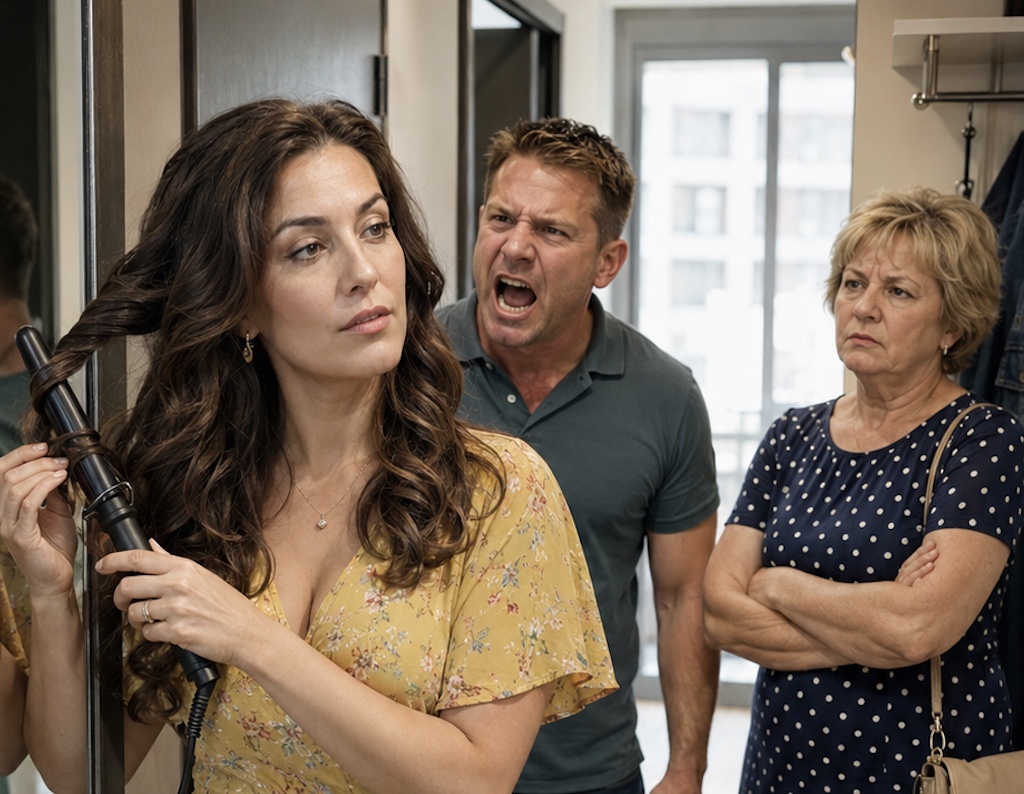
“Have you completely lost your mind?” Maksim shouted, hurling his phone onto the sofa so hard that it bounced and nearly fell to the floor. “What am I supposed to be, your personal ATM? I work all day to provide for you, and somehow you’re still unhappy!”
Sonya did not even turn around.
She stood in front of the hallway mirror, curling her hair with slow, deliberate movements, as though there were no one else in the apartment.
That irritated him more than anything.
Not tears. Not shouting.
Her silence.
It was louder than any argument.
“Are you even listening to me?”
“I am,” she replied, finally turning toward him. “Maksim, I asked you for one thing. One thing. I asked you to pick Dasha up from kindergarten because I had an important presentation. That was the only favor I asked of you in three months.”
“I had things to do too!”
“Things,” she repeated quietly.
There was no sarcasm in her voice. She simply repeated the word as though recording a fact.
“All right.”
She picked up her handbag and walked out.
They had been together for six years.
Sonya still remembered the man Maksim had been when they first met—funny, slightly awkward, always scratching the back of his head whenever he did not know what to say.
Back then, she had thought he was someone she could trust.
Not because he seemed powerful, but because he seemed honest.
She had misjudged only one thing.
She had failed to see Zinaida Arkadyevna standing behind him.
Maksim’s mother had not taken over their lives immediately.
At first, she merely called three times a day.
Then came the advice.
After that came the criticism.
And eventually, something much worse.
Zinaida Arkadyevna had mastered one particular skill: she never caused an obvious scene.
She sighed.
She pressed her lips together.
She said things like, “Well, of course, you know best,” in a tone that made the listener want to disappear through the floor.
Sonya always heard that tone.
Maksim did not.
He had grown up with it and had long ago learned to ignore it.
The apartment where they lived belonged to Sonya.
She had inherited it three years earlier after the death of her aunt Raisa, a childless woman who had adored Sonya since childhood.
Aunt Raisa left her a two-bedroom apartment on Komsomolsky Prospekt. It was not new, but it was solid, with high ceilings and a view of tall poplar trees.
At the time, Maksim had simply shrugged.
“It’s your apartment. Fine by me.”
And it had been fine by him.
Until one day, it was not.
Sonya could not say exactly when the change began.
Perhaps it was when Zinaida Arkadyevna casually remarked, “Maksim, you really ought to have the apartment transferred into your name. You never know what might happen.”
Or perhaps it was when Maksim suddenly became interested in where the property documents were kept.
Or maybe it was the evening when, after dinner, he stared at the television and said as though discussing something trivial:
“Maybe we should put the apartment in both our names. That would be fair.”
Sonya nodded as though she agreed.
Then she did nothing.
Later, she moved the documents somewhere else.
That October evening turned out to be particularly revealing.
Zinaida Arkadyevna arrived “for tea” without warning, carrying a bag of magazines and wearing her usual expression—the look of a woman who believed the whole world had personally offended her.
She entered the kitchen, examined everything like a health inspector and said:
“You could at least water the flowers. They look half-dead.”
Sonya said nothing.
They were her flowers, in her apartment, and they were perfectly healthy.
Zinaida Arkadyevna drank her tea without removing her coat and spent most of the visit talking about an acquaintance who had “done the right thing and transferred everything to her husband, because that is what a real wife does.”
Maksim nodded.
Sonya washed the cups and thought about the next day.
She had to take Dasha to the pediatrician, submit a report before lunch and remember to buy milk because they were almost out.
Eventually, her mother-in-law left.
That was when the real argument began.
“Why do you speak to my mother like that?” Maksim demanded.
“I did not speak to her at all.”
“Exactly. You sit there in silence, staring into space. She notices everything.”
Sonya turned and looked at him.
He was thirty-four years old.
He had a daughter and a respectable job in the city administration.
And he had just said, “She notices everything,” like a frightened child worried that his mother might be upset.
“Maksim,” Sonya said slowly, “do you realize that you’re thirty-four?”
“What does that have to do with anything?”
“I was just checking.”
His face flushed.
That was how it always happened.
She spoke quietly.
He became angry.
And then, without any help from her, he made himself look ridiculous.
“Go ahead and file for divorce!” he suddenly blurted out. It was obvious that he had rehearsed the sentence in his head. “You’ll be left with nothing! Do you understand? Nothing!”
Sonya placed a cup on the shelf.
Then she turned toward him, calm and almost sympathetic.
“You’re the one who will be left with nothing,” she said. “Check the apartment documents.”
Maksim opened his mouth.
Then closed it again.
Something in his expression changed—not instantly, but gradually, like the sky darkening before a storm.
For the first time, he seemed to realize that something had gone wrong.
Not that evening.
Long before it.
And while he had assumed she was simply remaining silent, she had actually been preparing.
The following morning, Maksim went to his mother’s apartment.
Sonya barely noticed.
She was taking Dasha to kindergarten, holding her daughter’s warm little hand as the girl excitedly explained that their teacher, Svetlana Igorevna, had promised they would make figures from salt dough.
Sonya was expected to understand that this was extremely important.
She listened, nodded and thought about where she needed to go at three o’clock.
Not to see a friend.
Not to visit a lawyer.
She was going to the public services center.
Some things were better handled in advance.
Quietly.
Without a scandal.
Zinaida Arkadyevna knew nothing about this.
She was sitting in her kitchen, drinking coffee with milk and telling her son that “his wife had become far too arrogant” and that “he should have taken action sooner.”
Maksim nodded.
But this time, there was a new uncertainty in the gesture—the confusion of a man who had suddenly discovered that the ground beneath him was not as solid as he had imagined.
Meanwhile, Sonya parked outside a gray government building on Leninsky Prospekt.
She picked up the folder containing her documents, adjusted her hair and pushed open the heavy glass door.
Everything was only beginning.
The public services center greeted her with a long queue and the stale institutional smell of office glue mixed with cheap coffee from a vending machine.
Sonya took a numbered ticket, sat on a plastic chair near the window and opened her folder.
Everything was in order.
She had checked the documents three times that week simply to reassure herself.
The ownership certificate.
The official property extract.
Every page clearly listed her as the sole owner.
Aunt Raisa had arranged everything correctly, almost as though she had known what might happen one day.
Sonya stared at the papers and wondered how her life had come to this.
She had never imagined sitting in a government office with a folder on her lap, thinking about how to protect something that already legally belonged to her.
She had expected an ordinary life.
Minor arguments.
Reconciliations.
Raising Dasha.
Summer holidays by the sea.
But Zinaida Arkadyevna had never known how to simply exist alongside other people.
She needed to control them.
Sonya’s number was called forty minutes later.
She approached the counter and explained what she wanted to do.
The employee, a young woman with tired eyes, listened carefully, nodded and began typing.
The process was calm and routine.
Sonya had already begun to think she might be home by lunchtime when her phone rang.
The number was unfamiliar.
A Moscow number.
“Hello?” she said, stepping slightly away from the counter.
“Good afternoon. Am I speaking to Sofya Andreyevna Belova?”
“Yes.”
“My name is Roman Yevgenyevich. I am a notary calling regarding an inheritance matter. You are the beneficiary named in the will of Raisa Petrovna Belova, correct?”
Sonya frowned.
“Yes, but my aunt died three years ago. I already completed the inheritance procedure.”
“That is correct. However, a second will has recently been discovered. It was written later, approximately two months before Raisa Petrovna passed away. It does not concern the apartment. It concerns another asset. I would prefer to discuss it with you in person. It is important.”
Sonya left the public services center feeling as though the ground had shifted slightly beneath her feet.
Not in a frightening way.
It was simply unexpected.
The notary’s office was located in an old building on Prechistenka Street, with decorative molding on the facade and heavy wooden doors that seemed to belong to another era.
Roman Yevgenyevich was around fifty, neatly dressed, soft-spoken and accustomed to speaking slowly, allowing each sentence to settle before continuing.
He invited Sonya into a small office, offered her water and opened a folder.
“Shortly before her death,” he began, “Raisa Petrovna sold a country property outside Moscow. She deposited the money into a long-term bank account. We were unable to contact you earlier because another individual contested the inheritance. Fortunately, the court has ruled against that person, and the matter has now been legally resolved.”
Sonya remained silent.
“The balance on the account is currently approximately four million rubles.”
She looked up sharply.
“How much?”
“Four million two hundred thousand, including the interest accumulated over the past three years. Raisa Petrovna selected a long-term deposit. She was a very cautious woman.”
Sonya felt something strange.
It was not exactly joy.
It was not even relief.
It was the realization that Aunt Raisa was still protecting her.
From a place where she could no longer call, visit or offer advice, she had quietly left Sonya one last safeguard.
That was how she had done everything while alive.
Without drama.
Without unnecessary words.
Sonya signed the required papers, collected the documents and stepped outside.
Maksim returned that evening.
He rang the doorbell even though he still had a key.
That alone meant something.
Sonya opened the door.
He stood on the landing looking like a man who had spent the entire journey rehearsing a speech but had suddenly forgotten how to begin.
“Dasha is asleep,” Sonya said. “Come in quietly.”
He followed her into the kitchen.
She filled the kettle, mostly to give her hands something to do.
“I lost my temper yesterday,” he finally said.
“Yes,” she agreed.
“My mother just worries. She worries about me.”
Sonya looked at him.
After six years, she knew the structure of this conversation by heart.
First came: “I lost my temper.”
Then: “My mother worries.”
After that came the pause during which she was expected to say, “It’s all right. Let’s forget about it.”
But this time, her silence meant something different.
“Maksim,” she said calmly as she poured the tea, “I went to see a notary today.”
His expression sharpened.
A trace of something appeared in his eyes.
Not fear exactly, but something close to it.
“Why?”
“Aunt Raisa left me something else besides the apartment. They found another inheritance. A long-term bank deposit.”
Maksim said nothing.
He was clearly waiting for more.
His unspoken questions were written across his face.
How much?
What was his share?
They were married, after all.
“The account was opened before we were married,” Sonya added, answering the question he had not asked. “So no, you are not entitled to any of it.”
He set down his cup, stood and paced across the kitchen.
Two steps in one direction.
Two steps back.
The room was too small for anything more.
“You did this deliberately, didn’t you?” he said. “You planned everything.”
“I did not plan anything,” Sonya replied. “It simply happened. Things happen.”
He left again.
This time, he was obviously going back to his mother.
Sonya heard the front door slam, followed by footsteps fading down the staircase.
She sat at the kitchen table, holding the warm cup in both hands, and thought about Aunt Raisa.
About how she used to watch old films every Saturday.
About the chocolates she always left on the table because she knew Sonya would visit.
Dasha breathed softly in the next room.
On the shelf, inside a folder, lay the documents.
Every one of them was in perfect order.
Somewhere across the city, Zinaida Arkadyevna still did not know that her plan had begun to collapse.
But she would find out soon.
She called the next morning at eight-thirty.
Sonya was getting Dasha ready for kindergarten, trying to braid her hair while the girl twisted from side to side and insisted that she wanted the blue bow, not the green one.
No one knew where the blue bow was.
The phone lay on the table.
The name on the screen appeared in large letters:
MOTHER-IN-LAW.
Sonya gave Dasha the green bow, promised that they would find the blue one that evening and only then answered the call.
“Yes?”
“So this is how you behave,” Zinaida Arkadyevna began without so much as a greeting.
Her voice had the confident sharpness of someone who had decided she was right before the conversation even started.
“You threw your husband out of his own home, and now you’re sitting there pleased with yourself?”
“He left on his own, Zinaida Arkadyevna.”
“Because you drove him away! I always knew you married him for the apartment. For the apartment! And now you think you’re going to keep everything?”
Sonya looked at Dasha.
Her daughter had already put on her boots and was carefully studying herself in the hallway mirror, adjusting the green bow with the seriousness of someone handling a matter of national importance.
“Zinaida Arkadyevna,” Sonya said evenly, “I’m taking my daughter to kindergarten. If you want to talk, we can do it this evening.”
Then she ended the call.
That evening, Zinaida Arkadyevna came in person.
She rang the doorbell at seven.
Once again, she arrived without warning.
Once again, she was still wearing her coat, as though she did not plan to stay.
But one glance at her face made it obvious that she intended to stay as long as necessary.
Maksim stood behind her.
He looked exhausted and avoided Sonya’s eyes, staring instead at the wall, the floor and anything else that did not require him to face her.
“We need to talk,” his mother announced as she stepped into the hallway.
Sonya moved aside to let them in.
Dasha was sitting in her room with headphones on, watching something on her tablet.
Thank goodness for small mercies.
They entered the kitchen.
Zinaida Arkadyevna did not sit down.
She stood near the wall with her arms crossed.
Maksim sat awkwardly on the edge of a chair.
“Maksim and I have discussed the situation,” his mother began. “He is legally entitled to half of this apartment. You have been married for six years. He is registered at this address. He has lived here. By law, half of it belongs to him.”
“I inherited the apartment before we were married,” Sonya replied calmly. “Under the law, it is not marital property.”
“The court will decide that.”
“The court can decide,” Sonya agreed. “I have no objection.”
Zinaida Arkadyevna narrowed her eyes.
She had clearly expected a different reaction.
Tears.
Fear.
At least some confusion.
Instead, Sonya stood beside the stove, stirring her tea as though they were discussing something entirely unimportant.
“And do not imagine that Maksim has no right to that bank deposit,” his mother continued, raising her voice. “You are married, so he is entitled to a share.”
“The account was opened in my name before the marriage,” Sonya said. “The date is easy to verify.”
Maksim lifted his head.
“How do you even know all this?” he asked.
There was no anger in his voice now.
Only confusion.
“I read,” Sonya replied simply.
Zinaida Arkadyevna left half an hour later.
She had not won, although she would never admit that aloud.
At the door, she turned and said:
“You’ll regret this.”
Sonya closed the door behind her.
Maksim remained in the hallway.
He did not leave.
He simply stood there, looking at the coat hooks, Dasha’s little boots near the door and all the familiar objects of everyday life that had suddenly become fragile.
“Sonya,” he said, “I don’t want a divorce.”
She looked at him for a long time.
“Maksim, yesterday you threatened me by saying I would lose everything. Today, you came here with your mother to take my apartment. What am I supposed to do with that?”
He said nothing.
“I’m not your enemy,” she continued more quietly. “I never was. But every single time, you choose her side. Every time. And I don’t know how I am supposed to live with that anymore.”
He left.
Two weeks passed.
During that time, Zinaida Arkadyevna called three more times.
Each time, she presented a new version of what Maksim was supposedly “entitled to by law.”
Sonya answered briefly and ended the calls.
Maksim sent messages.
At first, they were cold.
Then confused.
Then cold again.
Sonya continued with her life.
She drove Dasha to kindergarten, submitted work reports and spent Saturdays with her daughter at a children’s art center near Frunzenskaya, where Dasha enthusiastically sculpted clay creatures that vaguely resembled cats.
One evening, Sonya took an old photograph from a drawer.
Aunt Raisa stood outside her country house in the summer sunlight, laughing and squinting at the camera.
Sonya looked at the picture for a long time and thought about how that small woman, with her kind hands and her habit of slipping chocolates into Sonya’s coat pockets, had done more for her than almost anyone else.
She had left Sonya more than an apartment and money.
She had given her the ability not to be afraid.
The turning point came unexpectedly, as turning points often do.
Maksim called on Friday evening.
His voice sounded different.
He was neither apologetic nor angry.
He simply sounded tired.
“Can I come over?” he asked. “I want to talk. Without my mother.”
Sonya paused for a moment.
“Come.”
He sat at the kitchen table, holding his cup with both hands.
For a long time, he said nothing.
Then, finally, he spoke.
“I’ve been seeing a therapist. I’ve already had three sessions.”
Sonya had not expected that.
She looked up.
“She said…” He stopped, searching for the right words. “She said I don’t know how to separate myself from my mother. That I’ve spent my entire life living in whatever way was most convenient for her. And that I never even noticed how much it was affecting us.”
Outside, the city carried on as usual.
Cars passed.
Someone laughed in the courtyard.
It was an ordinary Friday evening.
“I’m not trying to excuse what I did,” he added. “I just wanted you to know.”
Sonya studied him.
This was the man she had once known.
Slightly lost.
Dark circles beneath his eyes.
And for the first time in six years, he had just said something completely honest.
“It’s good that you’re going,” she finally said.
“That doesn’t mean everything will be fixed immediately.”
“No,” she agreed. “It doesn’t.”
They sat in silence.
But this silence was different from the old one.
It was not sharp or suffocating.
It was simply the quiet of two exhausted people who did not yet know what came next.
“Dasha asks about you,” Sonya said.
Maksim closed his eyes briefly.
“Can I take her somewhere tomorrow? To the park, or wherever she wants?”
“She wants to go to the planetarium. She has been asking for weeks.”
“Then the planetarium it is.”
He left shortly before ten.
Sonya locked the door, leaned against it and looked around the hallway.
Dasha’s boots.
Her own handbag.
The shelf where the folder of documents rested.
Everything was where it belonged.
Everything was hers.
She did not know what would happen with Maksim.
She did not know whether he would truly change or whether his words would remain only words.
She did not know whether Zinaida Arkadyevna would finally stop interfering, although that seemed unlikely.
But Sonya knew one thing with certainty.
She was no longer afraid.
Not at all.
And that was already something.
A month passed.
Maksim continued attending therapy every Wednesday.
Sonya could tell from his messages that something in him was changing.
There were fewer excuses.
More pauses.
It seemed as though he was learning to think before speaking.
It was unusual, but noticeable.
Zinaida Arkadyevna became quiet.
Not because she had accepted defeat.
She was simply regrouping.
Sonya sensed it the way people sense a change in the weather shortly before rain.
With her mother-in-law, silence was never merely silence.
Sure enough, one evening, Maksim arrived to pick Dasha up for the weekend and said, as casually as possible:
“My mother wants to speak with you. In person. She says it’s important.”
“With me?” Sonya asked.
“With you.”
Sonya agreed.
Not out of politeness.
Out of curiosity.
They met in a café near the metro station.
Neutral territory.
Sonya’s choice.
Zinaida Arkadyevna arrived wearing the same familiar coat, sat opposite her and spent several minutes studying the menu even though she ordered nothing.
Then she raised her eyes and spoke in an unexpectedly quiet voice, without her usual aggression.
“I don’t want you and Maksim to divorce.”
Sonya waited.
“He has changed,” Zinaida Arkadyevna continued. “I can see that myself.”
She pressed her lips together, as though every word caused her physical discomfort.
“Perhaps I also… went too far.”
The admission was so unlike her that Sonya remained silent for several seconds.
“I hear you,” she finally said.
She promised nothing else.
Not reconciliation.
Not forgiveness.
Not that the past would be forgotten.
Only this:
I hear you.
Sonya walked home from the café.
October was nearly over, and the city was preparing for November.
Shop windows glowed warmly.
People hurried along the sidewalks, each absorbed in their own lives.
In the middle of that ordinary urban movement, Sonya suddenly noticed an unfamiliar feeling.
Lightness.
Not because every problem had been solved.
Not because she knew what would happen next with Maksim, or with their marriage, or with the family that had nearly fallen apart and might still somehow survive.
She felt light simply because she was walking through her own city, toward her own home, where her daughter was waiting.
And there was no fear following behind her.
Aunt Raisa would have been pleased.