My name is Lily. I’m twenty-nine years old, a single mother of three, and most days my life feels like a balancing act performed without a safety net.
There is always something demanding my attention—a crying child, an unpaid bill, a school message, another work shift, another meal to prepare. I love my children more than anything in the world, but love does not make exhaustion disappear, and it certainly does not make money stretch further than it can.
One morning, after barely sleeping through the night, I walked to the neighborhood grocery store with a few crumpled bills tucked into my wallet. I had calculated everything before leaving home.
Bread.
Milk.
A few basic necessities.
Nothing extra.
I checked the time twice as I hurried through the aisles, already worrying about getting back before someone called from school or one of the kids needed me.
The store was crowded that morning. Shopping carts bumped into one another, people stood impatiently in narrow aisles, and the entire place seemed filled with the quiet irritation of strangers who all had somewhere else to be.
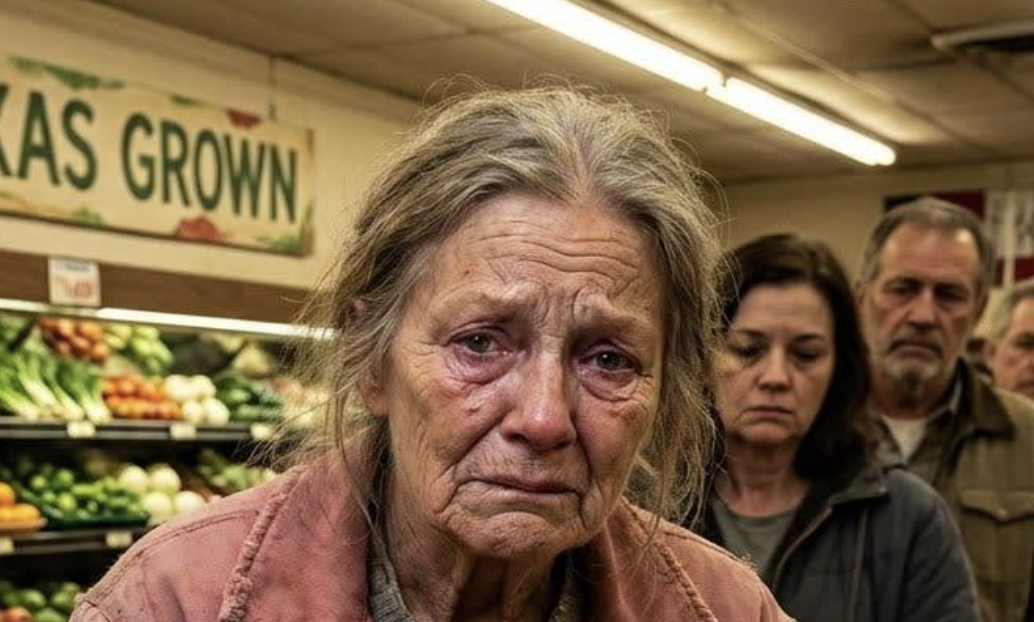
I joined the checkout line behind an elderly woman.
She was small and slightly hunched, wearing a faded coat and holding an old purse against her chest. When it was her turn, she placed several simple items on the counter and waited while the cashier scanned them.
Then came the total.
The woman opened her purse and began counting her money.
A few bills.
Then coins.
Her fingers trembled as she pushed them across the counter one by one.
The cashier counted everything and shook her head.
She was short by only a few dollars.
It was such a small amount, yet suddenly it felt enormous.
Someone behind me sighed dramatically.
Another person shifted impatiently and looked at the ceiling.
The elderly woman stared at the groceries as if she were deciding which necessity she could live without. Her shoulders seemed to shrink beneath her coat.
I recognized that look immediately.
It was the expression of someone trying desperately to preserve dignity while knowing everyone was watching.
I had worn that same expression before.
Before I could talk myself out of it, I stepped forward.
“I’ll pay the rest,” I said.
The cashier looked at me.
So did the woman.
For a moment, she simply stared.
“You don’t have to do that,” she whispered.
“I know,” I replied. “But I’d like to.”
I handed over the money.
It wasn’t much, but for me, every dollar mattered. Paying for her groceries meant I would have to change my own plans for the week.
Still, something inside me knew I could not simply stand there and watch her humiliation.
The woman looked into my eyes, and her own filled with tears.
“Thank you,” she said quietly.
There was so much emotion in those two words that I did not know how to answer.
I only smiled and told her to take care of herself.
Then I paid for my own groceries and left the store carrying less than I had intended to buy.
Strangely, though, I did not regret it.
By the time I reached home, life swallowed me again.
Lunches had to be made.
Laundry had to be folded.
There were work shifts, homework questions, sibling arguments, dishes in the sink, and nights when I fell asleep wondering how I would make it through the next month.
The elderly woman soon became another memory tucked into the chaos of my days.
Three days later, someone knocked firmly on my front door.
When I opened it, I saw a young man standing on the porch.
I recognized him immediately.
His name was Ethan. He had been working at the grocery store the day I helped the old woman.
He held a plain white envelope in his hands.
My name was written across the front in uneven, shaky letters.
“Are you Lily?” he asked.
I nodded.
His expression became solemn.
“The woman you helped at the store was Mrs. Hargrove,” he explained. “She passed away shortly after that day.”
I stared at him, stunned.
Ethan continued carefully.
“Before she died, she asked me to bring this to you.”
He held out the envelope.
For a few seconds, I did not move.
The news had struck me harder than I expected. I had known Mrs. Hargrove for only a few minutes, yet I could still see her trembling hands, her lowered eyes, and the gratitude in her face.
I invited Ethan inside.
We sat at my small kitchen table while I opened the envelope.
Inside was a handwritten letter.
I began to read.
Mrs. Hargrove wrote that what I had done for her was not important because of the money. The amount had been small.
What mattered, she said, was that when she had felt invisible and embarrassed, I had treated her like a human being.
She wrote that most people had looked away or become annoyed, but I had seen her.
Those words stopped me.
I had never thought of my actions that way.
I had simply recognized her pain.
Then I continued reading.
Mrs. Hargrove explained that she had very little family left and no one close enough to inherit what she had spent her life building.
She owned a small house.
She also had modest savings.
According to the documents enclosed with the letter, she had decided to leave both to me.
I read the pages twice.
Then a third time.
I was certain I had misunderstood something.
The house was not a mansion. The savings were not millions.
But to a mother struggling every month to keep three children fed and secure, it was life-changing.
It meant stability.
It meant breathing room.
It meant fewer nights lying awake wondering what would happen if the rent increased, the car broke down, or one of the children became sick.
My hands shook as I returned to the letter.
Near the end, Mrs. Hargrove had written one final request.
Take care of your children.
And someday, when you are able, help another person the way you helped me.
That was all she asked.
That evening, after the children were asleep, I sat alone at the kitchen table with the letter spread out in front of me.
The house was finally quiet.
I read her words again.
And again.
I thought about that crowded grocery store and the irritated strangers waiting in line.
I thought about how easily I could have looked away.
I also thought about how many times in my own life I had been only a few dollars away from embarrassment.
The truth was uncomfortable.
I could just as easily have been standing where Mrs. Hargrove stood.
That was when I finally understood what her gift really meant.
It was not a reward for being good.
It was not some magical rescue.
It was trust.
She believed that the kindness I showed her revealed something about the person I was capable of becoming.
And suddenly, that felt like a responsibility greater than any amount of money.
Today, my children’s future is more secure.
Life has not become perfect. There are still hard mornings, noisy evenings, unexpected expenses, and moments when I feel completely overwhelmed.
But there is now a steadiness that did not exist before.
And whenever I think of Mrs. Hargrove, I remember the lesson she left behind.
Kindness does not always require wealth.
It does not demand perfect circumstances.
Sometimes it is nothing more than noticing another person’s pain and choosing not to walk past it.
I gave an elderly woman a few dollars because I knew what it felt like to be afraid of not having enough.
In return, she gave me far more than a home or savings.
She gave me the chance to change my children’s future.
She gave me faith in the power of one compassionate decision.
And she left me with a promise I intend to keep.
Someday, when I see someone standing on the edge of despair, hoping not to be noticed while silently wishing someone would notice them, I will remember Mrs. Hargrove.
And I will step forward.