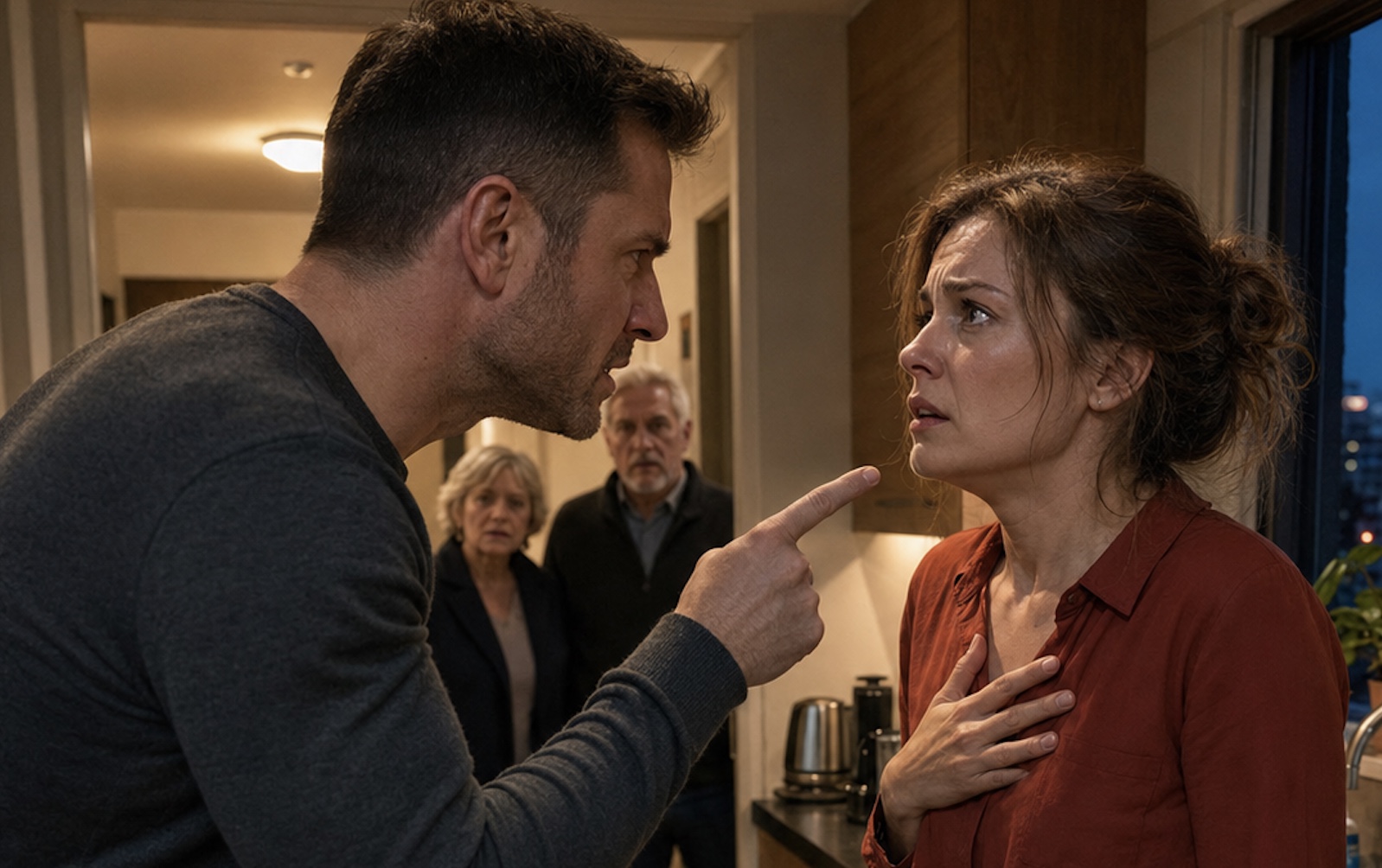
“Next week, my mother and father are moving in. I’ve already arranged everything with the movers,” Dmitry announced calmly over dinner as he helped himself to a second serving of roast.
Elena slowly lowered her fork onto the edge of her plate. The porcelain made a soft clinking sound against the table.
“You’ve already arranged it?”
“Of course. They’ll live here. We have enough space,” he replied without even looking up, continuing to eat.
“Are you serious?”
“Completely.”
He said it with such casual certainty that he might have been talking about buying a new kettle rather than moving two people into her apartment without warning, without asking permission, and without considering her opinion for even a moment.
Outside, evening was settling over the city. Elena stared at her husband and felt an ordinary dinner changing into something else entirely.
Something she could not yet name, although she already sensed where it was leading.
They had been married for twelve years.
They had never managed to have children. At first, they had focused on building their careers. Then they kept postponing the decision. Eventually, they simply stopped discussing it.
The three-bedroom apartment had been inherited by Elena from her mother before she married. It became the foundation of their life together. They had no mortgage, no loans, and none of the constant anxiety that came with worrying about keeping a roof over their heads.
Elena worked as a senior editor at a publishing house. Dmitry owned and managed an auto repair shop. From the outside, their marriage appeared stable, comfortable, and successful.
But over time, a crack had appeared between them—a crack Elena had refused to acknowledge for far too long.
Dmitry had gradually become accustomed to making every important decision on his own. At first, Elena had found it convenient.
“We’re going to Montenegro in August. I’ve already booked everything,” he would say.
“All right,” Elena would answer.
Later, he chose a new sofa without consulting her. Then he bought a car. After that, he began managing their shared finances without explaining where the money was going.
“Dima, we could at least discuss these things together,” she told him once.
“I’ve already made the decision. What’s the point of having unnecessary conversations?” he replied with a shrug.
And just like that, the discussion was over.
Elena convinced herself that her husband was simply taking responsibility. Perhaps that was not such a terrible thing.
Dmitry’s parents, Nikolai Pavlovich and Tamara Viktorovna, lived in a small town about one hundred and fifty kilometres away. Since retiring, they had begun complaining more often about their health, the long journey to the hospital, and the loneliness of living so far from the city.
Tamara Viktorovna called her son almost every day.
At first, the conversations were about money, and Dmitry sent whatever they needed. Later, his mother began hinting that they should move closer to the city.
Elena had never been against helping them.
“We could rent an apartment nearby,” she suggested. “Or help them buy a small one-bedroom place. We can afford it.”
“There’s no reason to waste money,” Dmitry cut her off. “We have three rooms.”
“Dima, that’s not the same thing.”
“They’re my parents,” he said in a tone that made it clear the conversation was finished.
Then, one evening, he simply informed her that the decision had already been made.
With every new conversation, the pressure increased.
Dmitry appealed more insistently to her sense of guilt, and his words began sounding less like explanations and more like accusations.
“They are my parents,” he would say, looking away.
“I understand that,” Elena would reply.
“Then why are you against this?”
“Because this is our life. And it is my apartment too.”
“That’s exactly it,” he said, turning a cold gaze toward her. “Your apartment. You always make sure to remind me of that.”
For the first time, Elena began to understand that the real problem was not the situation itself.
What bothered him was the fact that the apartment belonged to her.
Meanwhile, Tamara Viktorovna had already started behaving as though the move had been settled long ago.
She called Elena and asked in a practical, cheerful voice, “Lena, which direction does the window face in the room with the balcony? Kolya and I like plenty of sunlight.”
Elena answered briefly and ended the call.
No one was seriously asking what she wanted.
At a family dinner hosted by Dmitry’s sister, he laughed and announced to everyone at the table, “Lena is resisting for now, but I’ll convince her.”
Everyone laughed.
Someone shook their head with amusement. Someone else gave Dmitry an encouraging wink.
Elena smiled too.
It was automatic—the polite expression she had learned to wear when she wanted to hide what she was feeling.
At that moment, surrounded by people she had known for years, she suddenly understood that she did not truly exist in their eyes.
There was an apartment.
There was an inconvenience.
There was a woman Dmitry had promised he would eventually bring under control.
That evening, while Dmitry watched television, Elena opened her laptop and spent hours reading articles on a legal advice website.
She read about divorce.
She read about property ownership.
She read about what happened when a person finally decided that enough was enough.
The final confrontation came a few days later.
Elena returned from work earlier than usual.
Several cardboard boxes were standing in the hallway, and voices drifted from the living room.
She walked down the corridor and stopped in the doorway.
Dmitry and Tamara Viktorovna were standing in the middle of the room. Her mother-in-law held a measuring tape while Dmitry wrote something in a notebook.
“If we move the wardrobe over here, the bed should fit perfectly,” Tamara Viktorovna said as she measured the space along the wall.
“What is going on?” Elena asked.
Her mother-in-law turned toward her with an almost friendly expression.
“We’re planning the move, Lenochka. We’re deciding where the furniture will go.”
Elena said nothing.
She removed her shoes, walked into the kitchen, poured herself a glass of water, and drank it to the last drop.
After Tamara Viktorovna left, Dmitry entered the kitchen with the weary expression of a man who believed he had been forced to endure an unnecessarily long formality.
“That’s enough,” he said. “I’m tired of arguing. My parents are moving in, and this is no longer up for discussion.”
“No,” Elena replied quietly. “It is still up for discussion.”
“Then listen carefully.”
He paused deliberately, as people do when they want their words to land with maximum force.
“If you refuse, our marriage is over.”
He was certain he knew what would happen next.
She would cry.
She would become frightened.
Then she would give in.
Instead, Elena looked directly at him and said in a calm, even voice, “All right.”
He blinked.
“What do you mean, all right?”
“If the marriage is over, then it’s over.”
Dmitry stood in the centre of the kitchen without speaking.
For the first time in twelve years, he had no answer.
Over the following days, Dmitry waited.
Elena could see it in the way he exaggerated his silence at breakfast and behaved as though everything would eventually return to normal.
One day, she overheard him speaking to his mother on the phone.
“We’ll wait for now, Mom. Not yet.”
He believed the crisis had passed.
He was convinced that Elena would calm down and surrender, just as she had done so many times before.
But Elena was no longer uncertain.
Through a friend, she found a lawyer and arranged a consultation. She arrived carrying a folder of documents, composed and prepared, her voice steady.
“The apartment was registered in your name before the marriage,” the lawyer confirmed. “Your ownership rights are protected.”
Elena filed for divorce on Wednesday morning before going to work.
A week later, Dmitry received the official notice.
He came home earlier than usual, pale-faced, clutching the document in one hand.
“Are you serious?” he asked, staring at her as though she were a stranger.
“Yes.”
“Elena, we have been together for twelve years. Are you really going to throw everything away because of this?”
“I’m not throwing anything away. You were the one who gave me that choice.”
“I didn’t think you would…”
“That I would actually do it?” she finished quietly.
He continued talking.
He spoke about family, about all the years they had spent together, and about how she was destroying everything with her own hands.
Elena listened and waited for the familiar pain to appear.
But instead of pain, she felt something strange and almost unfamiliar.
Relief.
It was as though she had finally exhaled after holding her breath for years.
The divorce proceedings continued, and during that period Nikolai Pavlovich called her.
Elena was surprised to see his name on her phone. Her father-in-law had never called her directly before.
“Lena,” he began, his voice quiet and uncomfortable. “I want you to know something. Tamara and I never planned to move into your apartment. It wasn’t our idea.”
“What do you mean?” Elena asked, sitting down.
“Dima persuaded us. He said he wanted to sell our house because he needed money for some business premises. His plan was to move us in with you. I refused. We had a serious argument about it, and now he won’t answer my calls.”
Elena remained silent for a long moment.
“Thank you for telling me, Nikolai Pavlovich.”
“You must forgive us for getting involved,” he said after a pause. “Tamara will never forgive herself for allowing things to go this far.”
After the call ended, Elena stayed in her chair, staring into space.
Everything finally made sense.
It had never been about caring for his parents.
It had never been about responsibility or devotion.
It had been a scheme.
Dmitry wanted to sell his parents’ house, move them into Elena’s apartment, and use the money for his business.
Her home had never been a home to him.
It was an asset he believed he could include in his calculations.
A month later, Dmitry packed his belongings.
He filled boxes in silence and called a taxi.
Before leaving, he paused in the doorway and looked back. Perhaps he wanted to say something. Perhaps he expected Elena to stop him.
She did not.
He left his keys on the kitchen table beside a salt shaker they had once bought together at a market in Montenegro.
Six months later, the apartment was being renovated.
Elena decided to redesign the room at the far end of the hallway. She removed the old sofa and replaced it with a writing desk, a bookshelf, and a small floor lamp that cast a warm, gentle light.
The room became an office.
Her office.
In the evenings, she sat at the desk and listened to Italian audio lessons. Learning the language was difficult, but she enjoyed the challenge of discovering something unfamiliar.
One afternoon, her friend Natasha asked her over tea, “How are you really doing? Do you regret any of it?”
Elena thought about the question carefully and honestly.
“No,” she said. “It’s strange, isn’t it? I thought it would hurt much more.”
“You’ve changed,” Natasha observed.
“Maybe I’ve simply become myself.”
Sometimes, late at night, Elena remembered that dinner.
She remembered the roast, the sound of the fork touching the plate, and Dmitry’s calm voice saying, “My parents are moving in, and this is not up for discussion.”
At the time, she had believed something enormous and important was collapsing.
Now she understood that it had not been a family that fell apart that evening.
It had been an illusion.
The illusion that love could survive constant ultimatums.
The illusion that a person could respect herself while remaining silent.
The illusion that a place could be called home when her opinion meant nothing inside it.
And when that illusion finally disappeared, Elena discovered something waiting behind it.
Her own life.
Quiet.
Spacious.
And entirely hers.