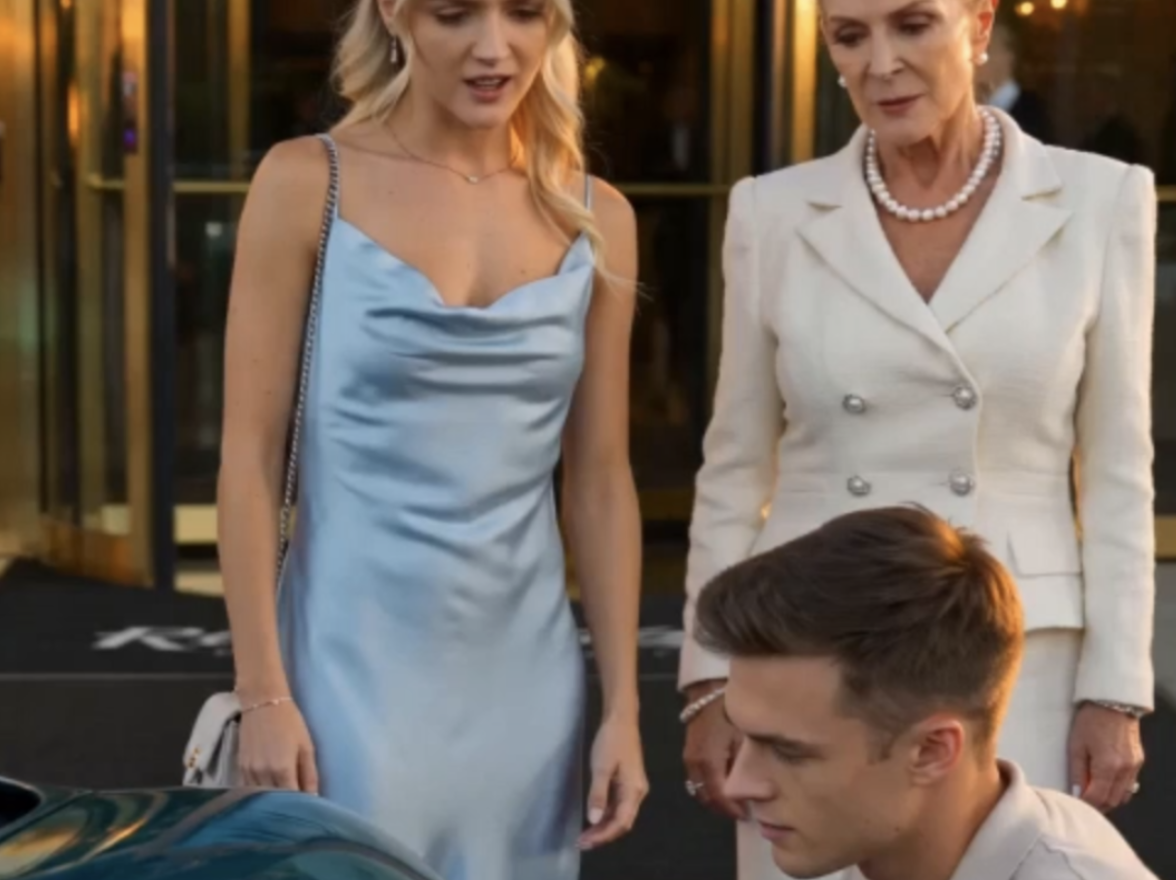
The emerald-green supercar drew attention before anyone even knew who owned it.
Parked beneath the sweeping glass canopy of the Imperial Crest Hotel, it gleamed in the late-afternoon sunlight like an expensive jewel. Its polished body caught reflections of the hotel’s bronze doors, marble pillars, uniformed doormen, and the steady procession of wealthy guests arriving in chauffeured sedans.
Yet the man crouching beside its rear wheel hardly looked like the kind of person anyone expected to own such a machine.
Noah Vale was on one knee, sleeves pushed to his elbows, rubbing at a faint gray mark on the rim with a piece of cloth.
That was exactly how Claire Ashford saw him.
She had just stepped from a black luxury SUV in a pale silver evening dress, prepared for a private reception on the hotel’s rooftop terrace. Her dark hair had been carefully arranged, a diamond pendant rested at her throat, and a tiny designer bag hung from one wrist.
Her mother, Celeste Ashford, emerged behind her wearing an ivory suit and the composed expression of a woman accustomed to entering rooms where everyone knew her name.
Claire stopped.
Celeste followed her gaze.
For several seconds, neither woman spoke.
Noah looked up.
Surprise flickered briefly across his face when he recognized them.
Then it vanished.
“Claire.”
Her eyes traveled from his face to the rag in his hand, then to the wheel, then back to his plain charcoal polo shirt.
“Noah?”
He stood slowly.
She gave a small, confused laugh.
“What are you doing?”
“Taking care of something.”
Claire glanced around as if searching for an explanation that would rescue her from embarrassment.
A young valet standing near the entrance suddenly became very interested in rearranging keys.
Celeste stepped closer.
Her judgment came faster.
It usually did.
“Noah,” she said, “do you work here?”
“No.”
“But you’re cleaning cars?”
“Not quite.”
Celeste’s expression changed in a way Noah had seen before. It was the look of someone who had already reached a conclusion and no longer considered facts necessary.
Claire pressed her lips together.
Only ten days earlier, she had described Noah to her mother as an entrepreneur. She had said he worked in hospitality technology and had been involved in several private investment projects.
All of that was true.
But Claire had never really understood his finances.
Noah did not wear designer logos. He did not post photographs from private jets. He had no interest in proving himself at parties. He drove himself, carried his own luggage, tipped quietly, and treated waiters, drivers, cleaners, and executives with the same calm respect.
Those qualities had once attracted Claire.
Lately, however, they had begun to make her uncomfortable.
Her world demanded visible proof.
Money should announce itself.
Success should enter through the front door accompanied by photographers.
Celeste had never approved of uncertainty.
Now she looked at Noah crouching beside a wheel and seemed almost satisfied.
At last, she believed she understood him.
Claire glanced toward the hotel’s entrance. Guests were arriving for the rooftop reception. Some of them knew her. A few had already noticed the scene.
Her shoulders stiffened.
“Noah, maybe we should talk.”
“We are talking.”
“Not here.”
“Why not?”
She looked around again.
That told him enough.
Celeste crossed her arms.
“Claire has a future to think about.”
Noah turned his attention to her.
“And?”
“And people should be honest about who they are.”
A small silence followed.
Noah almost smiled.
“That’s good advice.”
Celeste did not hear the irony.
Claire inhaled deeply.
“Noah, I think perhaps we’ve been avoiding something for a while.”
He waited.
She had practiced the speech. He could tell from the careful pauses.
“We want different things. We’re going in different directions.”
The statement was polished enough to sound reasonable.
That made it colder.
Noah looked at her for several seconds.
“You’ve decided that now?”
Claire’s face flushed.
“This isn’t about one moment.”
“No?”
“No.”
Her eyes dropped involuntarily toward the cloth in his hand.
Noah noticed.
So did her mother.
Celeste stepped in quickly.
“Claire needs someone whose life is compatible with hers. There is no shame in admitting that.”
Noah placed the cloth on the hood of the car.
Behind them, the Imperial Crest’s enormous revolving doors began to spin.
A man in a dark blue suit hurried outside.
His name was Martin Reeves, the hotel’s general manager.
He was nearly sixty, impeccably dressed, and normally incapable of appearing rushed.
Today, he was practically running.
“Mr. Vale!”
Claire turned sharply.
Celeste frowned.
Martin crossed the entrance plaza and stopped in front of Noah.
“Sir, I’ve been looking everywhere for you.”
Noah glanced at his watch.
“The meeting finished?”
“Yes.”
“And?”
Martin smiled for the first time all day.
“The final signatures have been completed. The board approved the transfer unanimously.”
Claire stared between them.
Celeste said nothing.
Martin continued.
“Congratulations, Mr. Vale. As of twenty-two minutes ago, you officially control the Imperial Crest Hospitality Group and all sixteen of its international properties.”
Silence swept across the driveway.
Even the traffic noise seemed to retreat.
One valet stopped halfway through opening a car door.
A bellman froze beside a pile of luggage.
Claire’s expression emptied completely.
Celeste blinked once.
Then again.
“All sixteen hotels?” she asked.
Martin finally noticed the two women.
“Yes.”
He looked at Noah.
“The executive team is waiting in the presidential conference room. The announcement is ready, the press has been assembled, and the London office is standing by for your call.”
Noah nodded.
“I’ll be there shortly.”
Martin lowered his voice.
“Of course, sir.”
Then he stepped aside.
Claire stared at Noah.
She looked as though she were trying to combine two completely different men into one.
The man she had just discarded.
The man who had just purchased one of the world’s most prestigious independent hotel groups.
Her eyes moved toward the green supercar.
Realization arrived slowly.
“That car…”
“Mine.”
Celeste’s posture changed.
Only slightly.
But Noah noticed.
Claire took one step closer.
“Noah, I had no idea.”
His expression remained calm.
“I know.”
“I mean, you never told me.”
“You never asked.”
Her lips parted.
He continued before she could answer.
“You asked whether I could afford certain restaurants. You asked why I didn’t buy better watches. You asked whether I planned to become more ambitious.”
Claire looked away.
“But you never asked what I was actually building.”
“Noah…”
“You were right about one thing.”
She looked back at him.
“We are going in different directions.”
The words struck harder now that they had returned to her.
Behind him, the green sports car shimmered beneath the evening sun.
But its ownership was not the most important thing Claire had misunderstood.
Not even close.
Twenty minutes earlier, a new valet named Mateo had been asked to reposition the car. He had been nervous. It was his second week on the job, and he had never driven anything remotely that expensive.
While maneuvering near the curb, he had lightly scraped one wheel.
The mark was superficial.
Mateo, however, had turned pale.
When Noah returned from a phone call and found him staring at the wheel, the young man looked ready to faint.
“I’m sorry, sir,” Mateo had said. “Please, don’t report me. My mother is ill. I need this job.”
Noah had bent down and examined the mark.
Then he had shrugged.
“Do you have a cloth?”
Mateo stared at him.
“Sir?”
“A cloth.”
The young valet brought one.
Noah crouched beside the wheel.
Mateo immediately protested.
“No, sir. Please. I’ll do it.”
Noah had glanced up at him.
“You made a small mistake. You didn’t commit a crime.”
“But the car…”
“Is metal.”
Mateo swallowed.
“They’ll charge me.”
That made Noah stop.
“Who will?”
“The hotel. Employees can be held responsible for guest damage complaints.”
Noah’s expression had darkened.
“Even minor ones?”
Mateo hesitated.
“Sometimes.”
Noah returned to cleaning the wheel.
“Then that policy won’t survive the day.”
Mateo had assumed he was joking.
That was the exact moment Claire and Celeste arrived.
They saw a man on one knee beside a car.
They saw plain clothes.
They saw a rag.
And in a matter of seconds, they decided they understood his value.
Now, standing under the hotel’s grand entrance canopy, Claire looked at the young valet.
The pieces came together.
“You were helping him?”
Noah glanced at Mateo.
“Yes.”
Claire’s face reddened.
Celeste recovered faster.
She always did.
“Clearly, there has been a misunderstanding.”
Noah turned toward her.
“No.”
Celeste’s smile stiffened.
“I beg your pardon?”
“You understood exactly what you thought you saw.”
Her eyes narrowed.
“That isn’t fair.”
“Isn’t it?”
Claire spoke quietly.
“Noah, I was surprised.”
“You were embarrassed.”
She flinched.
“That’s not the same thing.”
“No, it isn’t.”
He said it without raising his voice.
That made it worse.
For nearly a year, Noah had watched Claire become two different people depending on who was watching.
When they were alone, she was affectionate. Curious. Funny. She liked quiet dinners, long drives, and the fact that he remembered tiny details from conversations weeks later.
Around people she wanted to impress, however, she changed.
She mentioned prestigious schools more often.
She cared about table placement.
She introduced people by their companies instead of their names.
She wanted to know who owned what, who had sold what, who had been invited, who had not.
And Noah gradually became a problem she could not categorize.
He had confidence without display.
Resources without boasting.
Connections he rarely discussed.
She liked him.
But she wanted proof that liking him would improve her social position.
Until Martin ran through the doors and called him “Mr. Vale,” that proof had apparently been insufficient.
Celeste moved closer.
“Let’s not turn a private misunderstanding into public theater.”
Noah gave her a level look.
“You were comfortable making judgments in public.”
“I was protecting my daughter.”
“From what?”
Celeste’s jaw tightened.
“From a mismatch in ambition.”
“Interesting.”
She tilted her chin.
“Ambition matters.”
“So does character.”
Before Celeste could reply, the revolving doors moved again.
This time, three executives stepped out.
Leading them was Judith Mercer, the chairwoman of Imperial Crest’s board, a silver-haired woman in her late sixties with a reputation for surviving corporate battles that had destroyed men half her age.
She approached Noah carrying a leather folder.
“The documents for the announcement are ready.”
Then she noticed Celeste.
Her expression changed immediately.
“Mrs. Ashford.”
Celeste’s smile returned.
“Judith.”
Noah looked from one woman to the other.
“You know each other?”
Judith gave a dry laugh.
“Professionally.”
Celeste’s smile became thinner.
Noah waited.
Judith explained.
“Ashford Prestige Consulting submitted a proposal to manage the brand repositioning campaign after the acquisition.”
Claire looked at her mother.
“What?”
Celeste spoke quickly.
“It was preliminary.”
Judith raised one eyebrow.
“Seven-point-four million dollars is a remarkably ambitious preliminary proposal.”
Noah’s eyes settled on Celeste.
The entire scene shifted.
For months, Celeste had criticized his apparent lack of visible status while quietly attempting to secure a lucrative contract with the hotel chain he had been preparing to buy.
Claire stared at her mother.
“You never told me.”
“It had nothing to do with you.”
Noah doubted that.
Celeste was not merely status-conscious.
She was strategic.
She had spent years arranging connections, dinners, introductions, social alliances, and professional opportunities as if every relationship were a move on a chessboard.
A daughter’s boyfriend mattered.
A future son-in-law mattered even more.
The right marriage opened doors.
The wrong one could close them.
Noah turned to Judith.
“Has the consulting agreement been signed?”
“No.”
“Approved?”
“Not finally.”
He nodded.
“Reject it.”
Celeste’s face went blank.
Judith did not hesitate.
“Understood.”
Celeste stepped forward.
“You cannot seriously be making a multi-million-dollar business decision because of a personal disagreement.”
Noah’s expression remained unchanged.
“I’m making it because five minutes ago you insulted a man you believed was a hotel worker.”
“I did no such thing.”
“You questioned his ambition, his honesty, and his future based on the fact that he was holding a cleaning cloth.”
Celeste’s cheeks flushed.
“That is an absurd oversimplification.”
“No. It is a demonstration.”
“Of what?”
“Of how you evaluate people when you think they have nothing to offer you.”
Nearby employees pretended not to listen.
They heard every word.
Noah continued.
“You wanted to advise this company on luxury service culture. Yet you looked at someone you believed belonged to the service staff and decided he was beneath your daughter.”
Celeste’s polished composure finally cracked.
“You are acting emotionally.”
Noah nodded.
“Good.”
She stared at him.
“The previous ownership wasn’t emotional enough.”
That was the real reason Noah had bought Imperial Crest.
Not the buildings.
Not the brand recognition.
Not the suites in Manhattan, Paris, Singapore, Rome, Dubai, or Los Angeles.
The truth was buried much deeper.
Imperial Crest looked perfect from the outside.
Behind the scenes, it had been rotting for years.
Employees were punished for customer complaints before anyone investigated whether the complaints were true. Housekeepers were assigned impossible room quotas. Injuries disappeared into administrative delays. Front-desk staff were expected to endure humiliation from wealthy guests without responding.
The hotels sold perfection.
Workers paid for it.
Noah knew what that cost because his mother had spent eighteen years cleaning luxury hotel rooms.
Her name was Elena Vale.
She had raised him alone.
When Noah was young, she left home before sunrise and returned smelling of detergent, furniture polish, and exhaustion.
Her fingers were often swollen.
Her back constantly hurt.
But she rarely complained.
Whenever Noah asked whether work had been difficult, she usually smiled.
“Nothing I can’t handle.”
Only after her death did he learn how much she had handled.
While clearing out her small apartment, he found an old metal box beneath her bed.
Inside were wage statements.
Medical reports.
Rejected compensation claims.
Supervisor warnings.
Copies of complaints she had never formally submitted.
And beneath everything, a folded sheet of paper in her handwriting.
Noah still kept it.
One line had stayed with him for years:
A beautiful place is not truly beautiful if the people keeping it beautiful are treated as though they don’t matter.
Noah had built a hospitality software company while still in his twenties.
The platform simplified staffing, inventory management, service requests, and property operations. What began with a handful of independent hotels eventually became a system used by major chains across three continents.
At thirty-one, he sold most of his company.
The public numbers were large.
The private numbers were larger.
He did not buy yachts.
He did not collect houses.
Instead, he spent nearly two years buying Imperial Crest debt through a network of investment entities.
Quietly.
Methodically.
By the time the previous ownership realized what was happening, Noah controlled the financial leverage necessary to force a restructuring.
Today, he had taken possession of the keys.
He had not purchased Imperial Crest as a trophy.
He had purchased it because places like this had employed women like his mother for decades while pretending those women were invisible.
Claire wiped beneath one eye.
“Noah, I’m sorry.”
He looked at her carefully.
“I believe that you’re ashamed of what happened.”
“I am.”
“That’s not necessarily the same as being sorry.”
She lowered her head.
The statement hurt because she knew he was right.
Celeste touched her daughter’s arm.
“We’re leaving.”
Then she looked at Noah.
“This behavior is unnecessary.”
Noah turned to Martin.
“Were Mrs. Ashford and Claire invited to tonight’s reception?”
Martin checked the tablet in his hand.
“They were included under the consulting firm’s guest allocation.”
“Cancel the invitation.”
Celeste went rigid.
“You would throw us out?”
“No.”
“You just did.”
“I removed access to a private corporate reception.”
Her voice sharpened.
“You intend to humiliate us in front of everyone.”
Noah looked at Mateo.
Then at the cloth still resting on the car.
Finally, he looked back at Celeste.
“Humiliation is what people do when they believe the person standing in front of them has no power to answer.”
That ended the conversation.
Celeste seized Claire’s arm.
Claire did not move immediately.
She looked at Noah one final time.
The terrible part was that he did not look triumphant.
She almost wished he did.
Anger would have given her something to resent.
Revenge would have made him easier to dismiss.
Instead, he looked disappointed.
And she understood that she had not lost him because he had become rich.
She had lost him because wealth had revealed something about her that he could no longer ignore.
Noah turned away.
The hotel entrance waited.
Employees stood nearby, watching cautiously.
They had seen new owners before.
Usually, new owners arrived through private entrances.
Usually, they held champagne at press conferences and talked about heritage, excellence, optimization, premium guest experiences, and shareholder value.
Usually, nothing changed for the people pushing laundry carts at two in the morning.
Noah walked toward Mateo first.
“How long have you been here?”
“Thirteen days, sir.”
“And employees can be forced to pay for minor guest vehicle complaints?”
Mateo looked nervously toward Martin.
Noah noticed.
“You’re not in trouble.”
“Yes, sir. It happens.”
Noah turned to Martin.
“Stop it.”
Martin cleared his throat.
“Immediately?”
“Today.”
“Understood.”
Noah looked toward Judith.
“What about open workplace injury claims?”
She opened the folder.
“Thirty-seven active cases are currently under review.”
“Reopen every disputed one.”
“The legal department may resist.”
“Then replace the legal department.”
Judith almost smiled.
“Understood.”
“Housekeeping quotas?”
Martin answered cautiously.
“Above industry averages at nine properties.”
“Reduce them.”
“The financial model—”
“Will survive.”
Noah looked around the entrance.
“People should not have to destroy their bodies so a guest can receive a pillow five minutes faster.”
No one answered.
There was nothing to argue with.
He stepped toward the revolving doors.
Then stopped.
“Mateo.”
The young valet straightened.
“Yes, sir?”
Noah nodded toward the green car.
“You didn’t ruin anything.”
Mateo swallowed.
“Thank you.”
“And don’t apologize for doing honest work.”
Claire heard him.
So did her mother.
Neither turned around.
Thirty-five minutes later, Noah stood in the Imperial Crest ballroom.
Hundreds of guests, investors, executives, journalists, and hotel managers faced the stage.
Television cameras pointed toward him.
Behind Noah hung an enormous image of the hotel group’s golden crest.
The communications team had written him a speech.
He did not use it.
“Many of you expect me to talk about growth,” he began.
The room quieted.
“You expect expansion plans, new markets, profit targets, and brand strategy.”
He paused.
“We will discuss those things.”
Cameras clicked.
“But not first.”
He looked directly into the press section.
“My mother cleaned hotel rooms for eighteen years.”
The room became completely still.
“She understood luxury better than most executives I’ve ever met because she was one of the people who created it every day and rarely received credit for doing so.”
Noah rested both hands on the podium.
“I learned from her that no hotel deserves to call itself exceptional if its guests are treated like royalty while its employees are treated as replaceable.”
Several workers standing near the ballroom walls exchanged glances.
“Imperial Crest will remain elegant. It will remain profitable. It will remain competitive.”
He paused again.
“But beginning today, it will also become fair.”
The applause started in the back.
Not among investors.
Among employees.
Then it spread.
By midnight, Noah’s speech had been shared millions of times.
But another video traveled even faster.
A guest arriving at the hotel had filmed the driveway confrontation.
The clip began with Claire asking:
“Do you work here?”
Then Celeste’s voice:
“Claire needs someone whose life is compatible with hers.”
Then Martin running outside.
“Mr. Vale! The transfer has been completed. You now officially control the Imperial Crest Hospitality Group.”
The internet did what it always did.
It dissected every expression.
Every pause.
Every gesture.
Memes appeared within hours.
Commentators debated class prejudice, wealth, status, relationships, and appearances.
Reporters discovered the story of Noah’s mother.
Former Imperial Crest workers began sharing their own experiences.
Soon, the acquisition became far bigger than the humiliation of two people on a hotel driveway.
Noah made sure of that.
He refused nearly every interview asking about Claire.
Whenever someone tried to turn the story into revenge, he redirected the conversation.
“This isn’t about someone discovering I have money,” he told one journalist. “It’s about how easily people decide someone’s worth when they assume that person doesn’t.”
Within three months, the first major reforms began.
Employee charges for minor accidents were eliminated.
Every contested workplace injury case was independently reviewed.
Housekeeping room quotas were reduced.
A confidential worker protection office was created outside normal hotel management.
Employees received representation on a new workplace standards council.
After six months, Noah introduced a profit-sharing plan.
A year later, the company launched the Elena Vale Opportunity Scholarship for employees and their children pursuing education in hospitality, nursing, technology, business, engineering, and skilled trades.
Mateo became one of the first recipients.
He used the scholarship to study hotel management.
Martin Reeves remained with the group and eventually became chief operating officer.
Judith Mercer helped rebuild the board before retiring.
And Celeste Ashford never received her consulting contract.
As for Claire, she disappeared from Noah’s life.
Mostly.
Four months after the acquisition, a handwritten letter arrived at his office.
There was no expensive stationery.
No corporate logo.
No dramatic packaging.
Just an envelope with his name.
Noah nearly left it unopened.
Then he recognized her handwriting.
He read it alone after sunset.
Claire did not ask him to forgive her.
She did not ask for another chance.
That was why he kept reading.
She wrote that she had spent her entire life confusing status with security.
Her mother had taught her to evaluate the direction of a man’s future but never the character guiding him there.
She admitted that seeing Noah kneeling beside the car should have told her everything worth knowing.
He had seen a frightened employee and helped him.
She had seen the same scene and felt embarrassed.
The problem had never been that she misunderstood Noah’s wealth.
The problem was that, for a few ugly moments, she believed a person without wealth deserved less respect.
Near the end, she wrote:
I thought the worst thing that day was discovering that I had walked away from a rich man. It took me weeks to understand that the real loss was discovering how small I had allowed myself to become.
Noah finished the letter.
He folded it carefully.
Then placed it in the bottom drawer of his desk.
Eventually, he forgave her.
But forgiveness did not mean returning.
Some relationships end because love disappears.
Others end because one moment reveals a truth that cannot be unseen.
One year after the acquisition, Imperial Crest reopened its flagship property following a major renovation.
The architecture remained grand.
The bronze revolving doors were still there.
The marble floors still gleamed beneath crystal lights.
The suites remained expensive.
The rooftop bar was still nearly impossible to book.
But behind the beauty, the hotel had changed.
Employee turnover had dropped.
Injury reports were addressed openly.
Promotions increasingly came from within.
Workers who had once avoided senior executives now spoke during company meetings.
The building looked familiar.
Its culture did not.
On reopening night, Noah’s emerald-green car returned to the same driveway.
This time, he stepped out wearing a black suit.
Photographers waited near the entrance.
Executives stood inside the lobby.
Guests turned their heads.
Noah had taken only a few steps when he noticed an elderly woman struggling with a heavy suitcase beside the curb.
A bellman was hurrying toward her.
Noah reached her first.
“May I?”
The woman looked up.
“Oh, no. It’s too heavy.”
“I’ve carried worse.”
He lifted the suitcase.
The bellman arrived and stopped.
“Mr. Vale, sir, I’ll take that.”
Noah smiled.
“I know you will. But I already have it.”
Inside the lobby, people stared.
Staff members watched.
This time, nobody looked embarrassed.
A little boy standing beside the reception desk tugged his father’s sleeve.
“Dad.”
His father looked down.
“Yes?”
“Is that the owner?”
“Yes.”
The boy frowned.
“Then why is he carrying someone’s suitcase?”
Noah heard him.
He stopped and looked over.
The boy suddenly became nervous.
Noah smiled.
“Because she needed help.”
The child thought about that.
Then nodded as though the answer made perfect sense.
Noah continued toward the elevator, carrying the suitcase.
Outside, the hotel’s walls reflected the final orange light of sunset.
The bronze doors still turned.
The luxury cars still arrived.
The chandeliers still glittered.
To someone passing on the street, perhaps nothing had changed at all.
But inside, everything that mattered had begun to move in a different direction.