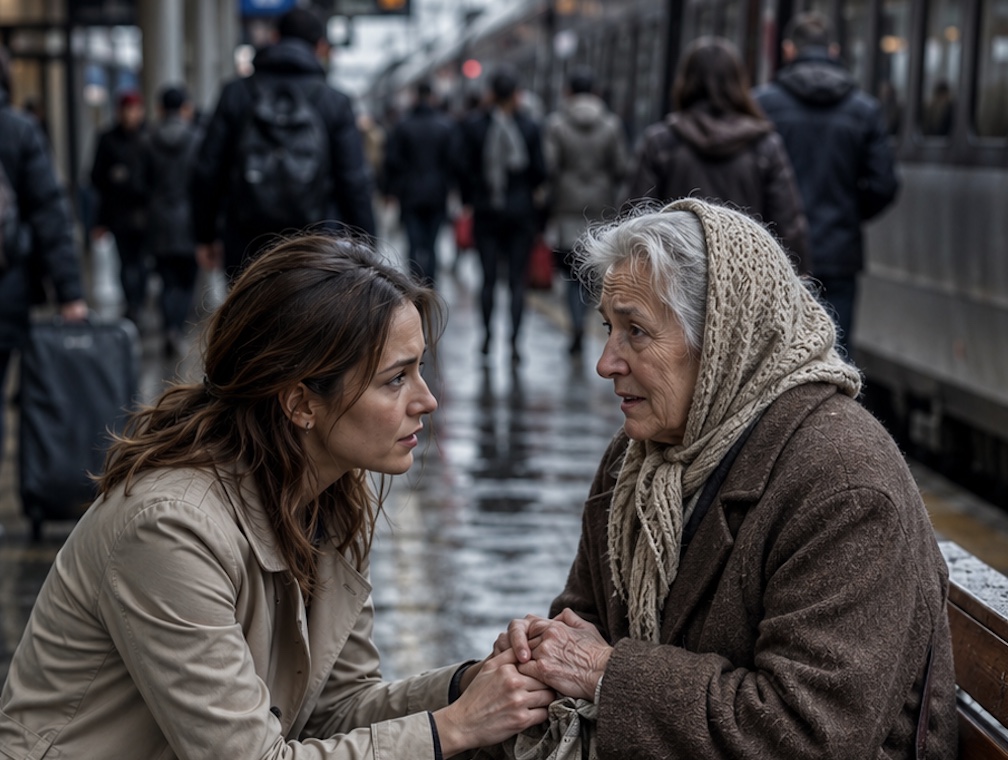
“Miss… does this bus go to the train station?” the old woman asked quietly.
At first, Nina did not even realize someone was speaking to her. She was standing at the bus stop, clutching a grocery bag to her chest, staring at the road where cars crawled through a gray mess of snow and slush. After her shift at the pharmacy, her legs ached, her back throbbed, and there was only one thought in her head: get home, take off her boots, and drink tea in silence.
“To the station?” she repeated, turning around.
At the edge of the bench sat an elderly woman in an old brown coat and a downy headscarf. She was small, thin, and had a lost look on her face. In her hands she held a cloth bag, pressing it to her knees as if everything precious she owned was inside it.
“I think I need to go to the station,” the old woman said. “Or maybe I don’t… I don’t know.”
Nina frowned.
“Where are you going?”
The old woman looked at her and suddenly began to cry. Not loudly, not with sobs. Tears simply rolled down the wrinkles of her face, and she helplessly wiped them away with the edge of her scarf.
“I don’t remember, dear. I don’t remember anything. I went out… but where I was going, I don’t know.”
Nina felt something tighten inside her.
The bus stop was crowded, but no one reacted. A young man in headphones stared at his phone. A man with a briefcase shifted impatiently from foot to foot. A woman in a red hat glanced quickly at the old woman and turned away, as if afraid someone else’s misfortune might stick to her.
“All right,” Nina said, placing her grocery bag on the bench. “Let’s stay calm. Have you been sitting here long?”
“I don’t know. It was light before. Now it’s dark.”
Nina looked at the sky. It had started getting dark about two hours ago.
“What’s your name?”
The old woman opened her mouth, stopped, and looked fearfully somewhere past Nina.
“I think… Zoya. Or Zina. Dear God, how can this be…”
She began crying again.
Nina sat down beside her.
“It’s okay. These things happen. We’ll figure it out. Do you have a phone?”
The old woman shook her head.
“I don’t like those phones. They beep.”
“Documents?”
“They should be…” She began rummaging through her bag with trembling hands.
Inside the bag were a handkerchief, an empty plastic bag, a small icon, a piece of bread wrapped in a napkin, and a key on a string. There were no documents.
Nina took the key and looked at it.
“Is this for your apartment?”
“Probably.”
“Do you remember your building? The street? The number?”
“No, dear. There’s fog in my head. I remember there’s a flower on my window. A red geranium. And my cat was called Barsik. Only Barsik is gone now.”
She said it guiltily, as if she herself were to blame for the fact that her memory had betrayed her at a bus stop.
Nina took off her gloves and pulled out her phone.
“I’m going to call for help. Just don’t go anywhere.”
“I don’t even know where to go,” the old woman said softly.
Nina had not always been the kind of person who stopped beside someone else’s trouble.
No, she did not think of herself as indifferent. Her life was simply ordinary: work, home, her mother after a stroke, her younger brother at university, utility bills, rising prices, constant exhaustion. Sometimes it seemed that if she stopped to help every person who looked unwell on the street, one day she herself would sit down on a bench and be unable to get up.
But she was afraid to leave elderly people alone.
Three years earlier, her grandmother had gone missing.
Not completely missing — she had left home and gotten lost. By then, her grandmother already had trouble remembering dates, confused granddaughters with neighbors, and could put a kettle on the stove without water in it. But that day, Nina’s mother had lain down to rest, Nina was at work, and her grandmother decided to go “to the store for sugar.”
They found her six hours later on the other side of the district. She was standing by a stranger’s entrance and saying:
“I came home, but they changed the lock.”
Someone passing by had called the police. Someone had not walked past.
After that, Nina had thought for a long time about that unknown person. They could have simply left. But they could also stay. And they stayed.
Now, sitting next to a lost old woman, Nina felt that she would not be able to leave.
She called the police and explained the situation. While she was speaking, a bus pulled up to the stop. People stirred, rustled their bags, and began getting on.
“Miss, are you getting on?” asked the man with the briefcase.
“No.”
“Then move your bag. It’s in the way.”
Nina silently put the bag down by her feet.
The bus left. The stop became quieter.
The old woman watched the red lights disappear.
“Maybe I was supposed to take that one…”
“Don’t worry. We won’t get on anything until we know where you need to go.”
“You’ll be late getting home.”
“Home can wait.”
The old woman looked at her with such gratitude that Nina looked away.
The police arrived twenty minutes later.
Two young men got out of the car. One immediately began typing something into his phone, while the other approached the bench.
“What happened?”
Nina explained.
“This woman is lost. She doesn’t remember her address, and she has no documents. She’s been sitting here, it seems, for several hours. We need to find out where she lives.”
The policeman looked at the old woman.
“Grandma, what’s your last name?”
“I don’t know, son.”
“Date of birth?”
“Oh… that was a long time ago.”
He sighed.
“I see.”
“Can you check missing-person reports? Maybe someone is already looking for her?” Nina asked.
“If her relatives reported it, we’ll check. But without any information, it’s difficult.”
“She has a key. Maybe she lives somewhere nearby.”
“Maybe.”
He said it in a tone that made “maybe” sound like, “Maybe she does, maybe she doesn’t — and what do you expect us to do about it?”
The second policeman came closer.
“We can take her to the station, then to a temporary care center. Social services will sort it out from there.”
The old woman lifted her head in fear.
“What center? I want to go home.”
“No one is going to hurt you, Grandma,” the policeman said. “It’s warm there.”
Nina felt irritation rising in her chest.
“Wait. She isn’t homeless. She has a key. She remembers a geranium, a house, a pharmacy, maybe a shop. Let’s at least try to find her courtyard.”
“Miss, we’re not a private detective agency.”
“And I don’t have five spare hours after work either, but somehow I’m still standing here.”
The policeman looked at her tiredly.
“We’re people too.”
“Good. Then let’s stay people.”
He was silent for a moment.
“All right. Try asking her some more questions. We’ll check reports in the area. But if we don’t find anything, we’ll have to process her officially.”
Nina nodded.
“Give me half an hour.”
She sat back down beside the old woman.
“All right. Let’s remember in little pieces. Were you going somewhere today?”
“For bread, probably. I have bread.”
She showed the piece wrapped in a napkin.
“Good. That means the store is nearby. What kind of store? Big? Small?”
“Small. There’s a plump saleswoman there. Sveta. Or maybe not Sveta.”
“That’s already something. What else is near your building?”
The old woman closed her eyes.
“A tree. A big one. A poplar. They keep wanting to cut it down, and I say, ‘Don’t touch it. It stood here before any of us.’”
Nina looked around. There were many poplars in this district.
“What else?”
“A pharmacy… a green cross. And a bakery next to it. It smells like bread.”
“A bakery, a green cross, a poplar, a five-story building?”
“Five floors. No need for an elevator. I’m on the second… or the third.”
“Good.”
Nina opened the map. There were several pharmacies with green crosses in the area. Two bakeries nearby. She cursed silently.
The policeman came over.
“No reports so far.”
“Then we’ll go to the nearest addresses.”
“Where are you going to walk with her in this cold?”
“And will she be emotionally warm in a temporary care center?”
He did not answer.
“We can drive you to the first pharmacy,” said the second policeman, the quieter one. “If it’s not far.”
Nina looked at him in surprise.
“Thank you.”
They helped the old woman into the car. She kept clutching the key in her hand.
“Don’t be afraid,” Nina said. “I’m with you.”
“What’s your name, dear?”
“Nina.”
The old woman suddenly smiled.
“I had a granddaughter named Nina.”
“Had?”
“Or have… I don’t remember.”
Nina felt that ache inside her again.
The first pharmacy was not the right one.
The old woman looked at the sign, at the bakery nearby, at the courtyard, and only shook her head.
“Not mine.”
“Are you sure?”
“Our bench is blue. This one is red.”
The second pharmacy was wrong too. A saleswoman came out onto the steps and looked at the old woman.
“She’s not from around here. We don’t have anyone like that.”
“Maybe you do, but you never noticed,” Nina said sharply.
The saleswoman shrugged.
“I work twelve-hour shifts. I’m not required to remember everyone.”
Nina said nothing because she no longer had the strength to argue.
The policemen left for another call, leaving their number.
“If you find the address, let us know. If you don’t, call us and we’ll pick her up.”
The old woman asked fearfully:
“Will they take me away?”
“Not if we find your home.”
“And if we don’t?”
Nina looked at her thin hands.
“We’ll find it.”
The snow grew heavier. Nina’s boots became soaked, her fingers froze, and her phone battery dropped to twenty percent. She bought two pastries and a hot tea in a paper cup from a bakery.
“Eat.”
“I have no money.”
“It’s my treat.”
“You shouldn’t take things from strangers.”
“You can, if the stranger is already almost family.”
The old woman smiled and took a tiny bite.
“It’s good. Our bakery used to have ones like this with cabbage. I always bought them on Fridays.”
“On Fridays?”
“Yes. After the clinic.”
Nina perked up.
“There’s a clinic nearby?”
“Across the courtyard. Or across the road. There’s also a rowan tree.”
“A clinic, a bakery, a pharmacy, a rowan tree, a poplar, and a blue bench. That’s not so little anymore.”
The old woman looked at her almost apologetically.
“I’ve become bad, haven’t I? I forget everything.”
“No. You’re not bad. Your memory is just tired.”
“People get tired of people like me.”
Nina did not immediately know what to say.
“Sometimes they do,” she said honestly. “But that doesn’t mean you can be left at a bus stop.”
They walked through two more courtyards.
In one, boys on scooters said:
“We don’t know her.”
In another, a janitor stared for a long time, then shook his head.
“There’s someone similar here, but ours is taller.”
The old woman was getting more and more tired. Nina could see how hard it was for her to walk, and she began to fear she had dragged her through the cold for nothing. But returning to the bus stop was not an option.
Then, in one courtyard, the old woman suddenly stopped.
“The rowan tree.”
Nina turned.
Near the entrance stood an old rowan tree, covered in red berries dusted with snow. Beside it was a blue bench. A little farther around the corner, the sign of a small pharmacy glowed with a green cross. And from the basement of the building came the smell of bread — there really was a bakery there, almost invisible from the street.
“Is this it?” Nina asked carefully.
The old woman looked around, wrinkling her forehead.
“It looks like it… Only the building isn’t mine. Or is it? Oh, dear God.”
At that moment, a woman in a puffer jacket came out of the entrance carrying a trash bag. She glanced at them and gasped.
“Zoya Petrovna! Where have you been?”
The old woman flinched.
“I’m Zoya?”
“Of course you’re Zoya! We’ve been looking for you since lunchtime! Marina has already called the police, the local officer, and hospitals. God, you must be frozen!”
Nina felt her knees go weak.
“You know her?”
“She lives in our entrance! Third floor, apartment forty-six. I’m her neighbor, Tamara. And who are you?”
“I… found her at the bus stop.”
Tamara grabbed Nina’s hand.
“Dear girl, you are an angel. We thought that was it. She used to only go out into the courtyard, but today she just left… The door was open, the stove was off, her scarf was gone. Marina nearly lost her mind.”
“Let’s get her home,” Nina said. “She needs to warm up.”
They went up to the third floor.
At the door of apartment forty-six stood a woman of about fifty with red eyes. When she saw the old woman, she covered her mouth with her hand.
“Zoya Petrovna…”
“Marina?” the old woman said uncertainly.
The woman began to cry.
“Yes, it’s me. Where have you been? We lost you.”
The old woman suddenly began crying too.
“I didn’t mean to. I was just going for bread.”
“I know, I know. That’s it. You’re home.”
The apartment was small, clean, with a carpet on the wall and a geranium on the windowsill. A red one. Nina saw it and, for some reason, almost burst into tears.
Zoya Petrovna sat on a kitchen chair, holding a mug of hot tea in both hands. Marina brought a blanket, and Tamara bustled around by the stove.
“Does she have relatives?” Nina asked quietly.
Marina sighed.
“A daughter in Germany. Her son died. Her grandchildren rarely call. We look after her as a building. I stop by every day and buy groceries. But her memory has gotten very bad. She hides her documents, turns off the phone, wears her keys on a string. Today… we didn’t keep watch closely enough.”
“She can’t live alone.”
“I know. But what can we do? Her daughter says she can’t take her. Zoya Petrovna is terrified of nursing homes. And we’re neighbors, not family. But we can’t abandon her either.”
Nina looked at the old woman. She was sitting with her cup and whispering softly:
“Good Ninochka. Ninochka found me.”
Nina’s eyes stung.
“I’ll leave my number,” she said. “If anything happens again… I don’t live nearby, but I work at the pharmacy on Central Street. I can stop by after my shift sometimes.”
Marina looked surprised.
“Are you serious?”
“Yes. But let’s make her a bracelet or a card with her address on it. And a simple phone with an emergency button. I’ll help choose one.”
Tamara crossed herself.
“Lord, there really are people like you.”
Nina felt embarrassed.
“I just couldn’t walk past.”
Marina answered quietly:
“In our time, that is already a lot.”
Nina got home close to one in the morning.
Her mother was not asleep. She sat in the kitchen in her robe, with a cup of cold tea beside her.
“Where were you? I was about to call the police.”
Nina took off her boots and dropped tiredly onto a stool.
“I was helping an old woman get home.”
“What old woman?”
Nina told her everything.
Her mother listened silently. After the stroke, she had begun speaking less, but her gaze was still the same — attentive and deep.
“You’re frozen,” she said at last.
“I know.”
“And hungry.”
“A little.”
Her mother stood up slowly, leaning on the table.
“Sit. I’ll heat up some soup.”
“Mom, I can do it.”
“I said sit.”
Suddenly Nina felt like a child again. The way she had felt when her grandmother was still alive and used to say:
“Ninka, you mustn’t walk past old age. It’s frightening enough all by itself.”
Her mother placed a bowl in front of her.
“You did the right thing.”
“What if I hadn’t gone up to her? She could have frozen.”
“But you did go up to her.”
“It’s frightening, Mom. A person lives an entire life, and then one day she’s standing at a bus stop and doesn’t remember her own name.”
Her mother sat across from her.
“That’s why we have to manage to be human to one another while we still remember how.”
Nina nodded.
That night she could not sleep for a long time. She kept seeing Zoya’s hands, the key on a string, the red geranium on the window. And also the indifferent faces at the bus stop. Not cruel. Just busy.
Nina understood them. She truly did. Everyone was tired. Everyone was rushing somewhere. Everyone had their own homes, children, illnesses, debts, dinners, buses.
But still, someone had to stop.
Three days later, Nina came to see Zoya Petrovna again.
After her shift, she bought a loaf of bread, cottage cheese, apples, and a small plastic bracelet with a pocket for a note. Marina placed a paper inside it with the old woman’s name, address, her own phone number, and Nina’s.
“You’ll wear this,” Marina said strictly.
Zoya Petrovna pressed her lips together in offense.
“What am I, a child?”
“No. You’re important. That’s why we need to find you quickly.”
The old woman looked at Nina.
“Was this your idea?”
“Yes.”
“Then I’ll wear it. Since Ninochka said so.”
Marina threw up her hands.
“See? She won’t listen to me, but she listens to you.”
Nina smiled.
They drank tea in the small kitchen. Zoya Petrovna told stories in fragments: about her husband, a war veteran who had been gone for many years; about her son, who loved fishing; about her daughter, who was “far away but good, just busy”; about Barsik the cat, who had died five years earlier but was still alive in her memory.
Sometimes she lost the thread.
“And who are you, dear?”
“Nina.”
“Ah, yes. Nina. You found me.”
“I found you.”
Ten minutes later, again:
“And whose girl are you?”
“I’m not from social services.”
“No?”
“I work at the pharmacy.”
“A good pharmacy?”
“Good enough.”
“Do pensioners get discounts?”
“Yes.”
Zoya Petrovna nodded with satisfaction.
Nina did not get annoyed. For some reason, she felt peaceful in that apartment. Maybe because it smelled of geraniums, old furniture, and tea — just like her grandmother’s place once had.
Gradually, she began visiting once a week.
Sometimes for ten minutes, sometimes for an hour. She brought medicine, helped sort pills into boxes, and stuck large labels on them: “MORNING,” “DAY,” “EVENING.” At first Marina was embarrassed to ask for help, but then she got used to it.
“Nina, only if you can. We don’t want to burden you.”
“I’m the one who said I would come.”
“But you have your own life.”
“Everyone has their own life. That doesn’t stop us from being there sometimes.”
Zoya Petrovna recognized her sometimes and sometimes did not. But every time, she was happy.
“Ninochka has come!” she would say.
Even if five minutes later she asked:
“And whose are you?”
One day, Nina brought her a small geranium plant in a pot.
“This is for you. A new one for the windowsill.”
“I already have one.”
“Now there will be two.”
“Why two?”
“So one won’t feel lonely without the other.”
Zoya Petrovna laughed.
“What a funny thing to say.”
Later, in the entrance, Marina said:
“She’s calmer after you visit. In the evenings she doesn’t get so anxious.”
“Why?”
“I don’t know. Maybe you remind her of her granddaughter.”
Nina said nothing.
Her own grandmother had died a year earlier. After her death, Nina often caught herself thinking she had not asked enough, listened enough, sat beside her enough. It had always seemed there would be time later. Later she would come. Later she would help sort the photos. Later she would write down her grandmother’s recipe for pastries.
Then later ended.
With Zoya Petrovna, she was not fixing the past. No, you cannot replace your own grandmother with someone else’s. But she was learning not to postpone warmth.
One day, Zoya Petrovna disappeared again.
This time, Marina called Nina immediately.
“Nina, she’s gone. I went to the store for five minutes. I came back — the door was open.”
“Is the bracelet on her?”
“Yes.”
“I’m coming now. Call the local officer and Tamara.”
Nina caught a taxi right outside the pharmacy. Her heart was pounding.
They found Zoya Petrovna forty minutes later by the old school. She was standing near the fence and crying.
“I’m waiting for my son,” she kept saying. “He should come out after class.”
Her son, as Marina quietly reminded Nina later, would have been sixty by now. He had died ten years earlier.
Nina approached carefully.
“Zoya Petrovna.”
The old woman looked at her.
“Ninochka?”
“Yes. Let’s go home.”
“And Seryozha?”
“He won’t come today.”
“Why?”
Nina did not know how to answer. You could not kill a person all over again every time by telling them their son was dead. She took Zoya Petrovna gently by the arm.
“He asked you to go home and drink some tea. You’re freezing.”
The old woman went with her obediently.
At home, Marina sat in the kitchen and cried from exhaustion.
“I can’t manage this,” she said. “I’m not family. I work, I have my own grandchildren. Tamara is ill too. And Zoya Petrovna is wandering off more often.”
Nina was silent.
“We need to arrange care, a social worker, maybe a care home. But her daughter doesn’t answer, she keeps rejecting calls. She says we should sort it out ourselves.”
“Give me her number,” Nina said.
“Why?”
“I’ll call her.”
“She’s a stranger to you.”
“Zoya Petrovna was a stranger at the bus stop too.”
Marina looked at her and handed over the phone.
The conversation with the daughter was difficult.
The woman’s name was Larisa. Her voice was tired and irritated.
“Who are you, exactly?”
“Nina. I helped your mother when she got lost. Right now, the neighbors are looking after her, but she needs constant help.”
“I’m in another country. Do you understand? I have a job, a family, a mortgage. I can’t just drop everything.”
“You don’t have to drop everything. You can arrange a power of attorney, pay for a caregiver, contact social services.”
“Do you think I print money?”
Nina gripped the phone.
“I think your mother has already gotten lost outside twice in winter.”
The line went quiet.
“Are you accusing me?”
“No. I’m stating a fact.”
“You don’t know our family.”
“I don’t. And I’m not interfering. But if you do nothing, one day they may not find her.”
Larisa was silent for a long time. Then her voice changed.
“She sometimes doesn’t recognize me.”
“Yes.”
“I called her a month ago. She asked when I was coming home from school. I… I couldn’t keep talking.”
Nina closed her eyes.
There it was — the other side of indifference. It was not always coldness. Sometimes it was fear. Sometimes helplessness. Sometimes shame that was easier to hide behind irritation.
“She still needs help,” Nina said more gently.
“I’ll try to come. Not immediately. In two weeks. And I’ll send Marina money. I’ll find a caregiver… Help me understand what needs to be done.”
“I’ll help.”
After the call, Nina sat for a long time in her own kitchen. Her mother asked:
“Did it work?”
“I think so.”
“You see? Sometimes a person doesn’t need judgment. They need a push.”
“I almost judged her.”
“Everyone almost judges. The important thing is not to get stuck there.”
Larisa arrived at the end of the month.
She was a tall, well-dressed woman with a face darkened by exhaustion. In her hands was a suitcase, and in her eyes there was fear.
At first, Zoya Petrovna did not recognize her.
“Are you from the clinic?” she asked.
Larisa turned pale.
“Mom, it’s me. Lara.”
The old woman looked at her for a long time. Then suddenly she smiled.
“Larochka? Did you come home from school?”
Larisa covered her face with her hands.
Marina stepped out into the hallway, leaving them alone. Nina wanted to leave too, but Larisa asked:
“Stay. Please.”
They sat at the table. Zoya Petrovna stroked her daughter’s hand and kept repeating:
“How grown-up you are. Where are your braids?”
Larisa cried quietly.
Later, on the stairwell, she said to Nina:
“I thought that if I didn’t see it, then it wasn’t happening. I thought the neighbors were exaggerating. Mom was always strong, always in charge. I couldn’t imagine her like this.”
“No one can imagine their parents becoming weak.”
“Thank you for calling me.”
“Thank you for coming.”
“I’ll arrange for a caregiver. And I’ll visit more often. I can’t take her to live with me — she would be completely lost there. But we can’t leave things like this.”
Nina nodded.
“That is already a lot.”
Larisa suddenly hugged her. Awkwardly, quickly.
“You’re a stranger, and you did more than I did.”
“Don’t say that. Everyone has their own road back to the people they love. Sometimes it’s a long one.”
Larisa began crying again.
In the spring, Zoya Petrovna turned eighty-seven.
They celebrated her birthday right in her kitchen. Marina baked a pie, Tamara brought a salad, Nina brought a new geranium with white flowers. Larisa came for a week and brought a warm robe.
That morning, Zoya Petrovna did not remember it was her birthday. But she was happy to see guests.
“So many people,” she said in surprise. “Are they all here for me?”
“For you,” Marina said.
“What for?”
“Because we have you.”
Zoya Petrovna smiled shyly.
At the table, she suddenly took Nina’s hand.
“You found me that day.”
Everyone fell silent.
“You remember?” Nina asked carefully.
“I don’t remember the bus stop. I remember the cold. And that I was scared. Then you came. You said, ‘I’m with you.’ That I remember.”
Nina felt her eyes sting.
“I really was with you.”
“And you still are,” Zoya Petrovna said.
Larisa turned toward the window.
After tea, Zoya Petrovna grew tired and dozed off in the armchair. The others quietly cleared the dishes. Larisa came over to Nina.
“I keep thinking: what if you had walked past that day…”
“Don’t think about that.”
“I can’t help it.”
“Then think differently. If it hadn’t been me who stopped, maybe someone else would have.”
“Do you believe that?”
Nina looked at the sleeping old woman, at the geraniums on the windowsill, at Marina washing cups, at Tamara grumbling that the pie had turned out a little dry.
“I want to believe it. But it’s better not to wait for ‘someone else.’”
After that, Nina often remembered that evening.
The bus stop. The snow. The people rushing past. The old woman with the key on a string. Her own exhaustion and irritation that had turned into worry.
She did not consider herself a hero. She simply did not leave one day.
And that was enough for a whole small chain of people to connect again: the neighbors stopped carrying everything in silence, the daughter came, a caregiver appeared, Zoya Petrovna got a bracelet with her address, and Nina received a strange, warm feeling that there is no such thing as someone else’s old people.
There are only strangers.
Until you sit down beside them.
One evening after work, Nina again stood at that same bus stop. It was warm now, and a May breeze stirred the young leaves. People nearby were looking at their phones, someone was laughing, someone was arguing loudly with a taxi driver on speakerphone.
On the bench sat a young mother with a stroller. The baby was crying, and the woman was digging through her bag, unable to find the bottle. Her grocery bag tore, and apples rolled across the pavement.
Several people looked and turned away.
Nina bent down and picked up the apples.
“Here you go.”
The woman smiled tiredly.
“Thank you. It’s just one of those days…”
“It happens.”
Nina handed her some napkins and helped collect the groceries. The bus pulled up, and the doors opened.
“Are you getting on?” the young mother asked.
Nina looked at her, then at the stroller.
“I am. Let me help you lift it.”
On the bus, she stood by the window and thought: the world does not become kinder because of big words. It becomes kinder when one person stops pretending not to notice.
Even if only for a moment.
Even if only at one bus stop.
Even if all they do is offer a hand to an old woman who has forgotten her way home.
Sometimes that is exactly where the return begins.