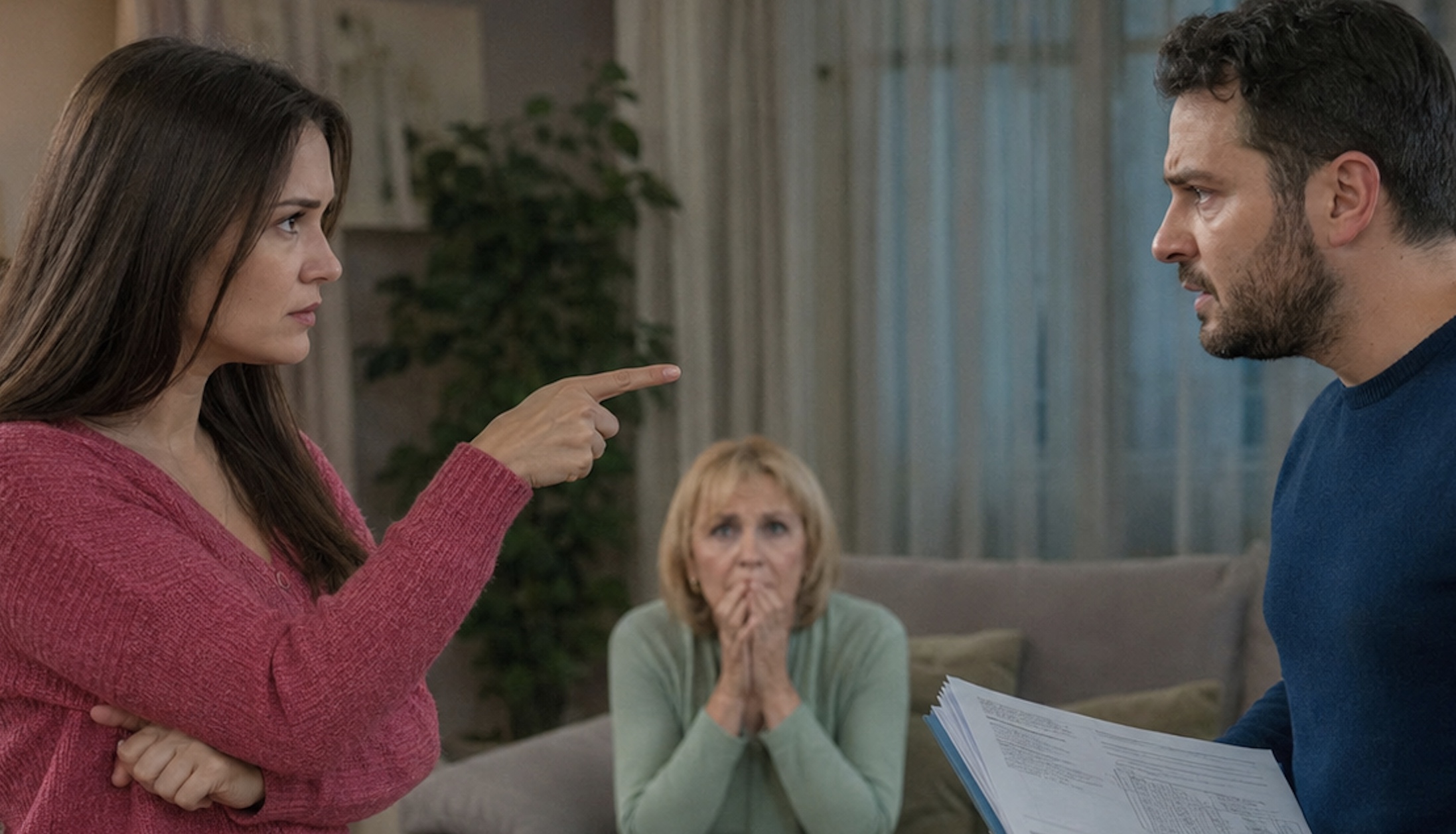
Victoria did not immediately understand when conversations about money had become part of the very air in their family. At some point, she simply began to notice that Rostislav was leaving the room more and more often, closing the door behind him and speaking in a lowered voice. That was how people spoke when they did not want to be overheard. She was not eavesdropping. One day, she had simply walked out of the kitchen with two mugs of tea and stopped by the wall because she heard her own name.
“Vika won’t understand, Mom. You know she’s already on edge after what happened last time.”
Victoria did not stay to hear the rest. She put the mugs back on the table, sat down, and stared out the window, where darkness was already gathering.
They lived in Yekaterinburg, in a two-room apartment they had bought with a mortgage five years earlier. The apartment was registered in both their names, and they split the mortgage payments equally. Victoria worked as a senior accountant at a construction company and earned about 68,000 rubles a month. Rostislav worked in procurement at a factory, and his salary was around 75,000. By the standards of their city, they were not poor, but they did not have much extra either, especially considering their monthly mortgage payment of 32,000 rubles.
Veronika Pavlovna, Rostislav’s mother, lived in Chelyabinsk. She had her own apartment, a small pension, and a little side income from teaching English to schoolchildren, though she did that only from time to time.
Victoria had met her mother-in-law several times during holidays and had always noticed the same thing: Veronika Pavlovna knew how to talk about her troubles in such a way that the listener immediately felt the urge to open their wallet. She did not pressure anyone or demand anything. No. She spoke quietly, with dignity, slightly lowering her eyelids, and in that silence it somehow became obvious that the person was suffering. Rostislav reacted instantly to that tone.
In the first years, Victoria wrote off the transfers to his mother as a son’s duty. A person helps his parents — what was wrong with that? The amounts were small: five thousand for medicine, eight thousand for utilities. Victoria did not interfere. She considered it her husband’s personal matter. Besides, Rostislav never took money from their shared budget; he transferred it from his own card.
Then something began to change. Slowly, almost imperceptibly — like a crack in a wall that you do not notice until it has spread all the way to the ceiling.
The amounts became larger. Fifteen thousand urgently for dental work. Twenty thousand because Veronika Pavlovna had borrowed money from a friend and the friend had asked to be repaid. Thirty thousand for something Rostislav explained vaguely, something about utility debts that had built up over the winter. Victoria asked questions, but her husband answered briefly, without details, and quickly changed the subject. She began to notice that the transfers were no longer coming only from his personal card. Sometimes money disappeared from their shared account, the one they both had access to.
One evening, Victoria sat with her laptop, checking the statement from their joint account. She was preparing to speak with the mortgage manager about early repayment. That was when she discovered a transfer of forty-two thousand rubles made three weeks earlier. The recipient was Veronika Pavlovna.
Rostislav came home late that evening. Victoria waited until he sat down to dinner, then placed the printed statement in front of him.
“What is this?”
Rostislav looked at the paper, then at Victoria.
“Mom asked. She needed it urgently.”
“Forty-two thousand was urgent?”
“Vika, don’t start.”
“I’m not starting anything. I’m asking. This is our shared account, Rostik. We both put money there for the mortgage and household expenses. You took it from there without saying a word to me.”
Rostislav put down his fork.
“She was in trouble. What was I supposed to do, wait until you approved it?”
“Yes. Exactly. Wait. Because that money was not yours alone.”
Her husband got up from the table and went into the bedroom. Victoria remained in the kitchen with the cold dinner and the printed statement no one had bothered to take.
Around that time, she began putting money aside separately. Not out of greed, but out of caution. She opened a deposit account at the bank and transferred a fixed amount into it every month: first ten thousand, then fifteen. She did not tell Rostislav. Not because she was hiding it, but because she understood that if she said it out loud, he would take it as a declaration of war. Victoria did not need a war. She needed a safety cushion. Just in case.
And that “just in case” did not take long to arrive.
It happened in October. Victoria stayed late at work and came home around eight in the evening. She put her bag by the door and immediately felt that something was wrong. Rostislav was sitting on the sofa with his phone in his hands, staring at the screen with an expression Victoria knew well. That was how her husband looked when he had already made some decision and was now preparing to explain it to his wife.
“Hi,” Victoria said, taking off her jacket.
“Hi. Sit down. We need to talk.”
She sat down in the armchair opposite him. Rostislav placed his phone on the cushion.
“Mom needs help. Serious help.”
“What happened?”
“Her apartment is a complete disaster. The pipes are leaking, the windows are rotten, the floors have swollen up. She’s been saying for a long time that repairs needed to be done, but she kept putting it off. Now it’s impossible to live there.”
Victoria was silent for a second.
“And what are you suggesting?”
“I’ve already decided everything.” Rostislav said it evenly, even quietly. “I took out a loan. For the repairs. Two hundred and fifty thousand, for three years. We’ll pay it together — you and me.”
Victoria did not move. She only looked at her husband. Then she asked slowly:
“You took out a loan?”
“Yes.”
“For repairs in your mother’s apartment? And you did that without saying a word to me?”
“Vika, you wouldn’t have agreed. I know you. You would have started talking about our budget, about the mortgage.”
“Because we have a mortgage!” Victoria stood up from the armchair. “Because every month we pay thirty-two thousand, and we have our own expenses, and we’ve already been helping your mother for years!”
“She’s alone! She has no one to rely on except me!”
“Rostik, the fact that she’s alone is not my fault. And it does not mean I’m obligated to pay her loan.”
Rostislav stood up too. His expression turned wounded — exactly wounded, not angry. Victoria knew that mask. It was the way he looked when he considered himself a victim of someone else’s lack of understanding.
“You talk about my mother as if she’s a stranger.”
“I’m talking about money you took on without my consent. That is not the same thing.”
“The loan is in my name! I took it out myself. I’m just asking you to help with the payments.”
“You’re asking. So I can refuse?”
Rostislav fell silent. In that pause, Victoria saw the answer: no, in his mind, she could not refuse. Because he had already decided everything. Because this was family. Because his mother was alone. Because — underline whichever reason applied.
Victoria felt the blood rush to her face. She stood in the middle of the living room and felt something inside her settle very clearly into place. It was not anger. It was more like clarity. The kind that comes when you have been looking at a blurry picture for a long time, and then suddenly its outlines become sharp.
“A loan for your mother’s renovation?” Victoria repeated. Her voice was calm, almost ordinary. “Excellent. Let her pay it back.”
Rostislav stared at his wife.
“What?”
“I will not pay that loan. Not a single ruble. You took it out without me, so you will service it. Or let Veronika Pavlovna help, since the repairs are for her.”
“Vika, are you serious?”
“Absolutely.”
Rostislav ran a hand through his hair. Then again. Victoria could see him searching for an argument that would work — and failing to find one.
“Do you understand how cruel that is? She’s an elderly woman, she can’t…”
“Rostik, stop.” Victoria raised her hand. “I am tired of this conversation. Not just today’s conversation — all the conversations from the last three years. Every time it’s the same thing: Mom asked, Mom is in trouble, Mom can’t cope. And every time it ends with me silently agreeing because I don’t want a scandal. But now you’ve taken out a loan. Without discussion. You simply came home and informed me that I would now be paying it too. That is not a request. That is something else.”
Rostislav said nothing.
“I am not paying that loan,” Victoria repeated. “That is my final word.”
The scandal that followed was long. Rostislav spoke about family obligations. Victoria reminded him of the forty-two thousand taken from the shared account. Rostislav said she was destroying his relationship with his mother. Victoria answered that only something built on honest foundations could be destroyed. Rostislav said she had never understood what real family meant. Victoria looked at her husband for a long moment and said nothing. She simply turned around and went to the kitchen.
Late that evening, Rostislav packed a bag and said he was going to stay with a friend. Victoria nodded. He seemed to expect her to say, Don’t go, let’s talk, I’ll think about it. But Victoria sat silently with a book she was not reading and stared at the page.
The door closed.
The first days were strange. Quiet. Victoria walked around the apartment and noticed how much space there suddenly seemed to be — not physically, no, the square footage had not changed. It was just that the constant background tension had disappeared, the one she had lived with for so long that she had stopped noticing it. In the morning, she could drink her coffee in peace. In the evening, she did not have to wait for a call from Veronika Pavlovna. She did not have to wonder how much they would have to give this time.
Rostislav called. At first rarely and coldly, asking whether Victoria had come to her senses, making it clear that he expected the first step from her. Victoria answered calmly, without aggression, but firmly: no, she had not come to her senses, and she was not going to pay the loan. Then the calls became more frequent, and his tone changed. Rostislav stopped waiting for her to meet him halfway and began to pressure her.
“Vika, I can’t handle this payment alone. I have the mortgage, the loan — you understand that, don’t you?”
“We have the mortgage,” Victoria corrected him. “I pay my half regularly.”
“But the loan is ours too. We are a family.”
“Rostik, you took that loan yourself. For your mother. Without including me in the decision. It is not ours. It is yours.”
“So you don’t care how I manage?”
Victoria closed her eyes. She was tired of this logic — this certainty that she was obligated to save him, that her disagreement was the same as betrayal.
“It’s not that I don’t care. But you have Veronika Pavlovna. Maybe she can help with the payments? Since the repairs were done for her.”
Rostislav hung up.
A week passed. Then another. Victoria waited — not consciously, exactly, but she left a small gap in her mind: perhaps her husband would call differently. Not to pressure her, but to talk. Truly talk. Maybe he would finally stop and think — not about money, but about what was happening between them.
But Rostislav called again with the same conversation. He could not manage alone. It was unfair. She had abandoned him in a difficult moment.
Victoria sat on the windowsill and looked out at the street. October in Yekaterinburg was gray and muddy, the trees almost bare. She listened to her husband’s voice on the phone and thought not about the loan, but about how many times over the past few years her opinion had actually been taken into account. How many times had Rostislav come to her not with a ready-made decision, but with a question? How many times had he asked, “Vika, what do you think we should do?”
The honest answer was: almost never.
A month after that evening, Victoria went to see a lawyer. She simply wanted to understand her rights. The lawyer explained briefly: the loan was in Rostislav’s name only, Victoria had nothing to do with it and was not obligated to pay it. The apartment was jointly owned and would be divided equally in a divorce. Her personal savings were hers alone, and her husband had no access to them.
“Tell me,” Victoria asked, “if I file for divorce, can he claim my savings?”
“No,” the lawyer answered. “If it is your personal account and you can prove that the money deposited there came only from you, then no.”
Victoria nodded. Thanked him. Went outside.
She stood for a while near the steps. She thought that Rostislav was probably sure she would give in any day now. Because that was how it had always been. Because she had always given in — not immediately, but eventually. The familiar routine, the familiar pattern. Scandal. Silence. Concession. Forgetting.
Only this time, the pattern did not work.
Victoria filed for divorce in early November. Rostislav found out from the lawyer and called immediately. His voice sounded unlike anything Victoria had ever heard from him before. Not angry, not offended — confused. Truly confused.
“Are you serious? You filed for divorce?”
“Yes.”
“Because of a loan?”
“Not only because of the loan, Rostik.”
“Then because of what?”
Victoria was quiet for a moment. Then she said:
“Because in three years I never became a person you consulted. I was a convenient source you could take from — money, silence, agreement. That is not a marriage. That is something else.”
Rostislav did not answer for a long time. Victoria could hear his breathing through the phone.
“I didn’t think it looked that way,” he finally said.
“I know,” Victoria replied. “That is the problem.”
The conversation ended without a scandal. It simply broke off — quietly and somehow very tired on both sides.
The divorce process lasted about two months. At first, Rostislav tried through his lawyer to raise the issue of jointly owned property and Victoria’s personal savings, but he was quickly told that savings built up in a separate account were not subject to division. They did not divide the apartment. They agreed that Victoria would buy out Rostislav’s share in installments. The numbers were settled without scandal, through a mediator. Rostislav seemed to have already understood that he would get neither sympathy nor money here.
The loan for the renovation of Veronika Pavlovna’s apartment remained with Rostislav. Two hundred and fifty thousand rubles, three years, a monthly payment of about eight thousand.
Maybe Veronika Pavlovna helped her son with the payments. Victoria did not know and did not want to know.
Victoria paid off Rostislav’s share from her savings. That was exactly what she had been saving for, without fully understanding it at the time. She had simply felt that she needed a safety cushion.
In the evenings, Victoria sometimes sat in the kitchen with a cup of tea and thought — not about Rostislav, not about Veronika Pavlovna, not about the loan. She thought about how strangely life worked: sometimes you make the most important decision not when you are ready, but when you simply can no longer do otherwise. Not because you have become stronger or wiser, but because your patience has run out, and beneath it you discover something solid. Something you can push yourself up from.
She did not regret it. That was perhaps the strangest thing — there was no regret. There was exhaustion, and at first there was confusion. But regret? No.
In the spring, Victoria did a small renovation in the apartment. She chose the wallpaper herself, arranged everything with the workers herself, and supervised the work herself. She paid with her own money — honestly earned, honestly saved. She did not ask anyone for help. She did not borrow from anyone. She did not present anyone with a decision after the fact.
When the workers finished and left, Victoria stood in the middle of the refreshed living room, looked around, and for some reason smiled. On the windowsill stood a small cactus in a clay pot. She had bought it back in winter, simply because she liked it.
Victoria put the kettle on. Then she sat by the window. Beyond the glass, April was beginning — damp and windy, but already carrying the scent of something alive.