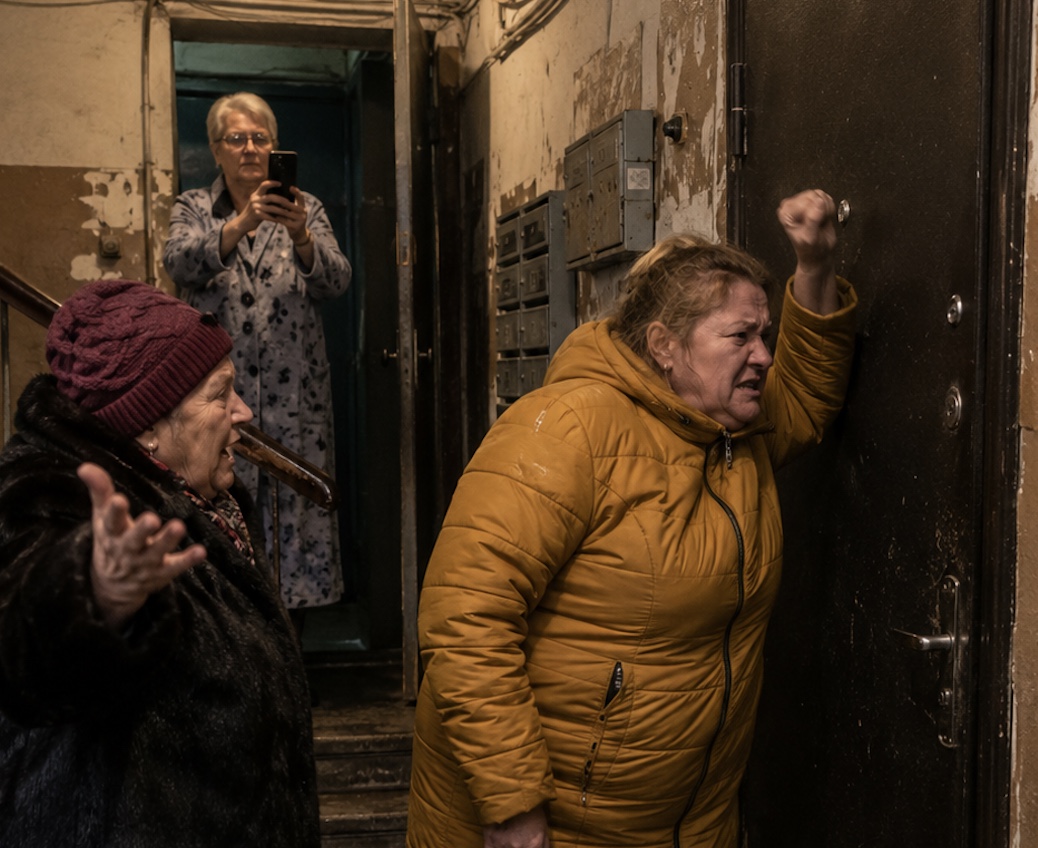
At half past seven on a Saturday morning, someone started pounding on my door as if there were a fire, a flood, and the tax police all at once.
I was making coffee at that exact moment. The good kind — in a cezve, with cardamom. The only little luxury I allowed myself after the divorce. The coffee began to rise, the foam swelling toward the rim, and right then—
BANG. BANG. BANG.
I turned off the stove. Walked to the door. Looked through the peephole.
And quietly said out loud into the empty hallway:
“Well, would you look at that. They finally showed up.”
Standing outside my door were two people: my former mother-in-law, Galina Arkadyevna, and her daughter, my former sister-in-law, Svetlana. Svetlana was holding two huge plaid market bags — the kind shuttle traders used in the nineties to haul Turkish jackets. Galina Arkadyevna had a folder of documents in her hand and the face of a woman who had arrived to administer justice.
Let me give you some context.
I divorced their son and brother, Oleg, a year and three months ago. We divorced, as people like to say, “civilly” — no scandals, no division of property, because there was nothing to divide. The apartment was mine before marriage; I inherited it from my grandmother back in 2009. The car was his, so he took it. What we had acquired together amounted to an Atlant refrigerator and a dog named Musya, a mongrel mixed with hope. I kept the fridge. I kept Musya too. Oleg didn’t object.
The divorce was quiet. Oleg moved to Krasnodar, to a new woman he had met, as it later turned out, six months before our divorce. Fine. I had already cried that out of my system.
Three weeks ago, Oleg died. His heart. He was forty-four.
I found out by accident from a mutual acquaintance. I didn’t go to the funeral because no one invited me. I lit a candle for him in a church near Sokol, remembered him at home with my friend Lena over cognac and a salted pickle, and that was that.
And now here we were — Saturday, eight in the morning, and they were standing outside my door.
“Anna!” Galina Arkadyevna shouted so loudly that my windowpanes rattled. “Open this door immedia
tely! We know you’re home!”
I didn’t open it.
I stepped away from the door, sat down on the little stool in the hallway, and drank my coffee.
With cardamom.
“Anya!” Svetlana called next, in a softer voice. “Anya, open up. We just want to talk. Like normal people.”
I knew very well what “like normal people” meant when Svetlana said it. It meant spending eight years at every family gathering asking, “So when are you two finally going to have children? The clock is ticking.” And when it turned out we wouldn’t be having children because, as it happened, Oleg was the one with the problem, Svetlana confidently explained to the whole family that “Anka is just a career woman, she doesn’t want kids.”
“Ladies,” I called through the door, taking another sip of coffee, “I didn’t invite you. Leave.”
“Anya, this is about Oleg!” Galina Arkadyevna switched into tragic mode. “We have questions!”
“You do. I don’t. Goodbye.”
That was when it began.
“Open up, you shameless woman!” my former mother-in-law wailed. “We buried our son! We are grieving! And you’re sitting there drinking coffee!”
How did she know about the coffee? Probably the smell through the door. Cardamom is stubborn like that.
“Anna Sergeyevna!” Svetlana said now, switching to an official tone. “We have a property matter to discuss. Oleg left some of his belongings here while he was alive. We came to collect them.”
I set my cup down on the little cabinet. Walked back to the door.
And here is the important part: I turned on the voice recorder on my phone.
Not because I am especially careful by nature. My friend Lena, who is a lawyer, taught me this during the divorce. “Anya,” she told me back then, “record everything with that family. They’re not done making you bleed.”
“Svetlana,” I said calmly through the door, “Oleg moved out of this apartment a year and four months ago. He took all his things with him then. Personally. I even helped him load two boxes into the trunk. There is not one single thing of his here. Not one.”
“You’re lying!” my former mother-in-law shrieked. “His television is there! His computer! His coin collection!”
I nearly choked on the audacity.
“Galina Arkadyevna. The television is mine. I bought it on credit in 2018, and I still have the receipts. Oleg took the computer. He used it for work in Krasnodar. You yourself called me a year ago and screamed that I had dumped an ‘old system unit’ on him. And what coin collection? Oleg never had any coin collection. He loved football and beer.”
“There was a collection!” she insisted. “His grandfather’s! Silver rubles!”
“Galina Arkadyevna,” I said, smiling at the door, “you sold your grandfather’s silver rubles yourself in 2015 to buy Svetlana a fur coat. You cried to Oleg about it in the kitchen. I heard you. Mink, wasn’t it? From that atelier on Preobrazhenka.”
Silence fell outside the door.
All I could hear was the melting snow dripping from their boots onto my doormat.
Then Svetlana changed tactics.
“Anya,” she said quietly, with feeling, “let’s do this peacefully. We used to be family. Open the door. We’ll have tea. We’ll talk. Mom’s blood pressure is up.”
“Your mother’s blood pressure has been up since 1987,” I replied. “I know. Her validol is in the right pocket of her coat, and her blood pressure monitor is at home. Don’t call an ambulance. Spare the paramedics.”
“You little bitch!” Galina Arkadyevna snapped, shifting right back into combat mode. “Do you even understand that Oleg owned a share of this apartment?”
There it was.
I knew this was where they were heading. I had simply been waiting for them to say it out loud — on record.
“What share, Galina Arkadyevna?” I asked sweetly. “Please explain. This is very interesting.”
“A marital share! You lived together for eight years! Oleg invested in renovations! He had rights!”
“Oleg had rights,” I corrected her. “Past tense. And the renovation was done in 2017, when I received a bonus. I have the bank statement and the contract with the crew, where I am listed as the payer. The apartment was inherited from my grandmother in 2009, before I ever met your son. Under the Family Code, it is not considered jointly acquired property. Would you like me to name the article?”
“You monster!” my former mother-in-law sobbed. “My son is in the grave, and she’s quoting legal articles!”
That was when the circus really started.
They began pounding on the door — not just with their fists, but, judging by the sound, with one of the bags. That same plaid bag. Beating a door with a market bag takes a special kind of talent.
The door across the landing opened.
It was Raisa Mikhailovna, my neighbor — a seventy-two-year-old “sweet little old lady” with whom I had been friends for years. I carried groceries for her from Pyaterochka, and she baked cabbage pies for me.
“Ladies,” Raisa Mikhailovna said in the kind of voice that used to disperse Soviet-era lines for sausage, “who exactly are you here to see?”
“None of your business, grandma!” Svetlana barked.
Big mistake.
“Oh, it isn’t?” Raisa Mikhailovna said gently. “Well, let’s find out whose business it is.”
I heard the familiar swish — Raisa Mikhailovna pulling out her smartphone. Her grandson had given it to her for her seventieth birthday, and ever since then she filmed everything: cats in the courtyard, illegal parking, the janitor smoking by the trash bins. She even had her own group on Odnoklassniki.
“I’m recording,” she announced briskly. “For the record. Please introduce yourselves. What are you doing in this stairwell at eight in the morning on a Saturday? Why are you trying to break down a door?”
“Put that phone away, you old hag!” Galina Arkadyevna snapped.
Calling Raisa Mikhailovna an old hag was something she would never forgive. I say this as her neighbor.
“Well, well, well,” Raisa Mikhailovna sang. “Insults, threats, attempted entry. Anya, are you alive in there?”
“I’m alive, Raisa Mikhailovna!” I called back. “Drinking coffee!”
“Drink it, sweetheart, drink it. I’ll do a bit of filming out here.”
And then it happened — the thing I had been waiting for.
Svetlana, whose nerves turned out to be weaker than her mother’s, swung one of the plaid bags and smashed it against my door with all her strength. The bag split open at the seam, and out spilled…
Laundry.
Old bedding. Yellowed with age. Tiny forget-me-not flowers printed all over it. Sheets, pillowcases, a duvet cover.
Svetlana froze.
Galina Arkadyevna froze.
Raisa Mikhailovna kept filming.
I couldn’t resist. I opened the peephole wider and looked.
“What is that?” I asked through the door. “Why did you bring that?”
Svetlana turned red as a tomato.
“It’s… it’s Mom’s. We… we wanted to leave it for you. As a memory.”
“A memory?” I repeated. “Of what? Of your mother saying at our wedding that I wasn’t good enough for Oleg? Or of you asking me at my birthday five years ago whether I was afraid my husband would leave me for ‘a normal woman’? Thank you, ladies. My memory is excellent without the bedding.”
“Anna,” Galina Arkadyevna tried one last card, “you have to understand. Oleg left that… new woman in Krasnodar. And she’s taking everything. Everything! And we, his mother and sister, get nothing. What would it cost you to give us his fishing rods? Anything of his you still have!”
And that was when I understood the truth.
They hadn’t come to me for an inheritance.
They had come to unload their rage because in Krasnodar someone had shown them the door. That same “new woman” I had cried over a year earlier had apparently turned out to be sharp enough to handle everything properly from the start.
So they came to me.
To the ex-wife.
To the one they thought they could trample over without consequences.
They thought they could.
I opened the door.
Not to let them in.
To look them in the eye.
They stood there against a backdrop of scattered little forget-me-not sheets — two women who had spent eight years treating me like a servant assigned to their precious Oleg.
“Galina Arkadyevna. Svetlana. Listen carefully, because I won’t repeat myself. I do not have his fishing rods — Oleg took them. I do not have his things. He had no share in this apartment, does not have one, and never will. I have no claims against Oleg’s new wife, and she has none against me. We actually spoke after the funeral, and she is a perfectly decent woman. Now take your sheets and leave. And never — do you hear me? Never — come to my door again. Otherwise, our next conversation will take place at the police station.”
“How dare you—” my former mother-in-law began.
“Raisa Mikhailovna,” I said calmly, without taking my eyes off her, “please write a statement for the district police officer. And send me the video on WhatsApp. I’ll attach it to my complaint.”
“I’m sending it already, Anechka,” Raisa Mikhailovna replied. “Just remind me of the station address.”
Svetlana hurriedly began gathering the bedding back into the torn bag. Galina Arkadyevna stood there opening and closing her mouth like a fish on a riverbank.
“You’ll regret this,” she finally hissed.
“I already have,” I replied. “For eight years. That’s enough.”
And I closed the door.
I stood there for a second and listened.
I heard them muttering angrily at each other as they stomped down the stairs. Heard Svetlana drop the duvet cover on the landing. Heard Raisa Mikhailovna comment with obvious pleasure, “Young lady, you dropped a pillowcase. Pick it up, please. We have a clean entrance here.”
I went back to the kitchen.
My coffee had gone cold.
So I made myself a fresh cup and sat by the window.
A minute later, there was a soft knock at the door — delicate, with knuckles.
Raisa Mikhailovna.
“Anya, open up, don’t be afraid. It’s me.”
I opened the door.
Raisa Mikhailovna stood there holding a plate covered with a towel.
“I brought you some pies. Cabbage. Baked them this morning, they’re still warm. You’re drinking coffee on an empty stomach again, I know you.”
“Raisa Mikhailovna,” I said, and my nose treacherously began to sting. “Thank you.”
“Oh, nonsense,” she waved me off. “What are neighbors for? And as for those two, I’ll sit down and write that statement right now. My grandson is a district officer in the next neighborhood. He’ll tell me the proper form. You just make sure you save the video.”
“I will.”
“And another thing, Anya…” She hesitated. “Don’t be angry with me, an old woman. I heard how you spoke to them. I always thought you were quiet. But you — well, you’re something else.”
I laughed.
For the first time that day. And maybe for the first time that week.
“I didn’t know it myself, Raisa Mikhailovna. I thought I was quiet too.”
“You are quiet,” she nodded. “But quiet people, my dear, when they finally explode, are louder than anyone. I’m telling you this as an old teacher.”
Two days later, Raisa Mikhailovna posted the video on Odnoklassniki, in her group called “Our Yard.” The video spread through the whole neighborhood. Neighbors from the next entrance stopped me by the trash bins to ask if everything was all right. Random grandmothers pressed apples and candies into my hands.
Galina Arkadyevna and Svetlana never came back.
After my complaint and Raisa Mikhailovna’s video, the district police officer issued them an official warning. It took exactly one week.
And since then, every Saturday morning, I make coffee with cardamom.
And do you know what I realized?
Sometimes the strongest protection is simply this:
Do. Not. Open. The door.
Not literally.
Not figuratively.
Especially not to people who spent eight years wiping their feet on it.