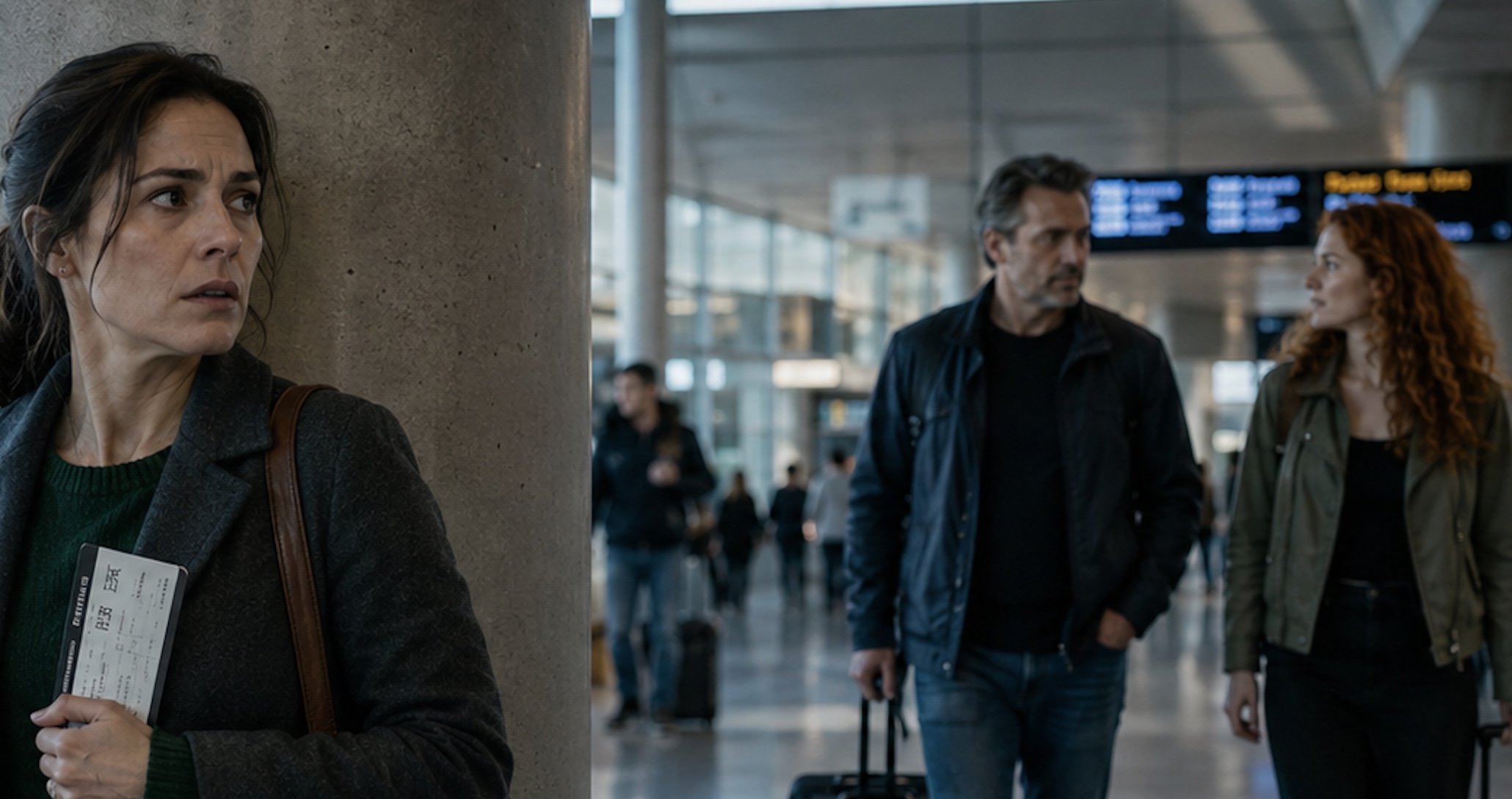
Galina was flying to Samara for three days. Her flight was canceled, so she stayed in the waiting area. And then she saw her husband with a suitcase. He was not alone.
The flight to Samara was canceled at 2:07 p.m. Galina stood in front of the departure board and watched the letters change: first “Delayed,” then “Canceled.” She was still holding a paper cup of coffee she had not managed to finish.
In her bag were documents for the conference, forty printed pages of her presentation, and a charger she always forgot but had somehow remembered to pack today. Galina called the coordinator, explained the situation, and received a calm reply: “We’ll move it to tomorrow. Don’t worry.” She was not worried. She simply stood there, wondering what to do with an evening that had suddenly become free.
She could have gone home. But Kostya had said that morning that he would be at the construction site until late and then would stop by Lesha’s place to discuss a project. The apartment would be empty, the cat had been fed by the automatic feeder, and she had cleared out the refrigerator before leaving. Galina sat down on a metal bench near Gate B7 and decided to wait. Maybe they would offer another flight.
The bench felt cold even through her coat. Nearby, an eight-year-old boy was sitting with a tablet while his mother spoke on the phone, covering her mouth with her hand. Galina stretched out her legs and felt her feet aching. That morning, she had spent two hours standing in heels while packing her things and explaining to her mother-in-law over the phone that there was no need to feed the cat.
Her mother-in-law, Zinaida Pavlovna, called every time Galina went away. Not because she was worried. Because she believed a woman should not go on business trips if she had a husband at home.
“Galinka, what kind of job is this, always sending you somewhere?”
“They don’t send me, Zinaida Pavlovna. I’m going myself.”
“There you go. Yourself. And Kostik is left all alone.”
Kostik. He was forty-one years old. He owned a construction company, had two foremen and a part-time accountant. He was not sitting alone. He drove to job sites, had dinners with partners, watched football, and went to bed without waiting for her call. Galina had stopped taking offense at it long ago. She had simply noticed.
She bought a second coffee and a cheese sandwich, which turned out to be cold and tasteless. The cheese stuck to the roof of her mouth. Galina chewed and watched people.
An airport at four in the afternoon is a strange place. It is neither the morning rush nor the evening crowd. It is some in-between hour when everyone moves slowly, as if no one is in a hurry. A woman in a red scarf rolled an enormous suitcase past her. Two men in identical gray suits walked in perfect sync like twins, though one was a head taller than the other.
Galina opened her phone. She wrote to Kostya: “My flight was canceled. I’ll wait for the next one.”
He replied twelve minutes later: “Ok. I’m at the site. Good luck.” And a thumbs-up emoji.
She put the phone into her coat pocket and finished her coffee. Twelve minutes. Once, he used to answer within seconds. He would call himself if she stayed silent too long. He would call back if her message seemed too short. Galina could not remember when that had changed. There had been no specific day. Just one day, his replies began arriving later, and the words in them became shorter.
And she got used to it.
Habit is a strange thing. It seeps into you unnoticed, like water slipping through a crack between a window frame and the wall. At first, you do not see it. Then you notice a stain on the wallpaper. And then it is already too late, and the whole frame has to be replaced.
Galina stood up, threw away the cup, and walked around the terminal. Her feet carried her past perfume and chocolate shops, past the pharmacy, past a newsstand. She stopped in front of a display window selling travel pillows. Pink, gray, dark blue with an embroidered owl. She thought the owl looked like her mother-in-law: round eyes and a disapproving beak.
And then she saw Kostya.
He was walking from the entrance toward the departure area. Dark jacket, jeans, sneakers. A black medium-sized suitcase on wheels. Not the one he used when he visited clients. That one was small, carry-on size. This one she had never seen before.
Galina did not move. Her feet seemed rooted to the floor beside the display of owls.
A woman was walking next to him. Shoulder-length red hair, green jacket, white sneakers. She was saying something to him, tilting her head slightly to one side, and he was listening. Not the way he listened to Galina when she talked about work: half-turned away, phone in hand. He was listening with his whole body. Turned toward her. Leaning in slightly.
Galina stood three meters away from the shop window and watched. Her fingers found the edge of her scarf on their own and began twisting it. She was not breathing. Not because she had deliberately held her breath, but because she had simply forgotten breathing was necessary.
They passed by. Kostya did not turn his head. The woman laughed, and he smiled. Galina knew that smile. The left corner of his mouth lifted slightly higher than the right, and a dimple appeared in his cheek — the one he hated and the one she had once kissed, telling him it was the most beautiful place on his face.
They walked toward the check-in counters.
Galina lowered her eyes. Someone’s boarding pass was lying on the floor, trampled. She stared at it and thought: nothing. Absolutely nothing. Emptiness.
And then it hit her.
She sat down. Not on a bench, but right on the floor against the wall, between the pharmacy and the travel pillow shop. Her knees bent on their own. Her coat rode up her back, and she felt the cold tile through her jeans.
A minute passed. Maybe five. A woman from the pharmacy looked out and asked:
“Are you feeling unwell?”
“No. Everything’s fine.”
The woman looked at her, hesitated, and went back inside. Galina sat there. A suitcase rolled past, humming over the seams between the tiles. Somewhere, boarding was announced for a flight to Sochi. Sochi. She and Kostya had been there four years ago. He had gotten sunburned on the very first day, and she had rubbed kefir on his back because there had been no cream in the room. He had hissed and laughed at the same time.
Four years. Or five. She was no longer sure.
Her phone buzzed in her pocket. A message from the coordinator: “New flight tomorrow at 9:40. Your ticket has been reissued.”
Galina read it and turned off the screen. Tomorrow. She had to make it until tomorrow.
She stood up, brushed off her coat, and walked toward the exit. Her legs obeyed. Her hands did not shake. Her face was calm. If someone had looked at her in that moment, they would have seen a thirty-eight-year-old woman in a beige coat, with her hair tied back and a bag over her shoulder. An ordinary woman walking toward a taxi.
In the taxi, she gave her address and leaned back against the seat. The driver turned on the radio. A song she did not know was playing. Something slow, with a guitar.
“Should I open the window? It’s a bit stuffy,” the driver asked.
“No. Thank you.”
She looked out the window. The road from the airport passed a gas station, a construction hypermarket, and a long fence covered with an advertisement for a residential complex. “Your New Home.” The letters were huge and yellow against a blue background. Galina turned away.
At home, she opened the door and stepped into silence. The cat, gray with a white spot on his chest, came over and bumped his forehead against her leg. The automatic feeder clicked, releasing a portion of food. The cat turned around and went to eat.
Galina put her bag on the floor, took off her coat, and hung it on the hook. She removed her shoes. Walked into the kitchen. Turned on the light.
The kitchen looked exactly as she had left it that morning: clean countertop, empty sink, two chairs pushed under the table. On the refrigerator was a magnet from Sochi. A dolphin with a stupid smile.
She turned on the tap and filled a glass with water. She drank slowly, in small sips, hearing the water pass down her throat. Her stomach tightened.
The first thing she did after putting the glass down was check his suitcases. She went into the storage room, where three suitcases usually stood, and counted. The small gray one for business trips. The large blue one they used for vacations. The medium black one was gone.
She already knew it. But she needed to see the empty space on the shelf. She needed the absence to become physical, tangible. Here was the shelf. Here were two suitcases. Here was the gap between them, wide enough for a hand.
Galina closed the storage room and sat down at the kitchen table.
What she knew: her husband had said he would be at the construction site. Her husband had been at the airport with a woman and a suitcase. Her husband was flying somewhere. Not alone.
What she did not know: where. With whom exactly. For how long. Why.
And most importantly: what now?
She sat there and went through the last few months like someone turning pages in a photo album: this evening, that conversation, that Sunday when he left at ten in the morning and came back at nine at night smelling of someone else’s perfume. No, not perfume. Back then she had thought it was construction dust, solvent, something chemical. Or maybe it had been perfume. Maybe she simply had not wanted to recognize the smell.
And that phone call in November. She had entered the room, and he had quickly put his phone away. Not hidden it, exactly, but placed it screen down on the table, like a card he did not want to show. She had asked, “Who called?” He had said, “A client.” And she had nodded.
Because that was easier.
Because if you start asking questions, you have to hear the answers.
At eight in the evening, she warmed up soup that had been left in the freezer. Chicken soup with noodles. She ate slowly, without tasting it, only because her body demanded food. The spoon tapped against the edge of the bowl. The cat sat on the windowsill and watched her with yellow eyes, not blinking.
“Well, Barsik. We’ll have to think.”
The cat blinked and turned toward the window.
Galina washed the bowl, put it in the drying rack, and took out her phone. She opened Kostya’s call history. The last incoming call from her: today, 2:23 p.m. The last outgoing call from him: the day before yesterday, short, forty seconds. She scrolled further. Calls once every two or three days. Short ones. “I’ll be late.” “Buy bread.” “Don’t forget the cat.”
When was the last time they had spoken on the phone for more than five minutes? She could not remember.
And the red-haired woman. She was about thirty, maybe thirty-two. Her green jacket fit her well, like something chosen carefully, not grabbed from a hanger. And she tilted her head when she spoke. That gesture belonged to people who were used to being listened to.
Galina caught herself trying to remember the woman’s face. She could not. Only red hair, a green jacket, and that tilt of the head. Everything else had blurred, as if she were looking through wet glass.
Maybe she was a colleague. Maybe a business partner. Maybe they had ended up on the same flight by chance.
And the suitcase? The new black suitcase that was not in the storage room?
And that smile. The dimple in his left cheek.
No. Galina knew. Her body had known before her mind did: that was why her legs had failed beside the display of owls, why she had forgotten to breathe, why she had sunk to the floor. The body always knows first.
She did not call him. She did not write. She did not check his email or search through his messages. Instead, she took an old sports bag from the closet and began packing things.
Not hers. His.
The shirts he had left on the bedroom chair. His razor from the bathroom shelf. His laptop charger. Slippers. Socks from the laundry basket.
She folded everything neatly, the way people pack for a move: in even stacks, tightly. The bag filled slowly. There were not many things. Most of his belongings were in the wardrobe, but she did not touch those. Not yet.
Barsik came over and sat beside the bag. He sniffed a shirt.
“Not yours,” Galina said.
She zipped the bag halfway and placed it in the hallway. Then she returned to the kitchen and sat at the table again.
Twelve years. They had been together for twelve years. They had met at the birthday party of a mutual acquaintance, Lena Voronina, who lived on Profsoyuznaya Street back then. A small apartment, too many people, someone had brought a guitar, someone had spilled wine on the carpet. Kostya stood by the window, smoking through the small open vent. Galina went over to ask for a lighter. She did not smoke. She simply went over.
He handed her the lighter and said:
“You don’t smoke.”
“How do you know?”
“Your fingers are clean.”
She laughed. He smiled. The dimple.
Twelve years, one cat, one apartment, no children. Not because they had not wanted them. First they postponed it, then it did not happen, then they stopped talking about it. The way people stop talking about things that hurt when touched.
At ten in the evening, he wrote: “I’ll be late. Don’t wait.”
Galina read the message and placed the phone on the table screen down. Like a card.
She took a shower. The water was hot, almost scalding. She stood under the stream and felt her skin redden, steam filling the bathroom, the mirror clouding over. She dried herself, put on an old T-shirt, and lay down in bed.
Sleep did not come. She lay on her back and stared at the ceiling. A crack in the plaster, which Kostya had promised to fix last year, stretched from the chandelier toward the corner. Thin as a hair.
The strange thing was that she did not cry. She did not scream. She did not call a friend to pour everything out. Inside her there was something else. Not pain, not anger. Something heavy and empty at the same time, like a suitcase packed with air.
She thought about how she had to fly to Samara the next morning. The conference. A forty-page presentation. People waiting for her speech. And she would go. She would get up, get dressed, take her bag, and go back to the airport. The same airport.
And then she would return.
And then.
Then.
She turned onto her side and closed her eyes. Barsik jumped onto the bed and lay at her feet. His warm body vibrated with purring.
Morning came quickly. The alarm rang at six. Galina got up, and the first thing she saw was that his side of the bed was empty, untouched. The pillow was smooth, the blanket neat. He had not come home.
She washed her face, dressed, and drank coffee standing by the window. Outside, a fine rain was falling, and the asphalt shone like a polished table. She ate an apple, though she did not want food. It was sour and crunched so loudly it seemed the whole building could hear it.
Her travel bag stood by the door. The one for Samara. Beside it stood the sports bag with his things. She looked at both and thought: two bags, two directions. One to the conference. The other to nowhere.
She left his bag in the hallway. Took hers and went out.
In the taxi, she called a friend. Not her closest one, but the one who knew how to listen without giving advice. Faina worked at a bank, had two children, and a husband who snored so loudly the neighbors complained.
“Faya, can you talk?”
“I can. What happened?”
“Yesterday I saw Kostya at the airport. With a woman. With a suitcase.”
Silence. Three seconds. Four.
“Are you sure?”
“I was standing three meters away.”
“Did he see you?”
“No.”
More silence. Galina heard Faina breathing. And sounds in the background: a child’s voice, dishes clinking.
“How are you?”
“I don’t know. Fine. I’m flying to Samara.”
“Galya.”
“Faya, I can’t right now. I’ll call you from there.”
“All right. I’m here.”
Galina ended the call and looked at the driver. A young guy wearing earbuds. He had not heard. Or he had heard and did not care. That is how a city works: everyone is close, and no one has anything to do with you.
The airport greeted her with the same smell: coffee, plastic, and a faint trace of kerosene from the runway. She checked in, dropped off her luggage, and sat in the waiting area. A different terminal, a different gate. But the walls were the same. The floor was the same. And the display of owl travel pillows was visible from here if she stretched her neck.
She did not stretch her neck.
A man of about fifty sat down nearby with a newspaper. A real paper newspaper, folded into quarters. He opened it on his knees and began reading, moving his lips. Galina looked away.
Her phone rang. Kostya.
She watched the screen for four rings. Five. On the sixth, she answered.
“Hello.”
“Hi, Gal. Are you already at the airport?”
“Yes. Waiting to board.”
“How’s the flight? Not delayed?”
“No, everything’s on schedule.”
“Good. I got home late yesterday. You were already asleep.”
She said nothing. He could not have known whether she was asleep or not, because he had not been home. But he said it so calmly, so naturally, that for one second she almost believed him. Almost.
“Gal? Are you there?”
“Yes. Just thinking.”
“All right. Good luck at the conference. Call me when you land.”
“I will.”
She pressed “end” and lowered the phone onto her knee.
The man with the newspaper glanced at her. Then he turned the page.
Galina took the presentation folder from her bag. Forty pages. Charts, tables, conclusions. She knew the material by heart. She could have delivered it with her eyes closed. But she opened the first page and began to read. The letters jumped around, refusing to become words. She read the first paragraph three times and understood nothing.
She closed the folder.
On the plane, she sat by the window. Seat 14A. Next to her was an elderly woman with knitting. The needles moved quickly, a ball of yarn lying in a plastic bag on her lap. The yarn was green. Galina looked at the needles and thought: green jacket. Green yarn. No. Enough.
“I’m knitting for my granddaughter,” the woman said, noticing her gaze. Her voice was slightly hoarse, warm. Like an old radio turned down low.
“It’s a beautiful color.”
“They told me at the shop it’s called mint. They said it’s fashionable.”
Galina smiled. Not because it was funny. Because a smile was the only answer that did not require words.
The plane gained altitude. The earth shrank in the window, houses becoming little squares, roads becoming threads. She pressed her forehead against the cold glass and closed her eyes.
What was she feeling? Honestly: nothing definite. Not the sharp pain shown in movies when a woman discovers betrayal. Not rage. Not despair. Something else, slow, like water rising in a bathtub: it had not yet spilled over the edge, but the level was climbing.
And there was exhaustion. Deep, old exhaustion that had not begun yesterday. The exhaustion of spending twelve years building a home that turned out to be a stage set. The walls were there, the roof was there, but inside there was only a draft.
The woman beside her kept knitting. The needles clicked softly, rhythmically. Stitch by stitch, row by row. Something about the movement was calming. Galina watched her hands: wrinkled, with raised veins, but nimble and precise. Every stitch in its place.
“Have you been knitting long?” she asked, without knowing why.
“Since I was sixteen. My mother taught me. Everyone knitted where we lived in Saratov.”
“I don’t know how.”
“It’s simple. Two needles and patience. I’ll teach you if you want.”
Galina imagined it: sitting at home in the evening, knitting. The cat on her lap, needles in her hands, silence. Without Kostya. Without waiting. Without his “I’ll be late, don’t wait.”
“Maybe,” she said. And she was surprised that her voice sounded steady.
Samara welcomed her with sunshine and wind. The airport smelled sweet, almost like burnt caramel. She took a taxi to the hotel, checked in, took a shower, and lay down on the white hotel bedspread. The ceiling had no cracks.
She lay there and thought. Not about Kostya. About herself.
When was the last time she had done something for herself? Not for work, not for the home, not for the relationship. For herself. She could not remember. The last film she had chosen herself instead of agreeing to his choice. The last walk without a purpose. The last evening when she had not been waiting for a message.
Her phone lay on the bedside table. She did not touch it for two hours. That was a record.
At seven in the evening, she went down to the hotel restaurant. She ordered fish and white wine. The wine was cold and slightly tart, with a faint floral taste. The fish was dry, but Galina ate all of it.
At the next table sat a woman about her age. Alone. With a laptop. She was typing something, occasionally pausing to look out the window, then typing again. She seemed calm. Not anxiously calm, but truly calm: a person who was comfortable with herself.
Galina caught herself feeling envious. Quietly, almost tenderly. Not “why does she feel good,” but “how do I learn to be like that?”
The conference took two days. She spoke well. Better than she had expected. Her voice did not tremble, her hands did not sweat, the slides changed on time. Afterward, a man in glasses approached her and said her analysis was the best thing he had heard all day. She thanked him and went to drink water.
During the breaks, she thought about the sports bag in the hallway. About whether Kostya had seen it. If he had come home. If he had come home at all.
He called once, on the evening of the first day. The conversation lasted a minute and a half.
“How’s the conference?”
“Fine.”
“When are you coming back?”
“The day after tomorrow.”
“All right. Bye.”
That was all. A minute and a half. She counted: over twelve years, their conversations had shrunk from hour-long talks to ninety seconds. Not counting discussions about who would buy milk.
On the second day, after the closing session, she went out to the embankment. The Volga was gray, wide, calm. The wind smelled of water and something metallic. A fisherman in a camouflage jacket sat on the bank and watched his float. Galina sat down on a bench and watched too.
The float did not move. There were no fish. The fisherman did not leave. And Galina did not leave.
She took out her phone and called Faina.
“Faya.”
“I’m listening.”
“I don’t know what to do. I’ve been thinking for two days, and I don’t know.”
“Do you want to leave?”
Galina was silent. The float twitched. The fisherman leaned forward.
“I don’t know if I want to stay,” she finally said.
“That’s not the same thing, Gal.”
“I know.”
“Will you talk to him?”
“I’ll have to.”
“When?”
“When I get back.”
The float froze again. The fisherman leaned back. A false alarm.
She returned on Sunday evening. She opened the door. The hallway smelled of his cologne. So he had been there. The sports bag stood in the same place, but the zipper was open. He had opened it. Looked inside.
Galina took off her shoes and went into the kitchen. Kostya was sitting at the table. In front of him stood a cup of cold tea. He was not drinking it. Just sitting.
“Hi,” she said.
“Hi.”
She put her bag on the floor. Hung up her coat. Went to the sink and poured herself a glass of water. She drank slowly with her back to him. She could hear him breathing.
“What’s that bag in the hallway?” he asked.
Galina put the glass down. Turned around.
“Your things.”
He looked at her. She saw his Adam’s apple move as he swallowed. His hands were on the table, wrapped around the cup.
“Gal.”
“I was at the airport on Friday. My flight was canceled. I saw you.”
Silence. The refrigerator hummed, then stopped. Barsik walked down the corridor, his claws clicking against the laminate.
“With a suitcase,” she added. Then paused. “And not on business.”
He took his hands off the table. Put them in his lap. Lowered his head.
“I can explain.”
“You can. But I’m not sure I want to listen.”
“Gal, it’s not what you think.”
She almost laughed. Almost. Because it was the exact phrase from every movie she had ever watched, every story she had ever heard. “It’s not what you think.” As if there were some universal explanation that could fix everything.
“And what do I think, Kostya?”
He lifted his head. His eyes were red and swollen. He had not slept. Or he had cried. Or both.
“Her name is Alyona. We’ve… we’ve been together for six months.”
Six months. Half a year. One hundred and eighty days, during each of which she had cooked dinner for two, washed his shirts, fed his cat, and gone to sleep in his bed.
“Six months,” she repeated. Not a question. A statement.
“I wanted to tell you. I was going to.”
“Where were you flying?”
“To Kaliningrad. For the weekend.”
“For the weekend.”
She repeated his words like an echo. Not because she did not understand. Because every word had to be spoken aloud before it could become real. Kaliningrad for the weekend. With Alyona. While she had been sitting on the floor near the airport pharmacy, forgetting how to breathe.
He talked for a long time. She listened. She did not interrupt. She sat across from him with her hands folded on the table and looked at his face. At the dimple that appeared when he was nervous, even though he was not smiling. At the scar above his eyebrow she had once touched with her finger while falling asleep. At the wrinkles around his eyes that had not been there twelve years ago.
He told her how he had met Alyona at some event. How he had not planned it. How “it just happened.” He repeated those words four times: “it just happened.” As if life made the decisions by itself, and he merely followed.
Galina listened and thought: he really believes that. He believes it just happened. That there had been no moment of choice, no second when he could have said no, or at least wait. For him, this was the truth: a current, a river, and he was only a splinter floating along.
“Do you love her?” Galina asked.
He fell silent. For a long time.
“I don’t know.”
“And me?”
Even longer.
“Gal, I’ve been with you for twelve years.”
“That’s not an answer.”
“I know.”
She stood up. Went to the window. A streetlamp was glowing outside. A puddle beneath it shone, reflecting the yellow, uneven light. The rain had stopped, but drops were still falling from the awning over the entrance.
“I want you to leave,” she said without turning around.
“Where?”
“That’s not my problem.”
He said nothing. She heard him get up. Heard the chair move. Heard his footsteps in the corridor. Heard the wardrobe open. Heard him take something out, clothes rustling, then the wardrobe closing again.
He appeared in the kitchen doorway with his jacket in his hands.
“Gal, can we talk tomorrow?”
“We can.”
“I’ll call.”
“All right.”
He left. The door closed softly, without a slam. The lock clicked. The elevator hummed behind the wall.
Galina stood by the window and waited until he came out of the building. A minute later, he appeared below. He walked quickly, hunched over, his jacket in one hand and a bag in the other. She had not noticed the bag earlier. He must have packed it while he was in the hallway.
He reached the car, opened the door, and got in. The headlights flashed. The car left the courtyard and turned right.
Galina stepped away from the window.
She sat in the kitchen until midnight. She did not cry. She drank tea. Then water. Then tea again. Barsik lay on her lap, and she scratched him behind the ear, feeling the vibration of his purr through her jeans.
Her head felt empty and clear. The way it does after a storm: the air clean, the sky transparent, everything visible for miles.
She could see far now. She could see that this was the end. Not because he had flown to Kaliningrad with another woman. But because she had sat on the floor in the airport and felt not pain, but emptiness. Because his replies had become twelve-minute replies, and she had gotten used to it. Because the crack in the ceiling stretched from the chandelier to the corner, and no one was ever going to fix it.
She took out her phone and wrote to Faina: “We talked. He left. I’m okay. I’ll tell you tomorrow.”
Faina replied with one word: “Holding.”
Galina smiled. Put down the phone. Stroked the cat.
Then she stood up, went to the refrigerator, and removed the Sochi magnet. The dolphin with the stupid smile. She turned it over in her hands. Then placed it in the drawer with small miscellaneous things.
On the refrigerator, there was a white spot left behind, slightly cleaner than the rest of the surface. Small. The size of a palm.
She turned off the light and went to bed.