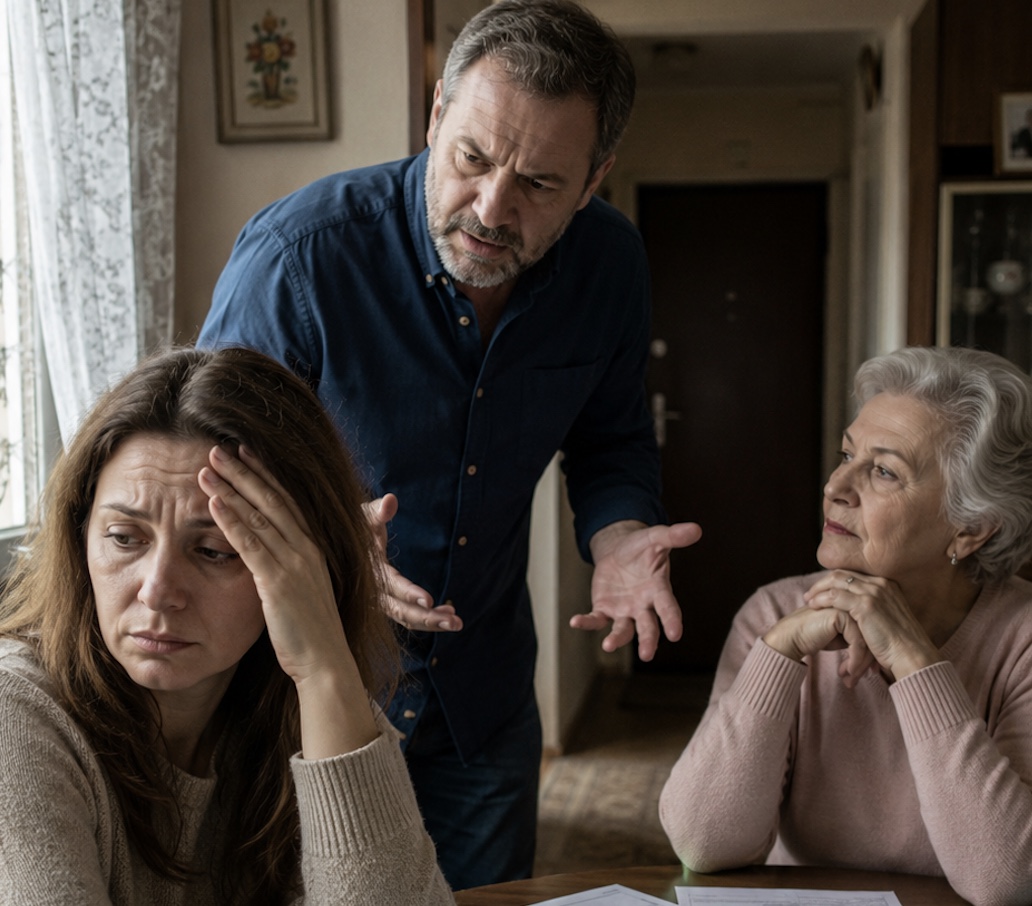
“The apartment may have been yours before marriage, but we’re one family,” Galina Arkadyevna said, placing her palm on the handle of the far room. “My wardrobe will go here. We’ll get rid of Olya’s desk. It’s old anyway. Misha, text Vadim and tell him to bring a proper one on Sunday.”
Olga froze in the hallway, a bag of groceries still in her hand. Five suitcases stood in the corridor, along with a box of dishes and a plaid bag with the corner of a bathrobe sticking out of it. Mikhail did not even look embarrassed. He took off his coat, hung it over Olga’s jacket, and said curtly:
“Mom is going to stay with us. And please, no scenes.”
“With us?” Olga set the grocery bag on the cabinet and looked first at her husband, then at her mother-in-law. “I didn’t invite anyone to live here.”
Mikhail immediately grimaced, as if she had said something indecent.
“Olya, don’t start. Mom sold her old apartment. Alla and Vadim are cramped right now, and they’re having money problems. You don’t want her wandering from one stranger’s place to another, do you?”
Galina Arkadyevna had already walked into the far room. Olga’s mother’s round table stood there, with a laptop, receipts, work folders, and a small lamp on it. Her mother-in-law pushed the folders toward the edge, studied the wall, and said in a businesslike tone:
“This table needs to be taken out. A woman doesn’t need an office at home, especially when an elderly person has nowhere to sleep.”
Olga felt not hurt, but strangely tired. The kind of tiredness that comes when a person finally realizes no one has been talking to them for a long time. Everything has already been decided for them.
“Galina Arkadyevna, leave the room,” she said. “Now.”
Her mother-in-law turned around slowly, wearing that same tight smile Olga had known for eleven years and seven months.
“Misha, do you hear her? I haven’t even unpacked my things yet, and she’s already throwing me out of the family.”
“Olya, enough,” Mikhail said more quietly than usual, but more harshly. “Yes, the apartment was yours before marriage. No one is arguing with that. But I’m the husband here. I did repairs here, bought furniture, brought money into this home. You can’t act like I’m some tenant sitting on a stool.”
“We did the repairs together. And I bought this apartment on May 18, 2010, before we were married.”
“Again with the papers,” he snapped. “Family is more important than papers.”
Galina Arkadyevna stepped closer and placed her cardigan on the round table, as if marking her territory.
“Don’t be selfish, Olya. Fifty-eight square meters is too much for one person. Misha promised me the far room, and I don’t understand why you’re turning this into a circus.”
“Because this is my apartment,” Olga replied.
Her mother-in-law gave a quiet snort.
“Even a dependent starts imagining herself the mistress of the house after a while.”
Mikhail did not stop his mother. He only looked away and picked up two suitcases, preparing to carry them into the room. Their wheels bumped against the threshold, and one suitcase struck the table leg. The lamp wobbled. Olga caught it with her hand just in time.
“The suitcases stay in the hallway,” she said. “Tomorrow I’m going to a lawyer.”
Mikhail set the suitcase down and turned toward her, his earlier lazy confidence gone.
“You’re trying to scare me with a lawyer? I put nine hundred thousand into this apartment. In a divorce, I’ll sue for half, and then we’ll see how you sing.”
“Write down a list with receipts,” Olga said. “Everything you consider yours.”
Galina Arkadyevna threw up her hands.
“She wants receipts. Misha, just look at the kind of family we have. A husband’s mother is welcomed at the door like she’s in court.”
Olga did not argue. She picked up her laptop, gathered the receipts into a gray folder with a worn corner, and put the documents into her bag. Mikhail noticed and narrowed his eyes.
“What, now you’re hiding documents?”
“I’ve started keeping them somewhere people won’t touch them without asking.”
That night, Olga lay in her room and listened to bags rustling behind the wall. Galina Arkadyevna was calling Alla and speaking almost in a whisper, but every word could be heard in the apartment: “I moved in. Olga made a fuss, but Misha put her in her place. The room is good. Vadim should measure for the wardrobe while she’s at work.”
After that, everything became clear. This was not an urgent request for help. It was a planned move, agreed upon in advance, and Olga had simply been left out of the decision.
In the morning, her mother-in-law had already rearranged the grains in the kitchen, removed Olga’s cezve from the stove, and hung her own rose-patterned towel on the cabinet handle. Mikhail sat at the table drinking coffee, pretending nothing unusual was happening.
“There will finally be order here,” Galina Arkadyevna announced. “Misha likes proper food, not your little containers from the fridge.”
“Misha knows how to cook for himself,” Olga said, picking up her bag.
“Where are you going?” Mikhail put down his cup.
“To a lawyer. Then to the public service center for a fresh property extract.”
He stood up from the table.
“I’m warning you. If you start a war, there will be no way back.”
“Mikhail, there is no way back anymore. Yesterday you brought a person into my apartment to live here and called it a family decision.”
He wanted to answer, but Galina Arkadyevna spoke first.
“Oh, there you go again: my apartment, my apartment. Family exists so people can share.”
“People share what they are ready to give. Not what someone else takes from them without permission.”
Olga arrived at the lawyer’s office on February 5, 2026, exactly at eleven o’clock. Marina Sergeyevna Tumanova did not sigh sympathetically or ask about feelings. She opened a blank sheet of paper and asked for facts: when the apartment was bought, when the marriage was registered, who was registered there, and whether Olga had given written consent for her mother-in-law to live in the apartment.
Olga laid out the purchase agreement dated May 18, 2010, the marriage certificate dated September 12, 2014, an old property extract, utility bills, and receipts for appliances and furniture. Then she showed a bank statement: for eighteen months, Mikhail had been transferring thirty-five thousand rubles to his mother every month, six hundred thirty thousand in total, while telling Olga at home that his bonuses had been cut.
Marina Sergeyevna reviewed the papers and pushed a notepad toward Olga.
“Your position regarding the apartment is strong. It was purchased before the marriage and is registered in your name. As for repairs, he may try to make a claim, but words about nine hundred thousand mean nothing on their own. He needs documents and proof that the investments significantly increased the value of the apartment. Based on your receipts, I currently see one hundred eighty-six thousand four hundred rubles for household appliances and some furniture. That is not half an apartment.”
“And my mother-in-law? She has already unpacked.”
“She is not registered there, and the owner did not move her in. You must not create a scandal by throwing her suitcases out. We’ll prepare a written demand for her to vacate the premises and document the situation with witnesses. Your husband is a separate matter. Since he is still your spouse and registered there, it is better to act through divorce and court, without taking matters into your own hands.”
Olga left the lawyer’s office with an electronic property extract, copies of the formal demand, and a very simple plan. Do not shout. Do not justify yourself. Do not leave documents at home. Do not allow someone else’s arrogance to become normal.
By evening, Mikhail sent a message: “Where are you? Mom is nervous. Vadim is bringing the wardrobe on Sunday. Clear out the room.”
A minute later, another message arrived: “And stop acting like you’re the sole owner. We’re not taking anything away. We’re handling this like a family.”
Olga replied with only one sentence: “On Sunday at ten, we will talk in front of witnesses.”
On February 8, Galina Arkadyevna greeted the morning like the lady of the house. She put on beads, placed her medicines on the round table, and laid a shopping list next to them. Open suitcases stood in the corridor. The far room already smelled halfway of someone else’s belongings.
At ten, the doorbell rang. Mikhail opened the door confidently, but the confidence quickly vanished from his face. Marina Sergeyevna, the local police officer, and Vadim with a tape measure were standing on the landing. Vadim had come to measure the space for the wardrobe, but when he saw the officer, he immediately slipped the tape measure into his pocket.
“What kind of performance is this?” Mikhail asked.
“This is not a performance,” Olga said. “My representative will hand over the demand, and the officer will document that there is a person in the apartment whom the owner did not invite to live here.”
Galina Arkadyevna came out of the room holding her cardigan.
“Misha, explain to her what she is doing. I am your mother.”
“And I am the owner of this apartment,” Olga said. “Those are not the same thing.”
Marina Sergeyevna placed the documents on the cabinet and spoke calmly, without pressure. The owner of the apartment was Olga Petrovna Ryabinina. The basis was the agreement dated May 18, 2010. The marriage to Mikhail had been registered later. Galina Arkadyevna was not registered in the apartment, and the owner had not given consent for her to live there.
Vadim tried to interrupt.
“She is an elderly woman. Where are you sending her?”
Olga looked at him.
“You and Alla took the money after she sold her old apartment. You and Alla decided she would live with me. So right now, it would be better not to pretend you’re just a random helper with a wardrobe.”
Vadim fell silent. Mikhail grabbed the demand letter and quickly scanned it.
“This means nothing. I’m the husband here. I have rights.”
“You are registered here, and I am not going to solve that by force,” Olga replied. “I am filing for divorce. After the divorce, the question of your right to use the apartment will be decided in court if you do not remove your registration voluntarily. But your mother is taking her things today, because I never consented to her living here.”
Galina Arkadyevna’s tone changed then, becoming softer and faster.
“Olya, why are you doing this? I’m not staying forever. Just until things get better for little Alla. The far room is empty anyway.”
Olga opened the room door wider. On the table lay someone else’s cardigan, medicine, knitting, and a shopping list.
“It is not empty. My work is there, my documents are there, and my mother’s table is there. Yesterday you had already decided it could be taken out.”
“Oh, stop going on about the table,” Mikhail snapped. “My mother is standing in front of you. She has nowhere to live.”
“Because her apartment was sold, and the decision was made without me.”
He pointed a finger at the lawyer.
“And the repairs? Nine hundred thousand. Let her pay me half.”
Marina Sergeyevna did not raise her voice.
“Provide receipts, contracts, proof of payment, and evidence that the value of the apartment was significantly increased. So far, the documents show one hundred eighty-six thousand four hundred rubles in confirmed expenses for property that can be discussed separately. That is not half an apartment.”
Galina Arkadyevna looked at her son as if she was hearing for the first time that his confidence could not replace documents. Mikhail said nothing. In that silence was everything: promises to his mother, conversations with Vadim, and the calculation that Olga would give in because she would feel uncomfortable arguing in front of outsiders.
“Mom is staying,” he finally said.
“No,” Olga answered. “And right now, you are not choosing between me and your mother. You are choosing whether you are willing to respect someone else’s property when that property belongs to your wife.”
Mikhail gave a bitter smirk.
“Then I’m leaving too.”
“That is your decision. I won’t stop you.”
He had clearly expected a different reaction: fear, pleading, or at least the usual “let’s talk tonight.” Olga no longer gave him that chance. She stood beside her lawyer, with documents and a witness, not with empty explanations in the middle of the kitchen.
Galina Arkadyevna sat down on a chair near the entrance and clenched the demand letter in her hands.
“Misha, where will we go?”
“We’ll rent,” he said dully.
“With what money?”
Olga opened the bank statement on her phone and turned the screen toward them.
“Six hundred thirty thousand rubles over eighteen months. You could have discussed housing earlier, while calling those transfers help.”
Her mother-in-law looked away. Vadim was already standing by the door, staring into the stairwell as if he had ended up there by mistake.
“I only came to bring a wardrobe,” he muttered.
“The wardrobe won’t be needed,” Olga said.
An hour later, the suitcases were back in the hallway, only now they were closed. Galina Arkadyevna slowly gathered her small things: her knitting, her medicines, the cardigan from the round table, and the rose-patterned towel from the kitchen. At the door, she stopped and tried to regain her old tone.
“You’ll end up alone anyway.”
Olga looked at Mikhail, who was holding two suitcases and did not know where to look.
“I have been doing many things alone for a long time. I simply won’t keep serving other people’s decisions while doing it.”
Mikhail removed a key from his key ring and threw it onto the cabinet.
“I’m still registered here.”
“For now, yes. That is why the rest will be handled in court.”
He wanted to say something harsh, but the officer was standing nearby, and Marina Sergeyevna was already putting the documents into her folder. Mikhail picked up the suitcases, Galina Arkadyevna followed him out, and Vadim hurried downstairs first.
After they left, Olga returned to the far room. She wiped the mark from someone else’s mug off the table, set the lamp back in its place, and put the gray folder into the drawer. The scratch on the tabletop was still there, the same old childhood scratch. Before, Olga had barely noticed it. Now, for some reason, that scratch annoyed her less than the trace of someone else’s cardigan.
Over the following weeks, Mikhail alternated between pressure and bargaining. He sent a photo of a room in a rented old apartment for twenty-five thousand rubles a month and wrote: “Happy now?” Then he suggested they “not disgrace themselves with divorce” and leave everything as it was, only letting “Mom stay sometimes.” Olga answered only practical questions: belongings by inventory, utility payments until his right of use ended, and the appliances worth one hundred eighty-six thousand four hundred rubles to be discussed through her representative.
At the divorce hearing, Mikhail arrived with a sheet of paper where he had written by hand: “repairs — 900,000.” The judge asked for documents. Mikhail began talking about a man’s hands, about his contribution to the family, about how without him Olga would have been “sitting inside bare walls.” Marina Sergeyevna silently opened the receipts and bank statements. Olga sat beside her and did not interrupt. Arguing with fantasies was pointless. Documents handled them better.
On April 16, 2026, the marriage was dissolved. At the exit, Mikhail caught up with Olga and said, without his former arrogance:
“Mom is suffering because of you.”
“That does not give her the right to live in my apartment.”
“You’ve become a stranger.”
“I stopped being convenient.”
He smirked, but it came out poorly.
“You won’t last long alone.”
Olga looked at his leather briefcase. He used to come home with it like the ruler of a small state where everyone had already been assigned their roles. Now the briefcase was just a worn object in the hand of a man who had finally understood that no one had given him the role of owner.
“For eleven years and seven months, you confused family with access to someone else’s home,” Olga said. “That access is over.”
On May 29, 2026, the court recognized that Mikhail had lost the right to use the apartment. The decision did not look dramatic: sheets of paper, signatures, dry legal wording. But after it, there were no more conversations about “our room,” “Mom’s shelf,” or “a family decision.”
A few days later, Mikhail came for the last of his things. Galina Arkadyevna was not with him. He held an empty sports bag, looked tired, and for the first time asked permission to come in instead of walking straight into the hallway.
“Can I have some water?” he asked.
Olga poured a glass and placed it on the cabinet. Mikhail drank it, took a box of books, old headphones, and two shirts. Near the far room, he stopped.
“You kept the table?”
“Yes.”
“You shouldn’t have. It’s junk.”
“This table never drove anyone out of their home,” Olga replied. “So it can stay.”
Mikhail tightened his grip on the bag handle.
“I could come back, you know. We could discuss everything normally.”
“Normal discussions should have happened before five suitcases appeared in the hallway.”
He nodded toward her hand.
“You still wear the ring?”
Olga looked at the thin silver ring. It was not her wedding ring. She had bought it long before the marriage, with her first serious bonus.
“This is my ring, Mikhail.”
He asked nothing else. He took the bag, walked out, and carefully closed the door. No slam, no threats, no old possessive look.
Olga opened the bottom drawer. Inside an envelope lay her wedding ring, a copy of the court decision, and the old key Mikhail had thrown onto the cabinet on the day he left. She added one more paper to it: the receipt confirming the transfer of his belongings. Then she closed the drawer and returned to the round table.
The far room was once again her office. A new project contract lay on the table, next to a cup of coffee and a blank sheet for notes. In the apartment of fifty-eight point four square meters, no one was measuring the wall for someone else’s wardrobe anymore, and no one was deciding for Olga who would live there.
She switched on the lamp and opened her work file. Behind the door remained the family that had called something “shared” only when they wanted to take it. The apartment was quiet now, and that quiet did not require explanations or witnesses.