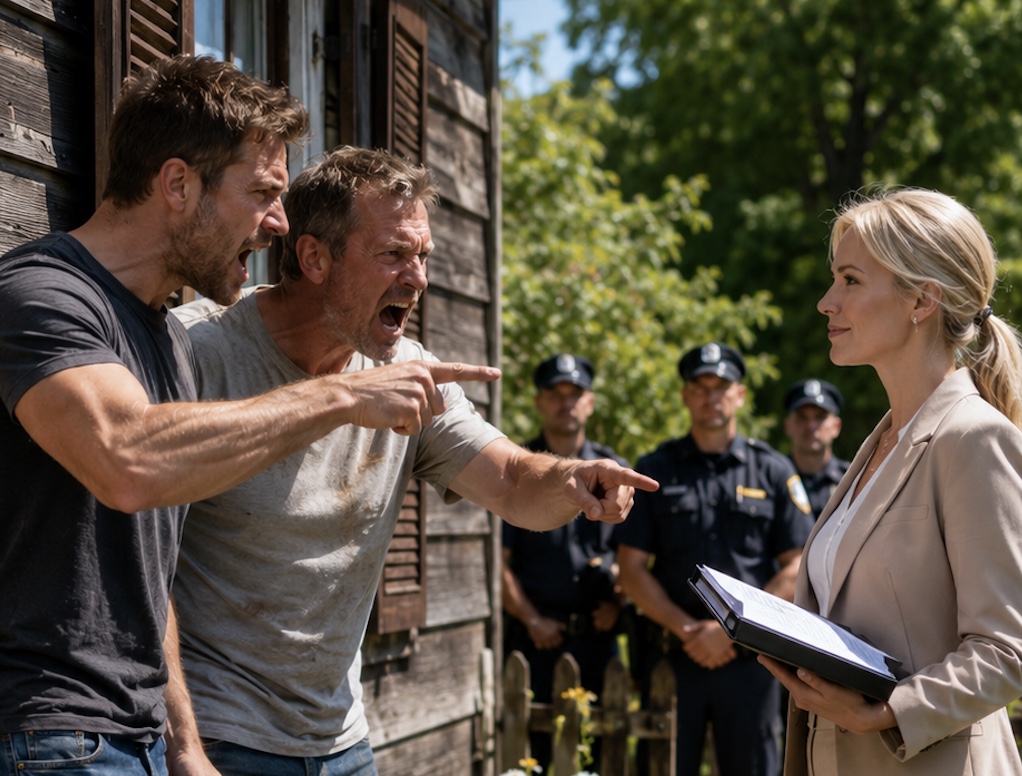
“We’re the owners here, so get lost while we’re still asking nicely,” Pavel said, without even taking his hand off my gate. He was wearing my rubber slippers, holding my pruning shears, and looking at me as if I had come begging to enter someone else’s property.
Behind him, the veranda of my country house stood wide open. Someone else’s laundry was hanging over the railing. Boxes full of dishes sat near the entrance, and Oleg’s jacket — my husband’s jacket — was lying on my folding table. My key would not go into the lock. A new cylinder had been installed on the gate without my permission.
“Pavel, this is my country house,” I said, lifting my phone to record the lock up close.
“It used to be yours,” said Raisa Ivanovna, Oleg’s mother, stepping out of the house. “Now the family lives here. You can’t manage it alone anyway, and we need it more. Don’t be selfish.”
Ksenia, Pavel’s wife, looked out from the kitchen and added that they had already unpacked their things, sorted the shelves, and “were not going to ask for permission every single time.”
Oleg was standing near the shed, saying nothing. He did not look surprised. He looked like a man who had been waiting for an unpleasant conversation and had already decided I would be the one to blame.
“Oleg, explain this to them,” I asked.
He rubbed the bridge of his nose and spoke in a tired voice, as though I had interrupted his rest.
“Nadya, let’s not make a circus out of this. Mom and Pavel are here temporarily. Things didn’t work out with their apartment. The house sits empty almost all week. I gave them permission.”
“You had no right to give permission,” I replied. “The house and the land are registered in my name.”
Raisa Ivanovna smirked.
“Oh, here we go again with the documents. My son is your husband, which means he is also the owner. We’re family, not strangers.”
She said it with such confidence that, for a second, everything became clear. They had not come for the weekend. They had already divided up the rooms, the garden beds, the kitchen, and even my right to enter my own property. Pavel lifted the pruning shears and tapped them against his palm.
“Show your little papers in the city. Here, we’ve already decided everything. Without Oleg, you’re nobody in this family.”
I switched on the recording on my phone and calmly asked Oleg to repeat that he had moved his mother, his brother, and his brother’s wife into my house without my consent.
He immediately stopped pretending to be tired.
“Don’t be dramatic,” he said. “This is a family matter.”
“No,” I answered. “This is a matter of an owner being denied access to her own home.”
Pavel stepped closer to the gate.
“Record all you want. We’re not leaving.”
I called emergency services. While I waited for the police, Raisa Ivanovna walked around the veranda, showing Ksenia where to move the jars, while Pavel demonstratively carried my pruning shears back to the shed, as though it was already his shed. Oleg came up to me only once and quietly said I was humiliating him in front of his relatives.
“They are not letting me onto my own property,” I said. “The shame here is not mine.”
The police arrived about forty minutes later. I showed them my passport, the property extract, the deed of gift, and photos of the new lock cylinder. The officers asked whether Pavel, Ksenia, and Raisa Ivanovna had registration at that address, a rental agreement, or written consent from the owner. They had none of it.
Raisa Ivanovna tried to explain that “her son had allowed it,” but one of the officers said briefly:
“Your son is not the owner. His permission does not replace legal documents.”
They were not removed immediately. I was told that my statement would be accepted, explanations would be taken, and the fact that I had been prevented from accessing the property would be recorded. But forced eviction from the house and land required a court decision and an enforcement order. Pavel was warned not to stop me from entering the property. He listened with the expression of someone who had decided simply to wait out the inconvenience.
When the police car left, Raisa Ivanovna walked up to the gate and said:
“So what? You filed a little paper? We’re staying anyway.”
“Today, maybe,” I replied. “But not later.”
Oleg turned sharply toward me.
“You’re destroying the family.”
I looked at his jacket near the entrance, at the strangers’ boxes on my veranda, and at Pavel, who was already giving orders around my shed. At that moment, arguing with them as relatives became pointless. They were not asking for help. They were testing how far they could go if they shouted the word “family” loudly enough.
The country house had been given to me in 2021 by my aunt, Lyubov Mikhailovna, under a deed of gift. She no longer wanted to deal with the land, and I spent several months driving her to government offices, sorting out the paperwork, arranging the cadastral documents, and paying for the land survey. Back then, Oleg laughed and called the place “our little estate,” but I always corrected him: the house was registered to me.
Our marriage had been peaceful only as long as no one tried to divide anything. We had separate bank accounts, separate incomes, and a habit of not mixing money. Oleg occasionally bought screws, charcoal, or small things for the barbecue. I paid for everything significant: the pump, the windows, the front fence, the roof repairs, and the delivery of building materials. The receipts and contracts were all kept in a separate folder at home.
Raisa Ivanovna used to laugh at that.
“Nadya sleeps with her paperwork,” she would say at family dinners. “A person should trust her relatives.”
Pavel would usually join in.
“You’ll start asking for a signed receipt for a spoon next.”
Now that habit of keeping documents had become the one thing that did not betray me.
A month before the takeover, Oleg had started bringing up Pavel more and more often. First, he said his brother’s rent had been raised. Then he added that Raisa Ivanovna was worried. Then he suggested letting them stay at the country house “until they figured things out.” I answered immediately: they could spend the night on weekends, but they could not live there permanently. Oleg got offended, stayed silent for several days, and then acted as if the subject was closed.
In reality, he had closed it only for me.
On Friday, May twenty-second, I stayed in the city because of work. I drove to the house on Saturday afternoon and saw Pavel’s car, Raisa Ivanovna’s car, and unfamiliar plastic crates by the gate before I had even reached the property. Zoya Egorovna, my neighbor across the lot, looked through the mesh fence and asked whether it was true that I had given the house to my husband’s relatives.
“Who told you that?” I asked.
“Pavel said so yesterday. He said the city suits you better, and the family needs the house more.”
That was when I understood why they had rushed. They did not simply need a place to stay. They needed to create a new version of events for the neighbors in advance: that I had willingly stepped aside, and they were now the rightful occupants by family agreement. Even if a dispute began later, half the gardening community would already think I had changed my mind and was making trouble out of spite.
After the police visit, I did not stay overnight in the house. I remained by the gate until evening, photographing the strangers’ boxes on the veranda, my belongings in the shed, the new lock cylinder, Oleg’s jacket by the door, and the seedlings Ksenia had placed on my table. I waited until I received the police notification slip, then went back to the city. I left not because I had surrendered, but because I already understood: from that moment on, this would not be a conversation. It would be a case.
On Monday, Oleg came home calm. He walked into the kitchen, sat across from me, and suggested we “come to a normal agreement.” According to him, Raisa Ivanovna could live at the country house until autumn, Pavel and Ksenia could stay too, and I could “come whenever I wanted.” He spoke as if he were generously leaving me the right to occasionally appear in my own home.
“They already threw me out,” I said.
“Pavel is hot-tempered. You know what he’s like. Mom thinks a house falls apart when no one lives in it.”
“Your mother is not part of this question. Pavel is not part of this question. Ksenia is not part of this question either. You are not the owner, and you could not give them permission.”
Oleg pressed his lips together.
“I’m your husband.”
“Yes. But you are not the owner of my country house.”
He took out his phone and said he would call his mother right away and ask her to be “softer.” I stopped him. The issue was not Raisa Ivanovna’s tone or Pavel’s temper. The issue was that they had occupied the house without my consent, and Oleg had helped them do it.
That same evening, I wrote to Yulia Andreevna, a lawyer our company worked with on contracts. She asked me to send the documents and called me back an hour later. I listed everything: the deed of gift, the property extract, receipts for the work, photos, videos, the conversation recording, and the police notification slip.
“Then this is not a family quarrel,” Yulia Andreevna said. “We prepare a claim to remove obstacles to the use of property and to oblige them to vacate the house and land. No emotions in the text. Only facts: who the owner is, who is there without consent, when they refused to leave, and what evidence exists.”
She specifically asked me to save all correspondence with Oleg and not discuss anything with the relatives by voice unless I was recording it. I did exactly that. I sent Raisa Ivanovna a short message: I demanded that they vacate the house and land, remove their belongings, and hand over the keys.
Her reply came twenty minutes later.
“Don’t embarrass yourself. Oleg allowed everything. We’ve already settled in.”
That message became one more piece of evidence.
The claim was several pages long. It contained no words about hurt, betrayal, or family arrogance. It contained surnames, the address, the cadastral number, a reference to the deed of gift, a description of the lock cylinder being changed, their refusal to leave, the police call, and the demand that the defendants be ordered to vacate, remove their property, hand over the keys, and stop interfering with my use of the land. Yulia Andreevna also included court expenses.
When Oleg saw the receipts proving copies of the claim had been sent, he laughed at first.
“You seriously sued my mother?”
“I sued Raisa Ivanovna, Pavel, and Ksenia. As people who occupied my house without a contract and without my consent.”
“She is my mother, Nadya.”
“In court, that is not a right of use.”
He got up from the table and began pacing around the kitchen. He said I was destroying relationships, that Pavel was “just short-tempered,” and that his mother would not survive such humiliation in front of the neighbors. I listened and, for the first time, noticed how skillfully he reversed cause and effect. They had not taken over the house — I was humiliating them. They had not refused to leave — I was dragging them to court. He had not opened the door to them — I was breaking the family.
“They can leave on their own,” I said. “Then bailiffs won’t be needed.”
“You’ll regret this,” Oleg replied.
“I already regret something. I regret trusting your silence at the gate.”
They all came to the preliminary hearing. Raisa Ivanovna wore a light-colored suit and spoke in a quiet voice, as if she had come to complain about an ungrateful daughter-in-law. Pavel brought a folder of photographs: him on the roof, Oleg with a screwdriver, Raisa Ivanovna near the garden beds, Ksenia in the kitchen. Their argument was simple: they had helped, therefore they had a moral right to live there.
The judge asked Oleg whether he was the owner of the house or land. He answered that he was my husband. The judge repeated the question. Oleg said he was not the owner.
Then the judge asked whether he had a power of attorney from me allowing him to move third parties in. Oleg was silent for several seconds and then admitted that he did not. Pavel tried to interrupt and said that “normal people value family more than papers.” The judge looked at him over the documents and asked him to answer only the questions being asked.
At the next hearing, Yulia Andreevna calmly went through their photographs. Helping on the property does not equal the right to live there. Buying screws does not turn someone else’s real estate into shared property. Working on the roof does not give anyone the right to change the lock and bar the owner from entering. If they had financial claims, they could file them separately and support them with documents, but they had no right to live in the house without my consent.
After that, Pavel stopped smirking. Raisa Ivanovna still tried to talk about family, but now it sounded weaker. In court, family words could not replace a contract, a property extract, or the consent of the owner.
The decision was issued in July. The claim was granted. Raisa Ivanovna, Pavel, and Ksenia were ordered to vacate the house and land, remove their property, hand over the keys, and stop interfering with me as the owner. Part of the court expenses was also recovered from them.
Oleg read the decision at home, placed the papers on the table, and said:
“Are you happy now? Mom isn’t speaking to anyone anymore.”
“She received a court decision,” I replied. “I was not the one who moved onto her property.”
“You could have avoided taking it this far.”
“They could have left after the first demand.”
I placed a second folder in front of him. Inside was a petition for divorce. No scandal, no long explanations, and no attempt to divide the country house. The house had been gifted to me by my aunt, Lyubov Mikhailovna, and was not part of our marital property. Oleg had known that since 2021, but he had still decided that through his mother and brother he could pressure me into accepting his version of “family.”
He flipped through the petition and asked:
“You’re divorcing me over a country house?”
“I’m divorcing you because you brought people into my home after I had refused, and then stood beside them while they threw me out.”
Oleg did not argue. That day, he left for his mother’s place, and a week later, he came back to collect his things from the apartment. This time, without threats. Apparently, court documents worked on him better than any conversation ever had.
The relatives did not comply with the court decision voluntarily. Raisa Ivanovna wrote that she considered it unfair, Pavel promised to “raise the neighbors,” and Ksenia posted photos of the garden beds in the gardening community chat with captions about how they were being “driven off the land they had restored.” Zoya Egorovna forwarded me a screenshot and added, “Don’t answer. Everyone saw who moved in without you.”
I did not answer. After the decision entered into force, Yulia Andreevna obtained the writ of execution, and the documents were sent to the bailiffs. The defendants were given time to comply voluntarily. They decided that could be ignored too.
On the appointed day, I arrived at the property at eight in the morning. Pavel was standing by the gate, with his car parked across the entrance. Raisa Ivanovna sat on a folding chair near the gate, and Ksenia held a plastic folder with some papers, though she still had no documents giving her the right to live in my house.
“You brought an entourage?” Pavel asked, nodding toward the bailiffs’ car.
The senior bailiff introduced himself, showed his identification and the order. He spoke calmly, without pressure or unnecessary words. The defendants were reminded that the period for voluntary compliance had expired, and that the house and land were now being cleared under an enforcement document.
“This is my son’s country house,” Raisa Ivanovna said.
The bailiff checked the document.
“The writ of execution names Nadezhda Viktorovna as the owner. Your son is not listed here.”
Pavel began calling Oleg. Oleg did not come. He sent me a message: “You’ve gone too far.” I did not reply. I simply showed the phone to Yulia Andreevna, who was standing beside me.
A few minutes later, a National Guard vehicle arrived. Someone behind a neighboring fence whispered that riot police had come, although the bailiff called it something else: assistance to ensure order during enforcement actions. For Pavel, the difference in terminology no longer mattered. He stopped waving his arms. Ksenia put away her phone. Raisa Ivanovna went quiet.
“Clear the passage,” the bailiff said.
Pavel tried to argue, but he was calmly informed of the consequences of disobeying lawful orders. After that, he moved the car away from the gate himself. Not because he agreed. Because for the first time in all those months, he understood that he was no longer facing me with a request. He was facing a state procedure with consequences.
Then the inventory began. Their bags, boxes of dishes, blankets, seedlings, three stools, a drying rack, pots, and plastic containers were carried outside. My belongings were separated: the stepladder, pruning shears, garden lantern, towels, and a box of tools. Ksenia tried to claim the lantern was hers, but I opened a photo from 2022 where that very lantern was already hanging on my veranda.
Raisa Ivanovna tried to give orders about where to place the boxes, but each time the bailiff brought the conversation back to the official record. What belonged to them, they took. What belonged to me, stayed. Anything disputed was documented. The word “ours,” which they had used for months to cover my entire house, shrank down to pots, bags, and stools.
When the house was cleared, the bailiff drew up the act. The keys were handed over to me, and the new lock cylinder was removed. I called a hardware specialist to restore proper access, and for the first time all summer, I stepped onto the veranda without an argument at the gate.
Pavel was the last to leave. Near his car, he threw over his shoulder:
“So, you won?”
“I got back what was mine,” I replied.
He looked at the bailiffs, at the National Guard vehicle, at the neighbors watching from behind the mesh fence, and said nothing more.
Raisa Ivanovna lingered by the gate.
“Oleg will never forgive you for this.”
“That is his choice.”
“You’ll end up alone.”
I looked at the house, where no stranger’s laundry was hanging anymore, at the empty veranda, and at the garden beds without anyone else’s labels.
“I am home, Raisa Ivanovna.”
After they left, I did not write to Oleg or call his relatives. I walked through the house with a notebook, writing down what was missing, what had been broken, and what needed to be fixed. I ordered the removal of the remaining junk, new shelves for the pantry, and proper hardware for the gate. By evening, the property no longer looked occupied. It looked like a place where I made the decisions again.
Oleg called the next day. He said Pavel was planning to file a counterclaim, and that his mother refused to speak to me. I told him that speaking through the court was more convenient and ended the call. After that, he wrote rarely, and only about the divorce.
The divorce went calmly. Oleg tried to mention the country house in a conversation with the lawyer, but he was reminded of the deed of gift. The apartment was not part of the dispute, our accounts were separate, the car was registered in his name, and we had no children. The marriage ended faster than it took me to restore the house after his relatives.
In autumn, I came to the property alone. I took the old faded sign off the fence, hung a new one, and cleared the shelf where Ksenia had kept her jars. Then I made a list of work for spring: check the pump, replace a couple of boards on the porch, order soil for the garden beds. Ordinary tasks for a homeowner who no longer needed to prove at her own gate that she had the right to enter.
By evening, I locked the house, checked the documents in my folder, and placed the keys in my bag. The court decision had been enforced, access had been restored, and the people who had called themselves the owners had removed their things and lost the right to control my country house.