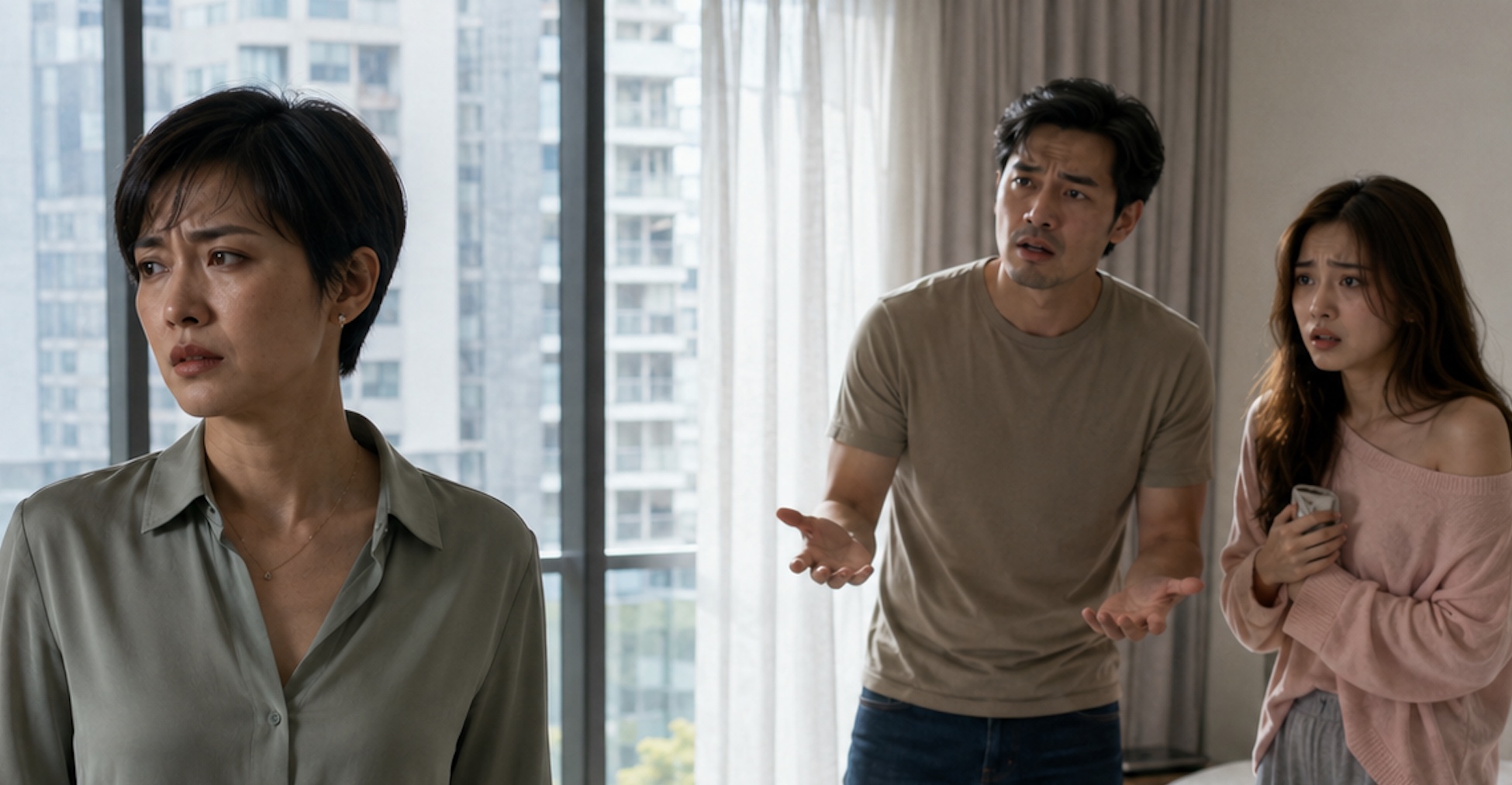
“Suitcases in your hands—and both of you out,” Arina said calmly to her husband and her best friend. “I don’t want to see either of you in my apartment again.”
Pavel stood in the middle of the bedroom with his shirt half-unbuttoned, staring at his wife as if she had walked not into her own home, but into someone else’s office without knocking. Ksenia sat on the edge of the bed, clutching her sweater to her chest with one hand while the other searched blindly across the floor for her phone. Her face had gone blotchy. Her eyes darted from Arina to the door, then to Pavel, as if she were waiting for him to explain everything, rescue them, turn it into some absurd misunderstanding.
But this no longer smelled like a misunderstanding.
Arina had come home earlier than usual. At the apartment where she was taking measurements for a new kitchen, the electricity had suddenly gone out. The contractor moved the appointment, and Arina decided to stop by home for a folder with sketches. Pavel was supposed to be at work. Ksenia was supposed to be with her mother, who, according to her morning messages, urgently needed help.
Even at the door, Arina noticed something strange: the lock had been turned only once. Pavel always locked it twice, even when he only went out to take the trash. In the hallway stood Ksenia’s ankle boots, and beside them lay Pavel’s jacket, thrown down so carelessly it looked as though he had been rushing not into the home, but out of it.
Arina did not walk farther right away. She placed her bag on the cabinet, took off her shoes, straightened the sleeve of her coat, and only then stepped into the hallway.
From the bedroom came muffled voices and laughter.
She recognized Ksenia’s laugh immediately. It was the laugh she always used when she wanted to seem carefree: a little too loud, a little too sharp to sound natural. For years, Ksenia had covered awkward silences, other people’s remarks, and her own mistakes with that exact laugh.
Arina moved slowly down the hallway. One last weak excuse still clung to her mind. Maybe Ksenia had stopped by to pick something up. Maybe Pavel was helping her with a box. Maybe they were simply talking. Arina even managed to get angry at herself for being suspicious.
But the bedroom door was half-open.
Pavel saw her first through the narrow gap between the door and the frame. His face stretched in horror, his shoulders jerked upward as if someone had pulled an invisible string. Ksenia turned right after him. Her hand slipped from the blanket, and her fingers clenched around her sweater.
The laughter stopped.
“Arina…” Pavel began.
He said her name so pitifully that her eyebrows twitched. Not from pain. From surprise. She had lived beside this man for years and had never known that in a decisive moment his voice would sound exactly like that—thin, empty, with nothing to stand on.
Ksenia was the first to look away.
Arina stepped into the bedroom. She did not rush at them, did not scream, did not grab the first object within reach. She walked to the wardrobe, opened the lower compartment, and took out two suitcases. One was large and dark blue with a worn handle—Pavel used to take it when visiting his mother outside the city. The second was smaller and red, the one Ksenia had once forgotten after a girls’ night and somehow never got around to collecting.
And now, finally, that suitcase had found its purpose.
Pavel took a step toward her.
“Listen, this isn’t what you think.”
Arina slowly turned her head. Blood rushed to her cheeks so sharply that her skin grew hot. She breathed out once through her nose and looked at her husband closely, almost with curiosity.
“Really?” she asked. “Then tell me what exactly I was supposed to think.”
Ksenia jumped up from the bed, hurriedly pulled on her sweater, and tried to smooth her hair. Her fingers were shaking, but she forced her voice into an offended tone.
“Arina, don’t do this. We’re adults. Let’s talk calmly.”
“Calmly?” Arina placed the red suitcase by the door. “I am very calm. Can’t you see?”
And that calm frightened them more than shouting would have.
Pavel quickly buttoned his shirt, missed a button, cursed under his breath, and started again. He did not look guilty. He looked caught. The difference was so obvious that Arina almost felt it physically. A guilty person thinks about the pain they caused. A caught person thinks about how to get out of it.
“Arish, we…” Pavel raised both palms. “We got confused. It happens. I didn’t want you to find out like this.”
“How did you want me to find out?” Arina tilted her head. “On a schedule? After dinner? Or once you and Ksenia finished deciding which one of you was more confused?”
Ksenia lifted her chin.
“Don’t humiliate me.”
Arina looked at her friend. The same Ksenia she had opened her door to at any hour. The same Ksenia who had slept here after fights with yet another man. The same Ksenia to whom Arina had left keys when she asked to “stop by and water the plants.” The same Ksenia who knew which shelf held the documents, where the spare towels were, and what medicine Arina took for migraines.
“Humiliate you?” Arina gave a faint smile. “Ksyusha, you’re sitting in my bedroom next to my husband. I think you handled the humiliation all by yourself.”
Pavel suddenly stepped toward his wife.
“Don’t you dare talk to her like that!”
Arina lifted her eyes to him.
“And you don’t you dare raise your voice in my apartment.”
The words struck more accurately than a slap.
Pavel froze.
The apartment was hers. Not family property. Not shared. Not “ours.” Arina had inherited that two-room apartment from her aunt, Lidia Pavlovna. The paperwork had been completed long before the wedding. Afterward, Arina had spent a long time renovating it, choosing the tiles herself, paying the workers herself, counting every purchase herself. Pavel had appeared here later with two sports bags and beautiful promises.
He was not registered there. When they got married, Arina had suggested not rushing with registration because he was still registered at his mother’s place, and he had said he “didn’t care at all.” Back then, it had seemed like a small everyday detail.
Now it felt like rare luck.
“Arina, don’t start with the apartment,” Pavel grimaced. “I’ve lived here for three years.”
“You lived here,” she corrected. “Until today.”
Ksenia laughed nervously.
“Do you seriously think you can just throw your husband out?”
“I don’t think. I’m already doing it.”
Arina pushed the suitcases closer to them.
“Pack your own things. Quickly. Personal documents, clothes, shoes, electronics you bought for yourself. Everything else stays here until it’s sorted out. Jewelry, my cards, the storage-room keys, the spare apartment set—put them on the dresser.”
Pavel turned pale.
“What is this, an interrogation?”
“No. An inventory.”
“Don’t go too far,” he hissed. “My things are here too.”
“That’s why you have a suitcase.”
Ksenia rushed to the nightstand and grabbed her phone.
“I’ll call a taxi.”
“You will,” Arina nodded. “But first, the keys.”
Ksenia froze.
“What keys?”
Arina held out her hand, palm up.
“The keys to my apartment. The ones I gave you temporarily when I had bronchitis and you promised to bring groceries. You never returned them. I decided not to make a fuss then. That was my mistake.”
Ksenia glanced quickly at Pavel.
He looked away.
That was the moment something inside Arina finally clicked into place.
Not just betrayal. Not an accident. Not “we got confused.” Ksenia had not kept the keys by forgetfulness. They both knew she had access.
“The keys, Ksenia,” Arina repeated. “Now.”
Her friend dug into her bag, rummaged around for a long time. A lipstick fell to the floor, then a store card, then a keychain. She picked it up and removed one key with a small yellow tag.
“Here.”
Arina did not take it right away.
“All of them.”
“That’s the only one.”
Arina looked at Pavel.
“How many sets do you have?”
“One.”
“Pavel.”
His anger began to rise. Not loudly, not openly. His jaw tightened, and his fingers clenched until his knuckles turned white.
“I said one.”
Arina went to her bag, took out her phone, and opened the camera. Then she aimed the lens at both of them.
“Repeat it. Loudly. Say that you have one set of keys to my apartment, and Ksenia has one too. And say that you are handing them over voluntarily.”
“Have you lost your mind?” Pavel snapped.
“No. I’ve finally started using my head. Say it.”
Ksenia covered her face with one hand.
“Arina, stop this show.”
“The show started before I arrived. I just turned on the recording.”
Pavel moved sharply toward her, but Arina did not step back. She lifted the phone higher.
“Try to grab it. Then I’ll call the police right now. And I’ll call the neighbors too. Tamara Sergeyevna across the hall has always considered you a model of decency. I’m sure she’d love to see what that model looks like in someone else’s bedroom during working hours.”
Pavel stopped.
For a second, the room fell silent. Somewhere in the kitchen, the refrigerator clicked. Downstairs, the entrance door slammed. Such ordinary sounds suddenly made everything even more humiliating: life in the building continued as usual, while Arina’s marriage and years-long friendship had ended within minutes.
But she was not going to cry.
Not in front of them.
“I’ll give them back,” Pavel muttered, reaching into his jeans pocket. “Just stop the circus.”
He placed his key on the dresser. Then, after a short pause, he pulled another one from the inside pocket of his jacket.
Arina silently looked at the second key.
“It’s a spare,” he said. “Just in case.”
“For what case exactly? In case your wife came home early?”
Ksenia sobbed quietly, but Arina did not even turn around.
“Pack.”
Pavel opened the wardrobe and began pulling out shirts, throwing them into the suitcase carelessly. Ksenia, instead of packing anything of her own, stood by the door, twisting the strap of her bag.
“I… I don’t have anything here,” she said. “I’ll just leave.”
“No.” Arina pointed at the red suitcase. “Your things are there.”
“What things?”
Arina went to the lower shelf of the wardrobe and pulled out a bag. Inside were Ksenia’s sweatpants, her house T-shirt, a makeup pouch, a charger, spare tights, and a small bottle of perfume.
Ksenia stared at the bag as though seeing it for the first time.
“You kept my things?”
“You kept them,” Arina said evenly. “Convenient, wasn’t it? While I thought you were visiting me as a friend, you had practically moved into my bedroom.”
Pavel angrily threw a shirt into the suitcase.
“Enough digging through filth!”
“You brought the filth here yourself.”
“I made a mistake, all right?” He turned sharply. “Yes, I made a mistake! But don’t pretend you’re a saint. You were always busy with your orders, your drawings, your clients. You were never home. It was impossible to talk to you.”
Arina straightened.
“Impossible to talk? Pavel, for months you talked to me about buying a new car, vacations, repairs at your mother’s country house, your plans to open a workshop. You knew how to talk when you needed my money, my apartment, and my list of trusted contractors.”
“I asked as your husband!”
“And received as a dependent with ambitions.”
Ksenia gasped.
“Arina, that’s low.”
“Low is taking keys from your friend, eating at her table, complaining to her about loneliness, and then coming here to her husband while she’s working.”
Ksenia straightened. A hurt expression appeared on her face, almost real. As if she had decided this was finally the moment to defend herself.
“You always looked down on me.”
Arina laughed softly.
“So that’s what this is.”
“Yes!” Ksenia became more animated. “You were always so proper. Everything counted, written down, paid for. Even when you helped, it felt like you were ticking off a box. Next to you, I always felt unnecessary.”
“So you decided to become necessary to my husband?”
“Pavel understands me!”
“Of course. It’s easy for him to understand a woman who came with no demands and no conscience.”
Pavel slammed the lid of the suitcase, but it would not close. He crouched down and began pressing on it with both hands, his face turning red.
“I’m not leaving right now,” he suddenly said. “We’ll cool down and talk. This is my family too.”
“There is no family here,” Arina answered. “There are two people I no longer allow in my life.”
“You can’t throw me out in the middle of the day!”
“I can. It’s daylight outside. Taxis are running. Your mother has a spare room. And Ksenia, as far as I remember, has her own place too.”
Ksenia jerked her head up.
“My place is rented out.”
“Then go to the tenant and explain that your personal life has malfunctioned.”
“You’re cruel.”
Arina walked to the dresser, took the keys lying there, and put them in her pocket.
“No. I was cruel to myself when I spent years making excuses for both of you.”
Pavel finally closed the suitcase and stood up.
“Fine. I’ll leave. But you’ll regret this. You think it’s that simple? I invested three years into this apartment.”
Arina looked at him without smiling.
“With what?”
“I put up the shelf in the bathroom.”
“Crooked. A repairman fixed it afterward.”
“I bought appliances.”
“The mixer you gave me for my birthday and then took to the garage a week later to mix paint for your wood projects?”
“Don’t twist things.”
“Pavel, you didn’t invest. You used. Those are different things.”
He ran a nervous hand through his hair.
“Fine. Then let’s talk about the workshop.”
Arina noticed Ksenia tense.
There it was. The sore spot.
The workshop had been Pavel’s long-time dream. He wanted to make wooden tables and shelves to order. He showed her beautiful pages online and said he was tired of working for other people. At the time, Arina had helped him find a space through an acquaintance, made a list of tools, ordered a website from one of her clients on an installment plan, and gave him contacts of designers who might need custom-made pieces.
But she had not gifted him the start-up money. She had lent it to him—officially, with a signed debt note. Pavel had been offended at first, then agreed, because without that money, the workshop would have remained nothing but kitchen-table talk. The note had repayment dates.
And those dates were approaching.
“We’ll discuss the workshop through a lawyer,” Arina said.
Pavel spun around.
“Are you serious?”
“Very.”
“You want to finish me off?”
“No. I want back what’s mine.”
Ksenia closed her eyes. Now both she and Pavel had gone pale.
“Arish,” his voice instantly softened. “Why do that? We can settle this like decent people.”
“Like decent people, you should have taken your pants off somewhere other than my bedroom.”
Ksenia covered her mouth with her hand. Pavel twitched as if he wanted to answer harshly, but held himself back.
“Things are difficult right now,” he said. “Orders are unstable. I’ll pay it back, just later.”
“You’ll pay it back according to the agreement.”
“And if I can’t?”
“Then court.”
“You’re ready to destroy my business because you’re offended?”
Arina slowly stepped closer to him. Her eyes were dry, her voice steady, but every word fell heavily.
“You destroyed everything I helped you build. I gave you more than money. I gave you access to people who trusted me. And you decided you could live in my apartment, take my contacts, use my name, and bring my friend here at the same time. No, Pavel. Not anymore.”
Ksenia suddenly snapped.
“Oh, enough about money! Contacts! The apartment! Maybe that’s why people leave you. You’re like a walking contract!”
Arina turned toward her.
“Nobody left me. They hid from me.”
Ksenia opened her mouth, but found no answer.
At that moment, Pavel’s phone vibrated in the hallway. He glanced at the screen and quickly rejected the call. Arina noticed the name: “Vadim Site.”
“Not answering your client?” she asked.
“None of your business.”
“It is now. I brought Vadim to you.”
Pavel gripped the phone.
“Don’t start.”
“I will.”
Arina took her own phone and dialed the number. Pavel rushed toward her, but she stepped back toward the door and turned the speaker on.
“Arina?” a man’s voice answered. “Good afternoon. I was actually trying to reach Pavel. He isn’t picking up. We have the material delivery tomorrow. Are we confirming?”
Pavel turned gray.
“Good afternoon, Vadim,” Arina said calmly. “I am no longer involved in any joint projects with Pavel and can’t be responsible for his work. Everything related to your agreements should now be handled directly with him. And please check the paperwork regarding the advance payment and deadlines. I am not part of those obligations.”
There was a pause on the other end.
“I understand,” Vadim said cautiously. “Thank you for warning me.”
Arina ended the call.
Pavel stared at her as if she had not broken his marriage, but smashed his cash register.
“What are you doing?”
“Separating my name from yours.”
“Do you understand he might back out?”
“Then, for the first time, he’ll make a decision without leaning on me.”
Ksenia whispered:
“Pavel, let’s go.”
But Pavel no longer heard her. His face had become angry, confused, almost childish. He had suddenly realized that the suitcase by the door was not the worst thing. Worse was the fact that, along with that door, connections, trust, and access to someone else’s stable life were closing too—a life he had treated as his natural right.
“You still won’t get rid of me that easily,” he said. “I’m your husband.”
“For now. That can be fixed.”
“I won’t agree to a divorce.”
“Then through court.”
“We don’t have children.”
“That makes it easier.”
“And property?”
“My inherited apartment isn’t divided. You take your personal belongings. A lawyer will make a list of everything else. If there’s anything to discuss, we’ll discuss it officially.”
Pavel sat down on the edge of the bed, then immediately stood up as if remembering where he was.
“Were you preparing for this?”
Arina looked at him tiredly.
“No. I simply know how to think even when I’ve been betrayed.”
Ksenia grabbed the red suitcase.
“I’m leaving.”
“You didn’t give back all the keys,” Arina said.
“I did!”
“Then open your bag.”
“You have no right.”
“I have the right not to let someone leave my apartment if I suspect they’re taking my things or my keys. We can check with the police present. Which would you prefer?”
Ksenia exhaled angrily, put her bag on the floor, and began emptying it herself. Makeup bag, wallet, phone, tissues, charger, a small box with earrings. At the bottom, metal jingled.
Arina bent down and saw a key.
Ksenia froze.
Pavel turned away.
“This…” Ksenia began.
“A spare just in case?” Arina suggested.
Her friend grabbed the key and held it out.
“I forgot.”
“Of course.”
Arina took it with two fingers, as if it were a dirty coin, and placed it with the others.
“Now leave.”
But Pavel still did not move.
“I’m not leaving without some of my things. I have tools in the storage room.”
“You’ll take them now, while I’m watching.”
“There’s a lot.”
“Then take what you need most. The rest at an agreed time. I’ll call a neighbor as a witness.”
“You’re turning this into a circus.”
“No. I don’t want to wake up tomorrow and find that documents, electronics, or jewelry have disappeared.”
Pavel flared up.
“Are you accusing me of stealing?”
“I’m accusing you of proving that you can’t be trusted.”
He did not answer.
Arina went into the hallway and opened the storage room. Pavel followed and began pulling out a toolbox, a drill, and a work bag. Ksenia stood by the front door, afraid to look toward the neighbor’s landing. She had always cared about what people would say. Arina used to think it was shyness. Now she understood: Ksenia wasn’t afraid of doing wrong. She was afraid of witnesses.
When Pavel carried out the tools, Arina looked around the storage room. On the upper shelf lay her folder with the apartment documents. She had placed it there herself a week ago after consulting a lawyer about another matter.
The folder had been moved.
Arina slowly took it down.
“Were you looking for the documents?”
Pavel did not answer immediately.
“No.”
“The folder was in a different position.”
“Are you going to inspect every folder now?”
Arina opened it. The documents were there, but between the pages was a foreign sticky note. Written on it in Ksenia’s hurried handwriting were the words:
“Certificate, extract, valuation, consent?”
Arina lifted the note.
Ksenia closed her eyes.
Pavel cursed quietly.
Only now did Arina’s fingers begin to tremble. She gripped the folder so hard that the plastic edge dug into her palm.
“Now explain.”
“It’s not what…” Pavel began.
“Again, not what it looks like?” Arina’s voice dropped lower. “You in my bedroom—not that. A second key—not that. My document folder—not that either. What a convenient life you have, where nothing is ever what it looks like until you get caught.”
Ksenia suddenly began to cry. Not loudly, but angrily, in short broken sobs.
“Pavel wanted to take out a loan for the workshop. He needed collateral. He thought maybe it was possible to… just find out the valuation.”
Arina slowly turned toward her husband.
“Against my apartment?”
“I didn’t file anything!” he said quickly. “I was only asking.”
“You couldn’t do anything without my consent.”
“Exactly! So nothing happened!”
“Then why the note?”
Ksenia said almost in a whisper:
“I used to work at an agency. I knew what documents they usually ask for.”
Arina looked at her, and it felt as if one door after another was closing inside her chest.
This friend had known her childhood wounds. This friend had gone with her to choose her wedding dress. This friend had received Arina’s help after losing her job, had taken small decorating orders from her, had been recommended to acquaintances.
And this friend had sat there writing a list of documents for Arina’s apartment.
“You wanted to mortgage my home?” Arina asked.
Pavel raised his hands sharply.
“Nobody wanted to mortgage anything! I was just thinking about possible options. I’m a man. I have to grow!”
“With my apartment?”
“I was going to talk to you.”
“When? Before sleeping with Ksenia, or after?”
He fell silent.
Arina took out her phone.
“That’s it. I’m calling the police.”
Ksenia rushed toward her.
“Don’t! Arina, please! I’ll have problems after this!”
“You already have problems.”
“I didn’t steal anything!”
“But you tried to get access to my documents.”
Pavel stepped between them.
“Put the phone away.”
Arina lifted her eyes.
“Move.”
“I said put it away.”
She pressed call.
Pavel took a step closer, but at that moment a voice came from behind the door.
“Arina? Is everything all right?”
Tamara Sergeyevna, who lived across the hall, had opened her door several minutes earlier. Of course, she had not heard everything, but she had heard enough. Arina did not like involving neighbors in personal matters, but right then she was grateful for that voice.
“Tamara Sergeyevna, please stay on the landing. My husband and his guest are leaving. I want everything to go calmly.”
“Of course, dear,” the neighbor replied at once. “I’m right here.”
Pavel deflated. In front of a witness, he always became more polite. Ksenia grabbed her suitcase and was the first to rush into the hallway.
“I’ll never come to you again,” she threw out.
Arina looked at her almost indifferently.
“That’s the best thing you’ve said today.”
Pavel took his suitcase and tool bag, then paused at the threshold.
“You’ll regret this,” he said quietly. “When you’re alone in your perfect little apartment.”
Arina came close and held out her hand.
“The phone.”
“What?”
“My old tablet is in your bag. I saw you take it from the nightstand. Get it out.”
He froze.
Outside the door, Tamara Sergeyevna coughed loudly.
Pavel slowly unzipped the side pocket of the bag and pulled out the tablet.
“I thought it was mine.”
“You’ve thought that about a lot of things that weren’t yours.”
He placed the tablet on the cabinet.
Arina opened the front door wider.
“Out.”
They left. Ksenia almost ran to the elevator. Pavel dragged the suitcase and kept looking back. Arina stood in the doorway until the elevator closed. Then she thanked the neighbor.
“You should change the locks immediately,” Tamara Sergeyevna said. “My nephew is a locksmith. I can give you his number.”
“Please do.”
An hour later, the lock had already been replaced. No statements, no unnecessary conversations. The locksmith worked quickly while Arina stood nearby, holding the folder with her documents. When the new key landed in her palm, she allowed herself to sit on the small stool in the hallway for the first time that day.
She did not collapse. She did not burst into tears. She did not start calling everyone she knew.
She simply sat, straight-backed, and looked at the closed door for several minutes.
Then the calls began.
First Pavel. She did not answer.
Then Ksenia. Arina declined the call.
Then Pavel’s mother, Valentina Igorevna. That call Arina accepted—not out of respect for the situation, but because she knew that if she didn’t, her mother-in-law would come in person.
“Arina, what happened over there? Pavel came home white as a sheet and says you threw him out!”
“I threw him out of my apartment.”
“What do you mean, threw him out? He’s your husband!”
“A husband who brought my friend there.”
Silence fell on the other end.
“What do you mean, brought?”
“Exactly what I said.”
Valentina Igorevna was quiet for several seconds. Then her voice changed. It did not become softer. It became calculating.
“Well, things happen in life. A man stumbled. You don’t just throw suitcases out right away.”
“You can. I checked.”
“Arina, don’t make rash decisions. Pavel is in a difficult position right now. The workshop, business matters, obligations. You’re an adult woman. You should understand.”
“I do understand. That’s why tomorrow I’ll send him a notice through my lawyer regarding the debt note.”
“What debt note?”
“The one where he promised to return the money he borrowed from me for the workshop.”
Her mother-in-law’s breathing grew louder.
“Have you lost your mind? You want to drag your own husband through court?”
“Not my own. Legal. And, judging by today, temporary.”
“You’ve become cruel, Arina.”
“No. I’ve simply stopped being convenient.”
She ended the call.
That evening, Pavel finally sent a message:
“Let’s do this without lawyers. I’ll explain everything. Ksyusha has nothing to do with it.”
Arina looked at the screen and smiled for the first time that day.
Ksenia “had nothing to do with it” while sitting in her bedroom, keeping a key, writing a list of documents, and forgetting a makeup pouch in the wardrobe.
Arina replied:
“After 12 tomorrow, expect a letter from my lawyer. You’ll collect your personal belongings according to an inventory list. Alone. With a witness present.”
Pavel sent a long text. Then another. Then a voice message.
Arina listened to none of them. She opened her laptop and made a list: locks changed; old keys collected; documents to be moved to a bank safe deposit box; clients to be informed; passwords to be changed; online banking to be checked; Pavel’s access to the family subscription to be blocked; divorce and debt consultation with a lawyer to be scheduled.
Her fingers moved quickly. The more items appeared on the list, the steadier her breathing became.
The next day, Ksenia came by herself.
Arina saw her through the peephole and did not open immediately. Her former friend stood there with a small bag, no makeup, her down jacket hanging open. She looked as though she had not slept all night.
“Why are you here?” Arina asked, leaving the chain on the door.
“To talk.”
“Talk through the gap.”
Ksenia flushed.
“Are you really going to tell our mutual friends everything?”
“Right now, I’m planning to protect myself.”
“Pavel said you already called Vadim.”
“Vadim is my client.”
“Do you understand that everything could collapse for Pavel because of this?”
“And do you think yesterday was a celebration for me?”
Ksenia lowered her eyes.
“I didn’t want to betray you.”
For a moment, Arina could not even find words. Then she said quietly:
“Ksyusha, betrayal rarely begins with the words, ‘Now I’m going to betray you.’ It starts with ‘I’ll just stop by,’ ‘I’ll just listen,’ ‘I’ll just take the key,’ ‘I’ll just help Pavel figure out the documents.’ Every time, you chose yourself. It just finally became visible.”
Ksenia pressed the bag to her chest.
“I brought your brooch. You lent it to me for one evening. I forgot to return it.”
Arina held out her hand. Ksenia placed the brooch in her palm.
“And also…” She swallowed. “Don’t file a complaint about the documents. Please. I didn’t take the folder. Pavel only asked me to check what papers were needed for a valuation.”
“Ksenia, do you hear yourself?”
“I was afraid he’d leave me if I didn’t help.”
Arina looked at her carefully.
“He didn’t leave his wife until he was thrown out. Did you really think he would become brave for you?”
Ksenia’s face trembled. She stepped half a step back.
“You always knew how to hurt with words.”
“No. I’ve simply stopped softening them.”
Arina closed the door.
Three days later, Pavel came for the rest of his things. He did not come alone—he brought his mother. Valentina Igorevna stood in the entrance hallway with the face of a woman offended by the very existence of someone else’s property.
Arina had already called Tamara Sergeyevna and her cousin Sergey. Not for a fight, but for calm. Sergey was quiet, tall, an engineer by profession, and had the gift of cooling other people’s arrogance simply by being present.
“Why are outsiders here?” Valentina Igorevna complained.
“So nobody confuses anything,” Arina answered.
Pavel entered the room and began collecting what remained. Arina checked the list: winter jacket, three sweaters, a box of cables, books on woodworking, two pairs of shoes, his car documents, and the camera he had bought himself.
Valentina Igorevna followed them around, lamenting.
“To throw a person out of your life like this! After everything! Pavlik helped you so much.”
Arina did not raise her voice.
“With what exactly?”
“There was a man in the house.”
“There was a man in the house. But a repairman fixed the shelves, a plumber replaced the faucet, and I ordered heavy groceries with delivery.”
Sergey turned toward the window so he would not smile.
Pavel sharply threw a book into a box.
“Can you stop humiliating me?”
“You came with your mother.”
Valentina Igorevna flared up.
“Because you’re acting like a stranger! You should have sat down, talked, given him a chance.”
Arina closed the list.
“A chance at what? A third key? A loan against my apartment? Another friend?”
Her mother-in-law stopped short.
Pavel cast a quick look at his mother. Apparently, he had not told her about the documents.
“What loan?” Valentina Igorevna asked.
“No loan,” Pavel said quickly.
Arina took a copy of the sticky note from her folder—the one she had photographed the day before—and placed it on the table.
“Your son and Ksenia were interested in documents for my apartment. I have a recording of the conversation and a witness. If this comes up again, I’ll make it official.”
Valentina Igorevna slowly turned to her son.
“Pavel?”
He reddened.
“I was just considering options.”
“With someone else’s apartment?” his mother asked quietly.
For the first time, Pavel lowered his head. Not in front of Arina. In front of his mother.
And Arina understood: he only felt shame when seen by someone whose opinion he was afraid to lose. Her opinion, he had long considered guaranteed.
The packing ended quickly. Sergey helped carry the boxes to the car, but Pavel was not allowed back into the apartment. Arina closed the door and turned the new key.
The following week, she filed for divorce. Pavel did not agree, hoping to delay the process. He called at night, wrote that he had “realized everything,” that “Ksenia came onto him,” that “a family shouldn’t be destroyed because of one mistake.”
Arina did not respond to emotions. Only to practical questions. Where to pick up remaining belongings. When to return the money. Where to send documents.
Through her lawyer, she sent a formal demand based on the debt note. Pavel first threatened her, then asked for more time, then suggested they “forget it peacefully.” But the document had been written properly: deadlines, sum, passport details, signature. He had once laughed at her carefulness.
Now that carefulness had become a wall.
The most unexpected part was not Pavel’s behavior.
It was Ksenia’s.
Two weeks later, Arina heard from an acquaintance that Ksenia had tried to present herself as the victim. She said Arina had long tormented Pavel with coldness, that the marriage had been fake, that the apartment had become a cage for him. But the story fell apart quickly. Too many people knew how Arina had helped Pavel with the workshop, how she had recommended Ksenia for small projects, how she had let her into her home during difficult days.
Then Vadim, the same client, refused to work with Pavel. Not with a scandal. He simply checked the deadlines and paperwork and decided not to risk it. Two more followed. Not because Arina ran around begging them to leave. But because trust in such matters rests on reputation. Pavel had hidden behind her calmness and responsibility for years, and once that support disappeared, people saw how organized he really was.
Ksenia lost more than she expected too. She stopped being invited to mutual gatherings. Not demonstratively, without loud accusations. People simply forgot to message her, did not send the address, answered briefly. One acquaintance told her directly, “Today you came into your friend’s apartment to see her husband. Tomorrow you’ll come to me for something else. No, thank you.”
Arina did not rejoice over this.
Joy would have been unnecessary.
It was enough to have silence in the apartment, a new lock, and the clean feeling that every morning she woke up in a place where no one whispered behind her back anymore.
One evening, Pavel came again. Without warning. He rang the doorbell. Arina looked through the peephole and did not open.
“Arina, I know you’re home,” he said through the door. “Please. Five minutes.”
She remained silent.
“I’m not in contact with Ksenia anymore. Understand? It’s over. She turned out to be nothing like I thought.”
Arina smirked.
How convenient. When a woman helped betray his wife, she was “understanding.” When life became uncomfortable because of her, she turned out to be “not like he thought.”
“I lost everything,” Pavel continued. “The workshop is hanging by a thread, the clients left, my mother barely talks to me. I’m not asking you to forgive me immediately. Just open the door.”
Arina pressed record on her phone and said through the door:
“Pavel, you don’t live here. Leave.”
“Don’t be made of stone! I’m not a stranger!”
“You are now.”
“I love you.”
She closed her eyes for one second. Once, those words could have stopped her mid-sentence. Now they sounded like a line from an old receipt that had long lost its meaning.
“Leave,” she repeated. “Or I’ll call the police.”
He stood there a little longer. Then he hit the door with his palm—not hard, more from helplessness.
“You’re cruel, Arina!”
She opened the door on the chain. Pavel quickly lifted his head. Hope flashed across his face.
Arina looked straight at him.
“No. I’m simply no longer participating in my own deception. You came not because you understood my pain. You came because life without me has become unprofitable for you.”
He wanted to answer, but the words got stuck.
And that silence was more honest than all his confessions.
“Tomorrow my lawyer will send you a new payment schedule,” Arina added. “Don’t come here again.”
She closed the door.
The divorce passed without beautiful scenes. Pavel tried to delay things, but he did not have the endurance for long. There was nothing to divide: the apartment belonged to Arina, they had no children, and he had collected his personal belongings. The debt was handled separately. When it was all over, Arina left the courthouse, stopped on the steps, and lifted her face to the cool air.
There was no feeling of victory.
Victory implies joy, and behind her lay a burnt-out part of her life.
But there was something else—clarity. That firm clarity a person feels when they finally see where their boundary is and no longer allows anyone else’s suitcases to be placed on it.
A few months later, the apartment had changed—not outwardly, but in feeling. Arina did not make dramatic renovations, did not throw everything away, did not try to prove her new life through grand gestures. She simply reclaimed her space.
There were no stranger’s chargers in the bedroom anymore. Pavel’s jacket no longer hung in the hallway. Ksenia’s random belongings no longer appeared in the wardrobe. On the dresser lay one set of keys.
Hers.
One day, Tamara Sergeyevna met her by the elevator and asked:
“How are you, dear?”
Arina thought for a moment and answered honestly:
“Calm.”
“Is that good?”
“Very.”
That same day, a message arrived from an unknown number:
“Arina, it’s Ksenia. I’m leaving the city. I wanted to say I’m ashamed.”
Arina looked at the screen for a long time. Then she typed:
“Your shame is yours. My part ended the day I took back the keys.”
And she blocked the number.
Later, she sometimes remembered that moment in the bedroom: Pavel with his shirt unbuttoned, Ksenia with a pale face, two suitcases by the door. Back then, it had seemed as though they had lost only a convenient shelter for their lies.
But in truth, at that moment, they had lost much more.
Pavel lost the woman who had believed in him more than he believed in himself. He lost the home where his weakness had been forgiven. He lost the reputation built by someone else’s hands. He lost the ability to hide behind the word “husband” when he himself had long stopped being support.
Ksenia lost the friend who had known her real self and accepted her anyway. She lost the circle of people who trusted her. She lost the right to come without calling, ask for help, and be certain the door would open.
Arina lost much too.
A marriage. A friendship. Several years in which she had explained too much and checked too little.
But with that, she kept the most important things: herself, her apartment, her money, and her right to decide who crossed her threshold.
And if her calmness frightened Pavel and Ksenia more than shouting that day, it was only because they were the first to understand:
standing before them was no longer a woman who could be deceived by pretty words.
Standing before them was the owner of her own life.
And she was finally closing the door.