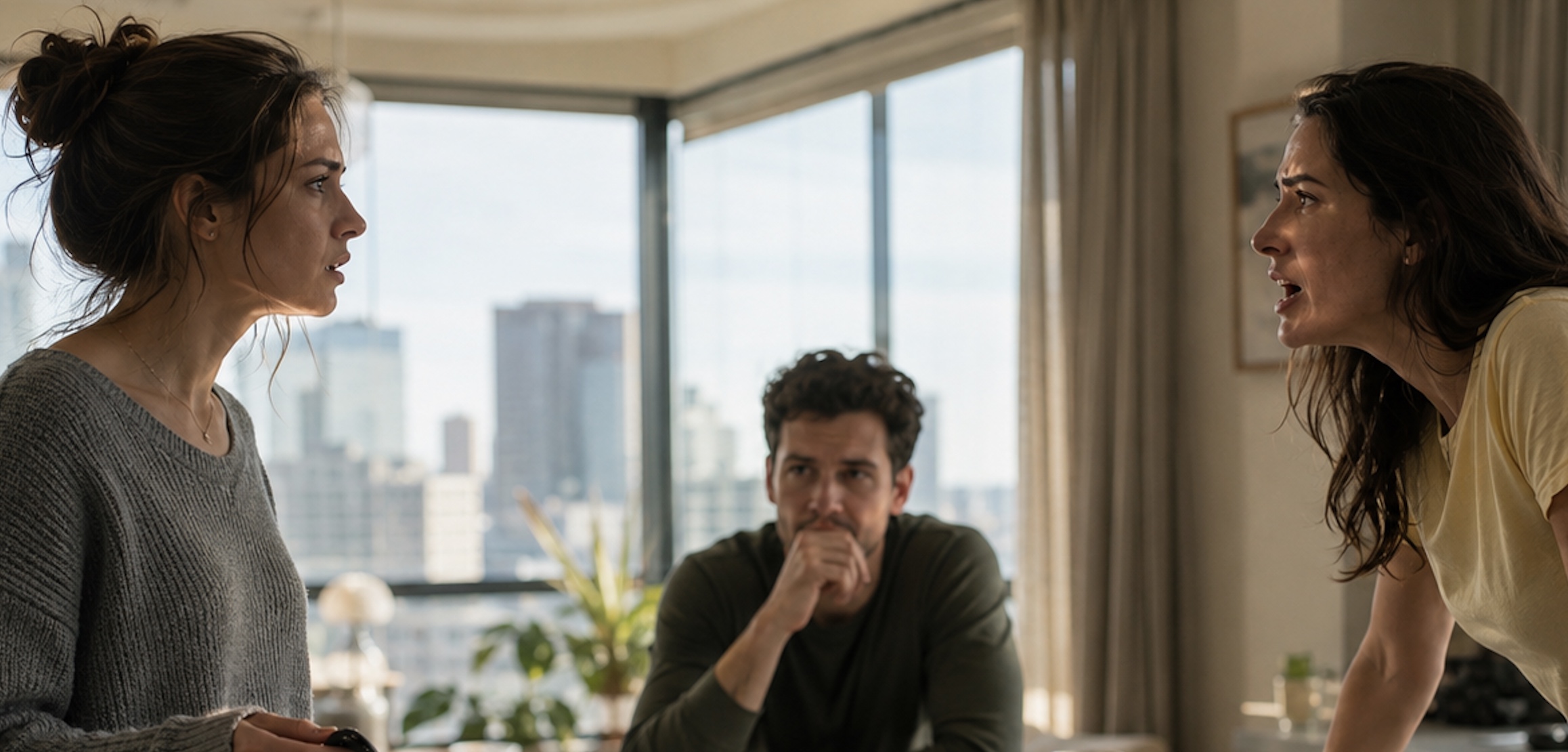
“Who exactly are you planning to throw out of this apartment? Us?!” her sister-in-law snapped, jumping to her feet the moment Natasha took the keys.
The kitchen suddenly felt cramped, as if that one sentence had sucked all the air out of the room. A moment earlier, voices had been overlapping, the television had been playing in the next room, someone had been laughing, someone had been opening bags, wrappers had been rustling, and a plate of sandwiches had been sliding across the table. Everything had sounded so confident, so settled, as though Natasha had not walked into her own home, but had accidentally stepped into someone else’s apartment and interrupted people who were already making themselves comfortable.
She stood near the table in a light jacket, her handbag still hanging from her shoulder because she had not even had time to take it off. Her fingers tightened around the bunch of keys she had found beside her sister-in-law’s bag. The metal gave a short, sharp jingle, and somehow that sound seemed louder than all the voices in the kitchen.
Svetlana, Pavel’s sister, stared at her as though Natasha had done something shameful. Beside Svetlana sat her two children: twelve-year-old Artyom, already tall and awkward, with the permanent habit of answering adults without even turning properly toward them, and eight-year-old Liza, who was chewing a cookie too quickly while anxiously shifting her gaze from her mother to Natasha. On the windowsill stood an open bag filled with children’s clothes. In the hallway, a sports bag lay on the floor. Near the door to the small room, several boxes had been neatly stacked.
Natasha’s eyes lingered on those boxes.
This was not a visit.
Not “we stopped by for an hour.”
Not “we’ll stay overnight and leave in the morning.”
This was a move.
Pavel sat by the wall and still did not get up. He merely pushed his mug away from himself, as if that small movement could somehow save him from the conversation. His face had turned gray and stubborn, as though he had already decided that if he stayed silent long enough, the whole thing would somehow resolve itself.
Natasha calmly took off her jacket and placed it over the back of a chair. Then she set her handbag on the floor, slowly, deliberately, so no one could pretend she was acting in the heat of the moment.
“Svetlana, sit down,” she said evenly. “There is no need to shout in my apartment.”
“Your apartment?” Svetlana gave a short laugh and pressed her palm against the edge of the table. “Oh, so that’s how it is now. Your apartment. And when my brother was putting up shelves here, carrying bags, meeting repairmen, was it still only your apartment then?”
Pavel suddenly seemed to come alive, as if someone had finally handed him a line he could use.
“Natasha, don’t start. We can discuss everything calmly.”
“We?” Natasha turned to him. “You didn’t discuss anything with me.”
He looked away toward the window. Irritation flickered across his face — not shame, not confusion, but annoyance. Annoyance that she had come home at the wrong time and ruined something that had almost already been decided.
Natasha had returned a day early. Everyone knew about her business trip: she had gone to a neighboring city to help launch a laboratory section at a new production facility. It was not the kind of job where deadlines could be moved for someone else’s convenience, but her supervisor had released her ahead of schedule. Part of the equipment had arrived incomplete, the launch had been postponed, and Natasha had decided to return home without warning anyone.
She had wanted to take a shower, unpack, go to bed early, and sleep in her own silence. Over the past few months, she had increasingly caught herself thinking that silence had become a luxury. Pavel could spend hours talking to his mother on speakerphone. Svetlana called about every little thing. Through Pavel, his father would ask her to drive somewhere, pick something up, or look over documents on a phone because “you understand these things.”
Natasha had put up with it as long as none of it crossed into her territory.
Today, it had crossed.
She opened the door with her own key and immediately understood that someone was home. Not even because of the voices — because of the smell of unfamiliar belongings, the sneakers thrown in the hallway, the child’s jacket hanging on her hook, and Svetlana’s bag beside the cabinet. For several seconds Natasha stood silently without closing the door, looking at the shoes: Svetlana’s large boots, two pairs of children’s sneakers, and Pavel’s slippers, which for some reason he had left right in the middle of the entryway.
The sound of the television came from the room. A man’s voice on the screen was arguing loudly, and over it Svetlana was telling someone about school, moving, and “proper living conditions.” Natasha walked down the hallway and saw the wardrobe open in the small room. Someone else’s sweaters were lying on the shelf where her folders, seasonal things, and the box of Aunt Zoya’s photographs had been kept.
Aunt Zoya — the woman from whom Natasha had inherited this apartment.
Aunt Zoya had died four years earlier. She had been a solitary, tidy, strict woman who had worked all her life as an X-ray technician at the district clinic. She had no children of her own, and she had treated Natasha almost like a daughter. After her death, Natasha had had to wait the required six months, collect documents, visit the notary, and register ownership. Pavel had not been in her life then. He appeared later — with a bouquet of chrysanthemums in his hands, a soft smile, and an ability to listen so attentively that Natasha felt, for the first time in a long while, that she had finally met someone beside whom she did not need to keep her guard up.
For the first six months, he really was gentle. He helped without forcing himself into everything. He did not interfere with decisions about the apartment. When they got married, Natasha said to him directly:
“The apartment is mine. Not because I don’t trust you, but because it is a memory of my aunt. I want everything here to remain under my control.”
Pavel nodded then.
“Of course. I didn’t marry you for square meters.”
Those were the right words. Natasha believed him. She did not even pay attention to how gradually Pavel began to speak differently. First, it was “at our place.” Then “our apartment.” Then, “Svetlana is having trouble with housing, and the small room is empty anyway.” Each time Natasha corrected him:
“The room is not empty. My belongings and documents are there. And it is not an option for your sister to live there.”
Pavel did not argue openly. He became quiet, offended, and walked around the apartment for a long time with the expression of a man who had been denied the most natural request in the world. Then Svetlana would join in.
“Natasha, I’m not asking forever. I just need to wait things out. There are problems with the landlord at my rental. The kids are tired. There’s a good school near you. You understand, don’t you? I’m alone.”
Natasha did understand. Svetlana had divorced two years earlier. Her ex-husband paid child support irregularly. She took orders from home, sometimes worked as an administrator at a salon, and sometimes disappeared into side jobs. Her life was not easy. Natasha had even helped: she brought clothes for the children, paid for Liza’s club when Svetlana ended up in the hospital, and picked the kids up after classes whenever Pavel asked.
But helping did not mean handing over the keys to her home.
Especially after the day Svetlana sat in their kitchen and said:
“You don’t have children anyway. That little room is just going to waste. Natasha could set up her work area somewhere in the bedroom, and the kids and I could stay there. Artyom is already big; he needs peace and quiet.”
Natasha had placed her spoon beside her plate and looked at her husband.
“Pavel, do you hear this?”
He gave an awkward smile.
“Svetlana is just thinking out loud.”
“Then let her think out loud in her own place.”
After that evening, the subject seemed to be closed. Pavel was restrained for several days, then became affectionate again. He brought home a set of good coffee, cooked dinner himself, and said he was tired of quarrels and wanted peace.
And while Natasha was away on her business trip, he gave Svetlana the second set of keys.
Now those keys were in Natasha’s pocket.
“Do you even understand how this looks?” Svetlana was still standing by the table, refusing to sit down. “We came because Pavel said we could. We didn’t break down the door.”
“Pavel is not the owner,” Natasha replied. “He had no right to let you move in.”
Artyom snorted.
“Mom, I told you she’d kick us out.”
Natasha turned to the boy. He immediately pretended not to care and reached for his phone, though his fingers twitched. The child was not to blame. Adults had brought him here, placed him in this situation, and made him feel as though he had a right to someone else’s room.
“Artyom, I am not throwing you out like an enemy,” Natasha said more quietly. “I am telling your mother and your uncle that they had no right to bring you here without my consent.”
“And where are we supposed to go now?” Svetlana demanded sharply. “To the train station? Onto the street? Are you even human?”
Natasha slowly pulled the bunch of keys from her pocket and placed it on the table in front of her. She did not give it back. She simply made it clear that the conversation was now about something concrete.
“You came here today with your belongings. That means you knew what you were doing.”
“I knew my brother wouldn’t abandon me with my children!”
“Your brother can help you with his money, his time, his car, his belongings,” Natasha said, looking at Pavel. “But not with my apartment.”
Pavel finally stood up. The chair scraped against the floor, and Liza flinched, frightened, stopping mid-chew.
“Natasha, let’s not turn this into a performance. Svetlana and the kids will stay for a couple of months. Until summer at most. I wanted to tell you, but you were away, and their situation was urgent.”
“An urgent situation does not begin with someone unpacking things in my room.”
“You’re exaggerating everything.”
Natasha smiled only with her eyes. It was not a happy smile. It was the kind of smile worn by people who have finally stopped doubting their own suspicions.
“I’m exaggerating? Pavel, you gave your sister keys to an apartment you do not own. You allowed her to bring her children and belongings here. You didn’t call me, didn’t ask, didn’t warn me. You’re sitting here as if I was supposed to come home, see someone else’s boxes, and say, ‘How wonderful, make yourselves comfortable.’ And after all that, I’m the one exaggerating?”
Svetlana quickly walked around the table and stood beside her brother.
“Pasha, don’t just stand there! This is your home too!”
Natasha turned her head toward her.
“No.”
One short word seemed to snap through the room. Even the television in the other room suddenly felt out of place. Liza got up and ran to turn it off without being asked. The apartment became unusually silent.
“What do you mean, no?” Pavel went pale. “I live here.”
“You live here because I allowed it. You are not registered here. You are not the owner. You did not put money into buying this apartment. You did not pay for renovations. The shelves and shopping bags Svetlana loves bringing up do not turn someone else’s apartment into yours.”
“So I’m nobody here?” he asked with a crooked smile.
“Today you answered that question yourself.”
Svetlana grabbed her bag from the table and pressed it to her chest as though Natasha might take that too.
“You’re very good at throwing words around. But you forgot something — we have children. What are they supposed to do? Pack themselves back into bags? Liza has already put out her toys.”
“Then Liza will collect them, and the adults will help her.”
The little girl, hearing her name, hid behind the doorframe. Natasha noticed and took a short breath through her nose. She felt sorry for the child. But pity for a child could not become permission for Svetlana to live in her apartment and give orders.
“Svetlana,” Natasha said, now almost calmly, “I’ll give you until nine o’clock tonight. It is seven now. In two hours, you will pack your things, call a taxi, and leave — back to where you came from, to your parents, or wherever you arrange to go. If you are still here at nine, I will call the police and tell them that strangers are refusing to leave my home.”
Pavel stepped toward her sharply.
“Have you lost your mind? You’d call the police on my sister?”
Natasha did not move back. She simply looked up at him.
“And you brought your sister into my apartment without permission. Everyone chooses their own level of scandal.”
For a moment Pavel froze right in front of her. He was used to Natasha speaking more softly. Even when she was angry, she explained, tried to preserve the appearance of a calm conversation. Now there was no pleading in her voice, no hurt. Only a decision.
And that was more frightening than shouting.
“You’ll regret this,” Svetlana hissed.
“Maybe. But I’ll regret it alone in my own apartment, without your boxes.”
Svetlana flushed. Red patches appeared on her face, and her eyes grew shiny. She snatched a child’s jacket from a chair and threw it onto a box.
“Artyom, pack! Liza, quickly! See what kind of people exist? They smile, bring presents, and then throw children into the street!”
“Do not drag the children into this,” Natasha said sharply.
“What am I supposed to do, stay silent? Let them know the truth!”
“The truth is that their mother decided to move into someone else’s apartment without the owner’s permission. Will you tell them that truth too?”
Artyom slowly got up, looking at the floor. He was already old enough to understand more than adults wanted him to. He unplugged his phone from the charger, picked up a hoodie from the sofa, and went into the small room. Liza slipped after him. Svetlana moved to follow, but Pavel caught her by the elbow.
“Wait. Natasha will calm down.”
Natasha took out her phone and checked the time.
“You have one hour and fifty-eight minutes.”
“Natasha,” Pavel changed his tone. “Listen. I understand I handled it badly. I should have told you. But you can see Svetlana is struggling. The kids go to school, her housing situation fell apart. Our parents are far away, there’s no space there, Dad just had surgery, Mom can’t manage alone. We’re adults. We can find a solution.”
Natasha nodded.
“Yes, we can. You rent them a place, sign the lease yourself, and help them move. Or you go with them to your parents and solve the problem there. Or you ask friends. Or you sell your car if it’s that urgent. There are many options.”
Pavel straightened his shoulders abruptly.
“Don’t bring my car into this.”
“Why not? You can bring my apartment into it, but I can’t bring up your car?”
He opened his mouth and fell silent. For the first time that evening, Natasha saw not irritation on his face, but understanding: the usual scheme had cracked. He wanted to manage her space while keeping his own comfort untouchable.
Svetlana noticed it too.
“Pasha, do you hear her? She’s kicking you out with us.”
“For now, I am talking about Svetlana and the children,” Natasha corrected. “But if you believe you must stay with them, I won’t stop you.”
Pavel looked at her as though, until that moment, he had not truly taken the situation seriously.
“So you’re ready to destroy our marriage because my sister asked for help?”
“No, Pavel. The marriage started falling apart when you decided my consent was unnecessary.”
He ran his hand over his face. His wedding ring flashed on his finger. Once, Natasha had chosen those rings herself, arguing for a long time with the consultant at the jewelry store, asking for something simple enough to wear every day. Now that shine seemed foreign to her.
“Fine,” Pavel said after a pause. “Let’s do this. Svetlana and the kids stay for one week. Just one week. I personally promise.”
Natasha looked at him carefully.
“You have already once made decisions about my apartment without the right to do so. Your promise means nothing right now.”
Svetlana gave a short laugh.
“Pasha, why are you humiliating yourself in front of her? Let’s go. Let her sit alone among her precious folders. Just let her not call later when she needs help.”
To everyone’s surprise, Natasha gave a faint smirk.
“Svetlana, over the past two years you have asked me for help more often than I have asked you in my entire life. So don’t worry, I’ll manage somehow.”
Her sister-in-law rushed toward the hallway, then stopped halfway.
“Give me the keys.”
Natasha tilted her head slightly.
“No.”
“They’re my keys! Pasha gave them to me!”
“Pasha gave you something he had no right to give. These keys stay with me.”
“And how are we supposed to pick up our things if we forget something?”
“Call me. We’ll agree on a time. I’ll be home and open the door.”
“And if you’re not home?”
“Then you’ll wait.”
Svetlana stared at her for several seconds without blinking. Then she strode into the small room. From there came the sounds of zippers opening, bags rustling, Artyom grumbling, and Liza quietly sobbing. Natasha stayed in the kitchen. Pavel stood opposite her in silence.
“Do you understand what you’re doing?” he finally asked.
“Yes.”
“You’re humiliating my sister.”
“No. I am taking back my apartment.”
“She won’t forget this.”
“Neither will I.”
Pavel’s fingers tightened around the back of a chair. His knuckles turned white.
“So that’s it? Just like that? Because of keys?”
Natasha went to the sink, poured herself a glass of water, and took several sips. She deliberately did not rush to answer. She needed to arrange the thought clearly so she would not doubt herself later.
“Not because of keys,” she said. “Because you saw me as an obstacle. Not as your wife, not as the owner, not as a person you needed to talk to. An obstacle that was easier to go around while it was away on a business trip.”
Pavel lowered his head. But Natasha knew that posture too well now. Before, she had mistaken it for remorse. Now she saw something else: he was calculating how quickly he could turn the conversation back in a direction that suited him.
“I wanted to help,” he said more quietly.
“Then help. Just not at my expense.”
In the hallway, a closet door slammed loudly. Natasha immediately went there. Svetlana was standing on a stool, taking down a box of Natasha’s belongings from the upper shelf. On the floor beside her were other people’s bags, Liza’s school backpack, and a blanket Natasha had bought for herself the previous autumn.
“The blanket is mine,” Natasha said.
Svetlana did not even turn around.
“Oh, come on. Are you really going to be stingy over a rag?”
Natasha walked over, calmly took the blanket from the bag, and carried it into the bedroom. When she returned, she saw Svetlana had opened the box of photographs.
“Close it.”
“I’m just looking where you shoved my things.”
“These are my aunt’s belongings. Close the box.”
Something entered Natasha’s voice that even made Artyom lift his head. Svetlana slowly lowered the lid.
“You’re kind of abnormal,” she muttered.
“Maybe. But don’t touch that box again.”
Pavel stood in the doorway. And again, he said nothing. Natasha looked at him and understood once and for all: he would not protect her boundaries, nor the memory of the person who had left this home to her. To him, all of it was just shelves, square meters, a convenient place for his sister.
While Svetlana packed, Natasha walked through the apartment and checked the rooms. In the small room, on the desk, there was a list written in her sister-in-law’s handwriting. Natasha picked it up and read it.
“Small room — kids. Natasha and Pavel — bedroom. Move some of Natasha’s things to the balcony. Buy folding chair. Divide fridge. Pay for groceries in turns. Svetlana looks for work nearby.”
Not a word about dates. Not a word about it being temporary.
At the bottom of the page, Pavel had written: “Discuss with N. later.”
Natasha laughed despite herself. Quietly, almost soundlessly. Then she took the sheet and returned to the kitchen.
“Pavel.”
He turned around.
“What?”
She placed the paper in front of him.
]
“Did you write this?”
He glanced at it and immediately frowned.
“It’s just a rough plan.”
“A rough plan of my life without my participation.”
Svetlana rushed out of the room.
“You were digging through our papers?”
“The paper was lying on my desk in my room.”
“What is it with you? Mine, mine, mine!” Svetlana threw up her hands. “Do you even have anything in your head besides this apartment?”
Natasha carefully folded the sheet in half.
“Yes. That’s why you’re leaving today.”
Time moved slowly and heavily. Svetlana packed loudly, theatrically: throwing things into bags, calling the children in a raised voice, accusing Natasha of cruelty, greed, and “ruining her brother’s life.” Pavel several times tried to take Natasha into the bedroom to talk, but she refused.
“Speak here,” she answered. “There have already been enough secrets today.”
He became more and more angry. A vein pulsed at his temple, and his movements turned sharp. But he did not dare raise his voice. Natasha was holding her phone, and he could see it was not just for show.
At eight-thirty, Svetlana announced that a taxi would take too long and they would not make it in time.
“Then call one now,” Natasha said.
“I’m not going God knows where with children at night!”
“You came here with children in the evening, already knowing I hadn’t been asked. So the issue of night travel didn’t bother you then.”
“Pasha!” Svetlana turned to her brother. “Say something to her!”
Pavel exhaled.
“Svetlana, pack. You’ll go to Mom’s for now. I’ll drive you.”
“To Mom’s?” Svetlana stared at him. “Are you serious? Dad just got out of the hospital, there are two tiny rooms, an old kitchen. Where are the children supposed to sleep?”
“Svetlana,” Pavel said tiredly, “now is not the time.”
Natasha noted it to herself: Pavel’s parents had two rooms. So there was space after all. Not convenient, not spacious, but space existed. They had chosen her apartment not because there were no other options, but because her place was better.
Svetlana realized her brother was not going to keep pressuring Natasha and turned back to her.
“Fine. We’ll leave. But you’ll find out what it feels like to be left without family.”
Natasha did not answer. She went into the hallway and began placing the unfamiliar shoes closer to the door. Not tossing them, but setting each pair on the mat so no one could later pretend to search for them and waste time. Svetlana looked at her as though Natasha were throwing her belongings out the window.
At eight fifty-seven, all the bags were by the entrance. Pavel took the two heaviest ones, Artyom picked up a backpack and a bag of clothes, and Liza hugged a stuffed rabbit to her chest. Svetlana was the last to leave the kitchen. She looked around and suddenly said:
“I left my charger in the room.”
Natasha went with her. Svetlana did take a charger from the socket, but on the way back she tried to nudge something under the cabinet with her foot. Natasha saw the flash of metal.
“What is that?”
Svetlana froze. Then she straightened.
“I don’t know.”
Natasha bent down and picked up the keys. Another set. New, with a bright plastic keychain.
Pavel went so pale in the hallway that Natasha did not even look at Svetlana immediately. Everything was clear without explanation.
“What is this?” she asked her husband.
He opened his mouth, but Svetlana spoke first.
“Spare keys. So what? The kids might have classes. I needed to be able to get in somehow.”
Natasha slowly turned to Pavel.
“You made a duplicate?”
He was silent.
“Pavel.”
“I thought it would be more convenient,” he forced out.
This time Natasha did not smile. She did not smirk. She did not argue. She simply placed the second set with the first and opened the front door.
“Leave.”
Svetlana understood she had gone too far. Confusion appeared on her face, but it was too late. Artyom was already standing outside the threshold. Liza sobbed quietly, and Pavel carried the bags onto the landing.
“Natasha, I’ll be back in an hour. We’ll talk,” he said, avoiding her eyes.
“No.”
He turned around.
“What do you mean, no?”
“I’ll pack your things in bags. Come tomorrow and pick them up. Tonight you are leaving with them.”
Svetlana fell silent for the first time all evening.
Pavel set a bag down on the floor.
“Natasha, don’t go too far. I live here.”
“Today you brought people here behind my back and made duplicate keys without my permission. I do not want you staying in my apartment tonight.”
“You can’t just kick me out!”
“I can refuse to let you back in, because the apartment is mine. You are not registered here and you have no ownership rights. If you want to dispute it, we’ll do it through the court. Tonight, you leave.”
He stared at her heavily, as if trying to push through with his gaze what he could not push through with words. Natasha held the door handle. She did not squeeze it until it hurt. She was not trembling. She simply stood there. And Pavel was the first to look away.
“Fine,” he said dully. “But you wanted this yourself.”
“No. You brought it to this yourself.”
He left. Natasha closed the door and immediately turned the lock. Then the second one. Then she checked the handle once more. Beyond the door, she could hear voices: Svetlana saying something to Pavel, Artyom snapping back at his mother, Liza crying openly now. Then the footsteps faded.
The apartment filled with silence.
Not cozy silence.
Not peaceful silence.
A heavy silence, with traces of strangers in every room.
Natasha went into the small room. A string from a bag was left on the floor. There were crumbs on the desk. In the corner, a child’s hair clip had been forgotten. She picked up the clip and placed it on the cabinet by the entrance so she could return it the next day. Then she opened the wardrobe. Her folders had been moved, the box with her aunt’s photographs sat crookedly, and several things were not where she had left them.
Natasha carefully put everything back in its place. Not because of tidiness. She needed to feel again that this apartment obeyed her hands, not someone else’s decisions.
Ten minutes later, her phone vibrated.
Pavel.
She did not answer.
Then a message arrived: “You’re emotional right now. We’ll talk tomorrow.”
Natasha looked at the screen and typed: “Tomorrow you will pick up your belongings. The only conversation will be about divorce and how your things will be handed over.”
He replied almost immediately: “Don’t be ridiculous. Divorce because of Svetlana?”
Natasha typed: “Because of you.”
Then she turned off the sound.
She did not go to bed. First, she took out the apartment documents: the property extract, the inheritance certificate, the old folder from the notary, copies of receipts. She checked everything twice. Then she photographed the sets of keys, including the new duplicate with the keychain. She photographed the boxes she had managed to notice before they were taken out, the “rough plan” sheet, and the mess in the small room.
Not for revenge.
For memory.
So that tomorrow Pavel could not say she had imagined it.
In the morning, Natasha called a locksmith. She did not file any statements, run from office to office, or pretend to be helpless. She simply found a specialist, explained that the lock cylinders needed to be changed, and waited for him to arrive. The man came in a gray jacket, examined the door professionally, and asked for the apartment documents. Natasha showed them. Forty minutes later, the old keys no longer opened anything.
When the locksmith left, she allowed herself to sit down for the first time in twenty-four hours. The kitchen was quiet. Sunlight fell across the table where Svetlana’s keys had been lying the day before. Natasha ran her palm over the surface, as though wiping away the last trace of someone else’s sentence.
At eleven, Pavel called.
“I’m downstairs. Open the door.”
“I’ll bring your things out now.”
“What do you mean, bring them out? I need to come in.”
“No.”
There was a pause beyond the door.
“Natasha, don’t put on a circus.”
“Your things are packed. I’ll hand them over on the landing.”
“You changed the locks?” His voice shifted.
“Yes.”
“Are you even normal?”
“After yesterday, I became more careful.”
He slapped his palm against the door. Not very hard, but enough for the sound to travel through the hallway.
“Open it.”
Natasha picked up her phone and started recording video. Then she approached the door without opening it.
“Pavel, I am going to hand you your things now. If you keep knocking and demanding to come in, I will call the police.”
“Go ahead! Let’s see how you explain not letting your husband into his own home!”
“I’ll explain. The apartment is mine, you are not registered here, yesterday you unlawfully gave keys to third parties and made a duplicate without my consent. I have plenty to say.”
It went quiet again outside the door. Then Pavel spoke in a lower voice.
“Natasha, open the door. I’m without Svetlana. Let’s talk like human beings.”
She looked at the packed bags in the hallway. They contained his shirts, car documents, tools, sneakers, chargers, razor, and several books. Nothing had been thrown away. Nothing had been damaged. Everything was neat.
“Talking like human beings should have happened before you started handing out keys.”
She opened the door only wide enough to see the landing. Pavel stood alone. His face was rumpled, his eyes red, and there was a pillow mark on his cheek — meaning he had spent the night either at his parents’ place or Svetlana’s and had slept badly. Yesterday that might have hurt Natasha. Today she simply noted the fact and bent down for the bags.
“Here are your things. The car documents and tools are inside. Check them.”
He did not take them.
“I’m not moving anywhere.”
Natasha placed the bags outside the threshold.
“You already have.”
“You really want a divorce?”
“Yes.”
“We don’t have children. There’s nothing to divide. The apartment is yours, the car is mine. We can do it through the registry office if you agree.”
He gave a short laugh.
“And if I don’t agree?”
“Then through court.”
Pavel stared at her intensely.
“You’ve already decided everything?”
“Yes.”
“Overnight?”
“No. Over the past few months. Last night simply showed me I was right to delay children, joint purchases, and your registration here.”
The phrase struck exactly where it was meant to. Pavel recoiled slightly, as if he had not been pushed by a hand, but by the meaning itself.
“So you never trusted me.”
“I trusted you. Until you showed me that trust, for you, meant the chance to act behind my back.”
He wanted to answer, but a door slammed upstairs, and their neighbor Raisa Petrovna began descending the stairs with a garbage bag. She saw the bags by Natasha’s door, Pavel, their tense faces, and immediately slowed down.
“Is everything all right?” she asked, not out of nosiness, but in that special tone neighbors use when they are ready to call for help if needed.
Natasha nodded.
“Yes, Raisa Petrovna. My former husband is picking up his things.”
Pavel turned sharply toward her.
“Former already?”
“In essence, yes.”
Raisa Petrovna passed by, but did not immediately go downstairs. Natasha noticed the neighbor lingering on the landing. Pavel noticed too. Pressuring her became inconvenient.
He picked up the bags.
“You’ll regret this.”
“I heard that phrase yesterday. The line is long, and the meaning is empty.”
Pavel smiled bitterly, took his things, and left. Natasha closed the door, but this time she did not lean against it or freeze there for long. She went straight back to the kitchen, opened her laptop, and began looking for a divorce petition template. Not because she wanted a war. Simply because she knew Pavel: if there was a way to delay things, he would try.
Two days later, her mother-in-law, Valentina Sergeyevna, called. Natasha looked at the screen and answered only because she wanted to end it immediately.
“Natalya, what are you doing?” her mother-in-law began without greeting. “Pavel didn’t sleep all night, Svetlana is crying, the children are upset. Why did you create such a scene?”
“Valentina Sergeyevna, your son gave your daughter keys to my apartment without my consent. Your daughter came with her belongings and children to live with me. I asked them to leave.”
“You could have been gentler!”
“They could have chosen not to move in.”
“Svetlana is having a hard time.”
“I don’t dispute that.”
“Then why are you being so cruel?”
Natasha looked at the new set of keys lying in front of her.
“Because someone else’s difficult situation does not give them the right to occupy my apartment.”
Her mother-in-law exhaled noisily.
“You were always too independent. You’re difficult.”
“Then now it will be easier for everyone. I’m filing for divorce.”
Silence hung on the other end of the line.
“Pavel won’t forgive you for this.”
“He doesn’t need to forgive me. He needs to collect any remaining belongings if he forgot something and decide whether he agrees to divorce through the registry office or wants court.”
“You speak as if this is a delivery order!”
“And yesterday I was treated as if I were an accessory to the apartment. The difference is noticeable.”
Her mother-in-law did not immediately find an answer. Then she said more quietly:
“Natasha, understand me. Svetlana is my daughter. I worry about her.”
“I understand. Then let her live with you.”
“We’re cramped.”
“So am I. Especially when no one asks me.”
Natasha ended the call first. Her hands were not trembling afterward, but her palms were damp. She wiped them with a towel and opened the window to air the room. The air came in cold, sharp, and street-scented. It became easier to breathe in the apartment.
Over the next two weeks, Pavel tried to return the situation to its old pattern. First, he sent short messages: “We need to talk,” “You were too harsh,” “I’ll fix everything.” Then he sent a long letter in which he admitted to “some mistakes,” but mostly wrote about how Natasha “didn’t know how to accept her husband’s relatives.” Then he started involving mutual acquaintances.
His cousin called Natasha, then a friend from work, then that friend’s wife, whom Natasha had seen twice in her life. They all said roughly the same thing: Pavel was a good man, Svetlana was simply in trouble, Natasha could have endured it, and the children were not to blame.
Natasha answered calmly every time:
“The children are not to blame. That is why the adults should not have used them as a pass into someone else’s apartment.”
After the third such call, she stopped answering unknown numbers.
Pavel refused to divorce through the registry office. He wrote: “I won’t divorce you. You’ll cool down and understand it yourself.”
Natasha filed a petition in court. They had no minor children and no disputed joint property, but since her husband would not agree, there was no other path. She gathered the documents, attached a copy of the marriage certificate, and kept the apartment ownership papers ready in case Pavel tried to drag the housing into the discussion. The lawyer she consulted only nodded.
“The apartment was inherited and is registered in your name. It is not subject to division. The main thing is not to sign any suspicious agreements and do not rely on verbal promises.”
Natasha had no intention of doing so.
The most unpleasant part was not the paperwork, but reclaiming the apartment in small details. For several days, she kept finding traces of that attempted move-in. A child’s sock under the sofa. A marker cap behind the armchair. Svetlana’s hair tie in the bathroom. A mark on the floor in the small room where a box had stood.
Every little thing seemed to ask the same question again:
“What if you had not come home a day early?”
If she had returned when planned, Svetlana would already have fully occupied the room. The children would have become used to it. Pavel would have met her at the door with a guilty smile and said, “Well, what can we do now? They’re already here.” Her mother-in-law would have called within an hour and asked her not to “stress the children.” The relatives would have urged, “Be patient for a little while.” And that “little while” would have stretched into months.
Svetlana would have gradually stopped asking. Artyom would have taken Natasha’s desk for homework. Liza would have spread out her toys. Pavel would have suggested moving some of Natasha’s things to his parents’ storage. Then Svetlana would have started taking part in grocery decisions, household rules, and shelf distribution. And Natasha, in her own apartment, would have become the inconvenient adult woman who got in everyone’s way.
That image made her fingers go numb. Not from fear, but from the precise understanding of how close it had come.
A month later, Pavel appeared at the first court hearing. Natasha saw him in the corridor and barely recognized him. He was neatly dressed, clean-shaven, with the same calm smile that had once won her over. Svetlana stood beside him. Without the children. She wore a dark coat, held a phone in her hand, and looked less like someone supporting her brother and more like someone making sure he did not back down.
“Natasha,” Pavel approached. “Let’s cancel all this. I’m ready to talk normally.”
“We already talked.”
“I admit the thing with the keys was wrong.”
Natasha looked at Svetlana. She immediately turned her eyes toward the board with the court schedule.
“It wasn’t something that just happened, Pavel. You made a choice.”
“I only wanted to help my sister.”
“And once again, you call it help. Not deception, not crossing boundaries, not trying to confront me with an accomplished fact. Help.”
His jaw tightened.
“You’ve become very hard.”
“No. I simply stopped explaining the obvious five times.”
Svetlana could not hold back.
“My brother is sleeping wherever he can because of you, and you’re standing here satisfied!”
Natasha turned to her.
“Wherever he can — does that mean at your parents’ place, at yours, or with friends? Pavel has options. I had one apartment, and you decided you could divide it without me.”
“As if anyone needs your apartment!” Svetlana flared.
“You did. With boxes and two sets of keys.”
Svetlana opened her mouth, but Pavel snapped:
“Svetlana, enough.”
It was the first “enough” he had ever said to his sister in Natasha’s presence. Too late. So late that it changed nothing.
The hearing itself was ordinary. No loud scenes, no beautiful speeches. The judge clarified both sides’ positions. Pavel requested time for reconciliation. Natasha calmly said reconciliation was impossible. They were given a period to think. After the hearing, Pavel tried to walk her to the exit, but Natasha went separately.
Outside, he still caught up to her.
“I really didn’t think you’d react like this.”
She stopped near the steps.
“That is exactly the problem. You didn’t think about me at all.”
He lowered his shoulders tiredly.
“I got used to you being strong. I thought you’d handle it.”
“Strong does not mean convenient.”
Pavel tried to touch her hand, but Natasha put it into her pocket.
“Don’t.”
He nodded. Something resembling understanding finally appeared on his face. Not full remorse, not readiness to change, but a late realization: the door really had closed.
And no new keys would appear in his hands.
After the second hearing, the divorce was finalized. Natasha left the courthouse without triumph. There was no music inside her, no feeling of victory. Only steady, dense calm. Like after a long noise, when someone finally turns off an unnecessary television.
That evening she returned home, took off her shoes in the entryway, and paused by the door. Only her jacket hung on the hook. Only her shoes stood on the mat. In the small room, her folders lay neatly, the box with Aunt Zoya’s photographs stood on the upper shelf, and the desk was free.
Natasha went to the kitchen, took out a clean plate, placed a fork and knife beside it, made herself a salad, and fried potatoes with mushrooms and herbs. She ate slowly, not because there was no reason to hurry, but because no one was bursting into her evening anymore with someone else’s decisions.
Later, a message came from Pavel: “Svetlana rented a room near the school. I’m helping her move. I guess we should have done that from the start.”
Natasha read it and did not answer immediately. Then she typed:
“Yes. You should have done that from the start.”
She put the phone aside and looked at the new set of keys. One set was in her bag, the second was in a safe place. No more “spare keys” with her husband’s relatives, no more conversations about “it will be more convenient,” no more other people’s plans for her room.
A few days later, Svetlana came to pick up Liza’s forgotten hair clip and the charger she had taken by mistake that evening. Natasha met her at the door without inviting her inside. She handed the items over in a small bag.
Svetlana looked different. The old bravado was gone. She seemed tired, contained, with a hard crease between her brows. She took the bag, stayed silent for a moment, and unexpectedly said:
“Liza asked why you don’t love us.”
Natasha calmly held her gaze.
“I have nothing against the children. But loving children does not mean giving their mother my apartment.”
Svetlana jerked one shoulder.
“She’s little. She won’t understand.”
“Explain it simply. Tell her the adults made a mistake and went somewhere they had not been invited.”
“So I’m supposed to admit to my daughter that I was wrong?”
“That is better than teaching her that you can take what belongs to someone else if you want it badly enough.”
Svetlana flushed, but said nothing. For once, she said nothing. Then she nodded — sharply, dryly — and walked toward the elevator. Natasha closed the door without anger. She no longer needed to prove anything.
In spring, she reorganized the small room. She was not freeing it for anyone, not remaking it to suit someone else’s needs, not pushing her own things into a far corner. She simply arranged it exactly the way she wanted. She put her work folders on the lower shelf, left the box with Aunt Zoya’s photographs on top, and placed a new notebook on the desk.
On the first page, she wrote:
“Do not apologize for what is yours.”
It was not a slogan.
More like a reminder.
Sometimes she still dreamed of that evening: Svetlana jumping up from the table, Pavel silent, the keys jingling in her hand, Liza peeking from behind the doorframe. But the dream no longer frightened her. It always ended the same way: Natasha took back the keys, opened the door, and said that the free stay was over.
And then she woke up in her own apartment.
The very apartment where no one else decided who had the right to live there.