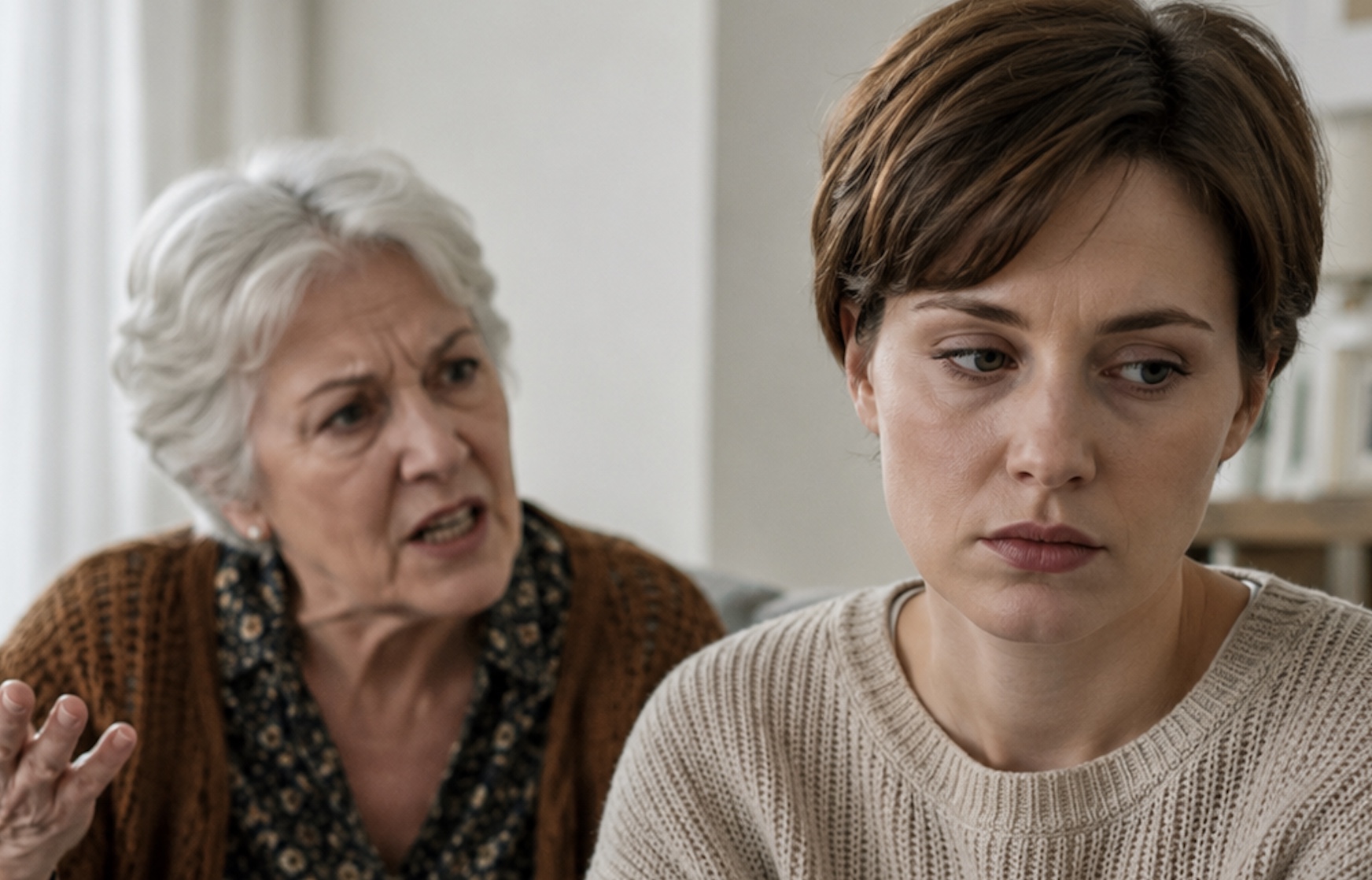
Marina came home close to eleven at night. Her legs ached, her back throbbed, and her head buzzed from the endless day behind her. She kicked off her shoes, walked into the kitchen, and put the kettle on, while reaching for the phone she had forgotten on the table that morning.
A notification glowed on the screen — a voice message from her father. Her finger froze over the play button. Gennady never sent voice messages. He preferred short, blunt texts.
“Marin, come over tomorrow at noon. We’re having a family meeting. It’s important. Everyone will be there.”
Her father’s voice sounded deliberately calm, as if he had rehearsed the line before pressing record.
Marina took a sip of hot tea and thought for a moment. The last time there had been a “family meeting” was four years ago, when they were deciding where Katya should go after school. Back then, everything had ended peacefully. Maybe this time would be the same.
The morning was hectic. Marina spent too long choosing what to wear, then gave up: jeans, a sweater, sneakers. It was not a formal event, after all. A taxi brought her there in twenty minutes, and she climbed the familiar staircase with a strange tingling feeling in her chest.
Zinaida opened the door. Her smile was flawless — smooth, wide, carefully arranged, like the smile of someone who knew exactly what she wanted from the conversation ahead.
“Marinochka, come in. Everyone’s already here,” her stepmother said in a honeyed voice. “The table is set, the tea is hot.”
In the living room, her father Gennady sat at the table — heavyset, with a stern gaze he tried to hide behind his cup. Beside him sat Dima, Marina’s stepbrother, broad-shouldered and short-haired, his shoulders always tense. His wife, Natalia, was feeding the baby from a bottle while their older son played with a toy car under the table. In the corner, on a small stool, sat Katya, Marina’s younger sister — fragile, quiet, with her usual habit of biting her lower lip.
“Hi, everyone,” Marina said, taking the empty chair. “Dad, you wanted to talk about something?”
“Wait, don’t rush,” Gennady raised his hand. “Let’s sit like normal people first.”
The conversation drifted aimlessly. Natalia talked about how their older son, Mishka, had gotten into another fight at kindergarten. Katya weakly complained about her landlady. Dima stayed silent, chewing a sandwich and occasionally nodding. Zinaida poured tea, added more cold cuts to people’s plates, fussed around with dishes — the perfect hostess, warm, caring, attentive.
Then Gennady finally cleared his throat and set down his cup.
“I’ve been thinking,” he said. “It would be nice for all of us to have a place outside the city. A country house, a yard, somewhere the children could run around. Barbecues, a bathhouse. A place where we could be together as a family.”
“What a wonderful idea!” Zinaida immediately picked up. “Gennady has been dreaming about it for so long. Haven’t you, Gena?”
“I have,” her father nodded, and it was obvious that the word “dreaming” had been suggested to him in advance.
Marina listened and smiled. A country house did sound lovely. Space for the children, peace for the adults. It sounded warm and right.
“The only question is money,” Zinaida said lightly, as though discussing the weather. “A plot of land, construction — none of that comes cheap. And then I thought…”
She paused.
Marina almost smiled to herself.
“Your grandmother’s apartment,” Zinaida said, looking directly at her. “The one you inherited. It’s just sitting there empty.”
“It isn’t empty. I rent it out,” Marina replied evenly.
“Exactly. You rent it out, and a few coins trickle in. But if you sold it, that would be real money. Enough for everyone. We could build the house, arrange the land, make something good for the whole family. It isn’t fair for one person to own the apartment alone. You sell it, and I’ll divide the money.”
Marina slowly put down her fork. She looked at her father. He looked away.
“Zinaida,” Marina said softly, forcing herself not to raise her voice. “Grandmother left that apartment to me. And not for no reason. I was by her side every day during the last two years of her life. I worked, cared for her, took her to hospitals, borrowed money to buy medicine that cost as much as a car. I slept on a folding bed beside her because she got worse at night. And where were all of you?”
Silence settled over the table, thick and heavy.
Dima was the first to break it. He pushed his plate away and looked at Marina with poorly hidden resentment.
“So what are we, then? Nobody?” His voice trembled. “I’m her grandson too. Katya is her granddaughter too. But Grandmother signed everything over to you, and we got nothing. Do you understand how that looks?”
“It looks exactly the way it was,” Marina said, holding his gaze. “You didn’t visit her once in two years. You barely even called.”
“I have children! I have work! I couldn’t!”
“And I could?” Marina asked. “I had work too, Dima. The difference is that I didn’t look for excuses. I just did what had to be done.”
Katya spoke next, quietly and almost pitifully, the way she always did.
“Nothing ever works out for me. Grandmother never really loved me much, even when she was alive. She always singled you out. You got the apartment, and I got nothing.”
“Katya, Grandmother offered you to live with her. You refused. You said her place smelled like ‘sadness and mothballs.’ Those were your words, not mine.”
Katya blushed and fell silent.
Zinaida quickly took control again, leaning forward with an expression of deep concern.
“Marina, no one is saying you didn’t deserve it. But family means helping one another. Dima has a mortgage and two little children. Katya rents a room. And you have an entire apartment that you simply rent out. Is that fair?”
“Fair?” Marina turned to her stepmother. “Was it fair when Grandmother was lying there after surgery and you didn’t even bring her broth? Was it fair that no one contributed a single ruble toward the medication that cost fifty thousand a month? I’m still paying off that loan, Zinaida. Still.”
“Well, you managed,” her stepmother smiled. “You’re strong. Now help those who are weaker.”
Marina understood then that the conversation was going in circles. Every argument she made crashed against the wall of their demands like a wave against concrete. Not because her arguments were weak — but because no one wanted to hear them.
“Dad,” Marina said, turning to Gennady. “What do you think? Was selling Grandmother’s apartment your idea?”
Gennady was silent for a long time. Then he said, without lifting his eyes:
“I think it wouldn’t hurt if everyone made some effort to meet each other halfway.”
“So I’m the one who meets everyone halfway,” Marina clarified. “And everyone else takes my money. Is that the arrangement?”
Her father did not answer.
Zinaida answered for him, as she always did.
“Marina, you’re making everything complicated. We simply want everyone to be happy.”
“No,” Marina said, standing up. “You want things to be good for you. At my expense.”
She took her bag and left the apartment, closing the door carefully behind her. She did not slam it. She did not break down. She simply left.
Outside, the wind was sharp. Marina took out her phone and called Lena.
“Lena, can you talk?”
“For you? Always. What happened? I can hear it in your voice — something nasty.”
“Family meeting. My stepmother suggested I sell Grandmother’s apartment and ‘split the money between everyone.’ Father stayed silent. Dima yelled that he was cheated. Katya whined. The full package.”
Lena was quiet for a second, then spoke clearly and firmly.
“Marina, listen to me carefully. You owe them nothing. You earned that apartment with your own hands, your time, your health. Grandmother left it to you not because she loved you more, but because you were the only one there. End of story. Don’t justify yourself. Don’t explain. Don’t give in.”
“I’m not going to,” Marina breathed out. “It’s just disgusting. You know, I went there with hope. I thought maybe Dad missed me. Maybe he really wanted us all together. And it turned out to be about money again.”
“With them, it’s always about money. Hold your ground. I’m here.”
The pressure did not stop. It simply changed its shape. Now it became quiet, creeping, daily — like rust eating away at metal.
Zinaida wrote first. The message arrived at midnight — long, detailed, written with a show of polished literacy. Every sentence was crafted to awaken guilt: “You know how hard things are for Dima… Your father is worried… Katya cries at night… Grandmother would never have wanted the family to fall apart over an apartment…”
Marina read it, closed the screen, and put the phone on her nightstand. She did not reply. Not because she had no words, but because any words would have been useless.
The next day her father called. The conversation was short and cold.
“Marina, have you thought about what we discussed?”
“I already said everything. The apartment is mine. I am not selling it.”
“You’re selfish.”
“I’m selfish? Dad, are you serious?”
“Zinaida is right. You only think about yourself. You always have.”
Marina felt something cold and sharp sink between her ribs. Not hurt exactly — disappointment. Deep and heavy, like a stone at the bottom of a river.
“All right, Dad. I heard you.”
And she hung up.
Three days later, Natalia caught Marina outside her building. She had come “by chance,” as if she had just been passing by. The baby was in her arms, the older child in the stroller. A perfect picture of an exhausted young mother.
“Marina, I don’t want to get involved in your family matters,” Natalia began, lowering her voice. “But we have a mortgage. The payments are insane. Dima doesn’t sleep at night — he calculates and recalculates everything. And you have an apartment. A whole apartment, Marina. You’re alone. You don’t need that much.”
“Natalia,” Marina said, looking her in the eyes. “I didn’t take out your mortgage. I didn’t plan your children. I didn’t give birth to them. That’s your life and your decisions. Why should I pay for them?”
“Because you can,” Natalia replied with such sincere conviction that Marina lost her words for a moment.
“Can doesn’t mean must. Please remember that.”
Natalia left with tight lips. The stroller wheels rustled over the asphalt.
That evening, Marina ran into Galina Petrovna near the store — her neighbor from the same floor, a woman around seventy with sharp eyes and the habit of telling the truth straight to people’s faces.
“Marinka, why do you look so gloomy? Is your family bothering you again?”
“How do you know, Galina Petrovna?”
“The walls are thin, child. And you’ve looked awful this past week. Go on, tell me.”
Marina briefly explained the situation. The old woman listened, shook her head, and said:
“I’ll tell you this. I had a dacha once. A good one — by the water, with a garden. My brother asked me to let him stay there ‘temporarily.’ I agreed. A year later, he registered his daughter-in-law there. Two years later, I was in court proving the place was mine. Lost years of my life. Don’t give in, Marina. You hold on to what’s yours. Pity is a poor adviser when greedy people are involved.”
“Thank you, Galina Petrovna. I won’t give in.”
“That’s my girl. Now go home and eat something decent. Your cheeks are sinking in.”
At work, Tamara — the only colleague Marina truly trusted — was the first to notice the change.
“You haven’t been yourself these past few days. Come on, tell me.”
“My relatives want me to sell Grandmother’s apartment and hand out the money.”
“How charming,” Tamara rolled her eyes. “And when your grandmother was sick, were they just as united?”
“Not one of them showed up.”
“There’s your answer. Marina, I’ve known you a long time. You’re kind. Too kind. But kindness without boundaries isn’t kindness — it’s weakness. Don’t follow their lead. Give in once, and they’ll come for a second time, then a third, then a tenth. Your relatives are insatiable.”
“I know, Tamara. I’ve already made my decision.”
On Saturday, Yulia called — an old classmate Marina occasionally exchanged messages with.
“Marina, I saw your post online. Reading between the lines, someone’s pressuring you. Am I right?”
“As always, Yul. They’re pressuring me hard.”
“Other people’s guilt is not your responsibility. They’re trying to dump their failures on you. Your father stays silent because he’s being controlled. Your stepmother manipulates because that’s what she’s used to. Your brother is angry because he’s jealous. Your sister whines because she doesn’t know how else to behave. But none of that is about you. You are not the problem.”
“Yul, sometimes I feel like a monster. Like maybe I should just give it to them so everyone shuts up.”
“That’s exactly what they’re counting on. That you’ll break. Don’t break.”
At the next family dinner, where Marina was practically dragged — her father called three times, Katya sent a tearful message — the conversation reached a new level.
Zinaida sat at the head of the table like the chairwoman of a board meeting, confident in her righteousness and absolute authority. Gennady sat beside her, his eyes dim. Dima drilled Marina with his stare. Natalia rocked the baby. Katya picked at her salad.
“Marina,” her father began, and every word sounded dictated. “We’ve thought everything over. If you consider yourself part of this family, you should help. Selling the apartment would solve several people’s problems at once.”
“Should?” Marina repeated calmly.
“Yes, should,” Zinaida cut in at once. “You live alone. You have enough. Meanwhile there are children, a mortgage, the future. You cannot be so heartless.”
“Heartless,” Marina repeated. “Interesting word. What word would you use for someone who didn’t pick up the phone for two years while his elderly mother was fading away? What word would you use for people who didn’t bring a single ruble for her treatment, but now show up and say, ‘Give it to us’?”
“Stop digging up the past!” Dima slammed his palm on the table. “We’re talking about the future!”
“No, Dima. You’re talking about my money. Those are two different things. And there is no future in this conversation.”
“You’ve always been like this — above everyone, better than everyone, Saint Marina!” he nearly shouted. “But in reality, you’re greedy to the bone!”
Marina stood up. Slowly. She looked at each of them in turn. Her father hid his eyes. Zinaida was practically glowing, apparently waiting for the pressure to finally work. Katya said nothing. Natalia turned away.
“You are the ones shaking with greed. I’ll say this once, and we will never return to this topic again,” Marina said, her voice steady and firm, without a single crack. “The apartment did not fall into my lap from the sky. I paid for it with two years of my life, my health, my money, and sleepless nights. Grandmother left it to me because I was the only one who stayed beside her. None of you has any right to it — not legally, and not morally. I will not sell anything. I will not change my mind. And if being part of this family means handing over what is mine, then I don’t need such a family. Tear each other apart without me.”
She took her bag and headed for the door.
“You’ll remember this a hundred times!” Zinaida shouted after her. “You’ll perish without family!”
Marina turned around.
“Without your family, Zinaida, I’ll finally start living normally. Thank you for the good wishes.”
The door closed.
That same evening, Marina left the family group chat. She deleted her conversations with Zinaida, Dima, and Natalia. She blocked incoming calls from those who did not call to talk, but to pressure.
A week later, she stopped answering her father’s messages. He wrote the same phrases again and again: “Think again,” “Don’t act rashly,” “You’ll regret this later.” Every message was like a copy of the previous one. Zinaida was probably dictating them.
Gradually, things became quiet. The calls stopped. The messages dried up. Her world shrank to a comfortable size — work, friends, evenings with a book.
Marina bought a new sofa — soft, warm caramel-colored. She ordered bright dishes: orange plates, blue cups, a green kettle. The apartment came alive and filled with color.
Then she went to an animal shelter and brought home a ginger cat. Thin, with a torn ear and suspicious yellow eyes. She named her Ryzhulya. Three days later, Ryzhulya was sleeping on the new sofa, curled into a ball, purring so loudly that the armrest seemed to vibrate.
One evening, Marina sat in the kitchen with a cup of tea. Ryzhulya dozed on her lap. Behind the wall, Galina Petrovna’s radio played softly. Tamara sent a funny picture. Lena wrote, “How are you? Hugging you.”
And in that moment, Marina understood clearly — without doubt, without the slightest sting of guilt — that she no longer needed a family that only demanded things from her. A family where every “let’s get together” turned into a conversation about money. A family where love was measured in square meters.
She felt light. Truly light.
Four months passed. Marina lived in a way she had not lived for a long time — calmly, steadily, without nervous phone calls or nighttime messages full of blame. Ryzhulya grew plumper. The sofa sagged in her favorite corner. The orange plates became covered with tiny scratches from knives, which meant they were being used, not displayed for beauty.
The phone rang on a Wednesday evening. It was Katya. Marina hesitated for a second, then answered.
“Marina…” Her sister’s voice sounded strange. Thin, broken.
“What happened, Katya?”
“Father left Zinaida. He sold the apartment and disappeared. Didn’t tell anyone. Just took the documents, his things — and left.”
“Wait. What apartment did he sell?”
“His. The one where he and Zinaida lived. She was trying to persuade him — no, demanding — that he sell it and give the money to Dima. Dima’s mortgage is collapsing, the interest is awful. It turns out Zinaida had already convinced Dima to take out a mortgage on a three-room apartment back when we were sitting around the table discussing Grandmother’s apartment. She was absolutely certain — one hundred percent certain — that you would agree to sell it. The money from the sale would have covered the mortgage.”
“Hold on. So Dima got into that mortgage before they even made their ‘proposal’ to me?”
“Exactly. Zinaida promised him everything. She told him Father would influence you, that you wouldn’t refuse. But you did refuse. And everything fell apart.”
Marina closed her eyes.
So that was it. That was why the pressure had been so aggressive, so persistent. It had not been just greed. It had been a calculation. Her stepmother had already spent someone else’s money, someone else’s apartment, someone else’s life. And when the plan collapsed, she began looking for another source.
“And Father?”
“Father sold the apartment. Zinaida thought he would give the money to Dima. But he took everything and left. They say he went to another city. He sent me a short message: ‘Forgive me. I’m tired.’”
“And Zinaida?”
“Zinaida is left without an apartment, without a husband, without money. She’s staying with some acquaintance now, calling everyone she knows and screaming that everything is your fault. That if you had sold Grandmother’s apartment, none of this would have happened. That you destroyed the family.”
“I did?” Marina gave a dry laugh. “I destroyed it?”
“Dima is panicking too. Natalia took the children and went to her mother. She called me crying, saying she hates Dima, that he deceived her, dragged her into banking slavery. Their small emergency savings are gone — all spent on the first payments. Now they have nothing to pay with. Dima walks around gray and lost. And he keeps saying it’s your fault too.”
“Brilliant,” Marina said calmly. “Tell me honestly. Do you think that too? That I’m to blame?”
There was a long pause. Then Katya answered quietly:
“No. I don’t. I was angry at you for a long time, Marina. I thought everything came easily to you. But then I remembered how you ran to Grandmother from morning till night. How you lost ten kilos. How your fingers trembled from exhaustion. And I realized it was easier for me to be angry than to admit that I had done nothing.”
“Thank you, Katya. That may be the most honest thing you’ve ever said to me.”
“Marina, forgive me. Truly.”
“I’m not angry. But I don’t want to go back to the way things were. I can’t.”
“I understand.”
They were silent for a while. Then Katya asked:
“Can I call you sometimes? Just like that. No requests. No complaints. Just to talk.”
“You can,” Marina answered. “But only honestly.”
“Honestly. I promise.”
The call ended. Marina put down the phone and looked at Ryzhulya, who was sitting on the windowsill and washing herself, completely indifferent to human drama.
“You see, Ryzhulya,” Marina said, stroking the cat’s warm back. “They said I would perish without family. The one who perished was Zinaida. No apartment, no husband, no money. All because she kept counting what belonged to someone else.”
Ryzhulya meowed and jumped down to the floor — asking for more food.
A week later, Tamara called Marina.
“Have you heard the news about your stepmother?”
“I have. Katya told me.”
“That’s what happens when you try to manage what doesn’t belong to you. She built a castle out of other people’s bricks and now she’s shocked that it collapsed. Marina, I’m happy for you. Truly. You’re the only one who walked out of that story with your back straight.”
“I still feel sick sometimes. After all, he’s my father. And he just left. Not just Zinaida — everyone.”
“Maybe he left because he finally understood what he had done. That he had let his wife twist him around her finger and try to turn his daughter into a cash cow. Maybe that was his way of saying, ‘Enough.’”
“Maybe,” Marina sighed.
Then another message arrived. From an unfamiliar number. It was short:
“Marina, it’s your father. New number. I am not asking for forgiveness — I don’t deserve it. I just want you to know: Grandmother made the right choice. And so did you. Take care of yourself.”
Marina did not answer. Not right away. She saved the number and put the phone aside.
Ryzhulya purred on the sofa. The orange plates stood in the drying rack. Behind the wall, Galina Petrovna’s radio was playing.
The world was in place. Her world. Small, warm, and honestly earned.
Meanwhile, Zinaida was calling acquaintances, trying to find at least someone who would let her stay “temporarily, just for a couple of months.” No one believed her. Because people who are used to controlling what belongs to others eventually end up empty-handed.
That is not revenge. It is not punishment.
It is simply a law of life: you get back exactly what you put into it.