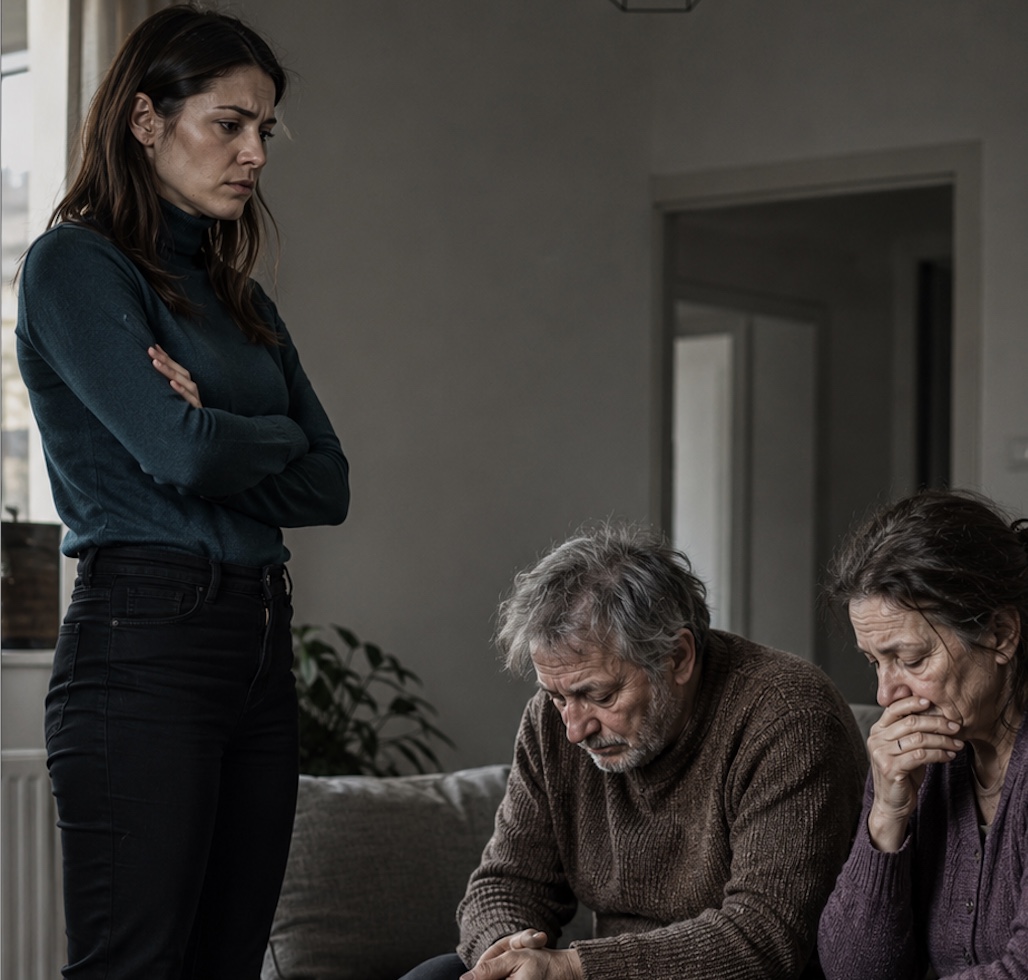
They stood in the doorway of her apartment — older now, slightly stooped, with guilty smiles that did not match the people Nastya remembered. Her mother was holding a bag of apples, as if she had simply dropped by to visit a neighbor. Her father kept twisting his cap in his hands. Behind them stretched the stairwell, filled with unfamiliar smells and the hollow echo of a city that had never belonged to them.
Nastya looked at them and felt something inside her slowly, inevitably tighten. Not from pain — no. She had let the pain go long ago. It was something else. Old wounds aching quietly under the skin.
“Nastenka,” her mother said, and her voice trembled so skillfully that Nastya almost admired it. “We’ve come about something important. May we come in?”
Nastya did not move.
“Something important,” she repeated. “Interesting.”
They came inside. Nastya did not know why she let them in — maybe because the neighbors could hear everything, or maybe because some deeply buried, long-forgotten part of her was still hoping for something good.
She led them into the kitchen and put the kettle on. She moved mechanically while her mother praised the cleanliness and order, and her father stayed silent, staring out the window. Outside was the city Nastya had chosen for herself.
“We need help,” her father finally said. “With a loan. Valya is getting married in two months. We need one million, but our income is low. You understand — the banks will refuse us. And you work at a bank, you could…”
Nastya set the cup down so sharply that it rang against the saucer.
“You abandoned me for my sister,” she said quietly, each word precise and clear, “and now you’ve come to me asking for a loan? Am I understanding this correctly?”
Her mother threw up her hands.
“Oh, why do you say it like that — ‘abandoned’…”
“I was fifteen,” Nastya said. “Fifteen. And you left.”
She had been fifteen when everything began.
Valya — the older daughter, the beloved one, the talented Valya — had finished school and announced that she was going to become a singer. She did have a voice, that was true. Not extraordinary, but pleasant. Her parents looked at their eldest daughter as if she were already standing on a grand stage. Her father would say, “Valyushka will make it. She has everything it takes.” Her mother sewed stage dresses for her and watched television auditions, studying how contestants were supposed to hold themselves in front of a jury.
Six months after Valya’s graduation, they moved to the capital. All of them — her father, her mother, Valya, and every bit of the family’s money. They rented an apartment, started taking their daughter to castings, producers, and some agencies. Both parents worked, barely managing to cover rent and Valya’s outfits.
Nastya stayed behind.
They did not leave her because they forgot about her. They left her because there was simply no room for her in this new plan. Her grandmother, Taisiya Ivanovna — her father’s mother — lived three streets away and took Nastya under her wing so quietly and naturally that at first the girl did not even understand the scale of what had happened.
She understood later.
When her classmates talked about how their mothers had helped them with their hair before a first date, Nastya stayed silent. When the teacher called parents to a school meeting, Taisiya Ivanovna came in her best dress and said, “I’m here for Anastasia.” When Nastya felt bad, she would go to her grandmother, lay her head in her lap, and the old woman would stroke her hair and say something about how everything would pass.
Her parents called once a week. They asked, “How are you?” Nastya said, “Fine.” And that seemed to be enough for them.
In the tenth grade, Nastya fell in love. Truly, the way only a sixteen-year-old can fall in love — without boundaries, without caution, without the experience that teaches you to protect your heart. He was from a parallel class, handsome and careless, the kind of boy who knew how to say the right words at the right moment. She had no one to ask for advice. Her grandmother was wise, but in matters like this Nastya needed her mother. She needed the woman who could have said, “Wait. Don’t rush. You don’t yet know how these things can turn out.”
But her mother was not there.
After graduation, on the night when the whole class stayed out until dawn, Nastya came home carrying something she could not tell anyone. A few weeks later, she discovered she was pregnant.
Her parents returned on their own. Valya’s career had never happened — producers shook their heads, auditions ended in polite rejections, and the money ran out sooner than their patience. They came back looking like people who had survived a war, and her mother immediately began complaining to the neighbors that they had “invested so much effort, but those capital-city sharks gave nothing to a talented girl.”
When she saw Nastya, her mother turned pale.
The conversation was short and terrifying. Her father shouted something about disgrace. Her mother cried and said, “This is the last thing we needed.” Valya stood in the doorway and looked at her sister with an expression Nastya would remember forever: not anger, not sympathy — just disgusted curiosity.
“Get out,” her father said. “Right now. Go wherever you want!”
Nastya left.
She stopped by her grandmother’s to say goodbye and take a few things she had kept there. Taisiya Ivanovna listened to her, then silently stood up, opened the wardrobe, and took out an envelope. All her savings. She gave it to Nastya without hesitating for even a second.
“Go,” she said. “Live. Don’t look back.”
And then, as Nastya was already leaving, she added:
“You are strong. You’ll manage.”
And Nastya did.
Not immediately. Not easily. But she did.
She chose a city almost at random — simply the largest one nearby. She enrolled in university to study finance, because she had always been good with numbers, because even a scholarship was something, and because that kind of degree could later help her find stable work. She got a job in a café — first as a waitress, then at the register. She rented a room in a shared apartment from an elderly woman who did not ask unnecessary questions.
Her daughter was born in March, while snow still lay outside the maternity hospital windows. Nastya named her Sonya. She looked at that tiny face and thought: this is who I will live for.
Even during maternity leave, Nastya could not simply sit still. It was not in her nature. She began reading everything she could find about finance, investing, and personal budgeting. She started a blog — at first only for herself, then she began answering subscribers’ questions. It turned out she had a gift for explaining complicated things in simple words. People trusted her. They were willing to pay for consultations.
By the time Sonya turned one, the blog was supporting them both no worse than the café had.
By the time Nastya received her diploma, she was already known in the city’s professional circles. The bank hired her almost immediately — for a good position with real prospects. A year later, she became head of a department.
She did not think of it as revenge. She was not trying to prove anything. She was simply living. Working. Raising Sonya. Sometimes she called her grandmother — they talked for a long time, and every time Taisiya Ivanovna would say, “I’m proud of you, Nastenka.”
She heard about her parents from her grandmother — briefly, in passing. That they had returned. That they were living somehow. That Valya worked in a shop. Her grandmother never condemned anyone aloud, but Nastya had learned to read between the lines of her silence.
She also learned from her grandmother that Valya was getting married. “Pregnant,” the old woman added softly, and Nastya felt a strange, almost bitter irony in it all.
And then, one fine day, the doorbell rang.
Now they were sitting in her kitchen, drinking her tea. Her mother kept fiddling with the handle of her mug. Her father stared at the table.
“We did not abandon you,” her mother finally said. “We thought you would manage. You were always so independent…”
“I was fifteen,” Nastya repeated. Her voice was even, almost without emotion, which made it more frightening than any scream. “I was independent because I had no choice. You left for Valya. You spent everything on Valya. Then you came back and threw me out of the house while I was pregnant, with nowhere to go.”
“You yourself…”
“I myself — what?” Nastya looked at her mother. “Gave birth by myself? Yes. Studied by myself? Yes. Built a career by myself? Yes. Everything — by myself. But not because I chose it. Because you chose it for me.”
Her father cleared his throat.
“Nastya, we understand that… that mistakes were made. But now this is about Valya. She’s getting married, there will be a child, they need to set up a home…”
“I heard you.”
“You work at a bank. You could help with the paperwork, maybe act as a guarantor…”
“No.”
The word fell into the kitchen like a stone. Short. Final.
Her mother raised her eyes.
“Nastya…”
“No,” she repeated. “I will not help. Not with the loan, not as a guarantor, not with anything. These are not my problems.”
“But she is your sister!”
Something stirred inside Nastya — not anger, not bitterness, but something calm and very solid.
“You abandoned me for my sister,” she said slowly, letting every word land exactly where it belonged, “and now you’ve come to me asking for a loan. Do you understand how that sounds?”
Her parents said nothing.
“When I was pregnant and alone in a strange city, you did not come. When Sonya was born, you did not call. You found out that I live well now, and you came for money. Money for Valya. Again, for Valya.”
“We thought you had forgiven us…”
“I did forgive you,” Nastya said, and it was true. She had long ago stopped carrying that burning resentment that keeps a person awake at night. “But forgiveness is not permission. I forgave you for myself. That does not mean I am obligated to solve your problems.”
Her father stood up.
“So that’s a no?”
“No.”
He put on his cap.
“Then live with your truth,” he said — not angrily, but tiredly, which somehow felt even worse.
Her mother stood too. She picked up the bag of apples — she had never taken them out and put them on the table. For a second she stopped by the door.
“You’ve changed, Nastya.”
“Yes,” Nastya agreed. “I have.”
The door closed. Nastya stood in the kitchen for a while, looking at the two almost untouched cups of tea. Then she poured them out, washed the cups, and put them back in their place.
Sonya was asleep in the next room. Small and warm, with dark hair scattered across the pillow. Nastya stood in the doorway, looking at her daughter, and felt neither triumph nor relief. Only a quiet certainty that she had done the right thing.
Six months later, Nastya bought an apartment — a little bigger than she and Sonya needed. A two-room place with a large kitchen and a view of the park.
She called her grandmother.
“Taisiya Ivanovna,” she said, and for the first time in a long while, her voice trembled slightly. “Would you like to move in with me?”
A pause. Then a quiet question:
“For good?”
“For good.”
Her grandmother arrived three weeks later with two suitcases and her knitting. Sonya immediately climbed into her lap and demanded a story. Taisiya Ivanovna looked around — at the clean apartment, the books on the shelves, the child’s drawings on the refrigerator — and her face looked as if she had finally seen something she had believed in for a very long time.
“You made it,” she said softly. Not exactly to Nastya — more to the room itself. “You made it, my girl.”
They began living together — Nastya, Sonya, and Grandma Tasya. In the mornings, Taisiya Ivanovna cooked porridge and took Sonya to kindergarten while Nastya went to work. In the evenings, they drank tea in the kitchen and talked — about ordinary things, about important things, about how the day had gone well.
Sometimes Nastya thought about her parents. Not with pain — she simply thought of them. The way one thinks about a long-closed chapter of a book: it existed, it meant something, but the story continues, and what comes next is far more interesting.
Her career kept growing. Her blog kept expanding. Sonya learned her letters and was absolutely convinced that Grandma Tasya knew the answers to every question in the world — and in that, perhaps, she was right.
One day Sonya asked:
“Mom, where are your mom and dad?”
Nastya was silent for a second.
“Far away,” she said. “In another city.”
“Will they come?”
“I don’t know.”
Sonya thought about it and nodded with the serious expression of someone who had accepted the information.
“All right. We have Grandma Tasya. That’s enough.”
Nastya looked at her daughter and laughed — softly, sincerely. Then she hugged her tightly and thought that yes. It was enough. More than enough.
Outside the window was her city and her life — the life she had built herself, out of nothing, against everything. No one had given her a foundation, so she poured it herself. No one had built walls for her, so she raised them herself. And the roof over it all was the elderly woman who had once given everything she had and said: go, live, don’t look back.
Nastya did not look back.
She looked forward.