The shirt smelled strange. Official somehow, chemical, faintly sweet — the smell of dry cleaning, the smell of defeat.
Igor buttoned it in front of the hallway mirror and tried not to meet his own eyes. The kitchen was quiet. There was no sizzling pan, no smell of coffee, no clinking cups. There was only silence — thick, heavy, alive, like an animal crouched in hiding, waiting.
Valya was sitting in the room. Igor could hear her turning the pages of a book — deliberately slowly, deliberately indifferently. He understood that this was war.
He left without saying goodbye. And only in the elevator, when the doors closed and reflected his blurred, unfamiliar face in the metal, did he realize that he had never felt like such a fool in his entire life.
And it had all started with a pair of boots.
The most ordinary children’s boots. Antoshka had started wearing them in September, and by October — would you believe it — he had already outgrown them. They squeezed his feet and were fit for nothing but the trash. Valya discovered it on Sunday morning while getting their son ready for a walk.
“Igor,” she said, appearing in the doorway of the living room, where her husband was lying with his phone, “Antoshka needs new boots. The old ones are too small.”
Igor lifted his head. The phone in his hand was new — the one he had bought two weeks earlier without asking anyone. He had simply come home from work and placed the box on the table. Back then Valya had looked at the box, then at her husband, then back at the box — and said nothing. She had stayed silent, cleared the table, and served dinner.
“We’ll buy them,” Igor said, turning his eyes back to the screen.
“When?”
“Well, not right now. Next month.”
Valya was silent for a moment. Antoshka stood beside her in his socks, looking at his father with that impartial childlike attention that makes you want the ground to swallow you whole.
“Next month?” Valya repeated. “It’s October. He has to go to school now, and at after-school care they go outside every day. What is he supposed to wear — slippers?”
“Valya, why do you have to turn everything into a drama? Find him something else for now. Some old sneakers or whatever.”
“The sneakers are too small too.” Her voice became calm. That was more dangerous than if she had raised it. “Igor, the child needs shoes. This isn’t a whim.”
“I hear you.” He finally put the phone down. “There’s just no money right now.”
“No money,” Valya said slowly. “But there was money for a phone?”
A pause. While he remained silent, she remembered everything: the box on the table, her own silence that evening, his smug smile as he described the camera, while she nodded and thought that Antoshka needed a winter jacket, and that they still hadn’t changed the water filter.
“The phone is different,” Igor said.
“How exactly?”
“It just is.” He sat up. “I need it for work. I can’t walk around with an old one. It doesn’t look professional.”
“Doesn’t look professional?”
“Valya, enough.”
“No, really, I’m curious.” She crossed her arms. “Why do you need to look so professional? Will they raise your salary?”
“You know perfectly well what I mean.”
“I understand that you bought yourself a toy, and now we have no money for our son’s boots. That’s what I understand.”
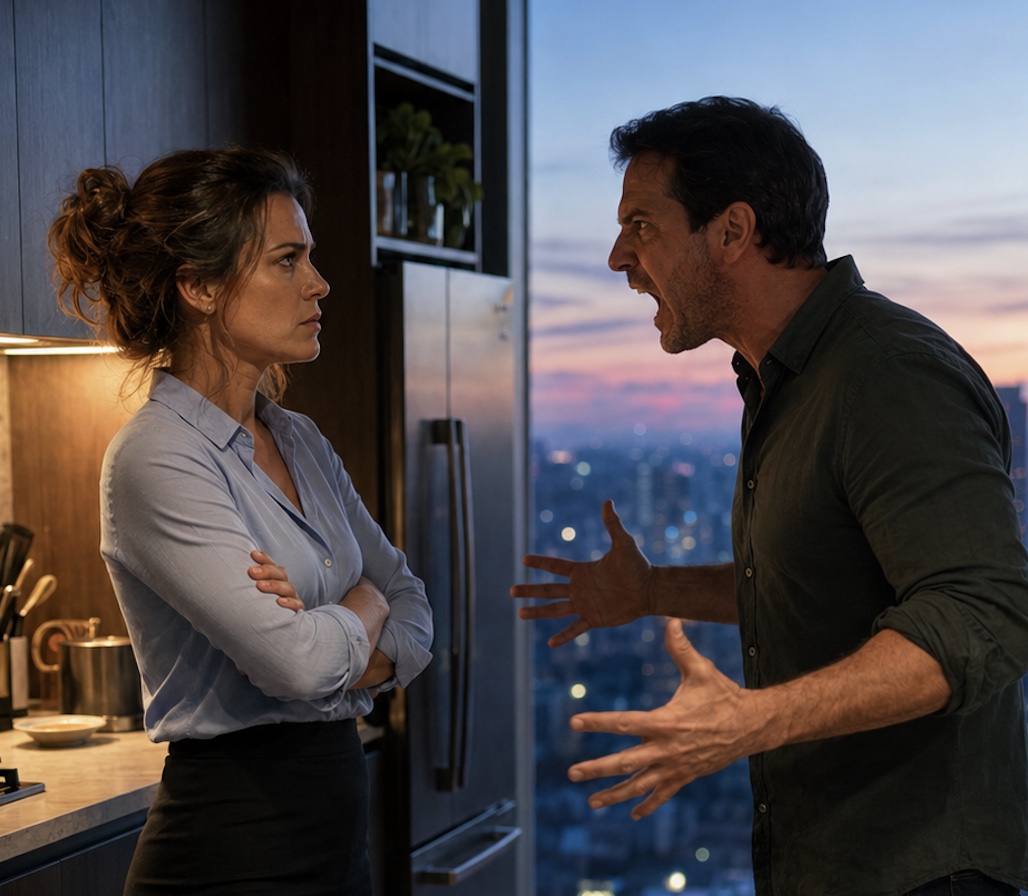
“What I spend my money on is none of your business!” Igor snapped — sharply, angrily, with that unpleasant feeling of a man who knows he is wrong but can no longer back down, because backing down would mean admitting it. “I earn it, I decide!”
Valya looked at him. For a long time. Antoshka quietly took her hand.
“Then take care of yourself too, since you’re so independent,” she replied — quietly, but very clearly. “Cook for yourself. Wash your own clothes. Iron them. All by yourself. Since you decide everything by yourself.”
She turned around, took Antoshka, and went into the hallway to put on his old, slightly tight sneakers. Igor heard her tying the laces. He heard Antoshka complain — quietly, not whining, simply saying, “Mom, they pinch a little.” And he heard Valya answer, “I know, sweetheart. Bear with it.”
The door closed.
Igor was left alone with his new phone and the feeling that he had just suffered a serious defeat, even though, formally speaking, he hadn’t said anything anyone could pin on him.
For the first few days, he held himself with dignity.
He ordered a large pizza with three kinds of cheese and pepperoni — the kind Valya never bought because “it’s just fat and salt.” He sat on the couch, watched football, ate straight from the box, and thought: fine then. Perfect. Nobody nagging, nobody lecturing him about healthy food. He could do whatever he wanted.
Valya didn’t nag. In fact, Valya barely spoke to him at all — only when necessary, only about Antoshka, dryly and briefly. She cooked for herself and their son, set the table for the two of them, cleaned up afterward. It was as if Igor did not exist. It was unpleasant, but he did not show it.
For the first three days, pizza felt like a celebration. On the fourth, it was just food. On the fifth, he caught himself staring at Valya’s pot of borscht with the uneasy attention of a hungry man. The borscht smelled the way home smells — rich, warm, comforting.
He ordered sushi. Then Chinese food. Then pizza again — a different one, with mushrooms — and threw away half the box because he simply couldn’t stand it anymore.
On the seventh day, he boiled himself some eggs, made a sandwich, and realized that this was probably the limit of his culinary abilities.
The shirts ran out on Wednesday.
He didn’t understand immediately how it had happened. It seemed like there had been plenty of them — seven or so hanging in the closet: white ones, blue ones, a gray checked one. But Valya wasn’t washing them, and he somehow had never thought that shirts eventually ran out. That they had to be washed. That they didn’t appear in the closet by themselves, clean and ironed.
On Wednesday morning, he opened the closet and saw empty hangers.
Well, not entirely empty. There was one shirt — a white one he had worn to a corporate party the year before. There was a small red wine stain on the cuff, which Valya, for some reason, had never managed to remove completely. Back then, he had been annoyed that the stain remained. Now he looked at that shirt as if it were a lifebuoy.
He put it on. Turned sideways. The stain wasn’t too noticeable if he kept his jacket on. It would do.
It did not do.
At the morning meeting, Romanov — the department head, generally not a malicious man, but painfully sensitive to employees’ appearance — looked at Igor in such a way that Igor immediately knew there would be a conversation.
The conversation happened right after the meeting.
“Igor, are you all right?” Romanov asked, and that “all right” contained everything: the sweatshirt Igor had been wearing for the past few days instead of a shirt, the wrinkled clothes, and the general disorder of his appearance.
“Everything is fine,” Igor said.
“You do understand that you represent the company? That it is unacceptable to look the way you’ve been looking these past few days?” Romanov paused. “You remember that the company can cut your bonus?”
“I remember.”
“Good.” Another pause. “Then it won’t come as a surprise to you.”
Igor left the office and stood in the hallway for several minutes, staring at the wall.
The bonus. He had lost his bonus because he didn’t have a clean shirt. Because there was no one to wash it.
No. Because he hadn’t washed it himself.
No. Because he had never once in his life thought about the fact that shirts needed washing — they had simply always been clean, always hanging in the closet, always smelling fresh. He had taken it for granted, like air, like water from the tap.
He took all seven shirts to the dry cleaner on Thursday.
The woman at the counter — elderly, with tired eyes — sorted through them, examined the collars and cuffs, made notes on the receipt. Then she named the price.
Igor blinked.
“That’s for seven shirts?” he asked.
“For seven shirts,” she confirmed. “Plus ironing. You wanted ironing, didn’t you?”
He did. Without ironing, there was no point. He had tried ironing once, back in his student days, and the shirt had looked afterward as if someone had slept in it.
“When will they be ready?”
“Friday after six.”
“I need them on Friday,” he said. “I have a meeting.”
“For Friday, that’s an express order.” She named a different price.
Igor said nothing. He took the receipt, went outside, stood by the door, and stared for a long time at the gray October sky.
He had spent a serious amount of money on dry cleaning. Plus the lost bonus. Plus all the food deliveries every day. Plus — and this only hit him now, outside the dry cleaner — Antoshka’s boots, which they still hadn’t bought.
He took out his phone.
The new one.
He opened a food delivery app, started choosing dinner, then closed it. He wasn’t hungry. Or rather, he was — but not for that. Not out of a box. Not with plastic forks. He wanted to sit at a table. He wanted the smell of homemade food. He wanted Antoshka to tell them about school, interrupting himself the way he always did — starting one story, suddenly remembering another, getting confused. Valya always laughed.
Igor could not remember the last time he had heard her laugh.
He came home and sat in the kitchen for a long time.
Valya had put Antoshka to bed and was now reading in the bedroom — he could see a strip of light under the door. The apartment still smelled of her dinner. She had fried chicken with potatoes; the scent lingered. Igor looked at the clean stove, the washed dishes stacked in the drying rack, the kitchen towel neatly hanging from the oven handle.
He tried to remember the last time he had washed the dishes himself. He couldn’t. Well, of course, he had done it sometimes — once every few weeks, demonstratively, so he could later say, “I help.” But every day, the way Valya did? Never.
He stood up, went to the stove, opened the refrigerator. On a separate plate, covered with a smaller plate, there was chicken and potatoes. Beside it lay a paper napkin. No note, no message — just food.
She had left him dinner.
He looked at that plate for a long time. Then he closed the refrigerator, walked down the hall, and knocked on the bedroom door.
“Yes,” Valya’s voice said.
He went in. She was lying with a book, looking at him over the pages — without anger, without theatrical coldness. She simply looked and waited.
“You left me dinner,” he said.
“I saw you hadn’t eaten.”
“You didn’t have to.”
“I didn’t.”
He was silent for a moment. Then he sat on the edge of the bed. She did not move away, did not pull her legs aside, did not show in any way that he was unwelcome. She simply looked at him.
“Valya,” he said. “I was wrong.”
She closed the book and placed it on the nightstand.
“I understand that what I said about money was rude. About it being none of your business.” He spoke slowly, choosing his words — not because words were hard to find, but because he wanted to say it properly, without blurring the truth. “You had every right to ask. It’s our money. And Antoshka needs boots — you were right. It isn’t a whim.”
“I know I was right,” she said quietly.
“Yes.” He gave a joyless little smile. “I knew it too. I just… admitting it was…” He searched for the word.
“Uncomfortable?”
“Shameful.” He looked into her eyes. “I bought the phone without thinking about other expenses. Boots. A winter jacket — you mentioned the jacket too. And probably other things. I wasn’t thinking. Or rather, I didn’t want to think.”
Valya remained silent. But the silence was no longer so stone-cold, no longer so distant.
“And one more thing,” Igor continued. “I think I didn’t understand at all how much you do. I mean, truly didn’t understand. Food, laundry, ironing, cleaning — that’s every day, isn’t it? It’s not ‘helping once a week by washing the dishes.’ It’s every day.”
“Every day,” she confirmed. “Plus Antoshka. Plus his school, his homework, his activities, his doctors.”
“Yes.” He rubbed his face with his hands. “I took seven shirts to the dry cleaner, and it cost…” He named the amount. “And I still had to wait. And because I need them for a meeting on Friday, I had to order express service, which costs even more. And at work they already reprimanded me for coming in a sweatshirt. And they cut my bonus.”
Valya looked at him, and he saw that she was not gloating. She wasn’t thinking, “Serves you right.” She was simply listening.
“I don’t know how,” he said. “I don’t know how to do any of it. I can boil eggs and order pizza. I lived on pizza for a week, and now I can’t even look at it. But you somehow manage to cook proper meals, and do laundry, and iron, and take care of Antoshka, and you work too.”
“I manage,” she said. “Not always gladly. Sometimes I’m very tired. And sometimes I wish you would notice.”
“I will notice,” he said. “I promise. These aren’t just words. I will notice.”
She took his hand. Simply took it and held it.
“And one more thing,” he said. “I’m going to talk to Romanov about work. There’s a position there — I could have tried for it long ago, but I was a little afraid of the responsibility. If they take me, it’ll mean different money. And from now on, big purchases — phones, or anything else — we’ll discuss together. In advance. We won’t put each other in front of a fact after it’s already done.”
“That would be good,” Valya said softly.
“And on Saturday, we’re going to buy boots.” He squeezed her hand. “For Antoshka. First thing.”
She nodded. After a pause, she asked:
“Have you eaten?”
“Not yet.”
“Go on. It’s in the refrigerator. Warm it up.”
He got up and reached the door. Then he turned back.
“Valya. Thank you for leaving it.”
“Go already,” she said.
But the corners of her mouth trembled.
On Saturday, they went together as a family.
Antoshka found boots quickly — first he liked one pair, then another, and in the end chose the ones with a zipper, because “laces take too long.” Valya watched him stomp around the store in his new boots, checking whether they pinched, and laughed — just like that, suddenly, lightly.
Afterward, they went to a café, and Antoshka talked about school, interrupting himself, getting confused, starting over, and Valya laughed again. Igor looked at both of them and thought that perhaps this was exactly what made life worth living.
He could have understood it sooner. But better late than never — he had heard that phrase somewhere. Before, it had sounded like a cliché.
Now it simply sounded true.