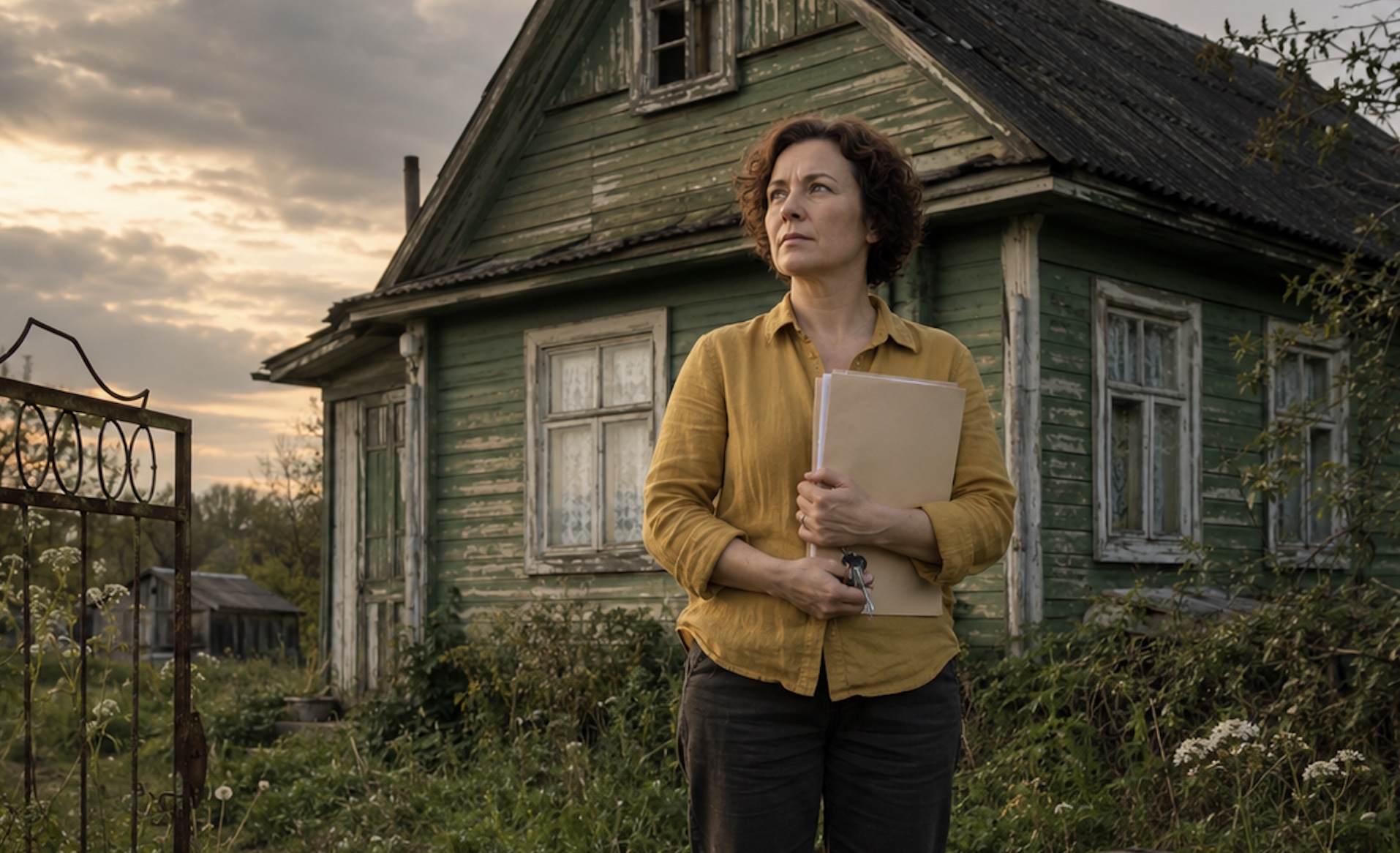
When I finally took the documents into my hands, something inside me loosened. For the first time in a year, I did not feel emptiness. I felt anticipation.
Outside the café window, the asphalt shimmered in the heat. The air conditioner pushed cool air through the room, and I sat there staring at the contract like a child staring at a candy wrapper.
Six hundred square meters outside the city.
And not a single person had told me I was doing the right thing.
Because everyone had told me the opposite.
“You’ve lost your mind,” my mother said, almost setting her cup down beside the table instead of on it when I showed her the bank statement. “Larisa, you’re forty-three. You’ve just divorced. You’re renting an apartment. What summer house? What garden beds? Have you ever even held a shovel?”
I had.
Once I planted a flower bed near our house — petunias, marigolds, everything neat and proper. My husband looked over the fence and said, “Nothing better to do, so you dig around in the dirt.”
After that, I never went near that flower bed again.
Not because of the flowers.
I simply lost the desire.
But now I had lost the desire to listen.
My brother called that same evening. His voice sounded as if he were speaking to a mentally unstable person — cautious, soft, almost theatrical.
“Lar, explain the logic to me. You invested everything you received from the property division. That was your financial safety net. And this plot? It has an old garden shack and a shed. Who talked you into this?”
“No one.”
“Exactly. No sane person would advise something like that.”
He worked as a real estate appraiser, and in his worldview, only new-build apartments, mortgages, and resale value existed. Anything outside that system gave him an attack of professional arrogance.
“There isn’t even water there,” he added, as if delivering a diagnosis. “The well is old, the pump is broken, and the electricity was disconnected because the previous owner didn’t pay the bills. Do you understand that you’ll have to pour just as much money into it as you already paid?”
“I understand.”
“And what? You’re going to live in a ruin while saving for repairs?”
“I will.”
He exhaled into the phone, long and heavy, like air escaping from an overfilled tire.
“Mom is right. This is hysteria. You simply don’t realize what you’re doing. Divorce is a trauma, Lar. Maybe you should…”
He stopped himself, but I knew exactly what word had almost slipped out.
Therapist.
Forbidden word number ten on the list of things I no longer wanted to hear after my ex-husband had spent two years convincing me that I was “unstable” and “too emotional.”
“Pasha,” I said calmly. “I bought a summer house. That’s it. Come visit in August if you want. Right now, it’s honestly…”
I paused, searching for the right word.
“A dump,” he helped.
“Right now, it needs a lot of work,” I finished.
And it really did.
On the first Sunday, I arrived at the property at seven in the morning with a thermos and three bags from the hardware store.
The minibus dropped me off on the main road. From there, I had to walk past silent fences. Behind some of them, construction work rattled. Behind others, there was only stillness — those summer houses that had grown empty along with their owners.
My plot was the second to last on the lane. The gate hung on one hinge and opened with such a nasty screech that my teeth clenched. The path was overgrown with ground elder mixed with nettles. The apple trees had not been pruned in four years. And the little house — once covered in green-painted wooden siding, now peeling down to gray bald patches — looked at me through a window without trim.
I stood there and looked back.
Inside, the smell of dust and old wood hit me.
Not mustiness.
Old wood, warmed by the sun.
There was a Dutch stove with a crack in its side, a table covered with a small floral oilcloth, a sagging sofa with a spring poking through, and on the windowsill, a glass jar filled with dried soil and the remains of a dead plant.
And silence.
The kind of silence you never hear in the city.
Only the wind in the apple trees and, somewhere far away, a dog barking.
I stepped back onto the porch, sat down on the shaky step, and cried.
Not out of self-pity.
Out of relief.
In the last year of my marriage, I had forgotten that silence could exist without reproach. That you could wake up and not wonder what mood the person behind the wall was in. That you could simply sit and listen to the wind without someone asking, “Why are you sitting there? Who’s going to make dinner?”
An hour later, I was already pulling out nettles.
My hands burned even through my gloves. Sweat ran into my eyes. But every weed I ripped from the ground felt like a small act of revenge.
This one.
And this one.
And this one.
A weed like a reminder of my ex-husband.
A weed like his mother’s phone calls.
A weed like my own fears, which I had watered for three years.
By August, I had cleared the plot. I found an electrician from the neighboring village who restored the wiring in three days. I persuaded a retired man from the next street to clean out the well. He shook his head for a long time while examining my “shed,” but when I told him I would pay in cash and immediately, he nodded and came the next morning.
Water came on the fourth day.
Muddy. Rust-colored from the clay.
But it was water.
I filled a bucket, poured it into the ditch, filled another. Then another.
And suddenly I realized I was laughing out loud.
July and August blurred into one endless day.
I quit my job as a certification specialist at the dairy plant. After the divorce, I could not stay there anyway — too many mutual acquaintances, too many questions, too many sympathetic looks.
I took what remained of my vacation pay and launched online courses for people who wanted to understand product labeling requirements.
I worked at night.
During the day, I built.
My brother finally came at the end of August. Without warning. I was painting the shutters at that moment — I had bought bright yellow paint and was moving the brush over the wood with almost furious concentration.
“Well, well,” he said, stopping at the gate. “You did all this yourself?”
“By myself.”
He walked around the plot in silence.
He looked inside the house. There was already a new gas stove there — a gift from my friend Liza, the only person who had supported me and even taken a week off to help me paint the walls. Pasha touched the freshly whitewashed corners, inspected the new wiring, and shook his head.
“Lar,” he finally said, “do you understand that this place is now worth twice what you paid for it?”
“I understand.”
“Do you ever sleep at all?”
“I sleep,” I said with a shrug. “I sleep well here.”
He left without ever saying, “Well done.”
But I had not expected him to.
Autumn was harder.
The courses brought in less money than I had hoped, so I had to take extra work. I consulted for a dairy plant in a neighboring region, traveling there twice a week and sitting for hours in a cold production room, checking protocols.
I came home after dark, lit the stove, and cooked bean soup — thick, rich, the kind of soup whose smell made you want to live.
In November, my mother came.
Without calling, of course.
She did not ring from the gate. She saw it was open and walked in. I was chopping firewood behind the house and did not hear her steps right away.
“Larisa,” my mother’s voice was dry as a fallen leaf. “I brought you proper food. You’ve lost weight. Have you even looked at yourself in the mirror?”
In the mirror, I saw a woman whose hands no longer trembled when she poured tea.
“Thank you, Mom. Come inside.”
She spent two hours on the property, and during that time she made a great many critical remarks.
“You should have poured concrete for the porch.”
“Why do you need three garden beds? You won’t be able to eat all that.”
“You hung the wallpaper yourself? It shows.”
“Does the internet even work here?”
“Who are the neighbors? Isn’t it dangerous alone?”
When she said, “Do you even understand that your father would not have approved of this?” I interrupted her.
“Mom, Dad died eight years ago. He didn’t even know I would get divorced. So let’s not decide for him.”
She pressed her lips together and fell silent.
For about fifteen minutes.
Then she said, “My neighbor Irka rents out a second apartment. She earns money. And you…”
“And I live,” I replied.
For some reason, that sounded heavier and more final than anything I had said before.
Winter was snowy.
I bought a snow shovel and cleared the path every morning — a ritual that replaced exercise for me.
In December, a woman from Krasnodar contacted me. She owned a small cheese-making business and ordered a full audit of her documentation. I worked almost without sleep for two weeks and earned enough money to replace the windows.
For the first time in many years, I celebrated New Year’s alone.
I put pine branches in a bucket, hung a battery-powered garland on them, and at midnight stepped out onto the porch.
Firecrackers exploded around the village. Dogs barked wildly. And I stood there in an old sheepskin coat and felt boots, thinking that for the first time in a very long while, I no longer had to prove anything.
To anyone.
March brought a surprise.
I met a man.
His name was Mikhail, and he appeared at my plot during the thaw. He had come to buy blackcurrant seedlings after seeing the notice on my gate. I was selling extra bushes that had spread after autumn transplanting.
He called.
We talked for forty minutes.
We stood by the fence discussing varieties, and then I suddenly said, “Let’s use first names? I’m Larisa.”
“Mikhail,” he smiled. “You know, you’re smiling while standing elbow-deep in mud. That’s rare.”
I laughed and invited him in for tea with dry biscuits.
Mikhail turned out to be a technician who adjusted equipment in private bakeries. He had been divorced for five years and had a daughter, a university student, who lived with her mother in a nearby town.
He did not shower me with compliments. He did not try to impress me.
He simply came on weekends and helped stack firewood.
In April, my mother called and said that Pasha’s birthday was coming up — he was turning forty-five — and that she wanted to gather everyone at my place.
“You’ve been living there for a year already. Let us see what you’ve made of it.”
“At my place,” I said, “not everything is finished yet.”
“We’re not coming for an inspection. We’re coming to see you. We’re family, after all.”
She said “after all” with pressure, as if reminding me of a debt I had no right to forget.
I agreed.
On the first of May, they arrived.
My mother, Pasha with his wife Dasha, their eleven-year-old son Tyoma, and even Aunt Raya from Voronezh — my mother’s sister, who for the last ten years had communicated with me only through birthday cards.
I met them at the gate.
I was wearing a new dress — simple, linen, bought not in a shopping mall but from a seamstress in the neighboring village who used old patterns. The day before, Mikhail had helped me set the table in the garden, build a canopy, and bring over two wicker chairs from his house.
“Wow!” Tyoma said, running into the yard first. “Mom, look, a hammock!”
And he ran toward the apple trees.
The others entered more slowly.
My mother looked around like an inspector. Pasha followed behind her with his arms crossed. Dasha carried a plastic container of salad. Aunt Raya squinted in the sun and kept repeating, “Well, we’ll see, we’ll see.”
I showed them the house and the yard.
Two rooms. A spacious kitchen-living room. The stove Mikhail and I had faced with tiles bought by chance at a construction warehouse. The flower bed. The greenhouse with spinach and radishes. The raspberry bushes along the fence — twelve of them.
“You did all this yourself?” Aunt Raya asked.
“Not all of it. I had help.”
“From whom?” my mother immediately seized on it.
“A neighbor. And a friend came.”
I did not mention Mikhail.
Not yet.
Let them digest everything else first.
Pasha touched the walls and, for some reason, looked into the electric meter. Dasha admired everything aloud — sincerely, I think, for the first time. Aunt Raya asked for my raspberry jam recipe, even though I had not made any jam yet.
And my mother stayed silent.
She walked through the house, ran her finger along the windowsill to check for dust, sat down in the wicker chair, and said, “You shouldn’t have started all this.”
I was standing by the table, arranging plates.
“Why, Mom?”
“Because a woman alone can’t handle something like this. Right now, you’re inspired, enthusiastic, all that. But then the rains will start, the stove will smoke, the money will run out. Who will need you here? In the city, at least there are people. Here there are only forests and fences. Who will you talk to?”
“To me, for example.”
Mikhail walked in through the gate I had forgotten to close.
He was wearing his work jacket and carrying a box of tomato seedlings he had promised to bring from a friend’s greenhouse. He saw the guests, nodded as if greeting old acquaintances, and set the box on the bench.
“I’m Mikhail,” he said simply. “I help Larisa. And you must be her mother?”
My mother did not answer.
She looked at him — at his hands covered in soil, his simple clothes, the way he smiled — and I could read the verdict in her eyes.
Not the kind passed in a courtroom.
The everyday kind, instant and merciless.
Not suitable.
“Mom,” I said, “he is my guest.”
“Guest?” she emphasized the word. “And do you often have guests like this?”
Pasha coughed. Dasha buried herself in her phone. Tyoma heard nothing — he was swinging in the hammock so hard the fastenings creaked.
“Often,” I said. “And you know what?”
I looked around at all of them.
At everyone who, a year earlier, had twisted a finger at their temple. Everyone who had called my choice hysteria. Everyone who had diagnosed me and given advice I had never asked for.
“We’ve decided to be together.”
Silence.
Tyoma broke it.
He fell out of the hammock and screamed. Everyone rushed toward him — pulling him up, dusting him off, fussing over him. The scene instantly turned into chaos, and my words hung in the air, unheard by anyone.
Or heard, but deliberately ignored — the way adults sometimes pretend not to notice an inconvenient truth, hoping it will dissolve on its own.
But I was not going to dissolve.
That evening, after the guests had left, I stood by the gate and watched the dust settle behind their car. Mikhail came up behind me and placed his hand on my shoulder.
“Were you serious?” he asked. “About us being together?”
I turned to him.
I noticed the gray strands at his temples, the fine lines near his eyes, the paint under his fingernails — he had painted the fence the day before and had not managed to wash it all off.
“A year ago, I bought this plot,” I said. “There were weeds, rotten boards, and a cracked stove. And do you know what I realized?”
“What?”
“That when a person wants something, they do it. And when they don’t, they look for reasons why nothing will work. My family looks for reasons. For themselves. For me. For everyone. That’s their form of care.”
I paused.
“I can’t live like that anymore. I don’t want to be judged all the time while everyone waits for me to fail.”
Mikhail nodded.
I think he understood.
Or maybe he had known it already, from his own experience, from his own family.
Three days later, my mother called.
Her voice was official, like a secretary’s.
“Larisa, we discussed it. Pasha thinks you’re rushing things. You barely know this man. You are in a vulnerable position right now. We’ve decided we’ll come again during the May holidays. All of us. Me, Pasha with Dasha, Tyoma. Aunt Raya wants to come too. We’ll sit calmly, relax. You’ll cook something. It’s nice and spacious there.”
She spoke as if she were doing me a favor.
As if my summer house were a resort they had agreed to visit.
As if the previous visit had not been a disaster, but a rehearsal.
I listened to her and looked at the apple tree outside the window.
It had finally bloomed — late, almost in the middle of May, but thickly, completely white. Petals drifted slowly through the air like snow that did not melt.
“Mom,” I said.
“What?”
“There will be no May holiday visit.”
There was a pause on the line.
A long one.
I could hear a kettle being switched on at the other end and someone rattling dishes.
“What do you mean?” Her voice became higher, sharper. “You’re refusing your own family? After everything we’ve done for you? Larisa, we supported you all year!”
I laughed.
Honestly, I did not mean to. But the laugh escaped on its own — joyless, almost like a bark.
“Mom, you came here and said everything was pointless. The only thing you, Pasha, and everyone else did for me was spend an entire year explaining that nothing would work out. So why do you now want to relax in the middle of something that was never supposed to exist?”
She began breathing quickly, as if preparing to argue, but I did not let her.
“The summer house is mine. I bought it with the money you advised me to put into a mortgage for a two-room apartment in some residential district. I worked for a year and turned a ruin into a real home. And now that everything is ready, you want to come for barbecue?”
“Larisa…”
“No,” I said quietly but firmly. “Enough.”
I hung up.
My hand did not shake.
I looked at the screen. Two missed calls appeared immediately — one from Pasha and one from an unknown number, probably Aunt Raya. Then a message from Dasha popped up: “Lar, what’s wrong with you? Call me back.”
I did not call back.
Instead, I went out into the garden.
Mikhail was working by the greenhouse, tying up cucumbers. He saw me and straightened.
“Well?”
“I refused.”
“Was it hard?”
I breathed in the warm May air. Somewhere near the road, a moped buzzed. The neighbor’s dog gave one lazy bark out of duty.
“No,” I said. “Surprisingly easy.”
In May, I relaunched my courses.
I enrolled four groups and earned more than I had during the entire spring. Mikhail brought some of his things over — not all of them, but his toolbox was already standing in the corner of the veranda, and his jacket hung on the hook by the entrance.
In June, the two of us replaced the roof.
At the end of the month, I opened social media.
I saw that Pasha had posted a photo of a new car — bought on credit against his apartment. Dasha stood beside it with a strained smile. My mother had commented, “My handsome son, a real man.”
I scrolled on.
Aunt Raya sent me a message: “Larisa, I keep thinking about your summer house. Forgive us old fools. We were simply afraid for you. But you managed.”
I read it twice and did not answer.
In July, the phone rang again.
It was my mother. Judging by the number, she was calling from home.
I hesitated.
Five rings.
Six.
On the seventh, I answered.
“Larisa,” my mother’s voice was tense, but not hostile. It sounded as if she had rehearsed and then forgotten the words. “I wanted to ask. When will you next be in the city? Maybe we could have dinner together? On neutral ground, so to speak.”
That was exactly what she said — “on neutral ground.”
As if we were opposing sides in a war.
“Mom, I can’t right now. Mikhail is helping me with the greenhouse. We have a lot to do.”
“We?” she caught the word.
“We,” I confirmed.
She was silent.
“I see. Well… maybe in August?”
“Maybe.”
“I want to see what you’ve made of the place,” she said, and I heard something very distant in her voice, almost forgotten.
She had repeated my own words — the ones she had said back in April.
There was something in that.
Maybe an attempt to build a bridge.
Maybe just coincidence.
“We’ll see,” I replied.
And I hung up.
That night, it rained.
Warm summer rain.
I lay in bed listening to the drops tapping against the new metal roof, thinking that tomorrow I needed to thin out the carrots.
In the morning, I woke early and went out into the garden.
Wet leaves shone in the sun. The apples were already growing — still green, but promising a good harvest. Mikhail was asleep inside the house.
I stood in the middle of the plot — barefoot, wearing an old T-shirt — stretched my whole body toward the sky, and laughed.
Because the cool earth chilled my heels.
Because now, finally, I belonged to myself.
The skeptics can wait outside the gate.
As for me, I think I’ll plant one more garden bed.
And still, I wonder: what would you say to the people who once called your decision a mistake, if they were now asking to visit your summer house?